
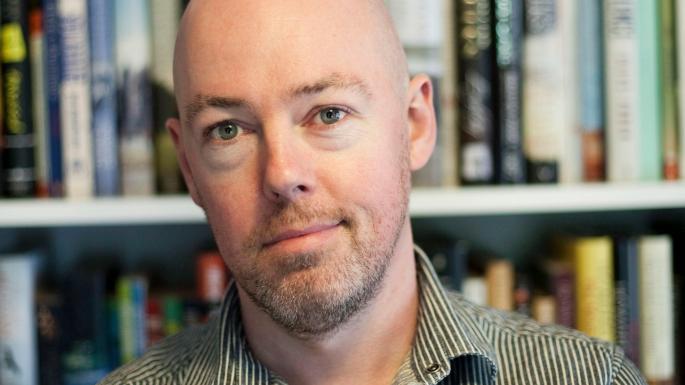
languages making him the most translated Irish writer of all time.
This is a single linear story. Yes, there are minor characters but their stories are sufficiently sketched to need no more elaboration. There is just the narrative of a woman whose life, her old life, until now, has been destroyed. Her new life is yet unknown both in location and content. So she runs away. The reason? She doesn’t know. There are several possibilities to choose from but none of them stand out as more or less important. She hides on a small island in the Atlantic Ocean off the coast of western Ireland. She changes her name. She cuts off her hair.
It’s a short novel. A quick read. But an emotional one.
This is the second book where Boyne has chosen to use a female first person narrator: the first, All the Broken Places (2022). This narrator, Willow, her new name, takes residence in a small cottage near the sea. The locals, including a cat, are surprised by her, especially so since she seems not to have a husband, children, or a job. She is content to take long walks, watch the grey days, revel in what sunshine there is, and tries not to worry too much that there isn’t any Internet. Sometimes she walks into the village to get a sandwich and a bowl of soup at the New Pub. Sometimes she goes to the Old Pub. Sometimes she talks to people, sometimes they talk to her.
Slowly she can feel a possible life, sort of, returning to her. The horror, the truth, of her past is released in bits and asides. They pile upon each other like daubs on a canvas creating, and compiling, a past tangle of events that have you wondering how worse can it get. It does. The real story here is what happened to her; this, her running away, is her immediate response to those dreadful deeds. And here in this small isolated community she is forced to look at herself and wonder if she could’ve done something, anything, to avert the destruction. Is there guilt? And if so, there is blame.
Many writers, often-read and famous, have described the art of fiction writing as a force from without that could be from god, infers Jon Fosse; Colm Tóibín says its like opening a window and letting your imagination fly; Alexander McCall Smith describes it as allowing the subconscious to escape; Jennifer Egan – this unconscious generation process; writing begins with an idea for an opening and then the rest is done in a kind of trance, Paul Auster; D. H. Lawrence was up to page 145 and I’ve no notion what’s it about; and here’s another one from a more modern writer – it’s like watching a TV show in your head and you just write down what you hear and see. All of these descriptions suggest an amorphous idea, a swirling of fate and luck, of wandering and wondering without knowing what’s coming. That’s true to some degree but Boyne, in this new novel, the first of a quartet, seems far more controlled, he’s in command, and the simplicity of the narrative line gives the impression of meticulous plotting made to feel natural and easy.
The first person narrator frees the writer from worrying about what the other characters are thinking and feeling. The concentration is on the first person, the story-teller, who can only record what they see and hear: a concentrated world view experienced only through the eyes and ears of one person to lead you on. That’s why this novel is so short: a mere 166 pages. Surely, his shortest work. But, it’s a quarter of a much longer piece, that will, one day, I’m sure, be published in one volume: The Elements Quartet, maybe. Water, Earth, Air, and Fire. The second instalment, Earth, is due out in May 2024. Looking forward to that.
Highly recommended.
You can buy the hardcover or Kindle editions here.
 Michael K Freundt
Pingback: The Labyrinth by Amanda Lohrey – Michael K Freundt
Pingback: Earth by John Boyne – Michael K Freundt