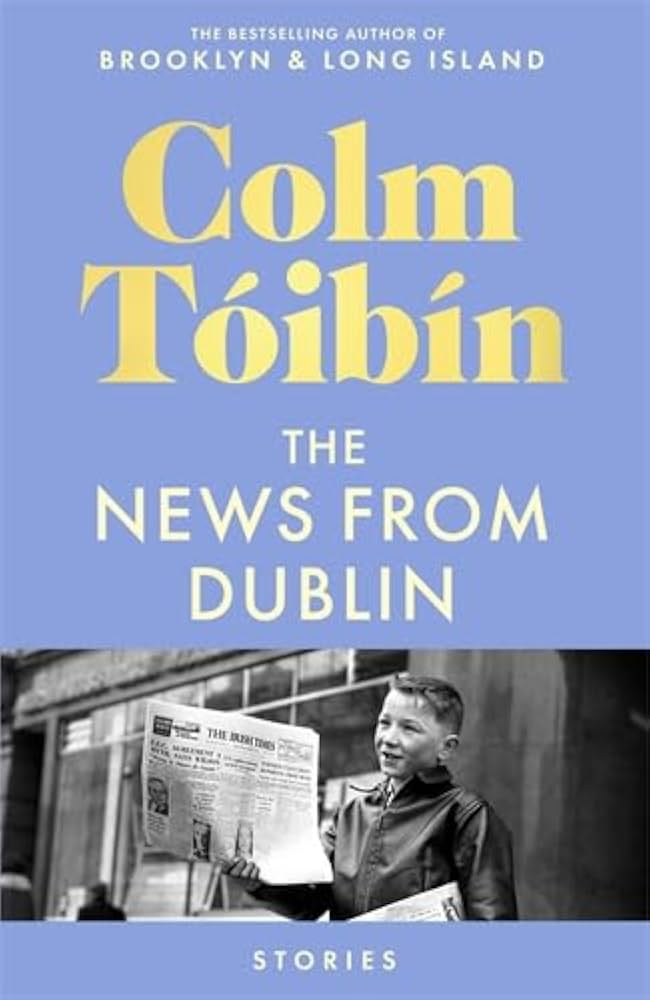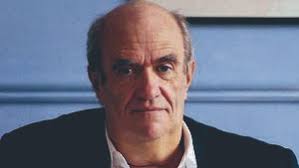
The News from Dublin by Colm Tóibín

Irish writer Colm Tóibín Laureate for Irish Fiction 2022-2024

Colm Tóibín remains a favourite of mine. This, his latest short story collection, is characteristic of his writing: sparse simple sentences using plain unadorned English without sentiment or judgement. Yet it always astounds me that such writing can still stir the emotions.

I’ve come to believe that his work, and writing like it, leaves room for the reader to insert their own experiences and understandings of human behaviour into the narrative, forcing it to be relatable and therefore moving. This is what readers do.

These stories are of everyday people confronted with everyday dilemmas and how they deal with them. Dilemmas such as delivering bad news; facing your own bad decisions; restoring a damaged life; trying to get a good night’s sleep. I’m reminded of the other master of the short story, W Somerset Maugham, but not because they are similar. Maugham’s stories are neat: a beginning, a middle and an end. This is now a dated format, which some readers find disappointing. Tóibín’s stories, and those of some of his contemporaries, are not like that. They are anecdotes. They could be scenes from a novel, there isn’t necessarily a climax, an end. There are sometimes resolutions but sometimes just an acceptance of how things are. This does not make them less engaging, less true, or less affecting. It just makes them different. 

This is the type of book that will sit on my bedside table with my phone, hearing aids and loose change. Just sitting there for me to delve into to remind me that the stuff of fiction is the stuff of life. A good resolution for a good night’s sleep. 

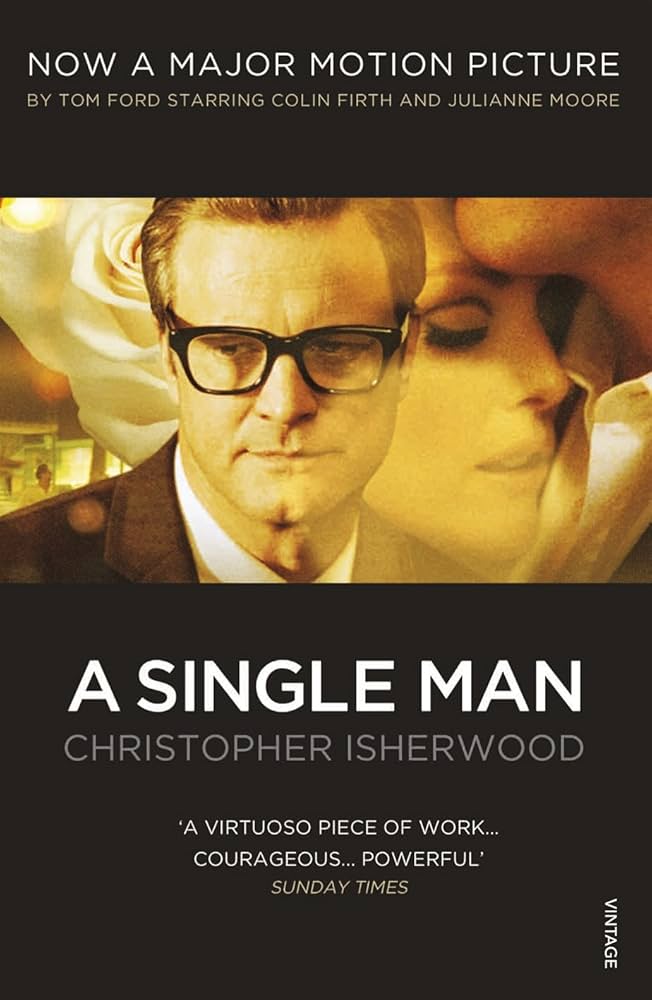
A Single Man by Christopher Isherwood

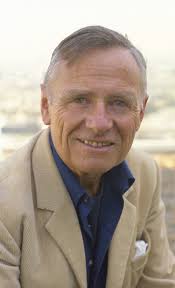
Christopher Isherwood, British born
American writer, (1904 – 1986)

If and when I’m asked about literary fiction, this is the book I will name to explain it. Don’t be put off by that, nor its first short sentence. Its meaning will be clear by the end of the first short paragraph. What an opening! It’s so apt … for every reader, for everybody … because we all know about it: getting up in the morning.

Christopher Isherwood is described as “a seminal 20th century Anglo-American writer, a chronicler of Weimar Germany, a pioneer of autofiction, and a monumental icon of the Gay Liberation movement” brought to prominence again by the fashion icon, Tom Ford, who produced, directed and cowrote the screenplay – along with David Scearce – of his 2009 feature film adaptation, and his debut, of this Isherwood classic.

A little piece of trivia: Isherwood’s partner, the portraitist, Don Bachardy is still alive (aged 92) and worked as creative consultant on the film and has a tiny cameo non-speaking role in it. He lives and works in the same Santa Monica home he shared with Isherwood for decades.

It’s 60’s beachside California when the word ‘old’ is a new dirty word, but the word ‘queer’ has been around, but whispered, for years. George, late fifties, with a kind face, is suddenly alone. His much younger partner, Jim, is gone. He is a single man again. Two men living together in a romantic relationship is rare, but made to look otherwise: for the sake of the well-meaning neighbours and the cashier at the supermarket. They know of course but it’s all hidden behind propriety and the wish for no unpleasantness.

The action takes place over a day and well into the evening. George tries to make this day as normal as possible, appearing remorseful for refusing a last minute dinner invitation from a neighbour who, pointedly, refuses his suggestion that they dine together the following evening; teaching his students the finer points of the work of Aldous Huxley, emphasising societal norms and how they affect the outsider; refusing to give into the sexual tension between himself and his favourite student Kenny; keeping at bay the amorous advances of his best friend, Charlotte. She seems more insistent now that he is single again.

Published in 1964, A Single Man is often considered Isherwood’s masterpiece and groundbreaking for painting a queer life as authentic, normal and representative of something simple, and as difficult as being human.

It’s a small book but with a big heart, and for those interested in writing as a craft, a must read.


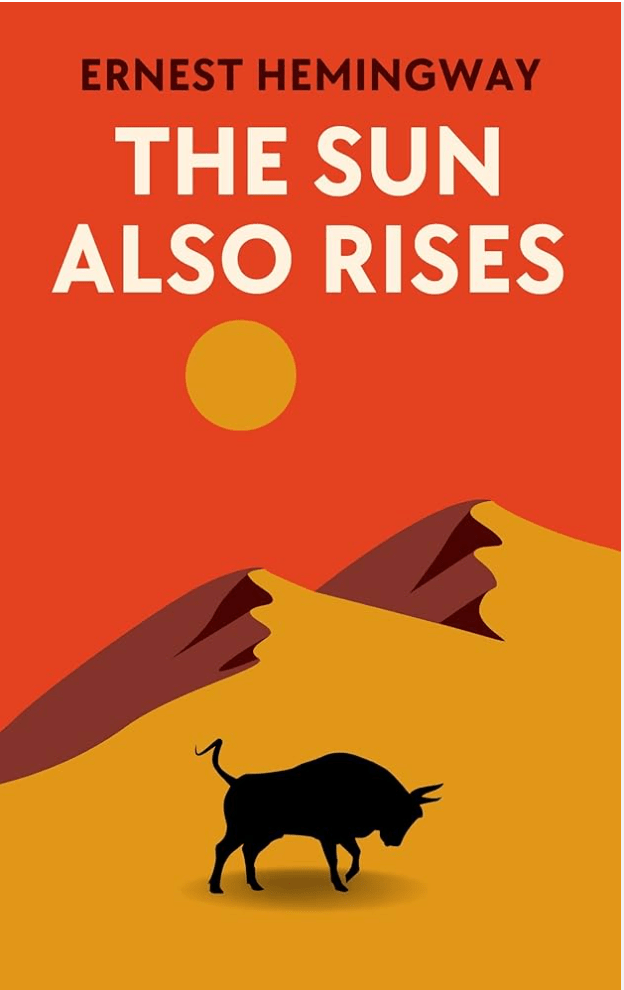
The Sun Also Rises by Ernest Hemingway

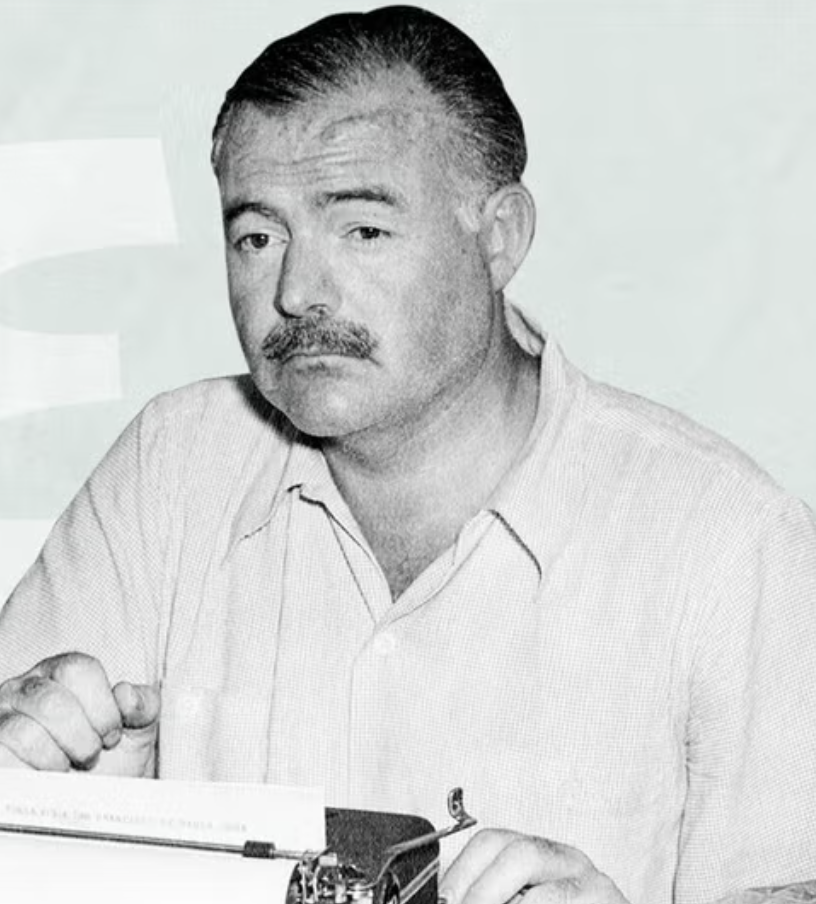
American writer, Ernest Hemingway 1899 – 1961

I haven’t read Hemingway since I was a boy. Note his simple language, short sentences:

No one was up before noon. We ate at tables set out under the arcade. The town was full of people. We had to wait for a table. After lunch we went over to the Iruña. It had filled up, and as the time for the bull-fight came it got fuller, and the tables were crowded closer.

Hemingway’s stark prose style is often referenced in writing guides and prose guru’s online posts. Despite The Sun Also Rises (1926) having a first person narrator, Jake Barnes, an American expat, journalist and WWI injured veteran, his recording of a trip to the running of the bulls of Pamplona with his Yankee mates and an English Lady, is starkly objective. His particular war-injury is significant to the theme – no spoilers here. This group, often likened to the ‘lost generation’, seem to be searching for meaning in the bars and the bottles of southern France and northern Spain where they observe the locals getting on with their ‘ordinary’ lives but seem blind to the meaning staring them in the face. The bull fighting festival is the climax of the piece and described in blistering but, of course, in his stark prose. If squeamish about such ‘sport’ you could skip it. These lost souls either with money or without who have ignored the ‘roaring twenties’ milieu of the cities, seem helpless to know where to turn or what to do. Hemingway’s theme: the damage of war. Although it received mixed reviews at its first publication it has become known in some circles as his greatest work. There aren’t too many contemporary novelists who write like this any more as this style requires the reader to supply a lot of detail, but it is nonetheless surprisingly effective. (Come to think of it, it is similar to that of David Szalay and his Booker Prize winning novel Flesh – 2025). And all the more effective by describing a time and place that would be unknown to most readers. Fiction can do that: take you to the unknown. If you haven’t read Hemingway, do; there’s a lot of his work to enjoy including a lengthy list of short story collections.

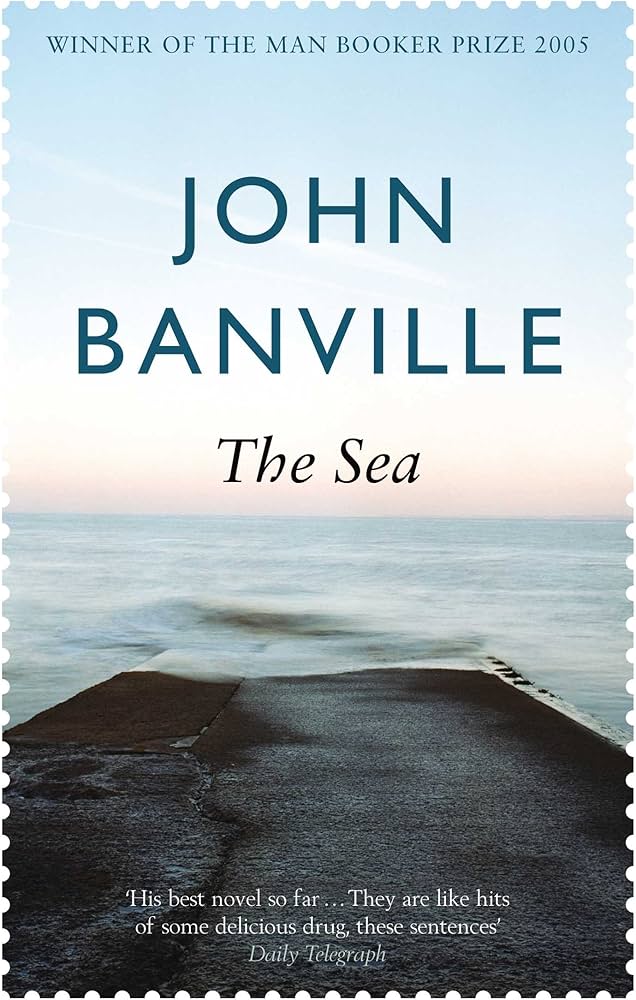
The Sea by John Banville

Irish writer John Banville

If you are looking for a definition of literary fiction, this 2005 Booker Prize winning novel is it. I know that may put some people off; it seemed to have put John Banville off too; from 2006 Banville began writing crime novels, featuring the pathologist Quirke (no first name ever mentiuoned), under the name of Benjamin Black right up until 2021 when the Quirke novel, April in Spain, was released under his own name. Since then his Quirke novels, beginning with Christine Falls (2006) have been released under his name as well.

An elderly man, Max Morden, returns to a seaside house where his family used to holiday when Max was a child. We meet the Grace family, parents and the children Myles and Chloe, from that time and the inhabitants of the same place, now a rundown boarding house, all those years later. These two time frames, and the people in them, are woven tapestry-like to create a picture of Max’s current demeanour.

This is a slow burn of a book. It creeps up on you, but you need to stay with it. I got to a stage where I could not pinpoint what was wrong but I knew that there was something definitely not right, either about what happened in the past or what was going to happen in the present. It’s about capricious memory and self-awareness and, more importantly, about that slippery slope between behaviour and intention.

Someone once wrote, memory is like an oven. You put something in, close the door, wait a while, open it, and there it is, something different.

I’m now searching for the Quirke novels. When a writer of this skill-set takes on the ubiquitous crime genre there has got to be reading richness to discover.

Give it a go.

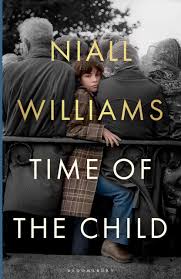
Time of the Child by Niall Williams

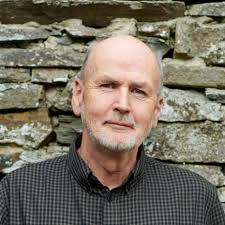
Irish writer Niall Williams born 1958

“From the reeds a second rain dripped harder than the first and the brim of the doctor’s hat released it as a third.” So, the poor doctor had three curtains of rain to deal with: from the skies, from the roof and from his hat before he made it to the back door. This descriptive layered richness of detail is the William’s trademark and peppers a simple scene with verbal interest and understanding of place and character. This latest novel Time of the Child (2024) from the Irish writer is again set in his mythical town of Faha on the western edge of Ireland making the third in what has become known as the Faha Trilogy. The first two being The History of Rain (2014) and This is Happiness (2019). The most notable feature of Faha is rain. Even when it stops, rarely, it is still on everyone’s mind; it will surely start again any minute.

There is not a lot of dialogue in William’s novels. The characters don’t talk much, hence many plot points rely on misunderstandings both comical and tragic. People understand each other by the nod, the look, the shrug, but ironically despite the lack of talking gossip spreads like a virus.

It’s coming up to Christmas 1962 and doctor Jack Troy and his eldest and unmarried daughter Ronnie are presented with a child, a foundling. Ronnie immediately loves it and names her Noelle. Keeping the child cannot happen without a man, husband and father to go with it and keeping it is exactly what Ronnie is determined to do. Jack Troy knows of a possible contender for the role of husband/father but he is in America, but conscious of his own failings and mis-steps as a father hatches a plan to bring happiness to his daughter.

It is not necessary to have read the first two to enjoy the third. Each novel is self-contained. The characters and culture of Faha are in themselves a story and you are presented with a rich tapestry of both before the child is found in a graveyard. The enjoyment of reading Williams is not just because of the plot – his focus he admits – it’s his writing style and his uplifting of daily detail to importance in the local’s lives but in rich and lyrical language. I loved this book. Highly recommended.

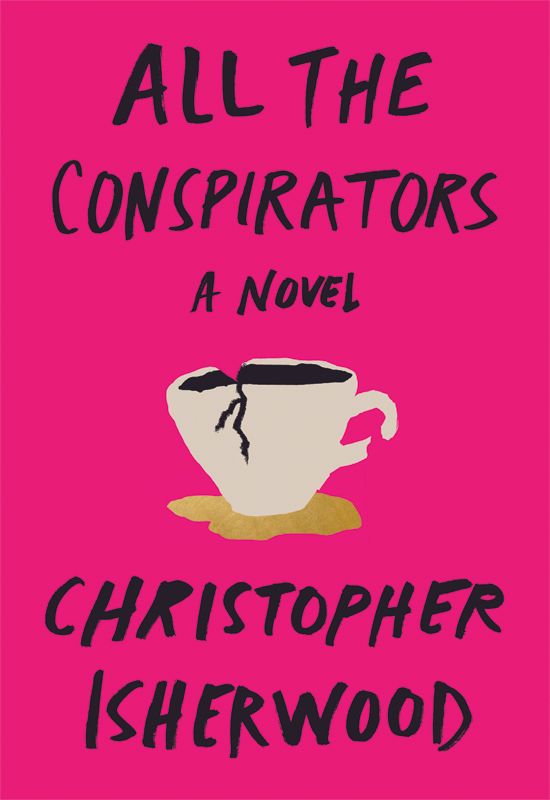
All the Conspirators by Christopher Isherwood.

Christopher Isherwood, British born American writer, (1904 – 1986

The 1920s was a period in English literature defined by intense experimentation, stream-of consciousness, away from linear narration and a concentration on the inner turmoil of characters. Notable works include, Ulysses (1920) by James Joyce, Mrs Dallaway (1925) by Virginia Woolf and T. S. Elliot’s The Wasteland (1922). American journalist and editor, Bill Goldstein, who co-founded NYTimes.com Books describes the year 1922 as a ‘literary earthquake’ in his 2017 book The World Broke in Two. Isherwood could not have missed this stumbling lurch into modernism and not been unaffected by it. He began writing All the Conspirators in 1926; it was published in 1928, the year before he moved to Berlin. Phillip Lindsey, a fey young man, as most middle-class men of the times seemed to be, who wants to simply paint and write is thwarted in his creative desires by his strict conservative society and family. A tragedy, yes. Isherwood incorporates modernist techniques with, in this reader’s opinion, not good enough reasons nor skills. Switching from the third to first person is clumsy and some passages are incomprehensible despite multiple readings. Isherwood is famous for the stark honesty of his auto-fiction. Had his life been a little more like his anti-hero’s I might have been more emotionally engaged and therefore enjoyed it more. In my recently-aquired Isherwood bro-mance (beginning with Christopher & His Kind) I’m looking forward to his latter works.

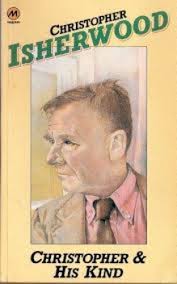
CHRISTOPHER & HIS KIND by Christopher Isherwood (1904 – 1986)

Christopher Isherwood, British born American writer, (1904 – 1986

This book is fascinating for its use of a split narrator: Isherwood as he is when he wrote it in the 1970s, the first person ‘I’ and Isherwood as he was then 1929-1939, the third person ‘he’ – Christopher. This gives the older writer ease to write objectively about his younger self which he does with critical abandon. The other fascination is his life-long friendship with Wystan Auden (W. H. Auden 1907 – 1973) about which he writes with alarming, but pleasing, frankness. They were never ‘a couple’, in fact in today’s jargon it would be described as ‘friendship with benefits’. His and Auden’s sexual relationship … ‘[was] unromantic but with much pleasure … they couldn’t think of themselves as lovers … [but] it was of profound importance … it made the relationship unique for both of them.’ Isherwood was far more promiscuous, would fall in love at the drop of a suggestion, and Auden would lament with wild self-deprication at not being able to find someone to love him. They both found their life partners in America where they migrated to in 1939. Auden with the poet Chester Kallman (1921 – 1975) and Isherwood with the portrait artist, Don Bachardy, who is still alive and living in their Santa Monica home. Of course Isherwood remains famous for his Berlin Stories, Mr Norris Changes Trains and Goodbye to Berlin – insights into these works are of great intetest. These provided the material for the play I am a Camera and ultimately the musical Cabaret, which Bob Fosse hacked to pieces in his 1972 movie version: Sally Bowles was NOT a talented performer (the whole point of the story). Stage productions – there’s always one playing somewhere – have reinstated this important fact as well as all the songs Fosse cut. Isherwood, in his later years, concentrated on auto-fiction producing many auto, and semi auto, biographical works. These I am eagerly seeking out. This one is a good start. Highly recommended.

It was filmed in 2011 by Geoffrey Sax.

The River Capture by Mary Costello

Irish writer Mary Costello

This novel, The River Capture (2019), is Costello’s third published work, her second novel. The style is literary and immersed in family values, loyalty, obligation, and what happens when all of these are challenged; it is written with the sensibility and skill we associate with Irish literature. Luke O’Brien is a thirty something teacher, a Joyce scholar, who took leave to care for dying relatives but then continued his sabbatical to deal with the family land in county Waterford on the banks of the River Sullane. There he also tends to his favorite, but very old aunt, Ellen. They are very close. Luke is a man in tune with nature, not religious, but believes in the uniqueness of the individual free of labels or what any other individual may think of him. He is willing to consider that natural objects, animals, including humans, trees and water are infused with special energy and may also contain elements of memory and the future. Like all natural things, everything, including mankind, will pass to allow for what is next.

When two rivers collide due to climatic devastation, geological disruption or similar, one captures the other and a third unexpected river is born: a river capture.

A young woman, Ruth Mulvey, hears about him and his passion for animals and asks him to take over the care of a young, but abandoned dog. This meeting develops into a relationship, emotional and sexual, and is hoped by both participants to develop even further. But then Luke introduces her to Aunt Ellen. She is aware of this young woman; more significantly, she knows her father. A family secret is revealed and Ellen, his devoted aunt, places a huge burden on his shoulders and mind.

Up to this point, almost half of the way through, the format is usual and expected: literary fiction, narration of elegant language, relevant and insightful dialogue (as it should be) that builds to a tension created by the revelation. An accomplished opening.

Then things change. Not only for Luke, who is devastated, and the choice he’s given, impossible, but also for the reader: the format changes. This can be seen as a metaphor for the state of Luke’s mind. Nothing is as expected. the rest of the novel is a description of Luke’s state of mind and choice of actions, what he believes and what he doesn’t; what he does to overcome the bolt of lightning that hit him far square in his heart and mind. The revelation is so devastating that the book itself is affected. The book no longer reads like a novel.

This unique and rare literary device was not, for this reader, entirely successful. It eroded most of my emotional investment in the characters and narrative. It became, or felt like, an academic exercise, and a repetitive one, and although I read it to the end, I have to admit I skipped bits.

However, Costello is a very good writer and I look forward to her next.

Click the link for my review of her first novel, Academy Street (2014).

The Swerve by Stephen Greenblatt

Stephen Greenblatt, Professor of Humanities, Harvard University

It has been suggested, more than once, that the greatest thought that mankind has ever made is that matter is neither created nor destroyed, it is just rearranged … endlessly. In other words, there is a finite number of atoms but an infinite number of their combinations. One of those combinations is you. This is one of the ideas of the Greek philosopher, Epicurus (341 – 270 BCE) and he got the idea from someone a little bit older, his teacher, Democritus (c. 460 – c. 370 BCE). It’s been around a very long time.

I’m a fiction nerd, but every now and again a non-fiction work, catches my eye. The Swerve: How the Renaissance Began (2012) is the story of Poggio Bracciolini (POH joh BRA cho LEE nee), a papal secretary, scribe and book-hunter, who in 1417 discovered a manuscript called De Rerum Natura (Of the Nature of Things) written by Lucretius around 55 BCE. It had been lost for over 1500 years. It was, is, an elegant and beautifully written poem describing the natural world in strong Epicurean ideas.

  • The Universe has no creator or designer; everything comes into being as a result of a swerve, which is also the source of our free will
  • Nature ceaselessly experiments ( this is the idea at the heart of Darwin’s theory of Natural Selection)
  • Humans are not unique
  • The soul dies and there is no afterlife; death is the cessation of all feelings, including fear
  • All organised religions are superstitious delusions, which are invariably cruel
  • The highest goal of human life is the enhancement of pleasure and the reduction of pain and the greatest obstacle to pleasure is delusion
  • Everything is made of minute, invisible and eternal particles, atoms, floating in a void (scientifically proved by Jean Perrin, via John Dalton, Robert Brown and Albert Einstein, in 1909)

Like any passionate book-hunter, Poggio was ecstatic. He had it copied – he is also credited with designing the font we know now as Roman – and circulated. Of course, only to people who could read sophisticated Latin and that meant highly educated people who invariably were clergymen. In a world where all aspects of life: commerce, travel, governance, art, architecture, music and science were dominated by the Catholic Church, the discovery of this poem was like a bomb going off … slowly.

It influenced writers and thinkers for centuries: Leonardo di Vinci, Thomas More, Shakespeare, Milton, Spencer, Montaigne, Voltaire, Isaac Newton, Ben Johnson, Copernicus, Galileo, Thomas Jefferson, (he owned 5 Latin editions of the poem) to name a few. But the incredible impact of Lucretius’s poem is not only measured by the influence it had on writers and thinkers but, more importantly, by the multiple efforts the Catholic Church created to oppose it.

Greenblatt has used novelistic techniques to tell the story not only of Poggio and his discovery but also of the characters he interacted with and the times in which he lived and worked. This is not a dry academic tome. It is a lively account of how one lived and worked in the early years of the Renaissance. For example the Council of Constance was arranged to end the Western Schism (1378 – 1417): three men had claimed simultaneously to be Pope. It is estimated that over 100,000 people descended on the small German town, Dukes, royalty, administrators, ambassadors, cardinals, archbishops each with his own retinue of servants, cooks, maids, scribes as well as opportunists, singers, actors, barbers, acrobats and over 700 whores. It is an engaging and wondrous read.
Lucretius wrote that atoms did not move in a straight line but they randomly changed course. He called it a swerve. According to Greenblatt that is exactly what Lucretius’s text did: its trajectory was a straight line to oblivion, but it swerved and was found. Thousands of fragments and editions exist today all over the world.

Flesh by David Szalay

Hungarian-British writer David Szalay

I posted recently my views on Szalay’s 2016 novel, All That Man Is, which was shortlisted for the Booker. This, his latest, Flesh, won this year’s Booker and is in the same mould. The former is a collection of short stories about nine unrelated men; the later is a collection of stories, scenes, about the life of one man, István, beginning in Hungary when he is fifteen years old. Like all the men in All That Man Is he says ‘I don’t know’, ‘OK,’ and ‘Sure’ a lot. He is not the driver of his own destiny. Women play far more important roles, his neighbour, his boss’s wife, his wife and ultimately and ironically, his mother. From a rudderless boy he becomes a soldier, a bodyguard, a wealthy man, a step-father, a father and … well, you’ll just have to read it to find out; no spoilers here. There are only a few clues as to what happens to him between the stories, scenes, of his life that Szalay chooses to feature. His style is minimalist: short sentences, simple language, stark facts without much linguistic adornment, a bit like István. This had the effect of causing this reader to gasp – I love it when a writer makes me do that – several times since the gob-smacking events are relayed with such simplicity and directness that they leap out at you like a favourite uncle who hides behind a door and says Boo! I had to re-read several of these events again to make sure I hadn’t missed anything. Although women and sex feature he is not exploitative nor unkind. He doesn’t use women, women use him, and he’s thankful to them. Without women you wonder how he would have survived. I love Szalay’s style as it respects readers’ intelligence and allows us to bring our own experience and understanding to fill in what he doesn’t say. He makes the story of a plain man an interesting one. I have criticised the Booker judges in the past for awarding the prize to a writer for writers; this one is a writer for readers.