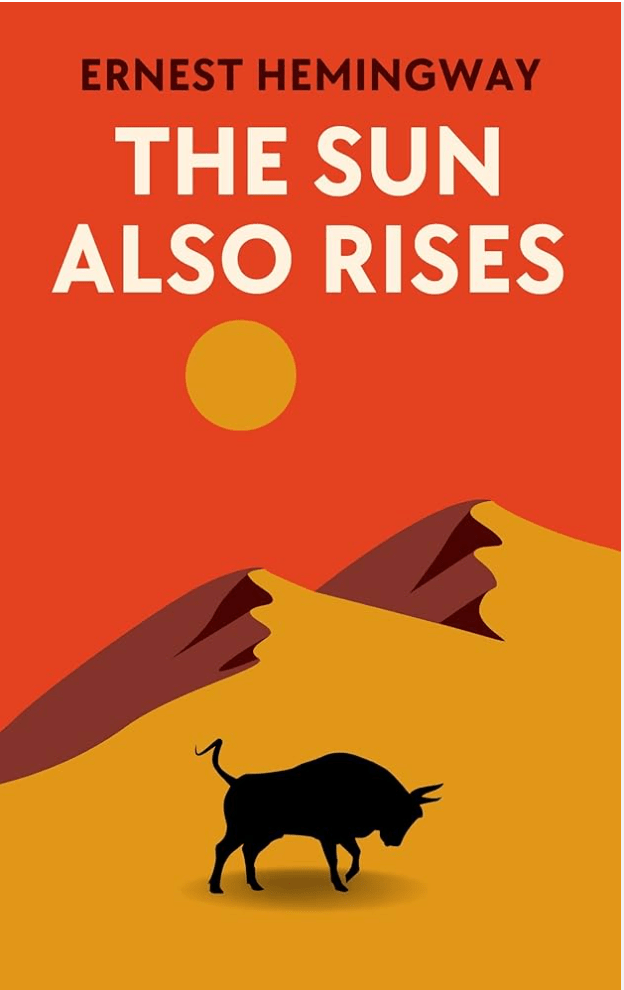
The Sun Also Rises by Ernest Hemingway

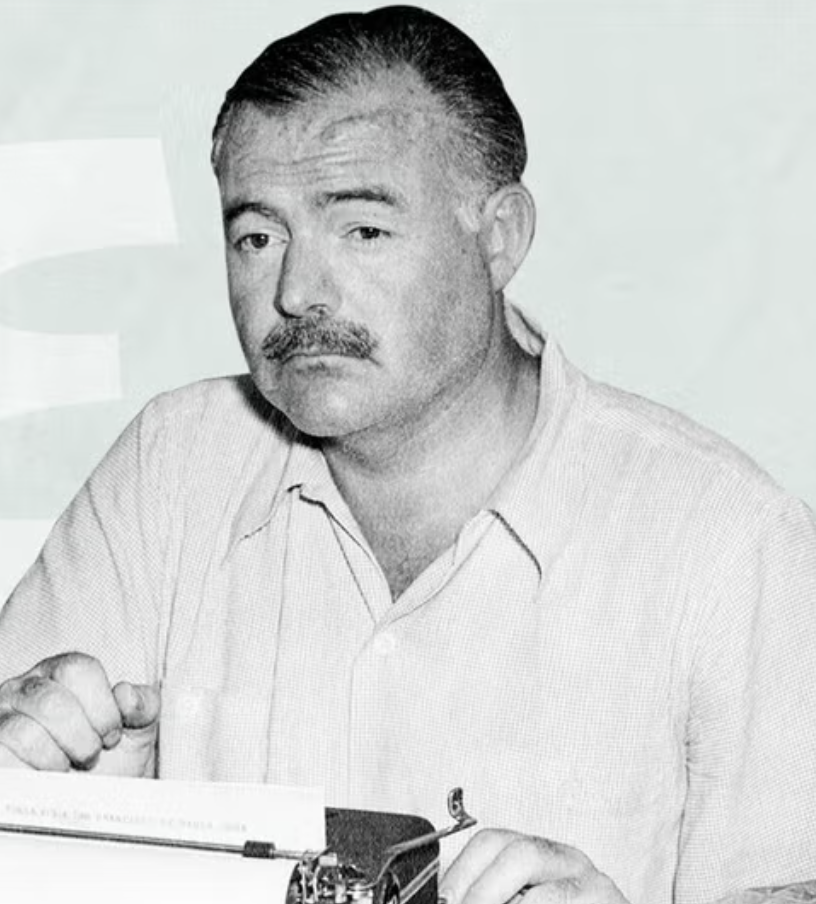
American writer, Ernest Hemingway 1899 – 1961

I haven’t read Hemingway since I was a boy. Note his simple language, short sentences:

No one was up before noon. We ate at tables set out under the arcade. The town was full of people. We had to wait for a table. After lunch we went over to the Iruña. It had filled up, and as the time for the bull-fight came it got fuller, and the tables were crowded closer.

Hemingway’s stark prose style is often referenced in writing guides and prose guru’s online posts. Despite The Sun Also Rises (1926) having a first person narrator, Jake Barnes, an American expat, journalist and WWI injured veteran, his recording of a trip to the running of the bulls of Pamplona with his Yankee mates and an English Lady, is starkly objective. His particular war-injury is significant to the theme – no spoilers here. This group, often likened to the ‘lost generation’, seem to be searching for meaning in the bars and the bottles of southern France and northern Spain where they observe the locals getting on with their ‘ordinary’ lives but seem blind to the meaning staring them in the face. The bull fighting festival is the climax of the piece and described in blistering but, of course, in his stark prose. If squeamish about such ‘sport’ you could skip it. These lost souls either with money or without who have ignored the ‘roaring twenties’ milieu of the cities, seem helpless to know where to turn or what to do. Hemingway’s theme: the damage of war. Although it received mixed reviews at its first publication it has become known in some circles as his greatest work. There aren’t too many contemporary novelists who write like this any more as this style requires the reader to supply a lot of detail, but it is nonetheless surprisingly effective. (Come to think of it, it is similar to that of David Szalay and his Booker Prize winning novel Flesh – 2025). And all the more effective by describing a time and place that would be unknown to most readers. Fiction can do that: take you to the unknown. If you haven’t read Hemingway, do; there’s a lot of his work to enjoy including a lengthy list of short story collections.

The River Capture by Mary Costello

Irish writer Mary Costello

This novel, The River Capture (2019), is Costello’s third published work, her second novel. The style is literary and immersed in family values, loyalty, obligation, and what happens when all of these are challenged; it is written with the sensibility and skill we associate with Irish literature. Luke O’Brien is a thirty something teacher, a Joyce scholar, who took leave to care for dying relatives but then continued his sabbatical to deal with the family land in county Waterford on the banks of the River Sullane. There he also tends to his favorite, but very old aunt, Ellen. They are very close. Luke is a man in tune with nature, not religious, but believes in the uniqueness of the individual free of labels or what any other individual may think of him. He is willing to consider that natural objects, animals, including humans, trees and water are infused with special energy and may also contain elements of memory and the future. Like all natural things, everything, including mankind, will pass to allow for what is next.

When two rivers collide due to climatic devastation, geological disruption or similar, one captures the other and a third unexpected river is born: a river capture.

A young woman, Ruth Mulvey, hears about him and his passion for animals and asks him to take over the care of a young, but abandoned dog. This meeting develops into a relationship, emotional and sexual, and is hoped by both participants to develop even further. But then Luke introduces her to Aunt Ellen. She is aware of this young woman; more significantly, she knows her father. A family secret is revealed and Ellen, his devoted aunt, places a huge burden on his shoulders and mind.

Up to this point, almost half of the way through, the format is usual and expected: literary fiction, narration of elegant language, relevant and insightful dialogue (as it should be) that builds to a tension created by the revelation. An accomplished opening.

Then things change. Not only for Luke, who is devastated, and the choice he’s given, impossible, but also for the reader: the format changes. This can be seen as a metaphor for the state of Luke’s mind. Nothing is as expected. the rest of the novel is a description of Luke’s state of mind and choice of actions, what he believes and what he doesn’t; what he does to overcome the bolt of lightning that hit him far square in his heart and mind. The revelation is so devastating that the book itself is affected. The book no longer reads like a novel.

This unique and rare literary device was not, for this reader, entirely successful. It eroded most of my emotional investment in the characters and narrative. It became, or felt like, an academic exercise, and a repetitive one, and although I read it to the end, I have to admit I skipped bits.

However, Costello is a very good writer and I look forward to her next.

Click the link for my review of her first novel, Academy Street (2014).

The Temple by Stephen Spender

Stephen Spender (1909 – 1995)

This book began as an early attempt by the British poet to write a memoir about a holiday in Germany in 1929. It was unpublishable because of its libellous and pornographic content according to the law at the time. Many books were banned then, including Ulysses by James Joyce, The Well of Loneliness by Radcliffe Hall and paintings by D.H. Lawrence. During a particularly lean period in the early sixties, Spender, by then an established, but poor, writer, sold the first draft manuscript and promptly forgot about it. Fast forward to 1985 when a friend told him about the manuscript he had read in the rare books section of the University of Texas. Spender wrote for a xerox copy (remember Xerox?) and re-wrote it between 1985 and 1987 turning it into “a complex of memory, fiction and hindsight”. He changed his own name to Paul Schoner and faintly disguised W. H. Auden and Christopher Isherwood as Simon Wilmot and William Bradshaw respectively. It is, what we now call today, auto-fiction. It is also one of a rare group of autobiographies that is written in the third person. Another example of this is James Joyce’s Portrait of the Artist as a Young ManThe Temple, its original title, was finally published in 1988. Germany between the wars had a reputation of being very liberal, emphasising personal freedom. Nothing at all was happening in England. Young Englishmen went to Spain for politics and to Germany for sex. The story is indeed an account of Paul Schoder’s holiday in Hamburg 1929 – 1931, the people he meets, the cafes and bars he frequents, the senses he explores, and the danger he foretells: the rise of the extreme right in the form of the Nazi Party. Only a few understand the danger; most are complacent, believing that their first parliamentary democracy, The Weimar Republic, will withstand the threat – it will pass. The parallel to our parliamentary democracy today and the rise of the Right, almost 100 years later, will not be lost on you. Part of the attraction for the young Englishman is the German youth who idolise the human body, praising it, showing it, using it, hence the title, The Temple; ironically from a biblical quote. It is full of ideas, conversations about ideas and characters and events that portray these ideas or are in contrast to them. I loved this book, and will undoubtedly read it again. There is so much to be gained from it, not just as a reader but as a writer: his use of the nameless, but god-like, narrator and his unjudgemental descriptions of feelings and experiences that are heightened, exaggerated, and sometimes invented in order to make a point, explore an idea; these are all part of the writer’s varied and colourful palette. Highly recommended.