Devotion by Hannah Kent

This novel is about Lutheran migrants from Prussia in the nineteenth century given the opportunity to flee religious persecution and settle in the unknown but free colony of South Australia. I was very interested in this novel as my ancestors did exactly that, as did hers. My great grandfather arrived in the colony in 1851.

Kent’s description of life in the Prussian peasantry as tenant farmers is evocative, and totally believable. The story is told in the first person by the daughter of the family, Hanne, who considers herself dull and plain; her close paternal twin brother having been blessed with all the beauty of their mother. Their life and relationships in the village of Kay is austere as is their religion with its undecorated homes, churches, and liturgy. It is indeed a dour Christian denomination, a result of Luther’s revolt against the hypocritical and outrageous wealth and flamboyance of the Roman Catholic Church. But Kent’s greatest achievement is, without actually saying it, the depiction of the Lutheran lack of demonstrative acts of parental affection, by words or deeds. It’s not that the children were unloved, but they certainly felt unloved, but were therefore forced to read and understand the minute signs of affection that, when delivered, or deduced, brought a child’s greatest joy. It is not surprising that Hanne seeks love and all its demonstrations outside the family. Yes, there is a beautiful romance, its full implications unknown to the pair, that sits in the narrative foreground in stark contrast to their bleak, and later, dangerous existence.

Their village life, the trip to the port of Hamburg and the incredibly treacherous voyage on the open ocean in appalling conditions of overcrowding and health risks is testament to Kent’s novelistic ability.

However at about two thirds of the way through, while still on board the crowded ship, and only days from their destination, Kent made a novelistic decision which, in this reader’s opinion, was a big mistake. No spoilers here but anyone who has read this book will understand what I refer to. One of the writer’s major concerns is to keep in place the reader’s suspension of disbelief: that strange mental phenomena that allows us to become fully engrossed in the written situation, the fear, the joy, the laughter, the tears, the tension, etc, or whatever the characters are going through while at the same time being fully aware, but therefore must disbelieve, that we are sitting in our reading chair by the window overlooking our own garden. At this point in the book my disbelief was restored and in more common parlance, she lost me. I didn’t finish it.

Here are personal and moving reflections from Kent about this book.

You can buy the book in various formats here.

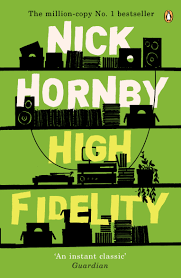
High Fidelity by Nick Hornby


Nick_Hornby_pic
British novelist and screenwriter, Nick Hornby.

High Fidelity (1995) is about an English self-pitying dead-sh*t and pop music tragic called Rob Fleming, (sorry about the coy symbols but I suspect my blog master has a ‘language’ filter) who runs a second-hand record (as in vinyl) shop stocking music that no-one, well only 3 people actually, wants to listen to and treats sex with women as doses of analgesic for his bouts of self-loathing depression. I suspect that Hornby created Rob as a way to get real a*sehole straight hopeless pr*cks to read books. Considering Hornby’s success I might be right. So what is a 60-something gay man living on a tropical island doing reading old English popular fiction, lad-lit, about straight a*sehole losers? Hornby-curious. He’s successful and was recently Oscar-nominated for his screen adaptation of my literary hero, Colm Tobin’s novel, Brooklyn. He did a good job although it wasn’t Oscar material. Besides, I found it in a pile of books someone else was throwing away.

And if you haven’t heard of Nick Hornby you might just be back from 35 years on Mars.

In an attempt to find out why his life is so meaningless and lonely Rob Fleming embarks on a quest to find his five most devastating and sadistic dumpers (He’s into lists), Alison, Penny, Jackie, Charlie (no, a girl), and Sarah to ask them why they did it – he’s always the dumpee; oh, and why does he want to do this? Because his latest live-in, Laura, has just dumped him (See!) for his neighbour, Ray, he of the loud and long upstairs orgasms, and he’s worried a pattern is forming. “Doh!” as another straight, and also fictional, but animated, a*sehole loser would probably say. Yes, if Homer Simpson had a back story it would be a little bit like Rob Fleming’s, only funnier.

But Hornby did made me laugh, several times, but he confirmed my view of 30-something single straight men who navel-gaze without a clue what they’re looking at, as deserving to remain single and f*cked-up since the women they want are exactly the women who are sensible enough, or should be sensible enough, to avoid them.

Rob also thinks he’s a typical (and therefore acceptable) bloke because he doesn’t remember anyone’s birthday, except his own, and is so self-deluded that he imagines his most recent ex-lover, the sensible but messy Laura, getting together with his parents to organise a massive surprise birthday party and then literally gets upset that they didn’t tell him.

Hornby made me re-think the oft repeated, and usual female line (why is that?) that ‘you can’t like a book if you don’t like the characters.’ Rob Fleming isn’t nice. I would ‘run a mile’ if I found Rod Fleming sitting at my lunch table: I’d certainly seat him at the other end of it. Yet, Hornby, makes him self-deprecating enough and helpless enough to make you wish he would find some sort of redemption, some one to take him on, someone to pay his bills, and someone to wipe his nose and tell him that everything will be all right in the end.

And when he finally gets “a shag” with an American B-grade country-rock singer that people have actually heard of, no less, he worries all through the deed if he is doing it right: no-one ever told him about G-spots, nor those ‘tad-pole things’, and what ‘good in bed’ means … and then he worries about worrying. He’s f*ck’d!

Eventually he manages to get one of his dumpers on the phone.

“Have you got, you know, kids and stuff, like everybody else?”

“I could’ve had them if I’d wanted them. I’m too young, and they’re too …”

“Young?”

“Well, yes, young, obviously,” – she laughs nervously, as if I’m an idiot, which maybe I am, but not in the way she thinks – “but too … I don’t know, time-consuming, I guess is the expression I’m looking for.”

I’m not making this up. This is how she talks …

Well, Mr. Hornby, you are making this up, but giving the narrator, Rob, this to say is a little cute novelistic trick to make novelistic truth (verisimilitude) feel like real truth; the kind of truth that tickles and stimulates the reader’s suspension of disbelief so you laugh or cry at exactly the moment that the author wants you to. You may have also picked up the tone, a kind of skatz that makes you feel that all this must be true since it’s so ‘conversational’ and ‘who would make up stuff like this anyway?’ and, besides, he tells you everything! He makes you feel like you’re his best mate, so, therefore you have to like, and believe him; which is exactly what skatz is meant to do.

Does it all work? Yes! By the time he gets around to the proposal (and I won’t be mean enough to tell you which dumper gets it) I was with him all the way. It’s not the down-on-one-knee proposal (he’s never been that kind of guy, and if he was that kind of guy and found himself kneeling before her he wouldn’t be thinking of proposing, he’s be thinking of oral sex – and why not, while I’m down here) but it’s funny, cute, dorky, sweet, cringe-making, charming, and well-written, as is her reply, er, replies. Yes, it’s kind of a romance for blokes; and as the final scene unfolds, a bit like in a movie, you’ll be smiling all the way to the last page. Cue music, “Got to Get You Off my Mind” by Solomon Burke, as the ex-dumper smiles across a bopping music crowd at the ex-dumpee. A-a-h! Fade to black. The End.


Veronica Spreads it Around by Michael K Freundt

Veronica, again, combines business with sex. She finds lovers but she also finds enemies, but in the most unlikely places. She embarks on a new career in hospitality although her previous career as a sex consultant proves hard to close down. However her biggest challenge erupts over her choices as a lover and as a friend. These combine to be life threatening but Veronica is a remarkable woman.

You can find this new Veronica story, Veronica Spreads it Around, on smashwords.com. Make sure to un-block ‘Adult Content’ otherwise you won’t find it. Simply type in the title into the ‘search’ box. I hope you enjoy it, and I’d love you to write me a review on the smashords site. Cheers!

Veronica Spreads it Around by Michael K Freundt

IMG_0606

For all you faithful readers of Veronica Comes Undone, the sequel, Veronica Spreads it Around will be available online at 12 midday on Wednesday 26 May 2015. 

There are new men in her life, and a temptation she tries hard to resist; but also a new career that could be the death of her. She’s not quite, but almost, 40, and she still has lessons to learn.

Only 15 days to go!