

Redhead by the Side of the Road by Anne Tyler

American writer, Anne Tyler.

This is the second Anne Tyler I’ve read and again it’s about small town/suburban life that has the feeling that it was inspired by over-the-fence conversations bordering on backyard gossip.
I’m not saying her work is bad or boring, far from it. She is an excellent writer; in the USA she is a fiction super star! This work was long-listed for the Booker! Her work is inspirational and educative for writers (like me), and her particular sub-genre, ‘soft fiction’ has a huge readership, but for this reader, her concerns are all about what I recognise, have sympathy for, and have some understanding of. I want to read about what I don’t know so that I’ll then understand something I didn’t. It’s those books I prefer.

The protagonist here is Micah Mortimer, he is a freelance computer technician but he also works as a janitor for an apartment building in return for his subsidised living space in the basement. He’s a nice bloke. His non-tech-savvy, usually older, clients keep him busy, he maintains his apartment methodically – he has designated each domestic task to a day of the week – and Cass, his girlfriend – sorry, woman friend – stays over occasionally. He is the youngest sibling in his blood family and they treat him as a bit of a fastidious loner and often niggle him about still being single. But, really, he’s content with his life.

Then two things happen: Cass tells him she fears her landlord is going to evict her because she now has a pet – Micah thinks this is unlikely and humours her – and a young boy, Brink, turns up on his doorstep claiming Micah is his father. The man knows this is untrue but feels for this runaway and agrees for him to stay the night…which upsets Cass since Micah didn’t suggest she move in with him, given her potential homelessness, and now he has a stranger living with him, so she ends their relationship. Micah’s life is upended and sorting everything out, or trying to, takes him into domestic and relationship territory he’s never been before.

Let me explain my description of this work as an example of ‘soft fiction’. Micah’s relationship with Brink’s mother, some twenty odd years before, was serious but not sexual – as some relationships were in those days, so he could not be Brink’s father. Had Tyler chosen, instead, for Brink’s claim to be true, Micah’s life would be seriously upended taking this work out of my ‘soft fiction’ category and into something much ‘harder’.

Tyler’s language is simple and direct, her characters are decent, unintellectual, but rather street-wise people where family is paramount. It’s a pleasant, engaging, and quick read.

Here you can buy the book is various formats.

There are very few videos available of Anne Tyler talking about her work; I couldn’t find one relating to this book, but here is her talking about her Booker Prize short-listed novel, A Spool of Blue Thread, in 2015.
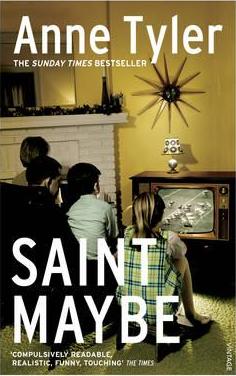
Saint Maybe by Anne Tyler

Anne Tyler pic
American writer, Anne Tyler.

Read Anne Tyler.

Have you read any Tyler yet?

You should read Anne Tyler.

These, and other inferences, came from a fellow book worm and one whose opinions as a reader I trust. So, finally, I read Anne Tyler.

Saint Maybe (1991) is typical of her work: family relationships. There seems two kinds of families in the American novel: the apple pie variety and the gun variety. Tyler’s are the former but, of course, coping with a threat, a dilemma.

Ian Bedloe, the son in an apple pie family in Baltimore did something he believes was very bad and caused two deaths. Only he knows what he did, what he said; the only other person, his older brother, who was there when he said it, and to whom he said it, is dead. He is desperate to be allowed to atone for his ‘sin’ and is drawn into a local Christian denomination called The Church of the Second Chance. After what he’s done, he so wants to be good. And forgiven.

What interested me in Saint Maybe is the subject of religion. I was brought up in a religious family but the Christianity taught by my Christian denomination (Lutheranism) always seemed to be more like an insurance policy than a belief system. My mother read the bible like a novel. I have come to understand that religion is a very important element in human existence: each group, tribe, and civilisation since the year dot has had a belief system; mainly to answer the big questions (How did we get here? What are we doing here? What’s that big ball of fire in the sky? and There’s got to be something better, doesn’t there?) so we can get on with the everyday necessities: digging for yams, inventing machines, filling in a tax return. What I object to, and what I see as a blight on humanity, is the administration, and interpretation, of these belief systems: the temple, the synagogue, the mosque, the church.

I believe in the Holy Spirit; the holy Christian Church, the communion of saints …”. So begins the last line of the Apostle’s Creed I learnt as a child, yet all three, the holy spirit, church, and saints are inventions of the (all male) administrators of Christianity over millennia.

The Church of the Second Chance is exactly one of these ‘administrations’; it teachers not so much what Jesus Christ said but what its leader, Reverend Emmett, says and Ian, so looking for a path to redemption and his second chance for what he has done, joins Emmett and his small flock, waiting, as the Reverend Emmett says, for a sign that he has been forgiven.

The Bedloes aren’t religious but Ian’s commitment to The Church of the Second Chance slowly pulls them in; ritual and routine can do that to people’s lives. The family conforms to the Church more out of respect for Ian than for a commitment to its beliefs.

Stream-of-consciousness is a novelistic technique (thank you James Joyce) that recently has had a revival: Anna Burn’s The Milkman won the 2018 Booker Prize and Lucy Ellman’s Ducks, Newburyport was shortlisted for the 2019 Booker. It usually is associated with internal thoughts,  the ordinary, the minutiae of people’s lives. Here, Tyler uses the more common third-person narrator to tell the very plain story of Ian Bedloe.

Above her work-desk is the following quote.

As a queen sits down, knowing that a chair will be there,

Or a general raises his hand and is given the field glasses,

Step off assuredly into the blank of your mind.

Something will come to you.

…from Walking to Sleep by Richard Wilbur.

“I see those words as about getting an idea and making a  book,” says Tyler. “I don’t get anxious. It will come to you, let it come in.”

She works in long hand, rewrites in long hand, and only when she is satisfied will she then type it onto a computer; print it out and work on another draft in long hand. And so it goes. Her style, if she has one – she says she has no style at all – is “unmistakably hers: transparent and alert to all the nuances of the seemingly ordinary,” wrote Charles McGrath in a 2018 profile in The New York Times.

It’s true that the appearance of truth in fiction is achieved through detail which is why her writing is so believable: her work is full of detail, to the brim with detail: the weather, the light on window glass, a tone of voice, a look, the type of cut and grain of wood, what people know and don’t know; but she also deliberately omits detail, for the reader to work out. This also, ironically, adds veracity to the work; creates an investment for the reader in the story and its meaning. She is a joy to read.

Saint Maybe was filmed for television in 1998 starring Blythe Danner and Tom McCarthy, directed by Michael Pressman from a teleplay by Robert W. Lenski.

You can buy the book in various formats here.