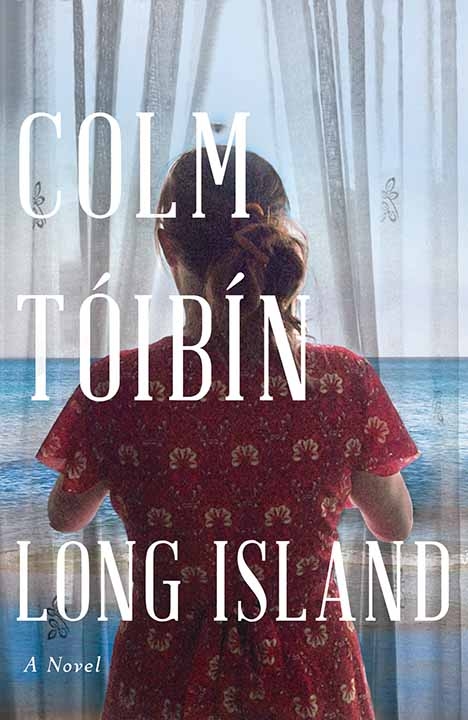
Long Island by Colm Tóibín

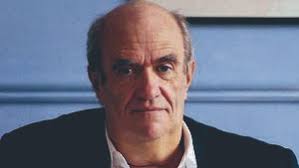
Irish writer Colm Tóibín, Laureate for Irish Fiction 2022-2024. This is his eleventh novel.

As a Tóibín fan it was like coming home to a cosy room as I settled in to page one and his simple very clear narrator’s voice with its always formal tone elicited by mainly short sentences with no contractions. It’s been twenty years or so of novelistic time since the happy ending of his novel Brooklyn (2009) when Eilis Lacey, from Enniscorthy (Tóibín’s home town in County Wexford, NE Ireland) returned to Brooklyn to continue her role as the recent wife of Italian, Tony Fiorello and to raise a family on Long Island.

Tóibín wastes no time and opens the narrative with the plot point that propels the story: a stranger arrives at Eilis’s front door with a piece of harsh news and his even harsher promise to make things worse. She lives in an enclave of the Fiorello family including her parents-in-law and Tony’s married brothers and she has forged a place in that family that she thought was secure but it’s her reaction to the news, and the only action she feels she can take, that causes her to doubt everything she has done in the past. This is despite her in-laws offering to solve the problem for her. Her stubborn Irish decision is played against the Italian pragmatic approach which she finds untenable. She refuses their help.

This is a common novelistic format: begin with an explosive event and then fill in the backstory along with the repercussions of the bomb. The reader is hooked from page one.

Brooklyn is an immigrant tale and the choices an immigrant must make, personified in the story as two men, one Irish and one an immigrant, like herself, forging an American life. She returns to Ireland to find if she has made the right choice; a little foolhardy since she has already married the Italian-American, something she does not tell anyone including her mother. She returns to America, her choice forced upon her because of her previous decisions. So, there has always been a doubt lurking in the dark, in the back of her mind and this doubt is brought to the fore in this new novel of a much older Eilis Lacey, a married American, secure, and with two teenage children.

She returns again to Ireland on the pretext of her mother’s forthcoming 80th birthday. Her twenty year ago Irish lover is still unmarried, but plans are underway to fix that. Can the way forward get more bumpy? Yes. Her children arrive! How does Eilis navigate her return to the family and ‘her Irish home’? She makes mistakes but will she learn from them? Meanwhile Tony, her foolish but devastated husband waits longingly for her to return to ‘her American home’. Once an immigrant, always an immigrant?

This is literary family fiction at its best.

You can buy the book here, in various formats.

On YouTube there are several videos, short and long, of Tóibín talking about this new book. Start with this short one.

A Guest at the Feast – Essays, by Colm Tóibín

Christmas Reading I

I’m usually a fiction tragic but anything my Colm Tóibín is worth reading so I was happy to take his new essay collection away with me on my Christmas break.

Most, but not all, of these essays were originally published in the London Review of Books. The book is divided into three parts: the first part is basically memoir ; the second concerns his writings about the Catholic Church and, in particular, the Popes and the Vatican; and the third is about writers – Marilynne Robinson, Francis Stuart, and John McGahern.

The most engaging is the first: Cancer: My Part in its Downfall (LRB 2019) and not just because of the opening line – “It all started with my balls.” He charts, with candour and detail, what led him to see a doctor, his examination, procedures, diagnosis (testicular cancer which had spread to his lungs), more procedures, surgery, chemo therapy, and recovery. He obviously wrote the piece well after it was all over; how else could he have written it with such dry humour, frankness, and detachment. Despite the content it’s a very revealing, educational, and entertaining piece of writing. The namesake piece, A Guest at the Feast, first published by Penguin in 2011, is a memoir of his early recollections about growing up in the small town of Enniscorthy, in County Wexford, south east Ireland in the 1960s. His early life was dominated, like all children in Ireland at the time, by Family and the Catholic Church with very little space between them. A Brush with the Law (The Dublin Review 2007) centres on his years as a journalist and the fight to repeal, or at least amend, the laws governing homosexuality in Ireland.

Part Two concentrates on the Vatican, Karol Józef Wojtyła who became Pope John Paul II and his determination to avoid any change whatsoever in policies concerning morality, women, and child abuse; Among the Flutterers (LRB 2010) the dragging of the Church, kicking and screaming, into the 21st century causing it to begrudgingly admit to the coverup of child abuse by the clergy, and the ongoing fight for apologies and compensation; The Bergoglio Smile: Pope Frances (LRB 2021) focuses on the current Pope and his very vague attitudes and activities during the political upheaval of the 1970 and 80s in his native Argentina, involving kidnappings, murders, and ‘disappearances’; The Ferns Report (LRB 2005), the official Irish government inquiry into the allegations of clerical sexual abuse in the Diocese of Ferns in County Wexford which placed the blame for child abuse firmly in the hands of the Church and the Police.

Part three contains essays on the American writer, Marilynne Robinson, and how her Christianity pervades her work; Francis Stuart, the controversial Iris writer (though born in Townsville, Queensland in 1902) who spent most of WWII in Berlin broadcasting to Ireland. He said he didn’t support Hitler, he supported change. His latter fiction, all inspired by his time in Germany, tries to explain his position and exonerate himself in the eyes of his readers; and John McGahern (1934-2006) arguably one of the most important Irish writers. His work is imbued with darkness, the Catholic Church, abusive fathers, long-suffering sons, and stoic women.

Above all this book is shadowed by the Catholic Church and Tóibín’s response to it. He was raised a Catholic, contemplated the Church as a career to ‘hide’ his homosexuality, now shares a Los Angeles home with his partner, Hedi El Kholti, a writer and editor. He teaches at Columbia University and was appointed Chancellor the University of Liverpool in 1917. He has written numerous books of fiction, non-fiction, poetry and plays and is ‘perhaps Ireland’s greatest living male writer’.I don’t know Tóibín’s current belief, or stance, on Christianity but what I took away from this collection of essays was that the Catholic Church, the Vatican, is going to continue to decline in influence, and may never recover, because of its basic premise, and number one flaw, indeed, it’s paradox: we are born sinful but must live to be good.

You can buy the book in various editions here.

The Magician by Colm Tóibín

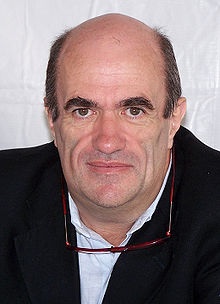
Irish writer, Colm Tóibín.

In 1984 I took my first trip out of Australia, to Europe. On a clear day while wandering through the old streets of Budapest I was fascinated by some of the old buildings, solid and substantial but on closer inspection I saw pock marks in the stone, little indentations that … I audibly gasped as I realised they were damage caused by bullets. I was born in 1952 but always thought of WWII as way way in the past. Here it was right in my face. The feeling in my stomach was significant and deep. These bullet marks may have been from the 1956 uprising but I didn’t know about that then; these bullet holes brought home to me the fear of war, bullets whizzing past you at head height, but in much the same way that Toibin’s new novel The Magician did. This is curious because most of the novel is set away from the war: they didn’t experience it.  But Tóibín’s gets inside the characters and, especially, Mann himself who battles with his reactions to things and what he should do, how he should feel, the guilt he felt by leaving Germany, his horror at what is happening to his country and countrymen, and his seemingly lack of control over his two eldest of six children, Erika and Klaus. Their sexuality, politics, and morals were free, fluid and difficult and epitomised the Germany between its wars and the Germany that Hitler wanted to bury. Mann kept his true sexuality hidden and it was only with the publication of his diaries well after his death that the extent of his homosexuality was revealed.

Thomas Mann was the second most famous German in his day: Einstein was number one. A Nobel Laureate (1929) his books were very popular but of the old school; elongated sentences, long and sometimes obtuse with philosophical passages and ideas about politics, art, and beauty, not unlike those of Henry James, another writer Tóibín successfully novelised in his novel The Master (2004). Ironically Tóibín’s writing itself is not at all like that. It is bold in its simplicity, short sentences plainly made and stimulating. There are very few adverbs; no-one ever says anything ‘accusingly’; no-one looks ‘disapprovingly’. There are no contractions – a Tóibín moniker – which gives the language a formal and serious tone. It’s as if Tóibín’s plain words paints deep feelings in the reader’s mind – or should that be, Tóibín’s plain words forces the reader to paint deep feelings in their own mind? 

There are passages about writing, especially concerning his three most famous works, Buddenbrooks (1901), his first novel about the decline of a family which launched his career; Death in Venice (1912) his popular novella about death and beauty; and The Magic Mountain (1924) the work that gained him the Nobel Prize. Thomas Mann understood that while Buddenbrooks was based on his own family, there was some source for it that was outside of himself, beyond his control. It was like something in magic, something that would not come again so easily. This is what the prolific novelist Alexander McCall Smith referred to when he said writing was about opening up the subconscious. This ‘magic’, this evidnece of ‘the muse’ can also be described as like watching a television scene and writing down what you see and hear. Mann experienced it and I’m sure Tóibín does too.

The detailed passages of Mann’s thoughts about war, literature, creativity, and desire lead me to think Tóibín must have done intensive research into the works of Mann, particularly his essays, diaries, and non-fiction, and even into the works of Mann commentators. However, I had no wish to follow him there in an attempt to prove that what he writes is correct; I don’t care if he is correct. What I do care about is the veracity, the verisimilitude, of this work, this novel. What Tóibín has written concerning Mann’s thoughts might indeed be novelistic creation, ie fiction, but its believability is strong. That’s a novelist’s job: to make the reader believe the fiction even if it might not be true.

The narrative covers Mann’s life from the age of sixteen (1891) in Lübeck, a small city north east of Hamburg in Northern Germany; the family’s exile in Switzerland in 1933 and then the USA from 1940 to 1950; and final tour of a very different Germany but settling in Kilchberg, just south of Zurich, Switzerland in 1952; to just before his death in 1955 at the age of eighty.

While Tóibín’s other novelisation of a writer and his work, The Master (2004), about Henry James’s failed attempt to become a noted playwright is more creative and successful; this work, although interesting and enjoyable, is more biographical, as if Tóibín felt obliged to stick to the truth, rather than creating his own.

Here is a video of a reading by Colm Tóibín from The Magician, and conversation with Friedhelm Marx, Chair of Modern German Literature at the University of Bamberg, given recently at the Thomas Mann House in Los Angeles.

You can buy the book in various formats here.