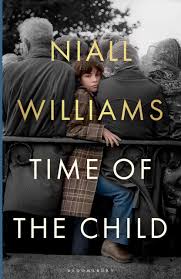

“From the reeds a second rain dripped harder than the first and the brim of the doctor’s hat released it as a third.” So, the poor doctor had three curtains of rain to deal with: from the skies, from the roof and from his hat before he made it to the back door. This descriptive layered richness of detail is the William’s trademark and peppers a simple scene with verbal interest and understanding of place and character. This latest novel Time of the Child (2024) from the Irish writer is again set in his mythical town of Faha on the western edge of Ireland making the third in what has become known as the Faha Trilogy. The first two being The History of Rain (2014) and This is Happiness (2019). The most notable feature of Faha is rain. Even when it stops, rarely, it is still on everyone’s mind; it will surely start again any minute.
There is not a lot of dialogue in William’s novels. The characters don’t talk much, hence many plot points rely on misunderstandings both comical and tragic. People understand each other by the nod, the look, the shrug, but ironically despite the lack of talking gossip spreads like a virus.
It’s coming up to Christmas 1962 and doctor Jack Troy and his eldest and unmarried daughter Ronnie are presented with a child, a foundling. Ronnie immediately loves it and names her Noelle. Keeping the child cannot happen without a man, husband and father to go with it and keeping it is exactly what Ronnie is determined to do. Jack Troy knows of a possible contender for the role of husband/father but he is in America, but conscious of his own failings and mis-steps as a father hatches a plan to bring happiness to his daughter.
It is not necessary to have read the first two to enjoy the third. Each novel is self-contained. The characters and culture of Faha are in themselves a story and you are presented with a rich tapestry of both before the child is found in a graveyard. The enjoyment of reading Williams is not just because of the plot – his focus he admits – it’s his writing style and his uplifting of daily detail to importance in the local’s lives but in rich and lyrical language. I loved this book. Highly recommended.
 Michael K Freundt