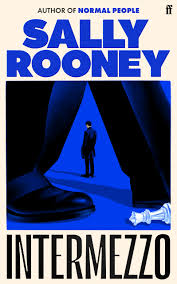
A few hundred pages into the novel I was struck by the narrative format; actually Rooney employs two narrative formats.
This is the story of two brothers and their bumpy relationship following the death of their father.
Peter, 32 is a lawyer and Ivan, 22 is, well, nothing much but a wiz at chess but scraping a living from his checkered passion is not easy.
Peter has two girlfriends; Ivan has one. Peter seems happy but Ivan is happy. I feel sorry for Peter but I love Ivan.
Sally Rooney is quite a literary phenomenon. Most of the action goes on in her character’s heads. She is a digger of truth about what goes on in the human mind which is often at odds with the way people behave. Especially men. So eager is she to explore our mental shenanigans, she sometimes overdoes it a bit. That’s a minor criticism.
But back to the double narrative styles: for the chapters about Peter the narrative is almost stream-of-consciousness. Short sentences. Shorter phrases. Even just one word followed by a full stop. They all tumble over each other. It pretty much reflects Peter’s state of mind: full. His two girlfriends, his high pressured job, what to do about his under-achieving brother, and did he love his father. Enough? Ivan’s chapters are more conservative, the third person narrator is more conventional: long sentences, precise grammar, at a slower pace. This is Ivan. He’s a simple soul not much concerned with material matters but he knows love when he feels it. Although I’m not a fan of stream-of-consciousness narration it works here; it works for Peter. Another grammatical technique binds the narratives together. The dialogue, there’s a lot, isn’t punctuated. A modern trend. But it is easy to follow. When you listen to an audio book – another modern trend – the punctuation is not read yet it is always clear who says what to whom.
I am almost to the end so I cannot tell you what happens. It’s a great read. I’m loving it. If you haven’t already give it a go.
Two introspective young people, Connell and Marianne, find a mutual attraction, sexual and psychological, at school but their socio-economic differences, other people’s perceived opinions, and their own view of themselves, keep them apart. As they mature and they cross paths, along with new partners, they still feel the attraction: one that they don’t fully understand.
The dialogue is simple, sparse, inarticulate like the speakers – belying their intelligence. The narrator carries all the nuances, the real meaning, and the narrative.
It’s this role of the narrator that struck me as unusual. In genre fiction the narrator’s role is very narrow: an isolated voice, in the 3rd person, past tense, with god-like abilities – seeing into everyone’s mind, their desires, regrets, and intentions, the past, present, and future, genderless, as if one minute sitting on the shoulders of characters gaining intimate knowledge of what they are thinking, planning, the next sitting on a drone just above the action seeing what is unfolding from all angles and from all points of view.
In literary fiction the role of the narrator is more varied; not only using the usual 3rd person voice, sometimes the 1st and even the 2nd, mixing past and present tense; or multiple voices, different narrators, some reliable, some not.
Rooney uses a narrator, yes with god-like abilities, but also as interpreter, explaining what the characters are thinking but do not know how to express. They are proto-adults, unaware of what is happening to them, and also unaware of why they do things, highly-strung and sensitive, feeling at odds with their surroundings and peers.
He tells her that she is beautiful. She has never heard that before though she has privately suspected it of herself, but it feels different to hear it from another person. She touches his hand to her breast where it hurts, and he kisses her. Her face is wet, she’s been crying. He kisses her neck. Are you okay? he says: It’s alright to be upset, you know. She lies with her face against his chest. She feels like a soft piece of cloth that is wrung out and dripping.
You would never hit a girl, would you? she says.
God, no. Of course not. Why would you ask that?
I don’t know.
Do you think I’m the kind of person who would go around hitting girls. he says.
She presses her face very hard against his chest. My dad used to hit my mum, she says. For a few seconds, which seems like an unbelievably long time, Connell says nothing.
Connell and Marianne are sensitive to each other although Connell hurts her deeply, unaware of what he is doing; and she accepts the rebuke as indicative of how she sees herself: unworthy, unlovable, and possibly mentally disturbed. This ugly duckling turns into a beautiful duck but with all the feelings of ugliness she grew up with just under the surface. Her mother and brother were, and are, her greatest enemies, whom she gives into as her way of surviving them; just like she does to the various men in her life. Connell rescues her on several occasions only letting her drift away again, usually because of their educational opportunities. Academically they are both exceptional. As readers, onlookers to this on-going train crash of a relationship, we hope they will one day survive it and stay together. This is where the dramatic momentum comes from fostered by the time line: each chapter is several months into the future, although one chapter is five minutes into the future and the tension this creates is remarkable.
The joy of reading this book is the insight into her characters Rooney gives us. We’re watching them along with the narrator wishing them well, cursing their decisions, cheering with their triumphs. We desperately want them to be happy.
I loved this book.
“I found Henry James almost unreadable five or six years ago, and now I love him! Who knows what I might get into next?” Yes, we’d all like to know that.
Sally Rooney, at 29, has had two novels published, Conversations with Friends (2017) and Normal People (2018), which was long-listed for the Booker 2018 and won the 2019 British Book Awards and will soon be on our televisions this year with a Hulu, BBC production penned by Rooney and directed by Lenny Abrahamson.
Here you can watch an interview with Sally Rooney from the London Review Bookshop in May 2019.


 Michael K Freundt