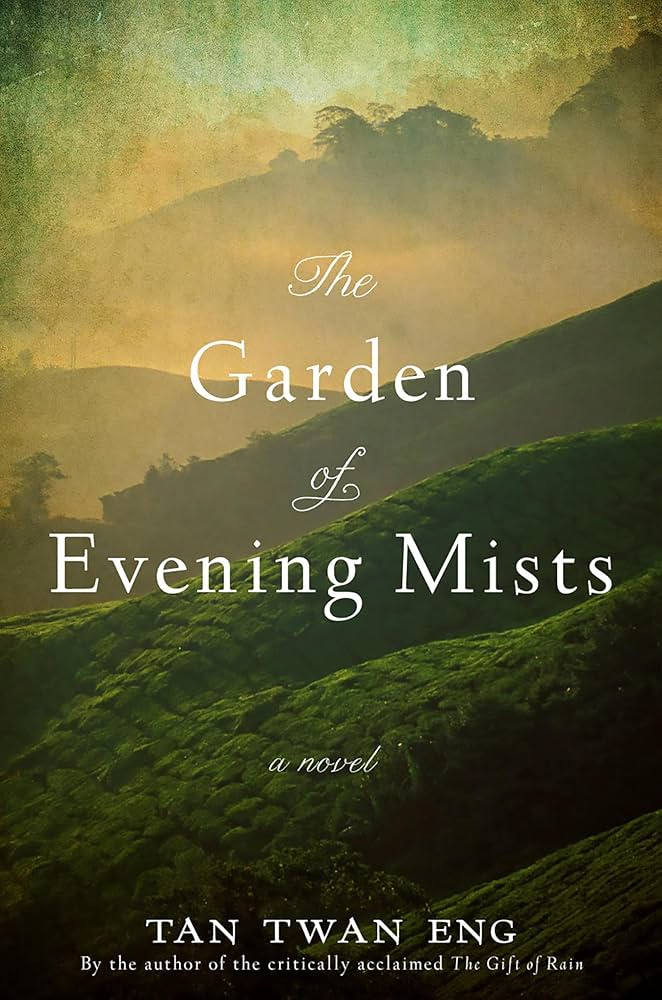
the Garden of Evening Mists by Tan Twan Eng

Malaysian/British writer, Tan Twan Eng

A Straits Chinese retired judge, Yun Ling Teoh, returns to spend her last days in a house in the Cameron Highlands in Central Malaya during the Communist guerrilla war with the British in the early 1950s. It was here, as a young woman, she was apprenticed to Aritomo, a famous Japanese gardener, who once was the gardener of the Emperor of Japan. This back story, their working and emotional relationship with the backdrop of WWII and the Malaya Communists against the Japanese, is THE story.

This is the second novel by Tan Twan Eng after his successful debut, The Gift of Rain (2008) which was long-listed for the Booker. His third novel, The House of Doors (2023), was also long-listed for the Booker. This one suffers from the cliched ‘second novel syndrome’. In this case, not as original and complex as the first, and not as imaginative and assured as the third. This is a personal opinion despite it being short-listed for the Booker. I enjoyed reading it but without that thrill of attachment. Like all three Tan novels, they transport you to a time, place, threats, joys and sensibilities that are completely alien, but therefore fascinating, to a contemporary reader. Of course, the raw human emotions we all know about. This one also has that Eastern flavour of wisdom and sage-like belief in elements of the world that we can’t quite grasp but which may guide or steer us in directions we haven’t planned.

Her sister, enamoured by Japanese gardens, disappeared during the war and Yun Ling wants to built a Japanese garden in her honour. Aritomo refuses to design one but offers to teach her how to design it herself. Yun Ling’s internment by the Japanese, her apprenticeship to Aritomo and her relationship with him form the spine of the narrative. The events, conversations and relationships appear ‘soft’ and incidental. I knew this work had been made into a movie in 2017 and although my interest wavered I reasoned that if there was cinematic interest in this work there must be a pay off. I continued reading and I am so glad I did. This is a ‘slow burn’ of a book … war, imprisonment, romance, intrigue, a tattoo! – there is so much I haven’t mentioned – but all will be revealed in a very satisfying climax. Highly recommended. I wait patiently for book number 4.

Here is a short video of Tan Twan Eng talking about this book.

The Gift of Rain by Tan Twan Eng

Malaysian/British writer, Tan Twan Eng

This book is the best of what fiction can do: it takes you out of your time, your place, your beliefs, your expectations, and your complacency. Its appearance of truth, verisimilitude, is so strong it’s hard not to feel that this is memoir – how does he do that? – yet Tan Twan Eng, the Malaysian / British author, was born in Penang 30 years after the action, 1941-46.

The novel is written in two parts. The first and longer is a slow burn of friendship, self-awareness, family, and discovery. The second is a rollercoaster ride as WWII decimates the contented and almost healed world of the protagonist, Phillip Hutton, the Chinese / British son of a wealthy English businessman whose completely English family seemed complete before he came along.

Phillip’s Chinese mother was his father’s second wife. Although the youngest, he feels he is in the middle: in the middle of everything, being pulled this way and that, fielding heavy demands on him from every angle: the Malay locals, his Chinese forebears, his English father, and, most importantly, his Japanese instructor in the ancient Japanese martial art of aikijutsu, testing his loyalty, his responsibilities, his obligations, and his sense of self. Phillip gathers all these strands of himself into one comprehensive knot and so is able to finally understand himself and his place in the world, or so he believes. Then the war arrives in December 1941 and everything unravels. But young Phillip discovers that all those strands of his life that he thought were fighting him, pulling him, were actually teaching him; he does the unthinkable, then recants, then … no, no spoilers here.

For anyone interested in the mysterious art of writing fiction don’t bother with all those vlogs on YouTube giving free writing advice from ‘experts’ most of which look like they’re just out of high school; you’ll find out more about writing fiction by reading this book, but read it like a writer: search for the ‘way’ and ‘how’ he writes and understand how he makes it so real.


The Gift of Rain (2007) was Tan Twan Eng’s debut novel, and it was long listed for the Booker Prize as was his most recent, The House of Doors (2023). I’m now searching for his second, The Garden of Evening Mists (2011), also a prize winner – it won the Man Asian Literay Prize – and which has been adapted for big screen by HBO.
Highly recommended.

Here Tan Twan Eng talks about the perils of being a new writer.

Listen to Tan Twan Eng’s advice to new writers here.

The House of Doors by Tan Twan Eng

Malaysian writer, Tan Twan Eng

Every week, on a Wednesday, I get the ‘pink’ Weekend Financial Times and I open it first to the culture section. That’s where I found a review of this book. What first attracted me was the mention by the reviewer, Michael Arditti, of the writer W. Somerset Maugham, a favourite of mine, although now he is very much out of fashion. I am always interested in novels that include real writers as characters (biographical fiction). My favourites of the genre are Colm Tóibín’s The Master (2004) and David Lodge’s Author Author (2004) both about Henry James and his failed attempt to become a playwright, as well as Damon Galgut’s Arctic Summer (2014) about E. M. Forster and his life leading up to the publication of his masterpiece, A Passage to India (1924). 

I was also prompted to read this book because its author, Tan Twan Eng, was on the Booker Prize short list in 2012 for his second novel The Garden of Evening Mists (2012). Reading a Booker Prize short listed writer has sometimes proved far more satisfying than reading the winner. 

The House of Doors (2023) is the story of Lesley Hamlyn, her husband, Robert, a successful lawyer in the Straits Settlement on Penang Island (the author’s birthplace) in 1921 and her affair with a local doctor; they meet in a large house where her lover keeps his collection of doors, hanging from the ceiling. Its’s a beautiful image and a symbol of the possibilities for all Tan’s characters. The Hamlyn home, Cassowary House, is the focal point of the local society and passing through are Dr Sun Yat Sen, the Chinese revolutionary seeking money and support to transform his country, and the British author, W. Somerset Maugham, an old friend of Robert’s, and Maugham’s ‘secretary’ – read ‘lover’ – Gerald Haxton who are guests in the house.

At the same time Lesley’s best friend Ethel Proudlock, living in Kuala Lumpur, is accused of murder and Lesley becomes involved in emotionally supporting her friend even though Ethel has admitted to the crime; she emptied a pistol of its six bullets into the body and head of a man on her verandah one night.

This famous case was the subject of world news and became the basis of one of Maugham’s most famous stories: The Letter, which first appeared in his short story collection The Casuarina Tree (1926) and became a very successful stage play in 1927 and, even more famously, a Hollywood movie in 1940 starring Bette Davis and Herbert Marshall. 

Most reviews concentrate on the Maugham element in their reviews but the book is a lot more than that: revolution in China, the colonial way of life, and fidelity. The later is particularly strong since Lesley’s affaire weighs heavily on her conscience even though she knows her husband is having his own. Her conservative social sensibilities, brought into focus when she finally realises the true relationship between Maugham and Haxton, and the effect on her marriage and on the society in which she lives, should the affair be discovered, create a dilemma for the woman but her sense of her own worth wins through. She is very careful and maintains her marriage, family, and social position while at the same time quite enjoying Maugham’s company. W. Somerset Maugham was not a very likeable person, but Tan portrays him as a kind and soft man, if somewhat aloof, but completely in the thrall of Gerald Haxton. 

Tan uses an anonymous omnipotent third person narrator interspersed with the first person, Lesley Hamblyn, which gives the work a stronger verisimilitude had it been completely told in the third. Tan has also moved the action of some of the true events to meet his novelistic needs as well as successfully mingling real and fictional characters in a known place juxtaposing the political and the romantic, against the suspense of a murder trial and the whispered prejudices of the British society sipping their G&Ts while sweltering in their linens. 

Tan is completely in control of his material and ideas. It is a very enjoyable and satisfying read. 

Here you can watch a short video of Tan Twan Eng talking about The House of Doors.

You can buy the book in various formats here