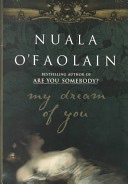

My Dream of You by Nuala O’Faolain (noola o fway lorn)

Nuala O'Faolain
Nuala O’Faolain

I loved this book!

After the international success of O’Faolain’s memoir Are You Somebody? this novel, her first, was published in 2001 and in a brief Afterward she acknowledges “splendid energetic advice” from fellow Irish writer Colm Toibin who recently opined that

“… in autobiographical writing your [the writer’s] job is to create illusion, to work with rhythm and image and detail to make the reader feel that whatever is on the page matters and must have happened.”

I would venture to say that this also applies to writing in the first person, memoir or fiction, since the first person point of view is meant to make the reader believe the protagonist is also the writer. I recently complained that in The Cast Iron Shore, Linda Grant’s debut novel, that I reviewed on this blog recently (posted January 27), Grant failed her first person POV responsibilities by inadvertantly creating a disconnect between the protagonist and the writer: they seemed like two different people.

O’Faolain does not make the same mistake. Although a novel (fiction), My Dream of You reads like a memoir, feels like a memoir; so skilfully does O’Faolain make you believe, using “rhythm and image and detail” that her story actually happened to her. Having read her first memoir there is a lot of O’Faolain’s past in Kathleen’s but autobiography and fiction are interwoven seemlessly. How do I know this? I cared about her.

Kathleen de Burca is an Irish travel writer fast approaching fifty, and with a waist to match, who travels the world, usually with her best friend, an gay American man called Jimmy, writing travel copy for her boss, and also close friend, Alex. These two men, and staff in the office in London, serve as her family, since she has all but abandoned hers, and her country, many years before. Then there is her boyfriend, Hugo, a law student, who interests her in a divorce case from the annals of Irish history: the young wife of an English aristocrat, on a forlorn Irish estate in the middle of nowhere, is accused of infidelity with her husband’s Irish groom, a very common man. In those days, the 1850’s, a divorce needed an act of parliament so the event is well documented although from a very English point of view. The wife is chastised, forsaken, deprived of her young daughter, and locked up in an asylum where she inevitably goes mad.

Kathleen is intrigued and fascinated by this tragedy and when Jimmy, her moral compass, suddenly dies she takes leave of her job (Hugo, the boyfriend, she betrayed and lost) and travels to Ireland to, maybe, write a book about this young wife and her passion for a comman man.

The book has three narrative arcs: Kathleen’s journey to Ireland, her adventures, and the brief reunion with her siblings and their families; her memories of her arrogant, distant, and emotionally violent father, her deeply unhappy and useless mother, and her friends and lovers; and the story from the 1850s of Marianne and her affair with the lowly William Mullen. Yes, there is a book within the book.

She thinks she is going to Ireland to research a story about someone else’s passion but what she actually does is confront passion in her own life and what she discovers is not what she expected.

The writing of the Marianne’s story (in the third person) begins confidently and the affair with Mullen is handled expertly: O’Faolain makes the reader understand how intense physical attraction can operate outside the realms of reason; but Kathleen discovers another document that proports to prove that … well, I don’t want to spoil it for you. There is here the flavour of a mystery to be solved.

O’Faolain’s literary skills are put to good use as she weaves the first and third narratives into a shared ending which also ends the book itself. Very satisfying.

My Dream of You is about love, sex, family, and aging, and it contains one of the best descriptions I have ever read of female friendship – how it works – and how emotional love with a woman can be far more rewarding and long-lasting than sexual love with a man. Mind you, Kathleen has a lot of experience with sexual love with men and she understands, and shows, that passion is far more complex and evolutionary than romantic books make out; and she comes to realize that her relationship with her body is also a part of the ‘passion’ equation and far from what she would like it to be, or thought it was. She is, or was, a beautiful woman and there are magic passages where a beautiful woman talks about being beautiful, without pride or sentiment, and when she believed it and when she didn’t. This is unusual stuff.

Nuala O’Faolain was engaged once but never married, had a fifteen year relationship with the Irish journalist, Nell McCarthy, but spent her latter years with a New York lawyer, John Low-Beer. She was diagnosed with metastatic cancer in 2008. Hugo Hamilton, whose memoir The Speckled People I recently reviewed on this blog (posted February 10), was a friend of O’Faolain’s and his 2014 novel Every Single Minute is a fictionalised retelling of a trip he took with the very ill O’Faolain to Berlin just before she died (May 9 2008).

She wrote two volumes of memoir Are You Somebody: The Accidental Memoir of a Dublin Woman (1996), and Almost There: The Onward Journey of a Dublin Woman (2003); another novel published posthumously in 2009 Best Love, Rosie; and a ‘history with commentary’ The Story of Chicago May (2005). Chicago May was the nickname of Mary Ann Duignan, an Irish criminal, who became famous in America, France and Britain in the beginning of the twentieth century.


Zeitoun by Dave Eggers

The American writer Dave Eggers

The relationship between truth and fiction is, and always will be, complicated and never more so than in the reading of this book: Zeitoun by Dave Eggers. It was published in 2009 to great acclaim, won many prizes and is a non-fiction account of Abdulrahman Zeitoun’s battle with the aftermath of Hurricane Katrina in 2005. I had heard of Dave Eggers but had never read any of his work. He is a remarkable achiever who sprang onto the literary landscape in 2000 with a memoir with the hubritic title, A Heartbreaking Work of Staggering Genius.

First of all it is a handsome and well-made book and heavy for its size; expensive paper perhaps. I was immediately impressed by the simple but effective language that painted a loving and respectful relationship between Zeitoun and his American, but Islamic, wife Kathy and their four children, while building the suspense of Katrina bearing down on them. The couple ran a busy and successful painting and maintenance business in New Orleans, but also had several rental properties that they managed. Everyone worked very hard. Zeitoun, originaly from coastal Syria, was a hard-worker, a loving husband, doting father, a devout Muslim, with a strong sense of community and duty to his neighbours. Here was the epitomic hero.

As the hurricane approached Kathy and the kids left for relatives further inland in Baton Rouge leaving Zeitoun to look after the house and their other properties. The storm comes and goes and Zeitoun wonders, is that all there is? No, the mighty storm was not the problem, but the rising water was. He moves everything he can to the second floor and when the water stops rising he jumps in his second-hand canoe and paddles around the city rescuing trapped people and neglected dogs. I knew from the back cover that he would be arrested for suspected looting and imprisoned in a cage but I hadn’t got that far yet.

Then on Thursday evening I went to meet some friends for dinner in a local restaurant. I was the first to arrive and so while I was waiting I Googled Zeitoun and Eggers; I was curious about what had happened to our real-life hero, Zeitoun, and his family. I wish I hadn’t.

Much has been written and reported about Abdulrahman Zeitoun and his wife Kathy since this book was published in 2009. The pressures of fame that the successful book generated, harrassment by the media, and not to forget the trauma of Hurricane Katrina herself all took their toll. Kathy Zeitoun accused her husband of repeated physical abuse, the first time, reportably, but witnessed, with a tyre-lever, and they were divorsed in February 2012. Abdulrahmin was then arrested on charges of attempting to murder his ex-wife and for paying a hit-man to do the deed. Both charges were dismissed in July 2013 by the judge who sided with the defense team who maintained that the prosecution pursued the case because of Zeitoun’s growing fame. In response to his aquittal Kathy Zeitoun said “I was shocked. I am now in fear of my life. I do believe he is going to attack me again, with all my heart.”

Knowing this informaiton before finishing reading the book changed the way I felt about it. This worried me. The publishers and Eggers himself have gone to great lengths to establish the story as not just non-fiction but as fact even though Eggers writes the book as a novel: he describes the thoughts in his character’s heads and conversation, in direct speech, between Zeitoun and Kathy in the privacy of their bed. These are the traits of fiction. Did Zeitoun leave out all the ‘bad’ stuff during his extensive interviews with Eggers? Kathy Zeitoun thinks so; or did Eggers only choose what he wanted to use for his narrative purposes? This is also a skill needed to write fiction.

I had to change my attitude about the book and treat it, think about it, as a novel; that was easy because it’s written like a novel, but changing the idea of the book from non-fiction to fiction wasn’t so easy. When talking about the frelationship between truth and fiction I’ve always used the line that

‘fiction is always about truth but, to make it clear, we have to lie about it a little’.

Dave Eggers has run away, literally, from reporters who want to ask him questions about the veracity of his book and if you google “Zeitoun + Eggers”, or similar, information runs out in late 2013 after Zeitoun was aquitted of the charges brought against him.

The hurricane itself certainly had a devastating effect on the people of New Orleans but for the Zeitoun family, did being the subject of Egger’s book bring its own misery and add to the family’s woes? Or were there already chinks in the relationship before Eggers came along? Chinks that he chose to ignore.

Non-fiction is about facts, truth is about emotion. The fiction may be set on a fictional planet or place but the interplay between the emotions and feelings of the fictional characters are about truth. I believe that the physical action of the story is true: the actual effect of Katrina on the people and the city of New Orleans, but I had to accept that the relationship between the characters, although they themselves existed, was not true, but manufactured, compiled, and organised by Eggers for his own novelistic purposes. This is what novelists do.

I went back to the book, I was only 50 pages in, but I was surprised to realise that I was no longer interested. I didn’t care anymore. The book was trying to be something it wasn’t. For years I’ve been telling people that if you’re not enjoying a book, stop and read something else, even though the urge to finish something you’ve started is very strong. I usually give in to this urge, but with this book, I didn’t. I stopped. Besides I had just found in my local bookshop a book that I’ve been longing for. This bookshop has a swap policy so I swapped my copy of The Luminaries by Eleanor Catton, the 2013 Man-Booker winner, ironically a book I also didn’t enjoy, but finished, for  Arctic Summer by Damon Galgut: a fictional biography of E.M. Forster. Ha! Yet another permutation of fiction and truth.

All writing is fiction. The only thing true about it is its physicality: little black marks on a white background.

The Dinner by Herman Koch

Dutch writer Herman Koch

Like most people I read all the words on the outside of a book before I read the words on the inside. My expectations, therefore, for The Dinner were high, as such marketing blurbs are meant to do, and my idea of the plot fairly set: two couples, the husbands are brothers, meet at a restaurant to decide what to do about a horrific crime committed by their sons, cousins, and now on YouTube for all the world to see. And, yes, that is the plot but this book is about much, much more.

Almost a third of the way into the book I wrote this in my notebook:

“Koch curiously plays with time. He begins a scene well into it and then ‘flashes back’ to explain how we got to the point where the scene began. There must be a point to this.”

Yes, there certainly is a point to this. There are three time-threads: the present, the past and the near-past. Koch weaves these threads like plaits, focusing on the first over the second which gives way to the third which in turn fades to give focus back to the first. This allows Koch to mete out information and back-story one little tantilising bit at a time ramping up the tension, and the mystery, and making you yearn for the next bit, and when it comes it isn’t what you expect.

At about the same place as I wrote that above note to myself all I had to go on, plot wise, was one of the fathers, Paul, the first person narrator, had seen something disturbing, we don’t know what, on his son’s computer just before they left for the restaurant, and when he kisses hello his sister-in-law, just after she arrives, he glances under her darkened glasses and notices that she has been crying.

Readers also tend to take sides with the first person narrator because usually, and in this case too, he is so honest, straight-forward, and ‘natural’ in the way he speaks to us, “I don’t know how to put it any more clearly.” It seems it is Paul who is writing this and not Herman Koch. You feel empathy for this man and it is only almost at the end when you realise that there is a reason for this too. Enough said.

The short chapters run numerically through four sections, Appetizer, Main Course, Dessert, and Digestif but this simple structure is nowhere near as limiting as you may expect. The action ranges far and wide but always comes back to the restaurant, the pretentious manager, the fawning staff, and the two couples trying to be the ‘happy family’ in a public place all the more threatening because, Paul’s brother, Serge, is a famous polititian. Everyone in the restaurant knows that they are dining in the presence of, maybe, the next Prime Minister. The stakes are high.

But this book is also about family, and about being a man, but most importantly about being a father. However it is not your feelings and thoughts about Paul that remain with you after you get to the ‘End’ it is … again enough said. I don’t want to spoil things for those who haven’t read it yet.

It’s easy to see how film-makers have been drawn to this book. There is already a Dutch version, an Italian version which takes some liberties with the plot and structure, and there is to be an English language version directed by, and making her directorial debut, Cate Blanchett. Read it before the film comes out.

This is a ripper of a yarn and as Christos Tsiolkas says on the cover, it’s “a punch in the guts but also a tonic.”