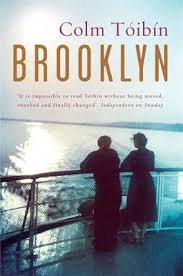

On Colm Tóibín’s website under ‘Essays” is a short story called “House for Sale.” It was written decades ago and attempts to recreate the atmosphere and situation of late 1967 when Tóibín’s father died and he and his brother were left alone in the house with his mother. Early in the story a nosy neighbour comes to visit and relates a story of two Irish men who meet in a hospital ward in Brooklyn. They discover not only that they are from Ireland, and not only from the same county, but from the same town. This obviously got Tóibín thinking about immigration and in particular the Irish kind of immigration: what is it you want by leaving and what is it that you leave behind? As a result of this digression another novel was born, Brooklyn (2010). This is the opening paragraph:
Eilis Lacey, sitting at the window of the upstairs living room in the house on Friary Street, noticed her sister walking briskly from work. She watched Rose crossing the street from sunlight into shade, carrying the new leather handbag that she had bought in Clery’s in Dublin in the sale. Rose was wearing a cream-coloured cardigan over her shoulders. Her golf clubs were in the hall; in a few minutes, Eilis knew, someone would call for her and her sister would not return until the summer evening had faded.
The language is simple – it is hard to imagine it being simpler – but contains a wealth of information. This is going to be a story about Eilis. Her sister works but she does not. Rose has her own money: she has taste and buys leather handbags in the sales in Dublin. She also plays golf, golf clubs are not cheap, and she is part of a crowd that Eilis is not; and the flit into the future makes it clear that this is a routine. Rose works but also parties, and parties late, eats and drinks at clubs, while Eilis does none of these things, she stays at home gazing at other people’s lives from a window.
By the way, the short story eventually became chapter one of his 2014 novel, Nora Webster.
What interests Tóibín is how the immigrant changes, not through any conscious decisions, but merely through contact with the strange and how that strange becomes normal by the immigrant adopting it as a matter of course; and this change is only evident if and when the immigrant goes back home. This is what happens to Eilis Lacey. She goes; she changes; she comes back; she is forced to choose. This provides a neat bi-line for the current movie adaptation of Tóibín’s novel: two loves, two countries, one heart.

The film, directed by John Crowley, with a screenplay by Nick Hornby, stars Saoirse (Ser sha) Ronan who you might remember as the 13 year old girl, Bryony, who gets it so so wrong in the film adaptation of Ian McEwen’s Atonement. Ronan, Hornby, and the film are all nominated for Oscars in this year’s awards announced on February 28th.
Having just read, and reviewed Marlon James’s A Brief History of Seven Killings (see previous blog February 6) I was curious to know why one award winning author left me unmoved (James) while another (Tóibín) had the opposite effect.
Tóibín places one character at the centre; his third person narrator describes her feelings, emotions, indecisions, prejudices, desires, faithfulness, and faithlessness in the simplest terms possible, even when the character herself is not aware, or does not understand them. He does this with no other character. Everything is seen through her eyes, her prism. It is as if the narrator is sitting close on her shoulder, spying on her thoughts, seeing everything from her point of view; it is the closest to a first person narrator as a third person narrator can get.
“When she returned she realised that Father Flood had heard about her job at Miss Kelly’s.” Tóibín could have left it up to the narrator to simply say ” Father Flood had heard about her job at Miss Kelly’s.” But he does not do this, we get the information through what Eilis does; how she sees it. His language is formal, no contractions, and straightforward which enhances his authority and leaves our emotions vulnerable and easily affected. However plot points are not obvious. We know all her misgivings, prevarications, fears and hopes; is she in love with Tony? She almost has to talk herself into it, but it is Tony’s reaction to her rehearsed confession that convinces her; but does she really?
“…and the next time if you tell me that you love me. I’ll …”
“You’ll what?”
“I’ll say I love you too.”
“Are you sure?”
“Yes.”
“Holy shit! Sorry for my language but I thought you were telling me that you didn’t want to see me again.”
She stood beside him looking at him. She was shaking.
“You don’t look as though you mean it.”
“I mean it.”
“Well, why aren’t you smiling?”
She hesitated and then smiled weakly.
“Can I go home now?”
“No. I want to jump up and down. Can I do that?”
“Quietly, ” she said and laughed.
He jumped into the air waving his hands.
All of Tóibín’s Irish characters come from his hometown, Enniscorthy, in Wexford, southeast Ireland. He knows these people but by putting them into unusual surroundings (Eilis in 1950’s New York: Katherine Proctor in Spain, The South; Richard Garay in Buenos Aires, The Story of the Night; Nora in widowhood, Nora Webster) he delights in seeing them falter, challenged, confronted, but ultimately surviving; getting through it all, if not unscathed.
Tóibín is not long on descriptions. In Nora Webster, no descriptions at all! However a sense of place and time is effectively created through fashion and behaviour of the day: the prices and availability of things, the New York Irish attitude to Jews and Norwegians; when coloured women are first served in department stores; the morality of dating, dancing, and music; and what your job, clothes, and choice of words say about you.
It is a romance, a tale of dislocation, of loyalty and belonging, and the meaning of ‘home’. It is also a bloody good read. You may guess the ending but you will not guess how it happens.


