Tom Lake by Ann Patchett

American writer, Ann Patchett

I never thought it was possible, but this book, Tom Lake (2023) by Ann Patchett, is a book about happiness. Of course bad things happen, they always do, but the bad things are related from another time well after the bad things, a happy time so the reader is always aware that the bad times were overcome.

I have been criticised before for using the term ‘soft fiction’. Some people think this a derogitory phrase. Not at all. By ‘soft fiction’ I mean there are no car chases, revolutions, earthquakes, spies, murders, or zombies. Plot points are naturalistic which the general reader can relate to. Patchett writes about family and in this book she writes about family to such a naturalistic degree that it feels like memoir; the verisimilitude is so strong. It’s very very good soft fiction.

The happy family are the Nelsons. Lara and Joe, in the general present, live on a stone friut farm in northern Michigan bordering the Great Lakes, Lake Michigan to be precise. They grow cherries, apples and pears in ‘the best’ and prettiest fruit growing district near Traverse City. Their three daughters, Emily, Nell, and Maisie, are adults and home for the late summer to help with the cherry harvest. While picking cherries Lara tells her daughters about her life from High School to her mid twenties when she had a romance with a famous movie actor, Peter Duke. He wasn’t famous then, of course, but the girls want to hear the details of the mother’s story having grown up with bones of the affaire all their lives.

Lara’s story begins with the auditions for a local, New Hampshire, production of Thornton Wilder’s iconic play Our Town. Lara and Peter met in summer stock when Lara thought she wanted to be an actor; she was ‘so good’ as Emily! Circumstances led her to another procuction of Our Town at Tom Lake where Peter Duke was cast as her father, Editor Webb. Their affaire began on the day she arrived only minutes after meeting Peter Duke who told her she couldn’t meet the rest of the company that afternoon because “you’ll be busy.”

What happens at Tom Lake is at the heart of the narrative. One of the things that makes the book so interesting and intringuing is that these two narratives, the cherry picking days and the summer stock months, we know will eventually converge to produce Lara’s happy family. But of course we don’t know how.

The other successful ingredient is Ann Patchett. Her first person narrator, Lara, is a reader’s joy. It’s like she’s leaning towards you, elbows on knees, in a living room in front of the fire when everyone else has gone to bed and telling you things she would’t dare tell anybody else, especially her daughters. You are forever in her thrall and made to feel special because of it.

I liked her The Dutch House (2019) but this is so much better.

It’s the best book I’ve ever read since the last best book I ever read … which was a while ago.

When next you go to your doctor for a perscription for anti-depressants don’t be surprised if it says ‘read Ann Patchett’s Tom Lake.’ It will be cheaper and more effective.

Here you can watch an interview with the wise and wonderful Ann Patchett courtesy of PBS News Hour.

You can buy the book in various formats here, where you can also read a sample for free.

-oOo-

P.S. It was very hard to find a picture of the cover of this book that didn’t look like this, the American cover:

Americans are so keen on overstatement. They don’t go horseriding, they go horseback riding, just in case you’re not sure where to sit. They don’t walk on a footpath they walk on a sidewalk, just in case you might think it’s OK to walk on the road. And they put ‘a novel’ on the cover of a novel just in case it’s a novel you really want to buy, not a cheesecake.
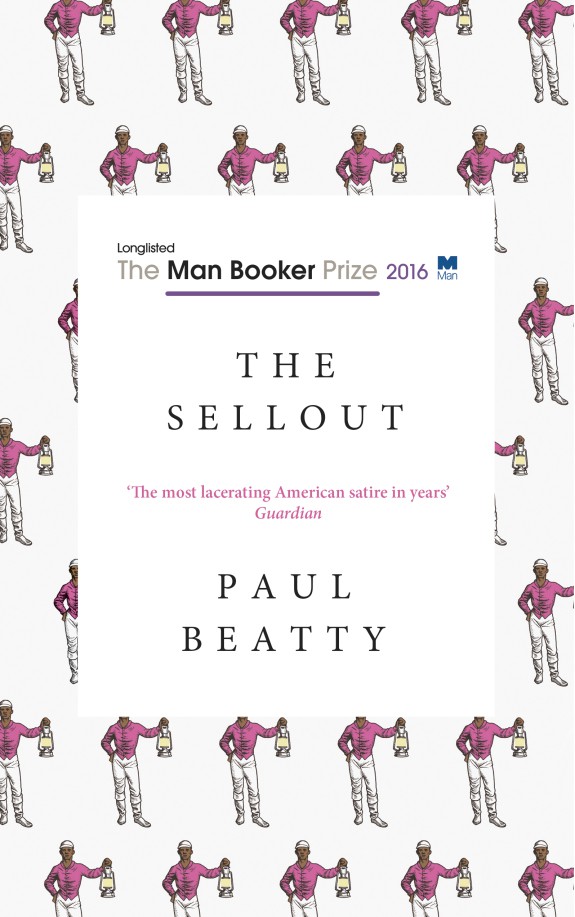
Slam-Prose takes the Prize. Again.

paul-beatty
American writer, Paul Beatty

The Sellout by Paul Beatty

Paul Beatty is a 54 year old African American from Los Angeles and the first American to win the Man-Booker Prize (2016) since American writers were included in 2014. He has an MFA in creative writing from Brooklyn College and an MA in psychology from Boston University. In 1990 he became the first ever Grand Poetry Slam Champion of the Nuyorican Poets Cafe which garnered him a book deal. Two volumes of poetry Big Bank Take Little Bank (1991), Joker, Joker, Deuce (1994) and three novels , White Boy Suffle (1996), Tuff (2000), and Slumberland (2008) followed.  The Sellout was also awarded the 2015 National Book Critics Award for fiction.

Rappers and slam poets are never stuck for words

… And on hot 104-degree San Fernando Valley days, when we’re carrying their groceries to their cars or stuffing their mailboxes with bills, they turn and say, “Too many Mexicans,” a tacit agreement between aggrieved strangers that it’s neither the heat nor the humidity, but that the blame lies with our little brown brothers to the south and the north and next door, and at the Grove, and everywhere else in Califas;

they begin a collocated list and then subvert the last item

… Charisma flung back her long straight black hair from her face and took a hit that illuminated the mysteries of the internet, Ulysses, and the American fascination with cooking shows;

foster a slick line in similes

and comforts you like a lover making your bed while you’re still in it;

manufacture an artistic range of compound adjectives

My paternal grandmother was mocha-tinged, cafe-au-lait, graham-fucking-cracker brown! How come they never describe the white characters in relation to foodstuffs and hot liquids? Why aren’t there any yoghurt-colored, egg-shell-toned, string-cheese skinned, low-fat-milk white protagonists in these racist, no-third-act-having books? That’s why black literature sucks!;

add a touch of ethnic colour

… If I was lucky, I’d catch a glimpse of Marpessa, Charisma, and their homegirls holding court at the rear gate, sassy as a brass big band, hula-hooping their hips, chanting Ah beep beep, walking down street, ten times a week …”Ungawa! Ungawa!” That means black power! … I’m soul sister number nine, sock it to me one more time…;

and toss in a joke or ten

If New York is the City That Never Sleeps then Los Angeles is the City That’s Always Passed Out On The Couch. 

“I hate the act [of writing], definitely,” said Paul Beatty. “I mean, I don’t write much. One book every seven years or so. But it’s slow. When I’m doing it, it does give me a satisfaction. But it’s hard. It’s like how do you string together enough of these little moments where something is happening? That’s a pain in the a—.”

This is odd, or clever, because reading this book impels you to read it as fast as you can as if it was written while standing bare-foot on hot coals. But, then that, I suppose, is what slam-prose is all about.

In an age where a song lyric is suddenly, and some say at-long-last, recognised as literature – thanks to the Nobel Academy, The Sellout finally brings slam prose into the mainstream, and how? By out slam-prosing last year’s slam-prose Booker winner, Marlon James’s A Brief History of Seven Killings by showing James how it’s really done. Where A Brief History … was a literary wank sprukin’ how boring seven pages of no-punctuation thought-stream can really be, The Sellout, o-n-l-y  j-u-s-t makes it over the literary line by having something to say. And no wonder publishing house after publishing house turned it down (What? A book about reinstating slavery? Are you kiddin’ me?!) until finally Farrar, Straus, & Giroux hyperventilated and agreed to take a punt.

If you like a novel to have ‘nice characters’ and a ‘good story’ stay away from The Sellout. If you like clever word-play, African-American street-speak, stand-up with balls, if you’re a book judge or a literary critic, or you like a book you can keep on the coffee table and dip in to when you’re feeling low you’ll lerve this one.

You can download the paper or ebook version here or from Amazon here.