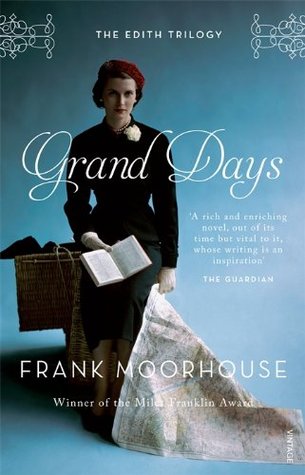
The most remarkable thing about Cold Light, the last in the Edith Trilogy (Grand Days 1993, Dark Palace 2000, Cold Light 2011), and indeed the trilogy itself, is the woman, Edith Campbell Berry. She is the type of woman who, while working at the League of Nations in Geneva in the 1920s and visiting a Paris nightclub, slips lightly from the lap of a lone black musician and puts his penis in her mouth; falls for and marries a bi-sexual, cross-dressing, English diplomat but only after mis-marrying an American journalist who turns out not to be whom he seems; masturbates a mutilated war veteran as her deed for post-war reconstruction; hates the smell of keys, and who kisses her brother’s girlfriend on the lips. This is Edith Campbell Berry who in 1950 finds herself, aged in her 40s, living in Canberra “…about as far from the centre of the modern world as you can get without being in a desert … a slap-dash country of such unhappy food.”
If this mismatch isn’t mismatched enough Cold Light opens with Edith discovering her long-lost brother, Frederick, who is now a working member of the Communist Party which is about to be banned by the new Prime Minister, Robert Menzies. How’s a girl, with a lavender husband and a red brother supposed to get a job in this town? This is particularly galling for Edith who wants – believing she deserves it – a status-riddled diplomatic post, which was something then a married woman could not have no matter what colour her husband was.
Because of a few pulled strings, she gets an invitation to dinner at the Lodge, where she airs and wears her Chanel, but diplomatically tells the other wives ‘it’s a copy’, and gets a hand up her dress from the man on her left, something she relishes, and offered a job by the man on her right, something she despises, because it’s only a job of sorts: as ‘special’ assistant to Canberra’s Town Planner. However, despite its low status, really no status as all, she is inspired by the sketches of the Canberra dream made by Marion Mahony Griffin, wife of Walter Burley Griffin, and takes the job but insists on her own office, gets one, but one with no windows, and decorates it with bespoke furniture from Melbourne and a cumquat tree. She drinks Scotch, is a fastidious dresser, wears stockings under slacks, a Tam o’ Shanter, when necessary, and does her husband’s nails and lets him wear her silk nightie to bed.
Edith Campbell Berry is a hotel cat: mistrusted by a few, loved by most, but belonging to no-one. Her wish for a Bloomsbury life leads her to recognise a man for her, and so marries again, but after years that began passionately, her marriage slips into one of normality and routine (wonderfully and insightfully described by Moorhouse) and when confronted by a new Prime Minister, Mr Gough Whitlam, whose lieutenants know nothing of her, her ideas, or what she has to offer, she is then unemployed, discarded, and emotionally alone. However, her past does not desert her, and her experience as an officer of the League of Nations in Geneva (Grand Days), her work in Spain during the civil war and her position on a UN committee (Dark Palace), and her reputation in Canberra, mainly fuelled by incorrect gossip about MI5, ASIO and her truthful but unconventional life, comes to the attention of Whitlam. She is offered a position as an ‘eminent person’ to be a pair of eyes for the new Australian government in areas of international diplomacy and unease. She is delighted. This takes her to the Middle East where the book ends, surprisingly, dramatically, but really, so appropriately. No spoilers here.
Frank Moorhouse is a living Australian writer who deserves to be better known. He has won the Miles Franklin Award (for Dark Palace) and many state and national awards as well. The Edith Trilogy is a major contribution to Australian literature where trilogies are rare: Henry Handle Richardson’s The Fortunes of Richard Mahoney (1917 – 1929) and Ruth Park’s Harp in the South (1948 – 1985) are ones that spring to mind. The books are big, Cold Light, is very big, but where Moorhouse excels is his tone and insight into love and all its shades, romance, sex, politics, human frailty, personal ambitions, and inevitable failures. All three books can be read in isolation but once you taste Edith Campbell Berry you will want to taste her again, so read them all. You won’t regret it and you won’t forget her.
You can buy the eBook here for $10.99, as well as the others in the trilogy.
Extraordinary. This is a word that we use too much. In fact, we use it so much that we have elided its pronunciation from ek-stra-OR-din-ai- ree to ek-STROR-din-ree; four syllables from the original six. English-speakers do this because, fundamentally, English speakers are lazy; and laziness elicits contractions. Therefore, the fact that this word has had two syllables, a third of it, elided from its pronunciation proves that we use this word a lot. I want to use this word, not only in its original six-syllable pronunciation but in its original compound word construction, before it became a word: its beginnings when the prefix ‘extra’, meaning ‘outside’ was joined to the word ‘ordinary’ meaning ‘normal’: outside normal, or not normal.
This is an extra-ordinary novel.
Imagine three novels of personal discovery by characters of varying nationalities, creeds, and circumstances – Polish, Australian, American, Jewish, African American, prisoner, ex-prisoner, displaced person, kidnapped child, holocaust survivor, trapped husband, abandoned wife, ghetto dweller, historian, oven-stoker, psychologist, and soldier – written by a writer who is fundamentally obsessed with what connects one person to another regardless of time, place, and belief; and who advocates that a connection, whether it be via six or thirty six degrees of separation is still a connection; who then knits them together as one. This ‘knitting together’ is not so much a writer’s skill; it’s more an editor’s, but the idea of it, the concept certainly is Perlman’s.
But there’s more to a book that its contents. One of the other things a book is, is its narrator: who tells it? Usually, but not always, a novel’s narrator is a third-person, unnamed, genderless voice that is all-seeing, all-knowing, god-like. In The Street Sweeper Perlman proves this is all undoubtedly true. It takes Adam Zignelik, a major character, 25 pages to wake up. Don’t think this is indulgent or dull: far from it. In the moment this happens in real time we learn, via the Herculean and history-obsessed narrator, about Emmett Till, a fourteen year old black boy from Chicago, who, in 1955, while travelling to visit relatives in Money, Mississippi, is tortured and murdered for sassing a white woman; about what happened at Central High School in Little Rock, Arkansas, in September 1957 to a fifteen year old black girl, Elizabeth Eckford; about the reasons, racism, and inconsistencies of the American Civil War, 1861 -1865; about what happened at the Coloured Orphan Asylum on the corner of 43rd Street and 5th Avenue in New York in the summer of 1863; about who is sleeping next to him as he’s waking, Diana; and even what will happen to her a couple of weeks after Adam wakes crying. Perlman doesn’t allow his narrator to tell you what happened, he shows you what happened; he takes you there. This is fresh history. But history that Adam Zigalick doesn’t know anything about, but could.
History is what excites Perlman and he explodes the idea that history is only a story that you’re not in.
Listen carefully. A young man – a very young man – lived in a house with his elderly father whom he loved very much. His father had grown unwell to the point of being bed-ridden. The young man shared the responsibility of taking care of the ailing father both with his mother and with a long-time and loyal servant of the family. . . He took pleasure in this even though, being a serious student at the time, he might have been forgiven for begrudging time away from studying in furtherance of his own future. It was all the more remarkable given the added stresses on him as a newly married man living upstairs in the family home with his even younger pregnant wife. . . Is any of this true? How can you know? How can you possibly know? I haven’t given you enough information even to ask better, more sensible, more meaningful questions. The better question is “Having heard what I told you about the young man, is it likely to be true?” Let me suggest these categories: true, untrue, likely to be true, unlikely to be true, and, there isn’t enough known to answer likely or unlikely.
His novelistic techniques are simple but effective. To flavour the testimony of a holocaust survivor, a Pole and obviously not a native-English speaker, he does as little as necessary, a little word-choice ‘mistake’:
I fell asleep in their second floor what was not yet finished,’ Mr Mandelbrot continued. ‘The cold come in through the missing windows but I was exhausted and fell asleep very quickly. The next thing what I knew was the SA man standing over me in the dark.
The use of ‘what’ not ‘that’ gives Mr Mandlebrot’s voice all the foreignness it needs.
Perlman has Adam discuss things in his head, not with himself, but with Diane, his partner who loves him but who he forced out of his life through his own inadequacies, fears, and selfishness: dialogue is far more interesting to read than blank prose:
He opened the mirror cupboard and found the comb that Diane had left still entwined with strands of her hair and he wondered how he became the man who held that comb.
‘So that’s it, is it?’ Diane whispered to him in the middle of the night.
‘I looked everywhere I could, did everything I could do . . . everything I could think of.’
‘Check them, Adam.’
‘Will you forgive me . . . for what I’ve done . . . to us?’
‘Sweetheart, check your notes.’
Adam went to his desk as he’d heard her direct him to do and started flicking through the pages.’
These ‘conversations’ not only keep the reader rooting for Diane and Adam’s possible reconciliation (no spoilers here) but also furthers the plot; not usual for thought bubbles.
Sensitive men, she had always felt, were intimidated by her looks, thinking that rejection was so likely that, as rich as the prize might be, they were too flawed, too certain to fail, to do anything but admire from a distance. (And then from the narrator, but in light of what this character had then thought, a little use of free indirect discourse) Men like these pursued women just slightly prettier than plain and then married whichever of them they were next to when suddenly the music stopped to announce that graduate school was over.
Immaculate, complex sentences with unusually expressed insight topped with a little poetry. This is classic Perlman.
Ultimately this book is about history and, more specifically, truth even in the little things:
It was the honey-skinned woman with jet-black straight hair, the student who no longer attended his ‘What is History?’ lectures; the one who had correctly guessed Gandhi. True? It was unlikely to be true but beneath the palm fronds as the past and the present wilted, beneath the candlelight where shadows snuff the sidle of evening, beneath the tropical motifs, thatch-clad walls and thud of the speakers there to help drown out people’s private internal, soon-to-be-publicly-misunderstood celebration of themselves, it was true.
There are no walk-ons in this story: a passing student has a goal, purpose, a history.
Elliot Perlman is a Melbourne barrister but has published three novels, Three Dollars (1998) which won the Age Book of the Year, and was adapted for film in 2005; his second novel Seven Types of Ambiguity (2004) was nominated for the Miles Franklin Award and the television adaptation will screen in Australia in 2017; and his third, The Street Sweeper (2011) was long-listed for the 2012 Miles Franklin Award. His short story collection The Reasons I won’t be Coming came out in 1999; the title story won the Age Short Story Award in 1994.
The Street Sweeper tells the stories, linked web-like through time and place, of a young African American man, Lamont Williams, and Adam Zignelik, a Jewish Australian historian, both living in Chicago and both trying to get their lives back on track: Lamont, after an unjust 6-year stint in prison, and Adam after his personal relationship and career starts to unravel.
Warning! The scenes set in the Nazi death camp of Auschwitz-Birkenau in 1944 are harrowing, detailed, vivid, and extremely disturbing. However, this book is also about memory, testimony, and what should not be forgotten; skipping these scenes is possible but not in the spirit of the work.
And the title? I’ll leave that for you to discover.
This is enlightening, intriguing, sometimes horrifying, but satisfying reading. Highly recommended.
You can get the hardback, paperback, and eBook editions here.
I marmaladed a slice of toast with something of a flourish, and I don’t suppose I have come much closer to saying ‘Tra-la-la’ as I did the lathering, for I was feeling in mid-season form this morning. God, as I once heard Jeeves put it, was in His Heaven and all was right with the world. (He added, I remember, some guff about larks and snails, but that is a side issue and need not delay us.);
a setting of a country pile called Totliegh Towers near the village of Totleigh-in-the-Wold; wold, by the way, apart from being the past participle of ‘will’ which we never use, is, apparently, a piece of open ground in Lincolnshire; and a cast of characters such as Sir Watkyn Basset, his daughter, Madeleine, Roderick Spode, Gussie Fink-Nottle, Emerald Stoker, the Rev. Stinker Pinker, and his fiancée, Stiffy Byng, you know what to expect, and that’s exactly what you get.
The irrepressible, and un-embarrassable Bertie Wooster and his faithful and loyal Man, Jeeves, motor to the said house to mix with the said folk and chaos ensues but it’s chaos of the very English countryside kind: all misunderstandings, gnashing of teeth, rolling of eyes, and spurious and fuzzy relationships where love is something like a decision about which scarf one should wear today, given the unseasonable weather.
Bertie Wooster, always the narrator, who doesn’t have a job – unless a job is having lunch at his club – often refers to himself in the third person, a somewhat English habit not unrelated to the royal ‘we’ and the uppity ‘one’. He has the hide of a hippo and the intelligence of a gnat. He seems to hate everybody except those he likes, and those he hates, hate him back, of which he is totally unaware; and those he likes think he’s a bit of a dill. That’s where Jeeves comes in, and always in the nick if t.; and that is one of Bertie’s little tropes, if ‘tropes’ is the word I want? (Ditto). But if it weren’t for Jeeves, who when he does come in it’s usually with tea on a tray, there’d be no story, no 14 books, and no laughs. Thank god – no, thank Wodehouse – for Jeeves since he knows absolutely everything about everything. Wodehouse, by the w, is pronounced ‘Woodhouse’ contrary to usual English pronunciation; so very Bertie Wooster!
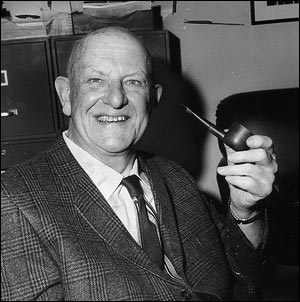
Pelham Grenville Wodehouse (1881 – 1975) was a prolific writer of humour and social commentary: novels, articles, short stories, and lyrics for musical comedies (Anything Goes, 1934), – at one time he had 5 musicals – in which he had a hand – running on Broadway, films (Gentleman of Leisure, 1915, Sally, 1929, The Girl on the Boat, 1961), and the creator of many memorable characters, Bertie Wooster and Jeeves being just two of them. At the age of 93 he received a long-overdue knighthood in 1975, but died on St Valentine’s Day 45 days later.
In his 90’s he was asked, “How about writing?”
Oh, as far as the brain goes, I’m fine. I’ve just finished another novel, in fact. I’ve got a wonderful title for it, Bachelors Anonymous. Don’t you think that’s good? Yes, everybody likes that title. Peter Schwed, my editor at Simon and Schuster, nearly always alters my titles, but he raved over that one. I think the book is so much better than my usual stuff that I don’t know how I can top it. It really is funny. It’s worked out awfully well. I’m rather worried about the next one. It will be a letdown almost. I don’t want to be like Bernard Shaw. He turned out some awfully bad stuff in his nineties. He said he knew the stuff was bad but he couldn’t stop writing.
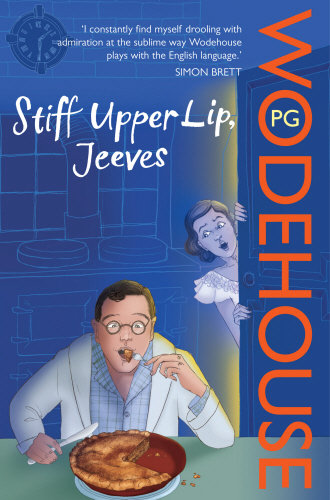
“Stiff Upper Lip, Jeeves” was first published in 1963. The plot? Well, let’s see. It has something to do with an ugly black amber objet b’thingummy which may or may not be stolen; an engagement that may be off, or it may be on; which all has something to do with a steak and kidney pie (see jacket cover). Perhaps I need to explain that the engagement is also threatened by conflicting opinions about sunsets, elves’ bridal veils, and something Dante wrote. Does that help? Oh, and there’s also a bit of fisty-cuffs and the cook elopes with someone’s fiancée which has a devastating effect on the prospect of dinner. Anyway, it’s all very cleverly muddled together to be as light as a … what’s the word I want? Starts with an f. Oh, yes; as light as fluff. And if you’ve ever tried to describe fluff you’ll know what I mean; light fluff is even trickier, but this being so light in fact, it blew away with the breeze before I had a chance to remember it. So, sorry, but entertaining? Very! If you like this sort of English thing; but it can be an effective diversion if read after Frank Morehouse and James Joyce.
-oOo-
You can find all things Wodehouse on his official website: http://www.wodehouse.co.uk
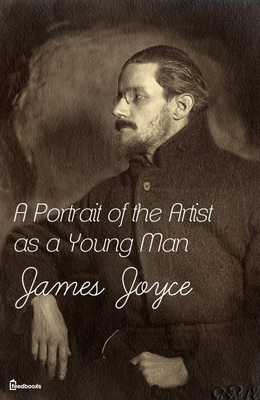
The Irish writer, James Augustine Aloysius Joyce (1882-1841).
The opening of “A Portrait …” is one of literature’s most famous:
Once upon a time and a very good time it was there was a moocow coming down along the road and this moocow that was coming down along the road met a nicens little boy named baby tuckoo.
His father told him that story: his father looked at him through a glass: he had a hairy face.
He was baby tuckoo.
There are several remarkable things about this opening. Firstly, the title has set up the idea that what you are about to read is going to be an autobiography, of the writer, the Artist, Joyce, about himself as a young man. But this is not what we read, this is not an autobiography in seems, since, if it was, the pronoun would be ‘my’ not ‘his’; so, it is not told by the Artist, the author, it is told by a third-person narrator. Secondly, it is written in the past tense, fine, as expected, but the moment you read the word ‘his’ you know that ‘his’ refers to the Artist, James Joyce. We only use a pronoun when it is clear who ‘his’ refers to and the only name prior to this pronoun is the author’s. It is him. This is confirmed by the line “He was baby tuckoo.” Again the pronoun and still only one name, the same name, the author’s, so, he is not the author. Well, yes, he is the author, we just choose to ignore that: we willingly accept what the author has written in order to enjoy the story. We play along. A few pages on this third person narrator, to confirm his existence, gives baby tuckoo a name, Stephen Dedalus. This is a story about a boy called Stephen Dedalus that we understand is the young James Joyce. Why has Joyce chosen to write his own story narrated by a third person god-like narrator? Because it is a much more useful novelistic tool. Writing in the first-person disallows the writer access to the minds, thoughts, tastes, dreams, wishes, and desires of all the other characters in the story. The first-person “I” can only describe what he feels, sees, tastes, dreams, and desires. The third-person god-like narrator has access to everyone and everything, but more importantly, the past, and the future. Also, the ‘baby’ language is the manifestation of yet another novelistic tool, new for 1914 and used here for the first time; so effective and now so widely used: a device that allows the narrator to adopt vocabulary, vocal mannerisms, colour, and tone of the character’s own speaking voice. In literary terms this is called free indirect discourse, or as critic James Wood likes to say, close writing. This is familiar to us now, (Edward St Aubyn’s The Patrick Melrose Novels, 2012, for example, and almost any novel written in the last 100 years) but innovative then. Also, usually for his times, early twentieth century and before, in novels of coming of age (Dicken’s David Copperfield, 1849 for one), biographical, or auto-biographical, the narrator wrote from the perspective of adulthood; there was a distance from the narrator to the subject. But here, as Stephen grows on the path to maturity, so does Joyce’s language. In 1916 Joyce’s text was radical. It’s as if Joyce, with this opening, was writing about Stephen at 6 years old when he, the narrator, was 6 years old. The action and tone are far more immediate, compelling, and authentic, and along with the non-judgemental narrator sets the ground-work for modernism which would be experimented with and adopted, not just by Joyce but by his contemporaries as well.
However, we know from this opening that this is going to be a story about a person called Stephen Dedalus (James Joyce) and that we are starting at the time when he was a very young boy and that his father wore spectacles and a beard. The original title of this book was another name, Stephen Hero, but he changed the title and the hero’s name.
In Greek mythology Daedalus was a skilled inventor and architect who built the labyrinth for King Minos of Crete to house the Minator, a monster, half man, half bull. He was also the father of Icarus. After Theseus killed the Minator, with Daedalus’s help, and fled with Ariadne, the king’s daughter, Minos imprisoned Daedalus and Icarus in the labyrinth but they escaped – after all, Daedalus built it – and flew the island by making themselves wings of feathers and wax.
The Fall of Icarus by Jacob Peter Gowy, 1637
Despite his father’s warning, Icarus, excited by the thrill of flying, flew too close to the sun god Helos as he rode his flaming chariot across the heavens, and the waxed wings melted, and Icarus fell and perished in the sea. Daedalus, after surviving another vengeful plot by Minos, escaped and finally settled in Sardinia where he joined a group led by Iolaus, nephew of Hercules; and as far as we know lived to a ripe old age.
In Romanticism, Icarus came to denote impetuousness, rebellion, and hubris, while Daedalus represented the classic artist, skilled, mature, and successful.
The young Stephen Dedalus is an observer, a listener. Early in the narrative he describes in great conversational detail a heated argument at the family Christmas table; an argument about Parnell, an Anglo-Irish politician, who by shrewd but steadfast political decisions became the figurehead of the Irish nationalistic movement in the nineteenth century; he renounced violent anti-Parliamentary action, but he was a protestant. Colm Tóibín writes that this scene could easily have been refracted around the tables of Irish dinners in the 1970’s and 80’s as family members argued over what was going on in Northern Ireland. And the scene where Stephen is unfairly punished resonated with Irish readers and writers: corporal punishment in Irish Catholic schools continued until the 1980’s. The influence of this book overshadowed generations of Irish long after it was published in 1916.
The young boy is also a thinker:
Was that a sin for Father Arnell to be in a wax or was he allowed to get into a wax when the boys were idle because that made them study better or was he only letting on to be in a wax? It was because he was allowed, because a priest would know what a sin was and would not do it. But if he did it one time by mistake what would he do to go to confession?
He asked the kind of questions Irish Catholic schoolboys have been asking themselves – and no-one else – for decades.
The first chapter ends with Stephan ‘reporting’ to the rector his unjust punishment at the hands of the prefect of studies, Father Dolan. This was a brave thing to do and his classmates hoisted him up, carried him along and shouted “Hurroo!” and threw their caps into the air. A stirring chapter-end of vengeance, courage, just fulfilment, and Joyce’s poetic language, not in a character’s words but from the narrator’s prose.
The fellows were practising long shies and bowling lobs and slow twisters. In the soft gray silence he could hear the bump of the balls: and from here and from there through the quiet air the sound of the cricket bats: pick, pack, pock, puck: like drops of water in a fountain falling softly in the brimming bowl.
Stephan has grown up a lot since moocow and baby tuckoo.
Chapter 2 is a portrait of a disillusioned young man in search of something profound which even he does not know what it is: “He wanted to meet in the real world the unsubstantial image which his soul so constantly beheld.” This “it” became “her” as if they would “make their tryst … in some secret place … and in that moment of supreme tenderness he would be transfigured … Weakness and timidity and inexperience would fall away from him in that magic moment.” This “her” in his mind (his muse?) is mingled with the heroine from Dumas’ novel The Count of Monte Cristo, Mercedes, or maybe its Ellen who, after a family bit of singing and dancing, comes with him on the tram where he is aware of her closeness, her wish for him to catch hold of her, “nobody is looking. I could hold her and kiss her” but he did neither and “stared gloomily at the corrugated footboard.”
This, a constant battle between the developing Artist and the developing Young Man.
And when he finally writes something about the tram, and Ellen and the kiss not made he “thought himself into confidence” over “a new pen, a new bottle of ink and a new emerald exercise” and “there remained no trace of the tram itself nor the tram-men nor of the horses” but only “of the night and the balmy breeze and the maiden lustre of the moon” and the kiss not given became a kiss “given by both.” Finally, the Artist at work; and, so often, his muse, his Art is so confounded with women, with sex. Women “demure and innocent” he sees by day, but by night “her face transfixed by lecherous cunning, her eyes bright with brutish joy” and he is left by morning nothing but a “humiliating sense of transgression.”
At school, he is studious but aware of voices urging him “to be a good gentleman”, “to be a good catholic above all things”, “to be strong and manly and healthy”, “to be true to his country,” “to raise up his father’s fallen state by his labours”, and “to be a decent fellow.” All this bidding by voices all around, “but he was happy only when far from them, beyond their call, alone or in the company of phantasmal comrades.” The battle continues. Even in his own existence. From 1904 he lived with a Dublin chambermaid who had little education nor any understanding of Joyce’s work and felt that he made his life more difficult by writing so strangely. She was vivacious, humerous, loved music, bore him two children, and stuck by him through intense poverty in Zurich and Paris while writing his most famous work, Ulysses. He was a husband and father, a Man, but then inside something else something separate, an Artist.
He is cast in a school play but his part humiliates him, “A remembrance of some of his lines made a sudden flush rise to his painted cheeks” but, surprisingly, the excitement and youth around him “entered into and transformed his moody mistrustfulness.” On stage he was amazed that the play during rehearsals that seemed a “disjointed lifeless thing” had taken on a life of its own and it was a success. He is amazed and confused by this and “his nerves cried out for further adventures” – this is Art and it is Alive! I want more! When he meets his family in the excited crowd outside the theatre he feigns an errand he annoyingly says he has to make and leaves them all before they can say a word. He strides alone through the city, his mind a “tumult of sudden-risen vapours of wounded pride and fallen hope and baffled desire” until he finds himself in a “dark cobbled laneway” where he “breathed slowly the rank heavy air.” Then this …
That is horse piss and rotted straw, he thought. It is a good odour to breathe. It will calm my heart. My heart is quite calm now. I will go back.”
*****
Here the close writing of the third-person narrator (“he thought”) in the past tense gets so close that it slips from the past tense into the first-person (“my heart…”) present tense (“… is calm”) – truly radical for literary 1916 – and suddenly Stephen Dedalus is James Joyce. But only for these three short sentences. After the ***** the third-person narrator and the past tense returns.
Stephen was once again seated beside his father …
There is no linking action between Joyce’s scenes; this stream-of-consciousness would be picked up by his peers and by writers even to the present (Marlon James, The Brief History of Seven Killings, 2015). The dialogue is sparse but realistic, but Stephen’s internal thought patterns are poetic and constantly at battle with the world around him. He feels he is alien from his family, “mythical kinship of fosterage” and burdened with a “savage desire … to defile with patience whatever image had attracted his eyes.” Joyce transformed the narrative into isolated scenes, the paragraph into pictures of feeling, and the sentence into impressionistic bits; like the painters were doing to landscape and interiors in studios and fields all over Europe.
But it is in part 3 that Joyce’s major theme, his Christian faith, is described and exalted in a lengthy sermon as his sinful, lustful, self is set against it and painted as on a slippery but vengeful slope to hell and damnation. The Christian parable is given in a naturalistic and almost movie-like narrative; the glory of heaven rent asunder by the treachery and downfall of the once “shining angel’, Lucifer, who is cast from heaven along with his “rebellious angels” into their fiery haven of Hell; and to fill the gap in Heaven left by these fiends, God created Adam and Eve and gave them a wondrous garden to live in; but Lucifer was jealous of these clay-born creatures and tempted them to disobey God and eat the forbidden apple; so the archangel Michael cast them out into the “world of sickness and striving, of cruelty and disappointment, of labour and hardship to earn their bread in the sweat of their brow;” but God is pitiful and promises a redeemer that will take on all the suffering of the fallen people and give them a way to salvation. It’s a heady and powerful text to the developing mind of a teenage boy who sees nothing but poverty and temptation all around.
He came down the aisle of the chapel, his legs shaking and the scalp of his head trembling as though it had been touched by ghostly fingers. He passed up the staircase and into the corridor along the walls of which the overcoats and waterproofs hung like gibbeted malefactors, headless and dripping and shapeless. And at every step he feared he had already died, that his soul had been wrenched forth of the sheath of his body, that he was plunging headlong through space… Flames burst forth from his skull like a corolla, shrieking like voices: Hell! Hell! Hell! Hell! Hell!”
Alone in the darkness of his room, curled up on his bed, hands covering his face his fear of Hell becomes manifest with images of reeking dung and weeds and “goatish creatures with human faces … trailing their long tails behind them … soft language issued from their spittleless lips … circling closer and closer to enclose;” and so terrified he springs up, vomits, cries, prays and walks the city streets always conscious and fearful of his blackened and sinful self but fearing more the idea of confession: saying aloud what he has done, the seven deadly sins – he lost his virginity at 14 with a whore – he knows them all; the thought of saying it all to a goodly priest; shame fell on him like ash.
There has never been a more vibrant, terrifying description of a young boy’s idea of hell fostered by effective and horrific mind-altering descriptions from a pulpit, feeding the limited but hungry imaginations of those who listen. The Church knows how to do it.
But he does confess and is absolved of all his sins and the chapter ends with Stephen “sitting by the fire in the kitchen, not daring to speak for happiness” and dreaming of a glorious altar with fragrant masses of white flowers as he awaits among other communicants for the body and blood that will soon be his.
Stephen Dedalus, our 16-year-old hero, is now pious and as blameless as any person can be: his intricate piety and self-restraint – he allocates a rigorous discipline to all his senses – even surprised himself but they failed to eradicate “childish and unworthy imperfections” and he felt the “flood of temptation many times” but always eluded them like jumping back from an incoming wave which threatened to engulf him. His piety and dedication grows until the possibility of a priestly life is offered and his contemplation of it is many faceted in poetic language of the mind and the soul and the landscape and the image of an innocent girl standing island-like in the river shallows of the beach. Her skirts and petticoats are hitched up above the waves and “her long slender bare legs were delicate as a crane’s and pure save where an emerald trail of seaweed had fashioned itself as a sign upon the flesh.” He runs from the idea of her and has to eventually admit that his “inherent sinful nature” makes a religious life impossible.
The fifth and final chapter sees him a university student, living at home and still existing on watery tea and fried bread crusts soaked in yellow dripping. He is not a punctual student and misses more classes, English, French, Physics, than he attends. He, instead, seeks out compatible priests and peers and discusses with them his theories and definitions, based on Aristotle and Aquinas, of truth, art, and beauty. Such dissertations are punctuated by scenes of the everyday streetscape: passing students, argumentative men, noisy vehicles and pretty girls, “holding the umbrellas at cunning angles…their skirts demurely”, who were his only distraction. There is always a connection between women, art and sex: each can dislodge the over but it is always art that has the strongest power but which is the most hidden but aches to be exposed; he aspires to “the highest and most spiritual art,” literature.
The penultimate scene is a long conversation with fellow students culminating in a more intimate discussion with his friend, Cranly, about freedom, art, and escape. Finally, the third person gives way to the first, Dedalas is Joyce, in the form of diary entries from March 20 to April 27 1904 where his mother is putting his second-hand books in order and dreading the inevitable: the loss of her son’s love that enables him to learn his own life “away from home and friends what the heart is and what it feels.”
Welcome, O life. I go to encounter for the millionth time the reality of experience and to forge in the smithy of my soul the uncreated conscience of my race.
But it is his oath and his confession to Cranly, a few pages earlier, that rings the loudest and the most true:
I will no longer serve in that which I do not believe, whether it call itself my home, my fatherland, or my church: and I will try to express myself in some mode of life or art as freely as I can and as wholly as I can, using for my defence the only arms I allow myself to use – silence, exile, and cunning.
And that is what he did.
-oOo-
You can find the free ebook here, along with all his other works published by www.ebooks.adelaide.com a wonderful resource of texts out of copyright established and maintained by the University of Adelaide.
Frank Moorhouse and his girlfriend were lying naked in their back garden drinking wine and soaking up sunshine when the writer threw aside the book he’d been reading and exclaimed: ‘My God. Oh my God. Copyright is the key to all understanding. If you understand copyright theory, you understand the whole way the world works. It’s all there.’
It’s just a vignette. But in its composition and tone, it’s also a story which takes us to the heart of Moorhouse and his work. There’s the eye for sensual detail. The juxtaposition of the intimate and the abstract. The continuum between the big picture and the everyday. The intellectual energy at play amidst other pleasures. And, of course, there’s the delicious irony of a man lying next to his naked lover, inflamed with passion by legal prose.
‘Our man at cultural studies cliff face’, by Professor Catharine (2004): in Gleeson, Lumby and Bennett: Frank Moorhouse: a celebration, Canberra: National Library of Australia.
Nowhere is the above more illustrative than in this following scene, from page 198 of Grand Days (Volume 1 of The Edith Trilogy, The Vintage edition, 2011).
The Australian protagonist, Edith Campbell Berry, an administrative assistant with the League of Nations in 1920s Geneva, is in Paris with friends at a jazz club. She is enthralled by the music, especially scat singing which she perceives as a new kind of language with staggering potential; she’s a little drunk. She is also fascinated with one of the black musicians, Jerome in a bowler hat, who comes, invited, to the table and explains about scat singing. A little time later, on her way back from the Lady’s, Edith stumbles across the musician’s room and enters, discovering Jerome, alone. She offers him her hand which he takes and guides her onto his knee. Then this sentence…
Time and movement then become slippery, as she gracefully slid, seeing for the first time his caramel and cream shoes and without thinking too much at all about things, it seemed his warm dark hands were on her exposed and very alive breasts, which she felt she had delivered up to him; all seemed to happen in flowing fixed steps, something like a waltz, except they were not moving from where they were adhered together in this strange way, and without any guidance at all and in no time at all, and with no impediment, with no thought at all, warm, fleshy and flowing, it was finishing, and she took her lips, tongue, and gentle teeth away, opened her eyes and looked across the room to an open instrument case.
Here the mundane, ‘cream and caramel shoes’, ‘no thought at all’, and ‘an open instrument case’, juxtaposed with the sensual, ‘dark hands’, ‘breasts’, and ‘lips, tongue, and gentle teeth’ create something perversely human; although once the penny drops and you realise what she has just done the sensual flavours the mundane and ‘an open instrument case’ takes on a brand-new meaning entirely.
That quote is an apt example of free indirect discourse which has become the characteristic of literary modernism ever since Joyce knowingly used it, and understood it as a style, in his 1916 autobiographical work, The Portrait of the Artist as a Young Man. There are also examples of it in the works of Goethe and Jane Austin but it was Joyce who used it in such an obvious and effective way, as a literary tool, that it was subsequently taken up and experimented with by his contemporaries such as Virginia Woolf (To the Lighthouse, 1927), and now it is so widely used that it’s hardly noticeable anymore. Free indirect discourse, or experienced speech, or, as The New Yorker literary critic and academic, James Woods, calls it, close writing, allows the author two very useful authorial tools. Firstly, it gives the writer freedom to flit from character to character to give their different view of the scene, character, action, etc. A vivid modern example of this is Edward St Aubyn’s The Patrick Melrose novels (2012) where St Aubyn describes the (autobiographical) sexual abuse of his 4-year-old protagonist by his father from the boy’s and the man’s point of view. It’s as if the unnamed, god-like, all-knowing, third-person narrator flits from the mind of one character to the mind of the other. Secondly it allows the writer to use the language and tone of the character, the times, and circumstance to colour the narrative prose itself. Joyce’s opening to “A Portrait …” uses baby language – moocow, little tuckoo – not as dialogue for his baby protagonist, Stephen, but in the prose itself making it very clear, and without the necessity of saying it, that the boy is very young. By the end of the first chapter the narrative language is that of an intelligent, sensitive, and inquisitive school-boy which is what Stephen is at that time in the story.
If you read the Moorhouse sentence again – go on! Re-read it! – remembering that Edith is quite drunk, it is in language and tone (defensive) that she might have used if she was asked to explain what happened; the narrator’s prose is using the language of the circumstance, the situation, and the character.
Pre-Joyce, this rarely happened: the unnamed, god-like, all-knowing, third-person narrator was usually sage-like, mature, and distanced in time and character from the people and all the elements of the story. Dickens is a solid example of this.
Edith Campbell Berry is a sophisticated and complex creation, which was an entirely intuitive process, says Moorhouse, and her genesis began with his mother. Moorhouse has always been interested in social and personal politics, citing the liberation movements, both social and sexual, of the 60s and early 70s as having a transformative effect on him; and literary works such as James Baldwin’s Giovanni’s Room (1956) he found enlightening and greatly affected his understanding of his own sexuality. Edith is aware of her multiple histories, ambiguities, desires and even chaos in her personal life which is separate and guarded from her professional life which she is immensely proud and protective of. She is an idealist and believes “the League had the task of making the manners of the world.” Her personal life in Geneva is founded on her early meeting, on the train from Paris to Geneva as she travelled to take up her post, of Ambrose Westwood, a British diplomat who too works for the League and, with Edith’s knowledge and support, investigates his own predilections for cross-dressing – she loans him her best evening gown forcing her to wear her second-best on their first tryst to The Molly Club – and homosexuality, while remaining Edith’s lover and confidant. Moorhouse admits there is some of him in the character of Ambrose Westwood. Her exploration of her own desires is stimulated by his, but she is constantly aware of, and ruminates at length, on her perceived reputation at the League (Is she a ‘vamp’?) finding it imperative that both her personal and professional lives are kept separate, and rightly so: a consistent theme in Moorhouse’s work. However, while making little effort to curtail her exploits with Ambrose into the secret and steamier side of Geneva’s social life, she is in constant threat of being exposed. This tension propels the narrative where both fictional and real characters and events are mingled to create a fascinating picture of the personal, the political, and the professional in the early years of the League of Nations.
At every turn, Moorhouse suggests, the answer to the question of how to live lies in learning to live with ambiguity and resisting the impulse to bury the contradictions of being human behind reductive, authoritarian codes.
It’s a fascinating read and once you get to know Edith Campbell Berry you are even pleased with the novel’s length – it’s big – as are the two to follow – because you just want more of her, as do many of the characters in the books.
Dark Palace is next, followed by Cold Light. A lot to look forward to.
The ebook edition of Grand Days is available here through ibooks for $US10.99.
McEwan’s first published work, First Love, Last Rites, appeared in 1975; another short story collection, In Between the Sheets, appeared in 1978 then two short novels, The Cement Garden (1978) and TheComfort of Strangers (1981). My then he was known as “Ian Macabre” for the subject matter in his work. An early story is about a love affair between a writer and her pet ape told from the ape’s point of view; another concerns a disgruntled husband who discovers a technique of body manipulation that results in the person disappearing into himself; he tries this on his wife during sex.
His work settled down a little but there is always something dark at the centre of his stories. His three most accomplished works belong to this latter period; Enduring Love (1997) which concerns a science writer being stalked by a disturbed man: both of whom witness a horrendous accident involving a hot-air balloon; one of the most suspenseful and superbly written opening chapters you can ever hope to read, rendered rather ho-hum by the 2004 film starring Daniel Craig; Atonement (2001) in which a young girl witnesses her sister having sex but misconstrues it as an assault and ruins her sister’s and lover’s lives, which the young girl, as a grown-up novelist, atones for by writing about it but with a happy ending. This was superbly adapted as a film in 2007 with Keira Knightly and James McAvoy. And Saturday (2005), a day in the life of a neurosurgeon who is confronted on the street by a man, who, as recognised by the surgeon, has a neurological disorder; the mentally ill man then menacingly invades the surgeon’s home.
He won the Booker Prize for a slim volume called Amsterdam in 1998, about a pact between two male friends who re-connect at the funeral of a shared lover, and he was nominated again for On Chesil Beach (2007) which begins with the wedding night of an extremely sexually naïve couple. I was so embarrassed for them, McEwan’s writing was truly effective, that I shut the book at page 6 and have never opened it since.
His 2014 novel, The Children Act, confronts a modern dilemma involving personal faith and medical intervention. You can read my blog on this here.
Nutshell, is another slim work, – nothing wrong with that – which begins with a superb, but short, opening line – I’ll leave it for you to discover. It is basically about the planning and execution of the murder of a poet, John, by his estranged wife, Trudy, and her lover, his younger brother, Claude. The identity of the narrator of this murderous pact by two unpleasant but intriguing people is the crux here: John and Trudy’s unborn foetus. Generally a reader can accept all of what a writer conjures, and this is the main ask a writer makes; however this foetus prefers a Sancerre, preferably from Chavignol, over a grassy Sauvignon Blanc from New Zealand; loves the radio; tends to use Latin and French in lieu of English when the urge arises; insists on words like ‘youngly’; is intimate with the physics of sound and the work of 20th century composers; clearly au fait with the intricacies of human sexual behaviour and romantic attachment; has a fine understanding of poetics, and has studied the psychological preferences of murderers, all garnered it seems from BBC Radio podcasts favoured by his mother. But if you have made your narrator a foetus then it is de rigueur to make him an intelligent one; no use boring your readers with goo goo and gar gar. Although how much suspension of disbelief is too much?
It feels like a short story s-t-r-e-t-c-h-e-d into a novella: too much about the self-absorbed (and observed) narrator and not enough about the protagonists. But then how is he to know? It’s a dilemma McEwan side-steps. However, if you accept without question what the writer throws at you it’s an entertaining and amusing read.
The title comes from Shakespeare’s Hamlet, and the continued illusion to that work – the main players, the victim, John Cairncross, A.S. Cairncross is famous for a 1936 book entitled The Problem of Hamlet, the mother, Ger(Trudy) and the usurper, (Claude)ius, (get it?) – still doesn’t raise it above a minor work. Let’s hang out for the next one.
You can find all editions, including the ebook, here.
It is not all that long ago, 1994, that Frank Moorhouse’s Grand Days was disqualified from the Miles Franklin Award (Australia’s most prestigious literary prize because it was not Australian enough (he won the prize for its sequel Dark Palace (2000), which contains one scene set in Australia); apparently Australian literary sentiment has grown up since then, thank god – although the real problem lies from the rules of eligibility for the Prize . Here now is an Australian author, Hannah Kent, whose debut novel, Burial Rites (2013) was set in Iceland and now her second, The Good People, is set in Ireland: and still not a gum tree in sight. The only thing Australian about this book is its author; but that’s all that is needed, and rightly so, to herald Kent as a new, rising, and shining voice in Australian literature.
Kent paints time, place, and character through dialogue. The time is 1825 in rural, south-west Ireland where the Catholic Church is as powerful as ever but also where old Irish superstition and language is still rife and useful. All of this is established through how the characters talk: here a man comes to seek council from Nance Roche about his troubling dreams. Nance Roche is a wise woman who lives alone in a windowless, mud hut near the wood and who is said to have ‘the knowledge’.
‘Faith, what does it matter? I’d best be on my way.’
‘Sure, Peter, Go on home.’
He helped Nance to her feet and waited as she used the tongs to pluck a coal from the fire, dipping it, hissing, in her water bucket to cool. She dried the dead ember on her skirt, spat on the ground and passed it to him. ‘You’ll see no púca tonight. God save you on the road.’
Peter put it into his pocket with a curt nod. ‘Bless you, Nance Roche. You’re a good living woman, no matter what the new priest says.’
Here archaic English (“Faith, what does it matter?”), old Irish (púca means ghost) and Catholic salutation (”God save you on the road.”) all create the world of this novel: illustrative, complex, colourful, informative, and believable. The last because of Kent’s success at creating verisimilitude: the appearance of truth. You do not need to look up the meaning of púca; nor do you need to research the veracity of the use of the word ‘faith’ as an exultation in nineteenth century south-west rural Ireland; nor that the possession of a cool coal from the hearth of a bean feasa living in a mud-hut will soothe one’s dreams. As quickly as you read the lines the reader accepts this created truth because of the trust we readers place in the creator of such truth; when the real truth is that we are sitting in our reading chair scanning and finding shared meaning from little dark marks on a pale background. All hail our imagination and those that tickle it!
Kent has done her publisher proud: produced a novel with all the qualities of her first that prompted her global success and her publisher’s trust in her in the first place (it’s rumoured her earnings from rights, foreign publishers and the like, was $1 million); mid-nineteenth century far-western Europe in a valley of poverty, crime, women, faith, and fear, but with such differences that make it fresh and new, in tone, theme, crime, spine, and ending.
This is a story of three women: a new and bitter widow, Nora; a servant girl, Mary; and a feared and revered loner, Nance Roach; unwedded, unbedded, and therefore considered unworldly, but ironically, powerful despite the “fear of any woman who was not tethered to man or hearth.” In a society of family and neighbourily trust, tension and anger can boil quickly if livelihood is threatened: if cow’s milk is without butter, if a hen’s egg is yolk-less, or if a man falls suddenly dead, the inhabitants clutch at reasons, causes – be it four crows seen huddled together at a crossroads; lights seen bobbing on a fairy mound; or a cretinous child thrust on a widow who has no means to support it.
This is what happens to Nora whose motherless and afflicted grandchild is suddenly handed to her but who firmly believes it is the mischievous fairies, The Good People, who have taken her Micheál and left her one of their own. Her attempts to return the fairy to its own kind and see the safe return of her grandson is what propels the narrative to its tragic finale.
The belief systems, be it Christian or fairydom, give meaning to these ignorant people; the world is mysterious and explanations are needed for everything that ties them down, keeps them safe, or lifts them up. They need these causes of things to be certainties to allow them to get on with their poor and mundane lives; to keep planting their potatoes, milking their skinny cows, and harvesting turf to heat their hovels because their only other choice is to take to the road: the worst of outcomes.
Some readers have found the book depressing; yes, the story is sad, but the writing is evocative and succeeds is creating a vanished world, surreal almost, for the reader to get lost in so when the world of this valley is pushed into a civilized courtroom the reader too is confronted by the complexities and necessities of belief, survival, and what is true, good, and right.
I urge you to read this book. You can find it here.
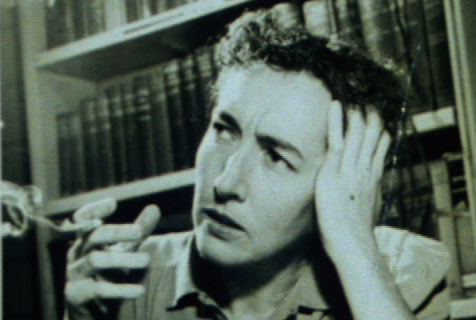
British writer Margaret Rumer Godden (1907 – 1998)
This is a story of drugs, prostitution, murder, and nuns.
Of all the writers of the 20th Century the British writer Rumer Godden (1907 – 1998) best known for her 1939 novel Black Narcissus filmed in 1947 by Michael Powell and starring Deborah Kerr wrote the most searchingly and movingly about women’s servitude to the Catholic Church.
Although born in England she spent most of her life in India, growing up in Narayanganj, colonial India (now in Bangladesh), later in Calcutta where she founded and ran a dance school for children for over 20 years and where her writing began, but then in Kashmir in India’s north west. She returned to England in 1945 to concentrate on her writing. She did not convert to Catholicism until 1968 but was always interested in the mystical and emotional balance between the Catholic Church and the practical world of secular existence. She lived, from 1968 to 1973, with her second husband, in Lamb House, Rye: also inhabited at various times by writers Henry James (Portrait of a Lady, The Turn of the Screw) and E. F. Benson (Mapp and Lucia).
She wrote 27 novels, 11 works of non-fiction, 4 volumes of poetry, and 28 books for children. She was made Officer of the Order of the British Empire (OBE) in 1993 and her last novel, Cromartie vs. the God Shiva (1997), was published the year before she died.
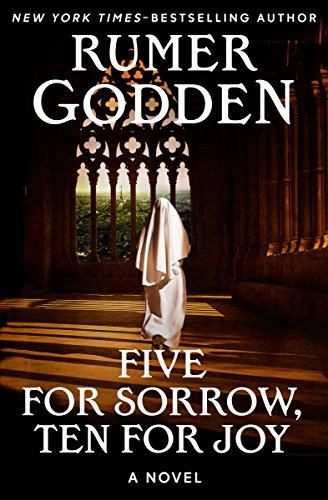
Five for Sorrow Ten for Joy (1979) her 20th novel, and set in France, tells the story of Lise (just one of her names), a notorious ‘madam’ with a facial wound and known to the press as La Balafrée (The Scarface), and Patrice, her lover, her jailer, her protector, her pimp. But it begins with her journey, after her release from prison, to a nunnery: a place she can’t wait to get to. Along the way Godden weaves narratives in various tenses and voices to colour Lise’s story and her past; how a painter might use colours to give depth to a picture. But what she doesn’t disclose is why she was in prison in the first place. She saves that for later.
It’s easy to call her work melodramatic, which is probably why 9 of her works have been filmed, but her writing skills belie the degrading element of that classification.
What obviously fascinated Godden was how belief, not necessarily the subject of that belief, can completely take over a person and compel her to sacrifice herself to a god and even live a life outside of how that same god commanded them to live (“Be fruitful and multiply”, Genesis 1: 28). Lise’s obedience is not to her god but to her order, which protects her from the world, but also, and more importantly, from men. A man ruined her life so she seeks the protection of women, which, ironically, is in the service of a paternalistic church.
Parallel to Lise’s story is that of Vivi and Lucette. The former, a 14 year old whore eager to get away from the arms of the nuns and into the arms of handsome Luigi; but once that happens and she has a babe forced into her own arms she rebels and hates Luigi, his family, and his child: she denies all wifely and motherly instincts prescribed to women but which are also the instincts that are shunned by nuns; one woman is damned, others are exulted.
Lucette is a lost child who is released from prison on the same day as Lise but who sees Lise’s desire to run into the care of the nunnery as nothing but out of the frying pan and into the fire.
“They tell me that often the worst criminals make the best nuns.”
Spiritual and mystical beliefs by women to a masculine god tussle with what other women think being a woman is all about. This is what makes Godden’s work so interesting.
You can find a full list of authors and titles, including 13 by Rumer Godden – and not all about nuns – at www.openroadmedia.com or follow @OpenRoadMedia on facebook or twitter.
When the Irish writer, Colm Tóibín, was working on his (masterpiece?) The Master (2004), about the American-English writer Henry James, he visited Lamb House, HJ’s East Sussex home in the town of Rye, and met 3 other writers all doing exactly what he was doing: researching HJ. There has been a resurgence in interest in Henry James usually considered an obtuse fiction writer but a recognition that his most alluring characteristic is that he was, like most literary greats, a writer like no other. The English writer, David Lodge, also produced a book on HJ in 2004 which seemed to have sunk from view since Tóibín’s effort was so successful: it was shortlisted for the Booker-Man Prize in 2004. Lodge’s story focuses on the same events, and in particular James’s unsuccessful foray into the theatre, as Tóibín’s, but it is a very different novel.
Lodges’s story is more old-fashioned in the sense that he puts HJ in the midst of his history setting up a life of work, friendships, and his exhausting social life, into which then Lodge plunges the unsuspecting, and dare I say it, theatrically naive writer to surround the reader with an understanding of the great cataclysm that befell HJ and his subsequent inability to come to terms with what had happened: failure.
It is not enough that one succeeds – others must fail.
However, Lodge has a more nuanced ambition: the juxtaposition of a literary figure and his sense of his own talent against the success of his peers, and in HJ’s terms, his inferiors. James had a contemptuous attitude towards his contemporary, Oscar Wilde, whose unprecedented theatrical success was a claw in his side, made more painful by the success of An Ideal Husband, an early performance James attended on the opening night of his own fateful play Guy Domville. He hurried from the thunderous and appreciative applause of Wilde’s audience to the jeering ‘gods’ of his own. HJ was deeply humiliated by the audience’s reaction to his play. Guy Domville only lasted three weeks and was, ironicly, replaced by Wilde’s even-bigger success, The Importance of Being Earnest. Wilde’s subsequent fall, social disgrace, trial for sodomy, and imprisonment were his just desserts in James’s mind even if they were, not for low-brow literary frippery, but for ‘outrageous and disgraceful conduct’; James’s own sexual proclivities were always buried deep and, it is surmised, never allowed expression. However it was the popular successes of his good friends, George Du Maurier and Constance Fenimore Woolson that really contrasted HJ’s failure and showed his idea of friendship to be constantly compromised.
It was Wilde who quipped
Anyone can sympathise with a friend’s success, but it takes a truly exceptional nature to rejoice in a friend’s failure;
which he topped a little time later with,
It is not enough that one succeeds – others must fail.
Gore Vidal, that Wilde-ish American, rephrased it in the late twentieth century as
Whenever a friend succeeds, a little something inside me dies.
HJ’s close friend, George Du Maurier, was famous as an illustrator for Punch magazine and only turned to writing a novel, Trilby, because of failing eyesight: he dictated the text to his wife. Trilby was, by today’s jargon, a blockbuster, on both sides of the Atlantic, in print and on stage; a level of success that Du Maurier never quite understood. Neither did HJ. The Trilby hat, the phrase ‘in the altogether’ and the name ‘Svengali’ are all due to George Du Maurier, who is now forgotten; his name only lives on in that of his grand-daughter, the novelist Daphne Du Maurier (1907 – 1989), author of Rebecca and Don’t Look Now.
Henry James at his desk, 1900. He was nominated for the Nobel Prize three times.
Henry James had many female friends but his closest was Constance Fenimore Woolson (grand-niece of James Fenimore Cooper). She, as did Du Maurier, considered HJ as a writer of the highest order and was always self-deprecating about her own short stories and novels which sold much better than HJ’s; he agreed with her but never said so. He was always haunted by her suicide – she fell from her apartment window in Venice to the payment below – in the fear that it had something to do with her un-reciprocated love for him.
In both Tóibín’s and Lodge’s accounts the failure, and in particular the doomed opening night, of Guy Domville is the focus, although Tóibín places it near the beginning, while Lodge puts it near the end. Both also are deeply interested in HJ’s recovery and his return to prose-writing. However Lodge’s structure of the event wrings every bit of drama there is. He alternates the thoughts and utterances of the audience members– HJ’s friends and allies – on the opening night with James’s actions and thoughts as he dresses and prepares for the evening, sits through a performance of Wilde’s An Ideal Husband, – which he hates and thinks is crass and silly, and then hurries to St James Theatre to be on hand, if required, for the curtain-call. It’s a very effective use of dramatic irony – the reader knows what the protagonist doesn’t – and when George Alexander, having just taken his own curtain call, beckons the unsuspecting James onto the stage, HJ assumes it has all gone well (readers mentally yell, ‘No, James! No!’); but when his presence in the spot-light elicits a volley of abuse from the cheap-seats he is confused and to make matters worse bows not once but twice causing the rabble to ramp-up the volume of their displeasure. The already humiliating moment is compounded by Alexander who then makes a fawning and apologetic speech about him promising ‘to do better, next time.’ Despite mixed reviews – and positive ones from the youthful but the then unknown H.G Wells and George Bernard Shaw – no report, vocally or in print, avoided the mention of the reaction from the ‘gods’, and the play was doomed.
Whenever a friend succeeds, a little something inside me dies.
What Lodge is getting at is summed up thus,
Something had happened in the culture of the English-speaking world in the past few decades, some huge seismic shift caused by a number of different converging forces – the spread and thinning of literacy, the leveling effect of democracy, the rampart energy of capitalism, the distorting of values by journalism and advertising – which made it impossible for a practitioner of art of fiction to achieve both excellence and popularity, as Scott and Balzac, Dickens and George Elliot, has done in their prime.
And the result of this was a growing craving for un-intellectual entertainment. Lodge is referring to, of course, the difference between what today we call popular fiction and literary fiction.
The plot of Guy Domville angered the public the most: an eligible bachelor, a Catholic, plans to enter the priest-hood, but he is the last of his line; he discovers that he is loved, decides therefore to marry, then realises his intended is loved by another; he fosters that relationship, succeeds, and then joins the priesthood anyway. The End; three acts and over two hours to finish as it began, and no happy ending. To James it was a serious dilemma, skillfully presented as art, to the public it was boring.
The effect of such an event on a writer, his work, his sense of himself, and his friendships is what makes this novel so engaging. It’s one of the most enlightening works on success, failure, and friendship and any reader interested in such things should read it no matter what their artistic bent.
The review of Author, Author in The Independent in 2004 puts it succinctly;
Lodge deploys all his seductive storytelling craft to explore not merely the life and art of James himself, but the fate of any proud writer in an age of hype and spin.
David Lodge’s Author, Author is an immensely enjoyable work; I scheduled reading time – always a good sign.
The kindle and paper editions of Author, Author are available here.
I leave the last word to Henry James: We work in the dark – we do what we can – we give what we have. Our doubt is our passion, and our passion is our task. The rest is the madness of art.
There are many Australian writers that seem to have been forgotten: Miles Franklin, Christina Stead, Katherine Susannah Pritchard, Henry Handle Richardson, Ruth Park, and Kylie Tennant (Thank god Elizabeth Harrower has been resurrected from obscurity by Text Publishing).
Kylie Tennant (1912 – 1988) was hailed in 1935 as the new star of the Australian social-realist tradition with the publication of her first novel Tiburon, a three-pronged story of a small mid-west New South Wales country town and its life and loses. This was followed in 1939 with Foveaux, which translated the themes of Tiburon to the inner-city suburb of fictitious Forveau, identifiable as the Sydney suburb of Surry Hills. Her reputation peaked in 1941 with the publication of her best known work, The Battlers, which deals with the itinerant unemployed who tramp the back-roads of the countryside when war breaks out in Europe in 1939. It also secured her an international reputation and is still her best-known work among Australians. A television series of Ride on Stranger (1943), her fourth novel, in 1979, starring Noni Hazlehurst and Liddy Clark, sparked a brief revival but unfortunately Kylie Tennant has slipped from the literary landscape.
Her third novel, Time Enough Later (1942), is a departure, in that it is more light-hearted – almost (but not quite) a comedy – than her first three novels which were a serious look at the working underclass, but also a continuation of her development as a writer as it is the first to feature an independent woman and her unconventional choices, a theme she continues and masters in the novel that followed, Ride on Stranger.
Time Enough Later is a light, slip of a story of a young girl’s discovery of an agreeable alternative to men: agriculture. Bessie Drew grows up in the inner-city Sydney suburb of Redfern. She is “unfashionably wholesome, sensible, and unselfconscious.” Her squabbling family, especially her hard-done-by mother and alcohol and temper ridden father, force her to set her feet on a different path to an unknown but adventurous future. She forms a tenuous relationship – part amorous, part professional – with a cad of a man, Maurice Wainwright: a theatrical, selfish, ego-maniac; a con-man who has a talent for photography, sets up a studio with Bessie’s self-sacrificing help, and establishes a reasonable living and reputation but without the work-ethic to make it a continuing success. Into Wainwright’s coterie of Bohemians, performers, and socialists comes Esther, a free-thinking loner who lives in the country and continually urges Bessie to come and see her place. This she finally does to house-sit for Esther as she travels on one of her botanical/zoological expeditions. Bessie takes the whinging and whining Maurice with her and all is set for what we would call in times between then and now, a ‘dirty weekend’. The seduction is a failure – a “disconcerting mixture” of Maurice’s self-possession; the normalities of the rural night – strange noises from out of the quiet, moths the size of dinner-plates, and a lumpy bed; and Bessie’s “unconventional matter-of-factness which strikes her would-be lover as exasperating stolidity”. But it’s Bessie’s plain-speaking that undermines Maurice and precipitates the slow and floppy end to their ‘affair’.
“I don’t see what you’re getting so mad about,” Bessie went on patiently. “If a thing doesn’t work, what’s the use of wasting time on it? Here’s twice we’ve had this hoo-doo on us. And it just looks like the idea is no good … Don’t think I’m not fond of you. But it just seems a waste of time getting all stirred up when it’s just as easy not to get stirred up.”
But what does grab city-raised Bessie’s interest is the countryside. Her eyes are opened to a possibility, and a place, that had never occurred to her. She had always thought of Esther as a “lonely and disappointed woman who put her passion into a wild hermitage, wilfully withdrawing into the desert.
Yet here was the desert flowering like paradise in a glory of red and gold. The trees, the earth, the smell of the leaves, stirred Bessie as none of Maurice’s ideas, none of his talk about beauty and art had done. This place talked a language of long thirst and survival, of struggle and rain and the bite of weather. Something in her knew this language; and the old restlessness clamoured as it had never done before – not Archer Street, not the studio – this place.”
Margaret Dick in her slight 1966 volume, The Novels of Kylie Tennant, almost apologises for the slapstick, the humour, and the ‘lightness’ of the theme, as if such novelistic considerations are beneath Tennant’s talent. However the success of Time Enough Later lies in the novelist’s expert handling of these difficult, and unlikely scenarios. It’s not easy making a believable failure of a sexual seduction by a selfish roué; nor is it a mere trifle to make the offerings of a rural existence, toil and thin-reward, a believable alternative for a young girl from a society which has already set her future: a future she sees as aprons, children, and the gray, grime, and gossip of Redfern. Tennant’s descriptive passages of the rural setting, nature, a threatening bushfire, and the simple rewards of husbanding chickens and ducks, rhubarb and radishes are beautiful, alive and even tantalising. You can well understand, and believe, Bessie’s attraction to such things. Light the story may be but the writing is assured, entertaining, and masterful.