
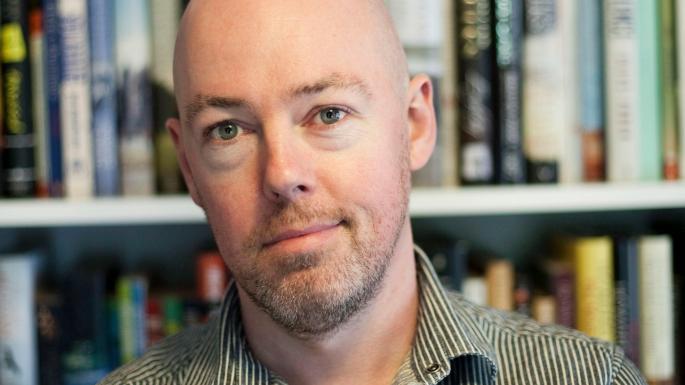
into 59 languages making him the most translated Irish
writer of all time.
This is my second reading of this book. Back in 2017 I read it for the first time and fell in love with Boyne’s work. Here is my blog from that first reading: it’s still apt and relevant.
Many years ago, on a small plane trip – the plane was small, not the trip – as we were about to land in a provincial Queensland town, I continued to assiduously read my book. I was laughing so much, trying not to, but not succeeding, that my eyes were streaming, my nose running, and my face felt hot and red; the flight attendant broke the rules, unbuckled, and hurried to my seat to ask if I needed medical assistance. I just held up the book; I was unable to speak. She understood. Maybe she’d read it too. It was the hit of the season. The hysterical section was the Nativity Scene from A Prayer for Owen Meany (1989) by John Irving. The next time I laughed out loud, many decades later (yes, decades), was with this book, and the (highly illegal) Dinner Party Scene, from early on in The Heart’s Invisible Furies (2017) by John Boyne. Ironically Boyne has dedicated this book to Irving.
Making people laugh via the written word, and only the written word, is an extremely difficult and hazardous task. You can’t under play it or over sell it, and you certainly can’t ‘back-explain’ it; it’s all to do with tone, and tone is like a law of physics: it only happens when the universal conditions are absolutely right. It’s as if you need to foster a certain psychological state of mind, and write the episode with as much truthfulness and sincerity as you possibly can – don’t elaborate – just tell it, and if the tone is right, it will be hysterical. If it isn’t you can’t go back and make it right, edit it funny, you have to delete it all and start again. A plane will only fly if all the necessary preparations and current circumstances, weather, wind, mechanical health, operational skill, and power source, are perfect.
The dinner party – and it’s impossible to explain why it’s illegal, you’ll just have to read it to find out – is on page 92, but the preparation for it, and the other laugh-out-loud bits, preparation for the tone, I mean, in true Irving-esque fashion, begins right from the first killer sentence; and by the way, the opening sentence of Owen Meany has to be the killer-opening-sentence in all literature. There was a time when I knew it by heart and it became my dinner-party piece for some time after. I can’t sing, tell a joke, or play the piano, you see.
Boyne considers Irving a mentor, and Irving should be chest-thumpingly proud.
It’s impossible for Boyne to escape the moniker of “author of The Boy in the Striped Pyjamas” which he understands only too well, and he’s certain it will appear on his grave stone, so internationally popular was the book and film; but it changed his life making writing full time not only a possibility but a happy necessity.
Boyne was born in 1972. Ireland brought him up but the Church brought him down. He still suffers from its cruelty and hypocrisy. He’s not alone. His anger is present in this book but, much to his credit, he’s fashioned it into a cutting humour without lessening the truth of his understandable hatred.
The Heart’s Invisible Furies explains the life of Cyril Avery, although not a real Avery, from his pre-birth to two months before his death; from 1945 to 2015; and it is also the story of Ireland over that time; from a society dominated, straightjacketed, and suffocated by the Catholic Church, under the guise of strengthening morality, to one that legalises same-sex marriage. It’s a hell of a journey.
It’s full of surprising events, fashion, villains, extremely bad behaviour, political unrest, beauty, deception, selfishness, redemption, tears – yours as well as the character’s, death, forgiveness, love, birth in the midst of murder, politicians behaving badly, coincidences, literature, weddings, doctors behaving courageously, dreams – both fulfilled and dashed, sentiment, laughter, bigotry, violence, and even the ludicrous; in fact the entire palette that paints our lives that all conspires to prove that age-old adage, nobody’s perfect. And all these elements are wound around a cast of characters you won’t easily forget, and nor would you want to.
Boyne skilfully uses many literary devices to tantalise and seduce his readers: he drops in an outcome before explaining how it happened; he triggers the reader’s memory before the character’s; and, best of the lot, dramatic irony: when the reader knows more that the characters do.
I love this book and I’ve recommended it to others, who too have loved it. I’m preparing a space on my bookshelf, between Jane Bowles and Peter Carey. You can get the book, in various formats, here.
 Michael K Freundt