A Sense of Style: The Thinking Person’s Guide to Writing in the 21st Century by Steven Pinker

Steven Pinker pic
American psychologist and language expert, Steven Pinker

If you are bored rigid by style guides, grammar tomes, and ‘How to write’ books, skip this one. However if you are fascinated by the building blocks of a sentence; how English has changed; and the black, white, and beige of grammar rules then keep reading.

Steven Pinker, the American “Rock Star” psychologist and a Professor in the Department of Psychology at Harvard University conducts research on language and cognition and has penned many popular and accessible books on language, the mind, and thought. His latest book is this one which came out in 2014 and for which he received the International Award of the Plain English Campaign.

Generally commentators on the English language fall into two broad camps: the prescriptivists, those who believe there are rules that define how language should be used, and that mistakes result from breaking those rules; and the descriptivists, those who believe that a language is defined by what people do with it. You may recognise the former as “sticklers, pedants, peevers, snobs, snoots, nit-pickers, traditionalists, language police, usage nannies, grammar Nazis, and the Gotcha! Gang” but Pinker also damns the latter as “hypocrites: they adhere to standards of correct usage in their own writing but discourage the teaching and dissemination of those standards to others, thereby denying the possibility of social advancement to the less privileged.”

Pinker is the chair of the Usage Panel of the famously prescriptive American Heritage Dictionary but he quotes the editor as saying, “We pay attention to the way people use the language”, a clearly descriptive view. Pinker, like most writers and readers, sit on the fence. Their anchor? Clarity and meaning. There are words that we continuously mis-use, such as decimate to mean ‘destroy most of’ instead of ‘destroy a tenth of’. There is no point in using the word in its original meaning if the reader or listener believes it to mean something else. The old prescriptivist rule of ‘never split an infinitive’ only exists because of the early English need to squeeze the language to fit Latin rules. The Latin word for the English verb to go is a single word ire; it’s impossible to split a single word but splitting the English word is of course possible: ‘to boldly go where no man has gone before’ is fine by Steven Pinker, and most people, I suspect.

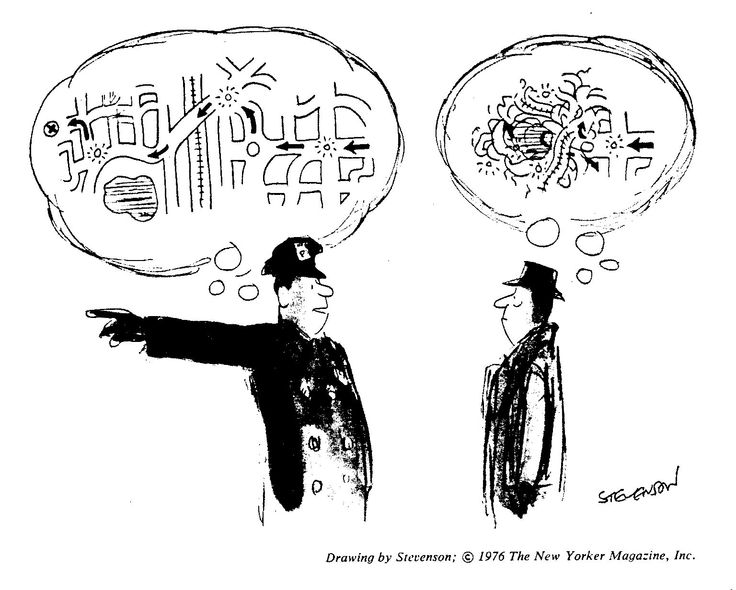
His chapter 3, The Curse of Knowledge, is a delight and has cleared up that old annoyance illustrated in the following cartoon
Giving Directions cartoon TNY

“The curse of knowledge: a difficulty in imagining what it is like for someone else not to know something that you know.” When someone gives you inadequate (to you) directions that they think are obvious (to them) and ends with the phrase ‘you can’t miss it’, you usually will. See! It’s their fault, not yours.

And did you notice I used the plural pronoun they for a singular subject someone? This has been common usage for over a century and solves the English language’s lack of a neutral singular pronoun. Oh, and did you notice I began that sentence with the conjunction, and? This was something that was considered the grammatical sin of sins in the 60s and 70s but has again been used for centuries.

However the last, and longest chapter Telling Right from Wrong will give you a lot of joy, understanding, and the edge in arguments about where to put that comma, when to use lay and lie, and the sometimes acceptable use of an adjective when the grammar police insist on an adverb.

Eggs over easily

P.S. In a student exam paper, recently, there appeared a sentence that confused everyone. “It would be a great idea if we went to the park tomorrow.” This is a sentence about the future but with the modal verb would, and the auxiliary past tense verb went. Using the future form sounds strange: “It will be a great idea if we will go to the park tomorrow.” No, the past tense is correct. This is called factual remoteness as Pinker explains with the example, If you left now, you would get there on time. “The if-clause contains a verb which sets up a hypothetical world; the then-clause explores what will happen in that world, using a modal auxiliary. Both clauses use the past tense to express the meaning ‘factual remoteness’.”

Note the full stop after the quote (not ‘ ….remoteness.’”). You’ll have to read the book now to find out what Pinker says about this (or is it that?).

You can by the kindle edition, and paper editions, here.



What W. H. Auden Can do for You by Alexander McCall Smith

Auden via Smith

In a primary school in a small country town on the Adelaide Plain in South Australia in 1960-something, poetry was a page of writing, usually with a rhyming pattern of a-a-b-b or, if we were good, a-b-a-b, given to us students at Friday’s last session. The copies were made on that ancient, clumsy, messy, clanky machine: the Gestetna. Each student had a poetry exercise book, blank not lined. We had to carefully smear Clag on the back of the poetry page and stick it nicely, no splodges, onto the right hand side of a double page in our poetry exercise book. On the blank left-hand page we had to draw something inspired by the poem. No matter what the poem was about, spring, the Queen, a train, elephants, I always drew a two dimensional, two-storey house as big as the page would allow; so big in fact that the smoke coming from the chimney – there was always a smoking chimney – had nowhere to go except, unrealistically, down the side of the page towards the ground. The teacher never made a comment about this.

No attempt was ever made to make us think that we could possibly write a poem. I didn’t write one but I learned one: a poem of the “A starling, a silly little darling, such a pretty sight to see” variety. I recited this poem to my parents one day in the car on the way to Adelaide, that little flat city that was the capital of the state and, to me, the centre of the universe. My stepfather said nothing: he was deaf. My mother said something nice to me, which I liked. I liked it very much even though my mother’s praise was usually of the “That’s nice, dear, but don’t get too big for your boots” variety. Somehow I understood that she thought that I had written it. I didn’t know how to tell her that I hadn’t and, besides the warmth of praise, even meagre praise, was something rare and utterly delightful. I let her believe that I had written it and felt guilty for years to come, especially since she made me write it down and submit it to my monthly children’s magazine, and in which it was printed. I thought the police would arrive any day and take me away and do what they did to little boys who told lies, claimed other people’s words as their own, and thought poems were things to be proud about.

I’ve had a love-hate relationship with poetry ever since: I love mine but hate everyone else’s. I thought for a long time that my schoolteachers weren’t telling me something: like a missing bit from an IKEA pack. However then I thought that maybe I was not getting something so I read a lot of poetry and from all those years only three have gained some traction in my satisfaction bank: Robert Browning’s Porphyria’s Lover, a narrative poem of sacrificial love but, as I understood later, extremely misogynistic; William Carlos Williams’ To a Poor Old Woman which is simple-sad but strong and showed me that poetry doesn’t need punctuation if the lines are the right length; and Clive James’ Japanese Maple which is about approaching death which is apt since he’s dying (talk-about write what you know!).

Anyway, imagine my expectation when I saw Alexander McCall Smith What W. H. Auden can do for you (2013) on a friend’s bookshelf. Maybe I’ll find what I’m looking for in this little book.

Mr. McCall Smith (or is it simply Mr. Smith?) obviously loves poetry and has been reading it since he was 15 and he also obviously loves Auden, although he seems eager to point out that his little tome is not a hagiography. Auden has often been criticized for using words simply for effect and without real regard to their meaning; a criticism McCall Smith agrees with. Here is a quote from his Letters from Iceland (1937).

And the traveller hopes; ‘Let me be far from my

Physician’; and the ports have names for the sea;

The citiless, the corroding, the sorrow;

And North means to all: Reject!’

The curious line “and the ports have names for the sea” is actually a misprint: he meant ‘poets’ but ‘ports’ was printed. Auden left it in. He liked the sound of it. The other line of interest is “Let me be far from my physician.” McCall Smith is critical of this word too, but as I read the first line the surprise certainly came with the word ‘physician’. I was expecting ‘mother’ or ‘country’ or ‘crowds’ (as McCall Smith suggests) but with the surprise came understanding. I read it as ‘far from all that is safe and fixable.’ McCall Smith thought it may stand “for all that is overly fussy and cosseting in modern society.” The point here is that, no matter what Auden meant, and what he meant is really irrelevant: meaning is in the mind of the reader. I’m sticking to my ‘safe and fixable.’

McCall Smith makes it clear that Auden’s homosexuality was reflective of his time which was full of perverse contradictions: single sex boarding schools which thrust a single sex together while punishing single sex itself, which is itself reflective in the hypocrisy of calling moneyed schools ‘public’ as if their money was for all, which it wasn’t. Such a system, a bed of oppression and treachery, not surprisingly, also produced spies. And intellectuals who in their declining years re-embraced Christianity, as did Auden. All this is mirrored in his choice of subjects, Freud, limestone, Iceland, Spain, Hitler, Rome, love – sexual and not, dreams, birds, water, fascism, and vales but not mountains.

Knowing something of the poet, and his times, helps in understanding his poetry; even an older Auden disowned the words of his younger self. Thank god he told us. McCall Smith also states that influences of time and place can’t be ignored. He identifies two great influences on artistic endeavour in the twentieth century: war and Freud… Now, hang on! All I’m looking for is an ‘in’ to the appreciation of poetry and here, Auden’s in particular. I, nor anyone, have the time for an academic investigation to eek out meaning to the words I’ve just read.

In the musical theatre characters sing when the emotion, or action, expressed is bigger than the text, when just words are not enough. Similarly it seems with poetry: it’s louder, stronger, more complex, more succinct, and usually more effective than mere words. To write about political decline, as he did in The Fall of Rome, less is more:

The piers are pummelled by the waves;

In a lonely field the rain

Lashes an abandoned train;

Outlaws fill the mountain caves.


Fantastic grow the evening gowns;

Agents of the Fisc pursue

Absconding tax-defaulters through

The sewers of provincial towns.


Private rites of magic send

The temple prostitutes to sleep;

All the literati keep

An imaginary friend. …


Caesar’s double-bed is warm

As an unimportant clerk

Writes I DO NOT LIKE MY WORK

On a pink official form…

The imagery here is singular but powerful: an abandoned train; fantastical evening gowns; tax-defaulters fleeing through sewers; private rites of magic; sleeping leaders; and an unimportant and disillusioned clerk. These are four of the six verses in the poem; Edward Gibbon’s  The History of the Decline and Fall of the Roman Empire stands at 12 massive tomes With Auden you don’t get the history, but you get the idea.

What I take from this book is the affirmation that if a poem doesn’t speak to you, read it again, really listen to what the words, and, more importantly, the words together, conjure, and what you think it means is what it means, but if you still can’t hear anything, put it back and read something else.

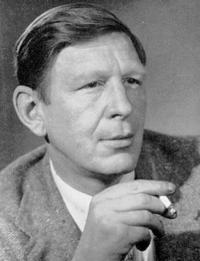
W. H. Auden
British poet, Wystan Hugh Auden (1907-1973)

Oh, and in 1940-41 W. H. Auden lived in Brooklyn Heights in a house, that has become known as the February House, with Benjamin Britten, Jane and Paul Bowles, Carson McCullers and Gypsy Rose Lee. What a Sunday-lunch gathering that would be!

For more insight into poetry John Goodman succinctly explains obscurity in poetry, not forgetting that obscurity as a fad in art comes and goes. You can read his article here.

And you can listen to Auden himself reading his As I Walked Out One Evening (1937) here.