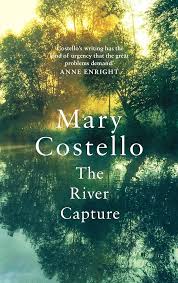

This novel, The River Capture (2019), is Costello’s third published work, her second novel. The style is literary and immersed in family values, loyalty, obligation, and what happens when all of these are challenged; it is written with the sensibility and skill we associate with Irish literature. Luke O’Brien is a thirty something teacher, a Joyce scholar, who took leave to care for dying relatives but then continued his sabbatical to deal with the family land in county Waterford on the banks of the River Sullane. There he also tends to his favorite, but very old aunt, Ellen. They are very close. Luke is a man in tune with nature, not religious, but believes in the uniqueness of the individual free of labels or what any other individual may think of him. He is willing to consider that natural objects, animals, including humans, trees and water are infused with special energy and may also contain elements of memory and the future. Like all natural things, everything, including mankind, will pass to allow for what is next.
When two rivers collide due to climatic devastation, geological disruption or similar, one captures the other and a third unexpected river is born: a river capture.
A young woman, Ruth Mulvey, hears about him and his passion for animals and asks him to take over the care of a young, but abandoned dog. This meeting develops into a relationship, emotional and sexual, and is hoped by both participants to develop even further. But then Luke introduces her to Aunt Ellen. She is aware of this young woman; more significantly, she knows her father. A family secret is revealed and Ellen, his devoted aunt, places a huge burden on his shoulders and mind.
Up to this point, almost half of the way through, the format is usual and expected: literary fiction, narration of elegant language, relevant and insightful dialogue (as it should be) that builds to a tension created by the revelation. An accomplished opening.
Then things change. Not only for Luke, who is devastated, and the choice he’s given, impossible, but also for the reader: the format changes. This can be seen as a metaphor for the state of Luke’s mind. Nothing is as expected. the rest of the novel is a description of Luke’s state of mind and choice of actions, what he believes and what he doesn’t; what he does to overcome the bolt of lightning that hit him far square in his heart and mind. The revelation is so devastating that the book itself is affected. The book no longer reads like a novel.
This unique and rare literary device was not, for this reader, entirely successful. It eroded most of my emotional investment in the characters and narrative. It became, or felt like, an academic exercise, and a repetitive one, and although I read it to the end, I have to admit I skipped bits.
However, Costello is a very good writer and I look forward to her next.
Click the link for my review of her first novel, Academy Street (2014).
 Michael K Freundt