The Good People by Hannah Kent

Hannah Kent lic
The Australian Writer Hannah Kent

It is not all that long ago, 1994, that Frank Moorhouse’s Grand Days was disqualified from the Miles Franklin Award (Australia’s most prestigious literary prize because it was not Australian enough (he won the prize for its sequel Dark Palace (2000), which contains one scene set in Australia); apparently Australian literary sentiment has grown up since then, thank god – although the real problem lies from the rules of eligibility for the Prize . Here now is an Australian author, Hannah Kent, whose debut novel, Burial Rites (2013) was set in Iceland and now her second, The Good People, is set in Ireland: and still not a gum tree in sight. The only thing Australian about this book is its author; but that’s all that is needed, and rightly so, to herald Kent as a new, rising, and shining voice in Australian literature.

Kent paints time, place, and character through dialogue. The time is 1825 in rural, south-west Ireland where the Catholic Church is as powerful as ever but also where old Irish superstition and language is still rife and useful. All of this is established through how the characters talk: here a man comes to seek council from Nance Roche about his troubling dreams. Nance Roche is a wise woman who lives alone in a windowless, mud hut near the wood and who is said to have ‘the knowledge’.


‘Faith, what does it matter? I’d best be on my way.’

‘Sure, Peter, Go on home.’

He helped Nance to her feet and waited as she used the tongs to pluck a coal from the fire, dipping it, hissing, in her water bucket to cool. She dried the dead ember on her skirt, spat on the ground and passed it to him. ‘You’ll see no púca tonight. God save you on the road.’

Peter put it into his pocket with a curt nod. ‘Bless you, Nance Roche. You’re a good living woman, no matter what the new priest says.’

Here archaic English (“Faith, what does it matter?”), old Irish (púca means ghost) and Catholic salutation (”God save you on the road.”) all create the world of this novel: illustrative, complex, colourful, informative, and believable. The last because of Kent’s success at creating verisimilitude: the appearance of truth. You do not need to look up the meaning of púca; nor do you need to research the veracity of the use of the word ‘faith’ as an exultation in nineteenth century south-west rural Ireland; nor that the possession of a cool coal from the hearth of a bean feasa living in a mud-hut will soothe one’s dreams. As quickly as you read the lines the reader accepts this created truth because of the trust we readers place in the creator of such truth; when the real truth is that we are sitting in our reading chair scanning and finding shared meaning from little dark marks on a pale background. All hail our imagination and those that tickle it!

Kent has done her publisher proud: produced a novel with all the qualities of her first that prompted her global success and her publisher’s trust in her in the first place (it’s rumoured her earnings from rights, foreign publishers and the like, was $1 million); mid-nineteenth century far-western Europe in a valley of poverty, crime, women, faith, and fear, but with such differences that make it fresh and new, in tone, theme, crime, spine, and ending.

This is a story of three women: a new and bitter widow, Nora; a servant girl, Mary; and a feared and revered loner, Nance Roach; unwedded, unbedded, and therefore considered unworldly, but ironically, powerful despite the “fear of any woman who was not tethered to man or hearth.” In a society of family and neighbourily trust, tension and anger can boil quickly if livelihood is threatened: if cow’s milk is without butter, if a hen’s egg is yolk-less, or if a man falls suddenly dead, the inhabitants clutch at reasons, causes – be it four crows seen huddled together at a crossroads; lights seen bobbing on a fairy mound; or a cretinous child thrust on a widow who has no means to support it.

This is what happens to Nora whose motherless and afflicted grandchild is suddenly handed to her but who firmly believes it is the mischievous fairies, The Good People, who have taken her Micheál and left her one of their own. Her attempts to return the fairy to its own kind and see the safe return of her grandson is what propels the narrative to its tragic finale.

The belief systems, be it Christian or fairydom, give meaning to these ignorant people; the world is mysterious and explanations are needed for everything that ties them down, keeps them safe, or lifts them up. They need these causes of things to be certainties to allow them to get on with their poor and mundane lives; to keep planting their potatoes, milking their skinny cows, and harvesting turf to heat their hovels because their only other choice is to take to the road: the worst of outcomes.

Some readers have found the book depressing; yes, the story is sad, but the writing is evocative and succeeds is creating a vanished world, surreal almost, for the reader to get lost in so when the world of this valley is pushed into a civilized courtroom the reader too is confronted by the complexities and necessities of belief, survival, and what is true, good, and right.

I urge you to read this book. You can find it here.

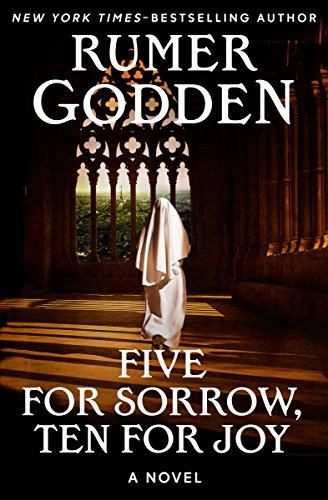
Five for Sorrow, Ten for Joy by Rumer Godden

rumer-godden-pic
British writer Margaret Rumer Godden (1907 – 1998) 

This is a story of drugs, prostitution, murder, and nuns.

Of all the writers of the 20th Century the British writer Rumer Godden (1907 – 1998) best known for her 1939 novel Black Narcissus filmed in 1947 by Michael Powell and starring Deborah Kerr wrote the most searchingly and movingly about women’s servitude to the Catholic Church.

Although born in England she spent most of her life in India, growing up in Narayanganj, colonial India (now in Bangladesh), later in Calcutta where she founded and ran a dance school for children for over 20 years and where her writing began, but then in Kashmir in India’s north west. She returned to England in 1945 to concentrate on her writing. She did not convert to Catholicism until 1968 but was always interested in the mystical and emotional balance between the Catholic Church and the practical world of secular existence. She lived, from 1968 to 1973, with her second husband, in Lamb House, Rye: also inhabited at various times by writers Henry James (Portrait of a Lady, The Turn of the Screw) and E. F. Benson (Mapp and Lucia).

She wrote 27 novels, 11 works of non-fiction, 4 volumes of poetry, and 28 books for children. She was made Officer of the Order of the British Empire (OBE) in 1993 and her last novel, Cromartie vs. the God Shiva (1997), was published the year before she died.

Five for Sorrow Ten for Joy (1979) her 20th novel, and set in France, tells the story of Lise (just one of her names), a notorious ‘madam’ with a facial wound and known to the press as La Balafrée (The Scarface), and Patrice, her lover, her jailer, her protector, her pimp. But it begins with her journey, after her release from prison, to a nunnery: a place she can’t wait to get to. Along the way Godden weaves narratives in various tenses and voices to colour Lise’s story and her past; how a painter might use colours to give depth to a picture. But what she doesn’t disclose is why she was in prison in the first place. She saves that for later.

It’s easy to call her work melodramatic, which is probably why 9 of her works have been filmed, but her writing skills belie the degrading element of that classification.

What obviously fascinated Godden was how belief, not necessarily the subject of that belief, can completely take over a person and compel her to sacrifice herself to a god and even live a life outside of how that same god commanded them to live (“Be fruitful and multiply”, Genesis 1: 28). Lise’s obedience is not to her god but to her order, which protects her from the world, but also, and more importantly, from men. A man ruined her life so she seeks the protection of women, which, ironically, is in the service of a paternalistic church.

Parallel to Lise’s story is that of Vivi and Lucette. The former, a 14 year old whore eager to get away from the arms of the nuns and into the arms of handsome Luigi; but once that happens and she has a babe forced into her own arms she rebels and hates Luigi, his family, and his child: she denies all wifely and motherly instincts prescribed to women but which are also the instincts that are shunned by nuns; one woman is damned, others are exulted.

Lucette is a lost child who is released from prison on the same day as Lise but who sees Lise’s desire to run into the care of the nunnery as nothing but out of the frying pan and into the fire.

“They tell me that often the worst criminals make the best nuns.”

Spiritual and mystical beliefs by women to a masculine god tussle with what other women think being a woman is all about. This is what makes Godden’s work so interesting.

You can find a full list of authors and titles, including 13 by Rumer Godden – and not all about nuns – at www.openroadmedia.com or follow @OpenRoadMedia on facebook or twitter.

Dear followers

I’m a little bit paranoid about grammar, typos, and spelling mistakes. I proof read my writing (all writing even my sms and emails) many times and often stretch friendships by asking friends to help (I wish I could afford to pay them); but no matter how hard I try some slip through. Nothing undermines a writer’s authority more than these pesky little do-dahs. If you see any in my posts Please Tell Me!

We all have to be vigilant. I usually use British English and spelling; these aside, please email me or comment on my post if you notice anything amiss.

Thanks.

Happy reading!

Michael.


My Brother, My Love & Other Stories

This collection of stories is now globally available here

This book is available for download with iBooks on your Mac or iOS device, and with iTunes on your computer. Books can be read with iBooks on your Mac or iOS device. Cost $6.99

This has been made possible through the Melbourne based publishing platform Tablo

In the coming months I will move my other publications from the American platform I’ve been using (smashwords) to this convenient and very user-friendly Australian platform.

If you are interested in writing and hassle-free self-publishing…

Give Tablo a Go.


Slam-Prose takes the Prize. Again.

paul-beatty
American writer, Paul Beatty

The Sellout by Paul Beatty

Paul Beatty is a 54 year old African American from Los Angeles and the first American to win the Man-Booker Prize (2016) since American writers were included in 2014. He has an MFA in creative writing from Brooklyn College and an MA in psychology from Boston University. In 1990 he became the first ever Grand Poetry Slam Champion of the Nuyorican Poets Cafe which garnered him a book deal. Two volumes of poetry Big Bank Take Little Bank (1991), Joker, Joker, Deuce (1994) and three novels , White Boy Suffle (1996), Tuff (2000), and Slumberland (2008) followed.  The Sellout was also awarded the 2015 National Book Critics Award for fiction.

Rappers and slam poets are never stuck for words

… And on hot 104-degree San Fernando Valley days, when we’re carrying their groceries to their cars or stuffing their mailboxes with bills, they turn and say, “Too many Mexicans,” a tacit agreement between aggrieved strangers that it’s neither the heat nor the humidity, but that the blame lies with our little brown brothers to the south and the north and next door, and at the Grove, and everywhere else in Califas;

they begin a collocated list and then subvert the last item

… Charisma flung back her long straight black hair from her face and took a hit that illuminated the mysteries of the internet, Ulysses, and the American fascination with cooking shows;

foster a slick line in similes

and comforts you like a lover making your bed while you’re still in it;

manufacture an artistic range of compound adjectives

My paternal grandmother was mocha-tinged, cafe-au-lait, graham-fucking-cracker brown! How come they never describe the white characters in relation to foodstuffs and hot liquids? Why aren’t there any yoghurt-colored, egg-shell-toned, string-cheese skinned, low-fat-milk white protagonists in these racist, no-third-act-having books? That’s why black literature sucks!;

add a touch of ethnic colour

… If I was lucky, I’d catch a glimpse of Marpessa, Charisma, and their homegirls holding court at the rear gate, sassy as a brass big band, hula-hooping their hips, chanting Ah beep beep, walking down street, ten times a week …”Ungawa! Ungawa!” That means black power! … I’m soul sister number nine, sock it to me one more time…;

and toss in a joke or ten

If New York is the City That Never Sleeps then Los Angeles is the City That’s Always Passed Out On The Couch. 

“I hate the act [of writing], definitely,” said Paul Beatty. “I mean, I don’t write much. One book every seven years or so. But it’s slow. When I’m doing it, it does give me a satisfaction. But it’s hard. It’s like how do you string together enough of these little moments where something is happening? That’s a pain in the a—.”

This is odd, or clever, because reading this book impels you to read it as fast as you can as if it was written while standing bare-foot on hot coals. But, then that, I suppose, is what slam-prose is all about.

In an age where a song lyric is suddenly, and some say at-long-last, recognised as literature – thanks to the Nobel Academy, The Sellout finally brings slam prose into the mainstream, and how? By out slam-prosing last year’s slam-prose Booker winner, Marlon James’s A Brief History of Seven Killings by showing James how it’s really done. Where A Brief History … was a literary wank sprukin’ how boring seven pages of no-punctuation thought-stream can really be, The Sellout, o-n-l-y  j-u-s-t makes it over the literary line by having something to say. And no wonder publishing house after publishing house turned it down (What? A book about reinstating slavery? Are you kiddin’ me?!) until finally Farrar, Straus, & Giroux hyperventilated and agreed to take a punt.

If you like a novel to have ‘nice characters’ and a ‘good story’ stay away from The Sellout. If you like clever word-play, African-American street-speak, stand-up with balls, if you’re a book judge or a literary critic, or you like a book you can keep on the coffee table and dip in to when you’re feeling low you’ll lerve this one.

You can download the paper or ebook version here or from Amazon here.


The Madness of Art


Author, Author by David Lodge

david-lodge-pic
British Writer, David Lodge

When the Irish writer, Colm Tóibín, was working on his (masterpiece?) The Master (2004), about the American-English writer Henry James, he visited Lamb House, HJ’s East Sussex home in the town of Rye, and met 3 other writers all doing exactly what he was doing: researching HJ. There has been a resurgence in interest in Henry James usually considered an obtuse fiction writer but a recognition that his most alluring characteristic is that he was, like most literary greats, a writer like no other. The English writer, David Lodge, also produced a book on HJ in 2004 which seemed to have sunk from view since Tóibín’s effort was so successful: it was shortlisted for the Booker-Man Prize in 2004. Lodge’s story focuses on the same events, and in particular James’s unsuccessful foray into the theatre, as Tóibín’s, but it is a very different novel.

Lodges’s story is more old-fashioned in the sense that he puts HJ in the midst of his history setting up a life of work, friendships, and his exhausting social life, into which then Lodge plunges the unsuspecting, and dare I say it, theatrically naive writer to surround the reader with an understanding of the great cataclysm that befell HJ  and his subsequent inability to come to terms with what had happened: failure.

 It is not enough that one succeeds – others must fail.

However, Lodge has a more nuanced ambition: the juxtaposition of a literary figure and his sense of his own talent against the success of his peers, and in HJ’s terms, his inferiors. James had a contemptuous attitude towards his contemporary, Oscar Wilde, whose unprecedented theatrical success was a claw in his side, made more painful by the success of An Ideal Husband, an early performance James attended on the opening night of his own fateful play Guy Domville. He hurried from the thunderous and appreciative applause of Wilde’s audience to the jeering ‘gods’ of his own. HJ was deeply humiliated by the audience’s reaction to his play. Guy Domville only lasted three weeks and was, ironicly,  replaced by Wilde’s even-bigger success, The Importance of Being Earnest. Wilde’s subsequent fall, social disgrace, trial for sodomy, and imprisonment were his just desserts in James’s mind even if they were, not for low-brow literary frippery, but for ‘outrageous and disgraceful conduct’; James’s own sexual proclivities were always buried deep and, it is surmised, never allowed expression. However it was the popular successes of his good friends, George Du Maurier and Constance Fenimore Woolson  that really contrasted HJ’s failure and showed his idea of friendship to be constantly compromised.

It was Wilde who quipped

Anyone can sympathise with a friend’s success, but it takes a truly exceptional nature to rejoice in a friend’s failure;

which he topped a little time later with,

It is not enough that one succeeds – others must fail.

Gore Vidal, that Wilde-ish American, rephrased it in the late twentieth century as

Whenever a friend succeeds, a little something inside me dies.

HJ’s close friend, George Du Maurier, was famous as an illustrator for Punch magazine and only turned to writing a novel, Trilby, because of failing eyesight: he dictated the text to his wife. Trilby was, by today’s jargon, a blockbuster, on both sides of the Atlantic, in print and on stage; a level of success that Du Maurier never quite understood. Neither did HJ. The Trilby hat, the phrase ‘in the altogether’ and the name ‘Svengali’ are all due to George Du Maurier, who is now forgotten; his name only lives on in that of his grand-daughter, the novelist Daphne Du Maurier (1907 – 1989), author of Rebecca and Don’t Look Now.

henry-james-at-his-desk-1900
Henry James at his desk, 1900. He was nominated for the Nobel Prize three times.

Henry James had many female friends but his closest was Constance Fenimore Woolson (grand-niece of James Fenimore Cooper). She, as did Du Maurier, considered HJ as a writer of the highest order and was always self-deprecating about her own short stories and novels which sold much better than HJ’s; he agreed with her but never said so. He was always haunted by her suicide – she fell from her apartment window in Venice to the payment below – in the fear that it had something to do with her un-reciprocated love for him.

In both Tóibín’s and Lodge’s accounts the failure, and in particular the doomed opening night, of Guy Domville is the focus, although Tóibín places it near the beginning, while Lodge puts it near the end. Both also are deeply interested in HJ’s recovery and his return to prose-writing. However Lodge’s structure of the event wrings every bit of drama there is. He alternates the thoughts and utterances of the audience members– HJ’s friends and allies – on the opening night with James’s actions and thoughts as he dresses and prepares for the evening, sits through a performance of Wilde’s An Ideal Husband, – which he hates and thinks is crass and silly, and then hurries to St James Theatre to be on hand, if required, for the curtain-call. It’s a very effective use of dramatic irony – the reader knows what the protagonist doesn’t – and when George Alexander, having just taken his own curtain call, beckons the unsuspecting James onto the stage, HJ assumes it has all gone well (readers mentally yell, ‘No, James! No!’); but when his presence in the spot-light elicits a volley of abuse from the cheap-seats he is confused and to make matters worse bows not once but twice causing the rabble to ramp-up the volume of their displeasure. The already humiliating moment is compounded by Alexander who then makes a fawning and apologetic speech about him promising ‘to do better, next time.’ Despite mixed reviews – and positive ones from the youthful but the then unknown H.G Wells and George Bernard Shaw – no report, vocally or in print, avoided the mention of the reaction from the ‘gods’, and the play was doomed.

Whenever a friend succeeds, a little something inside me dies.

What Lodge is getting at is summed up thus,

Something had happened in the culture of the English-speaking world in the past few decades, some huge seismic shift caused by a number of different converging forces – the spread and thinning of literacy, the leveling effect of democracy, the rampart energy of capitalism, the distorting of values by journalism and advertising – which made it impossible for a practitioner of art of fiction to achieve both excellence and popularity, as Scott and Balzac, Dickens and George Elliot, has done in their prime.

And the result of this was a growing craving for un-intellectual entertainment. Lodge is referring to, of course, the difference between what today we call popular fiction and literary fiction.

The plot of Guy Domville angered the public the most: an eligible bachelor, a Catholic, plans to enter the priest-hood, but he is the last of his line; he discovers that he is loved, decides therefore to marry, then realises his intended is loved by another; he fosters that relationship, succeeds, and then joins the priesthood anyway. The End; three acts and over two hours to finish as it began, and no happy ending. To James it was a serious dilemma, skillfully presented as art, to the public it was boring.


The effect of such an event on a writer, his work, his sense of himself, and his friendships is what makes this novel so engaging. It’s one of the most enlightening works on success, failure, and friendship and any reader interested in such things should read it no matter what their artistic bent.


The review of Author, Author in The Independent in 2004 puts it succinctly;


Lodge deploys all his seductive storytelling craft to explore not merely the life and art of James himself, but the fate of any proud writer in an age of hype and spin.


David Lodge’s Author, Author is an immensely enjoyable work; I scheduled reading time – always a good sign.

The kindle and paper editions of Author, Author are available here.

I leave the last word to Henry James: We work in the dark – we do what we can – we give what we have. Our doubt is our passion, and our passion is our task. The rest is the madness of art.


Time Enough Later by Kylie Tennant


kylie-tennent-pic
Australian writer, Kathleen ‘Kylie’ Tennant.

There are many Australian writers that seem to have been forgotten: Miles Franklin, Christina Stead, Katherine Susannah Pritchard, Henry Handle Richardson, Ruth Park, and Kylie Tennant (Thank god Elizabeth Harrower has been resurrected from obscurity by Text Publishing).

Kylie Tennant (1912 – 1988) was hailed in 1935 as the new star of the Australian social-realist tradition with the publication of her first novel Tiburon, a three-pronged story of a small mid-west New South Wales country town and its life and loses. This was followed in 1939 with Foveaux, which translated the themes of Tiburon to the inner-city suburb of fictitious Forveau, identifiable as the Sydney suburb of Surry Hills. Her reputation peaked in 1941 with the publication of her best known work, The Battlers, which deals with the itinerant unemployed who tramp the back-roads of the countryside when war breaks out in Europe in 1939. It also secured her an international reputation and is still her best-known work among Australians. A television series of Ride on Stranger (1943), her fourth novel, in 1979, starring Noni Hazlehurst and Liddy Clark, sparked a brief revival but unfortunately Kylie Tennant has slipped from the literary landscape.

Her third novel, Time Enough Later (1942), is a departure, in that it is more light-hearted – almost (but not quite) a comedy – than her first three novels which were a serious look at the working underclass, but also a continuation of her development as a writer as it is the first to feature an independent woman and her unconventional choices, a theme she continues and masters in the novel that followed, Ride on Stranger.

 Time Enough Later is a light, slip of a story of a young girl’s discovery of an agreeable alternative to men: agriculture. Bessie Drew grows up in the inner-city Sydney suburb of Redfern. She is “unfashionably wholesome, sensible, and unselfconscious.” Her squabbling family, especially her hard-done-by mother and alcohol and temper ridden father, force her to set her feet on a different path to an unknown but adventurous future. She forms a tenuous relationship – part amorous, part professional – with a cad of a man, Maurice Wainwright: a theatrical, selfish, ego-maniac; a con-man who has a talent for photography, sets up a studio with Bessie’s self-sacrificing help, and establishes a reasonable living and reputation but without the work-ethic to make it a continuing success. Into Wainwright’s coterie of Bohemians, performers, and socialists comes Esther, a free-thinking loner who lives in the country and continually urges Bessie to come and see her place. This she finally does to house-sit for Esther as she travels on one of her botanical/zoological expeditions. Bessie takes the whinging and whining Maurice with her and all is set for what we would call in times between then and now, a ‘dirty weekend’. The seduction is a failure – a “disconcerting mixture” of Maurice’s self-possession; the normalities of the rural night – strange noises from out of the quiet, moths the size of dinner-plates, and a lumpy bed; and Bessie’s “unconventional matter-of-factness which strikes her would-be lover as exasperating stolidity”. But it’s Bessie’s plain-speaking that undermines Maurice and precipitates the slow and floppy end to their ‘affair’.

“I don’t see what you’re getting so mad about,” Bessie went on patiently. “If a thing doesn’t work, what’s the use of wasting time on it? Here’s twice we’ve had this hoo-doo on us. And it just looks like the idea is no good … Don’t think I’m not fond of you. But it just seems a waste of time getting all stirred up when it’s just as easy not to get stirred up.”

But what does grab city-raised Bessie’s interest is the countryside. Her eyes are opened to a possibility, and a place, that had never occurred to her. She had always thought of Esther as a “lonely and disappointed woman who put her passion into a wild hermitage, wilfully withdrawing into the desert.

Yet here was the desert flowering like paradise in a glory of red and gold. The trees, the earth, the smell of the leaves, stirred Bessie as none of Maurice’s ideas, none of his talk about beauty and art had done. This place talked a language of long thirst and survival, of struggle and rain and the bite of weather. Something in her knew this language; and the old restlessness clamoured as it had never done before – not Archer Street, not the studio – this place.”

Margaret Dick in her slight 1966 volume, The Novels of Kylie Tennant, almost apologises for the slapstick, the humour, and the ‘lightness’ of the theme, as if such novelistic considerations are beneath Tennant’s talent. However the success of Time Enough Later lies in the novelist’s expert handling of these difficult, and unlikely scenarios. It’s not easy making a believable failure of a sexual seduction by a selfish roué; nor is it a mere trifle to make the offerings of a rural existence, toil and thin-reward, a believable alternative for a young girl from a society which has already set her future: a future she sees as aprons, children, and the gray, grime, and gossip of Redfern. Tennant’s descriptive passages of the rural setting, nature, a threatening bushfire, and the simple rewards of husbanding chickens and ducks, rhubarb and radishes are beautiful, alive and even tantalising. You can well understand, and believe, Bessie’s attraction to such things. Light the story may be but the writing is assured, entertaining, and masterful.

Why Evaline?

At a writer’s festival in the not so distant past I heard a British writer, Jill Dawson, speak. She was fun. I checked out her book in the bookshop afterwards. I turned to the first page – I put great faith in the first page – but within seconds I had frowned, put it back on the pile, and felt a nasty taste in my mouth. I was shocked, not by what I read; well, yes that too, but more so by my reaction to what I read. It was written in the first person and the narrator was a man. I wasn’t aware that I had this prejudice: this switching gender thing. Here was a woman, not writing from a man’s POV in the third person but AS a man in the first. This is rare. And I didn’t like it. And I didn’t like me not liking it. I thought I was a liberal minded kind of guy. I’d written a lot from a woman’s POV but never in the first person: as a woman. Maybe I should give it a go. I did. Here it is. 

That Other Evaline

I went into that place to pass some time but I really know that I went into that place to see if a man will look at me in that kind of way. You know the way I mean. I know I’m pretty and people keep saying it so I know but when I look in the mirror I see someone completely different. That doesn’t bother me because I’ve heard my own voice out of a recording machine and I didn’t sound like me either but people say that’s you Evaline so I know it’s me at the same time that I don’t know but I do, that it’s my voice, my reflection. That’s how I’ve learnt to distrust what I see and hear. It isn’t rocket science. Anyway in I go and I’m aware that my hips are doing this kind of sway-y sexy thing that I don’t remember telling them to do but they are doing it all right and so I add a smile and a shoulder thing to boot. Then as I’m easing my arse onto a barstool like I’m turning a plump apple cheek over in a pan of sizzling butter I think, where did I learn to do this? But I’m not doing it for somebody! No. It’s just me walking and sitting. Yeah, right. I’m doing it for everybody, you stupid dipstick. Yet I’m just sitting here minding my own business but I’m aware that there are a lot of eyes on me, heads full of eyes, but I’m not doing anything, I’m not saying anything, I’m not given anyone the look. I say this to myself and at the same time I know it’s the truth. I also know it’s a lie but nobody knows that because nobody’s a mind-reader. It’s that other Evaline I have to mind.

I usually order a G&T because that’s what I like to drink but tonight I order a margarita. I like them too but they’re too expensive for me but at the same time as I say to myself let’s have a margarita that other Evaline is also saying to me you just hope some nice man will pay for it when it comes to that time when everything has to be added up and paid for, one way or another.

And speaking of nice, it isn’t long before I can feel a quake in the air around me and I’m aware there’s a man sitting next to me. I don’t look up in case they see something that isn’t there but I can feel him folding his arms on the bar and resting his head with his eyes to the side looking at me like a boy does when he wants something he’s not allowed from his mum. He says something and so I have to look and I have to smile, it’s what I’ve been taught, and I know then, as clear as I know I’m sitting on it; I know what’s going to happen this night. He has a nice face, what I can see of it. He looks like a nice man.

Now there’s a phrase, a nice man. I truly believe that they exist but something happens to nice men when they think that your look says something you don’t want it to say, when you know damn well they’re right but there’s that no-mind-reader evidence again and so I sit there and sip my drink with my arms held in tight so my tits bulge like water wings. I’m just sitting having a drink.

You can tell by the look in their eyes, they’re looking at your face as if that’s the cause of it all but it’s not, it’s what’s under my clothes and between my legs that they’re thinking about. What are they thinking about exactly? Funny isn’t it? It’s not what they see but what they can’t see that sends the blood racing into the dead-end lane making them touch their crotch or are they egging it along? So it’s all up to what they think is there. Then I suppose one vagina is very much like another. Yeah, but it’s always the baubles and the arrangement of the icing on top that makes the difference between a cake and a tart. 

Why ‘Watching Time’

I usually don’t watch the ABC’s Q&A as it usually annoys me, either by the gruff bullying of the host, Tony Jones, or the stupid things people say (or should that be ‘the stupid things people say on television’?). When I find myself watching it it’s more by accident than design. But one episode I did catch was a program on the issue of same-sex marriage. One guest, representing the Christian Rights Lobby, kept referring to the need of a child to have a mother and a father, as if one of both was better than two of either. I instantly felt empathy for those who only had one of either, and especially for those whose one they had wasn’t the full deal. The man annoyed me. He kept repeating the same mantra like a Flinders Street Station announcement, only clearer. This itchy-annoying feeling thing stayed with me for days. And … 

In his introduction to the published script of his play PEOPLE (2012) Alan Bennett says that most of his plays start as a niggle. Yes, that’s what it is! I thought, Yes! I know exactly what he means. The CRL man left me with a niggle and scratching that niggle resulted in the short story, Watching Time. Here it is.

Watching Time

Sa’an sits in her little room high above the garage. It is late in the day; the leafy street is about to receive the workers coming home for the evening. She can see seven houses and she knows them all. It is the time of day she thinks of as hers. All her work is done, there will be no need for complaints; the table set, two of everything, and the dinner prepared, covered, and in the warmer. All the school children come straight home, no after school care, no quick trips to town to wait in an office, these are trusted children; they are doing their homework now, peeling potatoes, walking the dogs. Good children, older children, children can be any age, Sa’an now realises. Oh! she almost says aloud, children never stop being children. Oh.

First she sees Mr. Avenel. Tall and coated, he walks from the train with a backward leaning gait that makes him recognizable from afar. Mrs. Avenel is a teacher and will bring the children, Cinnamon and Connie, home with her in the Honda Accord. Mrs. Avenel dresses in a very modern style: matte, subdued colors with chunky jewelry made from resin. Sa’an wonders where there could be a shop that sells such jewelry, or perhaps Mrs. Avenel makes it herself. Sa’an has never thought this before and she rolls the idea over in her mind and settles it in a new place, pleased that today has added something new; but quickly attends to what is happening in her street, at the Avenel’s, she can see it like television in her head. Connie sets the table while Cinnamon prepares the vegetables. Yes, that’s right. Then they go to their room to do their homework while Mr. Avenel cooks dinner. Mrs. Avenel marks essays and makes crossword puzzles for her English class. She laughs at Mr. Avenel cooking in an apron. Whoever heard of such a thing?

Mr. Wild and Mr. Liatov have a computer business together. They live next door to each other and so arrive home together in Mr. Wild’s ute. Sometimes they use Mr. Liatov’s Toyota Camry. Mrs. Wild is always with them: she does the books and office work. Mr. Wild is a keen gardener and not long after getting home he is out in the front garden tending to it, staring at it, even talking to it sometimes. He is in a world of his own. Mrs. Wild prepares dinner and checks on their only child, Patty, who is a very quiet girl who loves birds and has many books and photographs in her room of birds from all over the world. She does not keep birds in cages: she thinks this is barbaric. Why would you do such a thing to a creature with wings? But Sa’an knows that people do do such things.

It was the Wild family that she thought about last night when Sa’an and her father were watching Q&A on the television, when that Christian man talked about the bond between a man and a woman and their children. Mr. and Mrs. Wild were very proud and doting on their daughter, Patty, but Sa’an knew her to be a bit stand-offish – someone once said.

She is aware that the light is fading.

Mrs. Liatov is in hospital at the moment so Mr. Liatov, after changing his clothes, drives with their three children, Mark, Sally, and Ivan, to visit her in the hospital. She will be home in three days. Mrs. Liatov is a very large woman who, apparently, has a golden heart.

Michelle Aboud lives right next door and Sa’an supposes that she is her own best friend although no one, not even Michelle or Sa’an, have said as much. Michelle always calls her by her full name, Sara-Ann, but most people when they have the opportunity call her Sa’an. Oh! she thinks; no. She realizes she hasn’t heard her name, Sa’an, spoken since her mother left. She thinks of herself as Sa’an but now it is only Michelle who actually speaks her name, Sara-Ann. Maybe she should begin to think of herself as Sara-Ann because that is the only name that someone says. Michelle says it. Sa’an, I mean Sara-Ann, is worried now about which name is hers. But it is this special treatment that Sa’an knows makes her feel this way towards her neighbour. Michelle’s parents have a fruit and vegetable shop in the main street near the train station. They work together, live together, do everything together so Sa’an imagines that they are never apart. She wonders what that would feel like.

Mr. and Mrs. Achebe were the first black people Sa’an had ever seen. They are from Africa. There was some problem when they moved in but Sa’an could never quite work out what it was all about. They have seven children, all as black as each other; made more so by their very white, and large, teeth. They are certainly all the children of Mr. Achebe who has the largest white teeth Sa’an has ever seen. Mrs. Achebe always wears very colorful clothes and a long brightly colored headdress. Sa’an has always wanted to watch as Mrs. Achebe constructs it on her head. Of course Sa’an would not dare to ask, she just wonders. She also wonders what it would be like to have a mother that everyone looks at.

The Munro’s house is locked and silent: the whole family is in New Zealand on a very happy holiday.

The Sanderson’s are Quakers; and the two Sanderson children, Shanti and Gordy, play violins, go to prayer gatherings, or whatever they are called, and pretty much keep to themselves. Sa’an is always curious about what they eat for dinner, even more curious than she is about what the Achebe’s eat for dinner, even though Sa’an knows that this country doesn’t have any of the African animals and probably not the same vegetables either. She suspects that because the Sanderson’s are rarely seen they generate more curiosity. She wonders if other children are curious about what the Sanderson’s eat for dinner, or is it just her. They seem more like four adults living together than a family of parents and children.

The Christian man on the television last night talked a lot about parents and children. The other people on the panel seemed to be in favor of anyone having children, even two men, or two women. Sa’an didn’t quite understand what the conversation was about and she could never ask. Her father doesn’t like questions. Besides, what words would she use? She has no idea. However, it was clear to her that the Christian man was saying things that the other panel members, especially the women, did not like. When one of the women on the panel seemed to be criticizing the Christian man the audience applauded very loudly. The Christian man kept talking about the bond between parents and children and that parents had to be a man and woman and that two men adopting a baby was breaking that bond: the bond between a mother and her child. Sa’an kept wondering what did he mean. What is a bond? She could not work out what he was talking about and why he was so disliked by the women on the panel. A woman from the audience was allowed to ask a question. She asked the Christian man what he thought a family was. He said that a family was a man and a woman living with their own children in a loving environment. Yes, Sa’an thought, she only had to look out the window to know that that was true.

Sa’an looks at her watch. Oh dear! She only has ten minutes of watching time left. She moves her chair a bit, straightens her skirt over her knees; such formalities give importance to her task, and she leans her nose against the chilled glass of her window that she cleaned only an hour earlier. She concentrates on what she can see in the fading light.

Mr. Wild is watering his Zinnias. Mrs. Achebe comes out of her house and calls her children; she calls five names, two children must be already inside; a string of five names that sound like singing, which Sa’an thinks is the most beautiful sound she has ever heard. Mrs. Achebe calls once, twice, like a melody, but only twice; and see? There they come, running with their arms flapping like wings, with their colours, stripes and patterns all jumbled up like pretty birds flying home to their nest; they haven’t a care in the world. Sa’an smiles sadly and her head tips slightly to the side like an old woman does when reminded by youngsters of what she used to be. Soon Mr. Wild will be inside too and the street will be quiet as all the families sit down together to eat their dinner. She knows that usually these families talk to each other while they are eating. Sa’an wonders how they could do that without making a big mess, and if they do the meal must go on for hours and hours. She does not understand what this could be like

As the light fades even further she tries to see any movements through front windows and lace curtains; but all she sees are the warm golden glows, evidence of family lives going on just as they should, except the Munro’s house, of course. They’re on holidays, remember?

Ah! She hears a car pull into the downstairs garage. She hears a door slam and then footsteps thudding on the stairs up to her tiny room. Her door squeaks open – I must get that oiled tomorrow, she thinks – and then the unmistakable sound of a belt being whipped from its trouser loops, and then a zip. Sa’an closes her eyes and waits, conscious of darkness now all around, inside and out, and thinks of nicer things: her lonely housework, another session of watching time: tomorrow, then … well … another new day will begin all over again.

Bad Blood: a walk along the Irish border by Colm Tóibín


toibincolm_-young
Young Colm Tóibín

In a pub in the little cross-road town of Cullaville, just two fields north of the border between the United Kingdom and the Republic of Ireland, the bar has two till-drawers: one for Euros (Irish currency) and one for the British pound. More than 200 formal and informal roads (tractor and foot paths) cross the border and it isn’t often clear for travellers which country they are in; sometimes it may only be the change of the speed-limit that may give them a clue, sometimes nothing at all.

Alastair McDonnell, an MP from Belfast has been flooded with queries, following the Brexit vote, from his constituents about what will happen if the border becomes ‘hard’ again. It’s possible that come the reality of Brexit (2019 says British PM, Therese May) little border towns like Cullaville will potentially become the EU’s back door to Britain.

Anne Devlin, a resident of the North who buys her petrol in the South where it’s cheaper, said, “Brexit got everyone talking, that’s for sure. It reminds everyone who is who, where is where, north or south, the Troubles, all of that.” It’s been only 18 years since the last bomb exploded during the religious-based conflict that claimed more than 3,500 lives.

With the signing of the Anglo-Irish Agreement in 1985 between the UK and the Irish Republic the path was finally set for peace but which didn’t come for another 13 years with the signing of the Good Friday Agreement in 1998. In the summer of 1986 Colm Tóibín walked the border in preparation for his account of the feat published the following year: Bad Blood: a walk along the Irish border. Actually it was more like a ‘drink’ along the Irish border: Colm likes his ale.

For a border that may now need to be re-fortified, given the European refugee problem that doesn’t look like slowing down – certainly not within the next two years, its ‘hardness’ may have many other repercussions. Sometimes it runs through the middle of someone’s field; in South Armagh (the North) there is a shop whose “doorway itself was the border, the outside of the shop being in the North, every entry and exit involved smuggling”; and not only that, where the border separates County Fermanagh (the North) from County Caven (the South) there is a house where “the border went right through like a slicer through a block of cheese.

The house was a small, modest, old-fashioned cottage. When I knocked on the door a man in his sixties came out. His name was Felix Murray, I discovered, and the border ran through his house in which he and his two brothers lived. These days, he said, all three slept in the North, but there was a time when one of them had slept in the South. ‘Only an odd time now,’ he said, ‘we sleep in the State’. There was a sofa in the kitchen, he pointed out through the window. Where you could sit and let the border run through you.”

This was 20 years ago and things may be a different now but as you can see from the image below, the border to this day, seems a long way from logical.

irish-border-pic

His early non-fiction shows the development of Tóibín’s style later employed, to some extent, in his novels; his first novel, The South, was published in the following year, 1990. His fiction shows his debt to journalism with his plain unadorned prose, seen here in Bad Blood.

“I told him I was writing a book. He invited us in. He didn’t say anything. The front room of the house was small and comfortable. There was a fire lit. A television and a video machine stood in the corner.”

Compare this is a passage from his second novel, The Heather Blazing (1992),

“His grandmother was in the kitchen with his Aunt Margaret and his Aunt Molly who was married to his Uncle Patrick. Two of his cousins were in his the back room in cowboy suits. They all stood round as Eamon distributed the presents. Stephen sat by the fire, huddled in against the wall with his legs crossed. He opened his parcel slowly and smiled when he saw the book.”  Short, bald, unadorned sentences.

Tóibín trusts his readers to do most of the descriptive work and gives them great responsibility to fill in the detail, so much so that in his latest novel, Nora Webster (2014) no place or person is described: every reader has a hometown, its feel and smells, and every reader knows a nosy neighbour or a favourite aunt and Tóibín relies on this reader-experience. In this way Toibin’s work, for readers, becomes very personal. A reader from Melbourne, Australia, on finishing reading The South, slept with it under her pillow for two weeks.

In 1989, even though the border may have been on the map it wasn’t, in a lot of places, on the land (large white crosses had to be painted on roads to make the border visible to British helicopter pilots), but it was in people’s hearts. Back then it was all about tension in the air but a stiff upper British lip, this is in the North, was still the way people behaved.

At dinner in a hospitable family house in the North the first course served was beetroot soup. Toibin, from the South, innocently commented that it was called borscht, and it was a great favourite of the Pope’s. That word hung in the air like a fart. Everyone stopped listening and became immensely interested in their soup and the care it took to not let it spill on the white tablecloth. No-one spoke.

Religion was not at the heart of it but at the bottom of it.

“Yes, one of them said, the older people maintained that the accidents were a sort of revenge for what was done to the Grahams. God, you know, did I understand? It was God. It seemed like a large number of young people from the same area, I said, to be killed in accidents. They nodded grimly. I said I didn’t think it was God. No, they agreed, they didn’t either. It was just something which was said.”

Since Brexit the talk now is again about Irish re-unification: Gerry Adams, leader of Sinn Fein (once a terrorist organisation, now a major political player), said that since the vote by the North against Brexit (56%) a referendum over unification was necessary, Michael Martin leader of the main opposition party in Ireland agrees; Arlene Foster, first minister of the North, thinks such a move would be ‘a folly’.

When Tóibín walked the border the air was still tense. Now a lot of golf is being played and it’s a nice place to be a cow. In people’s lives now the border is a shadow: it’s crossed for shopping, for school, for selling. No-one wants it to become a frontier again. What everyone wants is for the leaders in London, Brussels, Dublin and Belfast to manage Brexit while preserving the peace and allowing the economy to flourish. They’ve got 2 years.