
This is a novel about friendship; no, it’s more than that, it’s about love-ship. It’s a solar system of people, with planets, Willem (an actor), JB (a painter), and Malcolm (an architect), and their hugging friends who hover like moons as they all circle in ever-decreasing orbits around Jude (a lawyer), the sun-like centre; where a career is as important as sex, where sex is fluid and non-defining, where who you think you are can be a million miles away from who others think you are, and where desire is unhinged from the brain and is a simple bodily necessity.
Yes, on one level it is a hymn to this love-ship but it is also a harrowing account of the affects of child sexual abuse and “how far a body will go to protect itself, at all costs. How hard it fights to live. But then the fact is,” she suggests, “our bodies don’t care about us at all.”
Yanagihara puts omnipotence back into the qualities of the third-person narrator: her narrator is fluent in the intricacies of pure math[s] – zero must exist but has it been proven to exist; the legal arguments that define the difference between what is fair and what is right; the architectural pitfalls of urban interior design; the sexual ambivalence of well-heeled twenty-somethings as opposed to the sexual certainty of the under-educated; and the life-threatening aspects and the psychological roller-coaster ride of a physical and emotional retard whose depths of self-loathing are bottomless, but who is, by every account, the most intelligent of the lot of them. This character, Jude St Francis, whose little life this book is about, is the emotional heart of this group of friends living in and around New York City, and we are not spared any of the tragic, horrific, and dehumanising aspects of his existence and upbringing and it is all due to Yanagihara’s skill that his life is so enthralling. She makes it very clear that intelligence can overcome even the most debilitating consequences, while at the same time proving that, in regards to the self, intelligence has very little traction.
Yanagihara’s prose is informal and chatty (conjunctions often begin new ideas, just like a chat with your neighbour), dense (a paragraph can contain the past, the future, and the present – she loves dashes and brackets), and of course her characters are flawed (after-all there are no novelistic perfect characters) but her description of them is pure, true, but non-judgemental; unlike her characters’ descriptions of each other.
And even though it is difficult at any given moment to understand where the narrative is on its own timeline there is a feeling of moving forward; that despite the rich characterisation and back-story anecdotes a narrative is unfolding. She pulls no punches so even as you are enjoying a moment of happiness in Jude’s chaotic, damaged, but professionally charmed life, there is a dread in your guts that it could all come tumbling down disastrously, on the next page. Sometimes you feel like you want to skip a bit, so detailed and horrendous are the descriptions of moments in Jude’s life but the skipping moment is always voyeuristically delayed and finally when the dread is over you can feel that lump in your throat slowly melting away and you can breath evenly again.
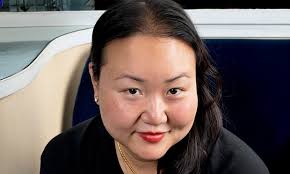
Hanya Yanagihara is an American writer and editor of Hawaiian extraction and currently works as the deputy editor of The New York Times Style magazine. Her first novel, The People in the Trees, was considered one of the best in 2013.
I wrote my second novel, A Little Life, in what I still think of as a fever dream: for 18 months, I was unable to properly concentrate on anything else … but if the actual writing of the book was brief, it’s only now that I realise that I had been thinking of this novel for far longer. I began collecting photography when I was 26, 14 years ago; and when I actually began writing, it was these images I returned to, again and again: they provided a sort of tonal sound check, as it were … Now that the book is done, I realize that these images are now so inextricable from the book — and my experience of writing it — that looking at them again is somehow jolting: they’ve become a visual diary of that year and a half, and I find myself unable to look at them without thinking of the life of my novel.
Hanya Yanagihara (http://www.vulture.com/2015/04/how-hanya-yanagihara-wrote-a-little-life.html)
Yanagihara is not interested in marriage; it is not for her, nor for her friends, nor for her characters. A Little Life makes us aware of the meaning of the word, family: how we create them, keep them, succour them, honour them, even when there are no blood-ties, the lack of which seemingly makes this family stronger, truer, safer, more honourable.
This is the first book I can remember reading that made me cry (there are also a lot of laughs, mainly of recognition) well before the half-way mark; it is however, despite the title, a big book. If you find the first fifty pages just a blur of dense information persevere, it is very much worth it.
A great book!


