A Sense of Style: The Thinking Person’s Guide to Writing in the 21st Century by Steven Pinker

Steven Pinker pic
American psychologist and language expert, Steven Pinker

If you are bored rigid by style guides, grammar tomes, and ‘How to write’ books, skip this one. However if you are fascinated by the building blocks of a sentence; how English has changed; and the black, white, and beige of grammar rules then keep reading.

Steven Pinker, the American “Rock Star” psychologist and a Professor in the Department of Psychology at Harvard University conducts research on language and cognition and has penned many popular and accessible books on language, the mind, and thought. His latest book is this one which came out in 2014 and for which he received the International Award of the Plain English Campaign.

Generally commentators on the English language fall into two broad camps: the prescriptivists, those who believe there are rules that define how language should be used, and that mistakes result from breaking those rules; and the descriptivists, those who believe that a language is defined by what people do with it. You may recognise the former as “sticklers, pedants, peevers, snobs, snoots, nit-pickers, traditionalists, language police, usage nannies, grammar Nazis, and the Gotcha! Gang” but Pinker also damns the latter as “hypocrites: they adhere to standards of correct usage in their own writing but discourage the teaching and dissemination of those standards to others, thereby denying the possibility of social advancement to the less privileged.”

Pinker is the chair of the Usage Panel of the famously prescriptive American Heritage Dictionary but he quotes the editor as saying, “We pay attention to the way people use the language”, a clearly descriptive view. Pinker, like most writers and readers, sit on the fence. Their anchor? Clarity and meaning. There are words that we continuously mis-use, such as decimate to mean ‘destroy most of’ instead of ‘destroy a tenth of’. There is no point in using the word in its original meaning if the reader or listener believes it to mean something else. The old prescriptivist rule of ‘never split an infinitive’ only exists because of the early English need to squeeze the language to fit Latin rules. The Latin word for the English verb to go is a single word ire; it’s impossible to split a single word but splitting the English word is of course possible: ‘to boldly go where no man has gone before’ is fine by Steven Pinker, and most people, I suspect.

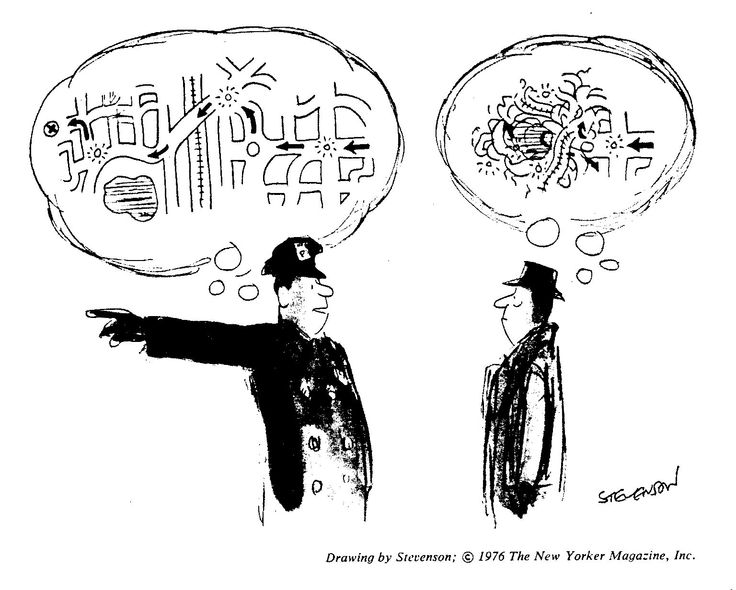
His chapter 3, The Curse of Knowledge, is a delight and has cleared up that old annoyance illustrated in the following cartoon
Giving Directions cartoon TNY

“The curse of knowledge: a difficulty in imagining what it is like for someone else not to know something that you know.” When someone gives you inadequate (to you) directions that they think are obvious (to them) and ends with the phrase ‘you can’t miss it’, you usually will. See! It’s their fault, not yours.

And did you notice I used the plural pronoun they for a singular subject someone? This has been common usage for over a century and solves the English language’s lack of a neutral singular pronoun. Oh, and did you notice I began that sentence with the conjunction, and? This was something that was considered the grammatical sin of sins in the 60s and 70s but has again been used for centuries.

However the last, and longest chapter Telling Right from Wrong will give you a lot of joy, understanding, and the edge in arguments about where to put that comma, when to use lay and lie, and the sometimes acceptable use of an adjective when the grammar police insist on an adverb.

Eggs over easily

P.S. In a student exam paper, recently, there appeared a sentence that confused everyone. “It would be a great idea if we went to the park tomorrow.” This is a sentence about the future but with the modal verb would, and the auxiliary past tense verb went. Using the future form sounds strange: “It will be a great idea if we will go to the park tomorrow.” No, the past tense is correct. This is called factual remoteness as Pinker explains with the example, If you left now, you would get there on time. “The if-clause contains a verb which sets up a hypothetical world; the then-clause explores what will happen in that world, using a modal auxiliary. Both clauses use the past tense to express the meaning ‘factual remoteness’.”

Note the full stop after the quote (not ‘ ….remoteness.’”). You’ll have to read the book now to find out what Pinker says about this (or is it that?).

You can by the kindle edition, and paper editions, here.


Between You & Me: Confessions of a Comma Queen by Mary Norris

Mary-Norris-pic
Mary Norris, the New Yorker’s Comma Queen

Punctuation may not be the most riveting of reading matter but for those of us who ‘get off’ on grammar, it’s a small diversion. Marry Norris has been working at The New Yorker since 1978 and her revelations of how the magazine works, and the characters who work there, are fascination enough. However with chapters called “Comma Comma Comma Comma, Chameleon” and “A Dash, A Semicolon, and a Colon Walk into a Bar” you know that her tongue is firmly in her cheek. However I do note that in her few pages on ‘the serial comma’ (some call it the Oxford comma, named by them who decreed it should be used, but it is used more by the Americans than the British), that’s the one before the ‘and’ in a series (or list), she is rather snobbish about its use:

Chances are that if you use the Oxford comma you brush the crumbs off your shirtfront before going out. The British get to have it both ways: they deride us Americans for our allegiances to a comma that they named and then rejected as pretentious.”

If you don’t use the Oxford comma you run the risk of the following, “This book is dedicated to my parents, Alan Jones and God.”

I didn’t “laugh out loud” as the jacket cover said I would (although you might in her chapter on symbols, F*ck This Sh*t), but I certainly had a constant smile on my face; except when it came to the hyphen.

I use these rarely except in a compound word (a made up word) like in the phrase ‘a comma-bashing critic.’

A bird-watcher is a watcher of birds; a bird watcher would be a bird that keeps an eye on things.”

As for the dash, a long hyphen, I never use it and never see the need to; commas will do very nicely.

I did enjoy finding out about something new: the diaeresis (pronounced ‘die heiresses’), also spelt dieresis. It is those two little dots over the vowel to denote the beginning of another syllable; for example, naïve, Charlotte Brontë, and coöperation (see Mary, I use the Oxford comma). Not to be confused with the German umlaut which denotes a change in the vowel’s pronunciation.

It is often said that texting will be the death of punctuation, if not spelling; but I don’t think so as long as there are people who punctuate their texts.

Punctuation was invented to facilitate reading aloud: from the pulpit originally. However we do this rarely these days and so the use of punctuation can often be individualistic; and if so all that Mary asks is that you be consistent.

Anyway the bottom line is that punctuation to prose is like music to film: it should never overpower that which it is there to enliven.

How Novels Work by John Mullan

John Mullen pic

English writer and academic, John Mullan

-oOo-

Works like this are gleaned from what novels become not how they are made. A more accurate title, if accurateness is what a title should contain, is How Novels Are.

If you are interested in such things, Mullan gives you a detailed description of the building blocks that he describes from a considerable collection of novels. Don’t worry if you haven’t read them all; one of the beauties of this book is that it whets your appetite for some of the books you had no intention of reading, such as Underworld by Don DeLillo, which is a novel that sets out to describe the second half of the 20th century via the ownership of a single object: in this case, a baseball. Mullan’s descriptions of novelistic tools also throw some intellectual light on those books you may have recently read that left you feeling a little underwhelmed: in my case Adam and Eve and Pinch Me, a ghost story by Ruth Rendell.

However don’t be fooled into thinking that these tools sit in the novelist’s brain like paint on an artist’s pallet waiting to be chosen. This is not true.  No novelist thinks “Today I’ll begin a romantic mystery via a split-narrative, with a parenthetically obsessed first narrator, in an attempt to personalise her skaz, who cleverly murders the plain speaking (no contractions) second narrator where the clue to the crime rests on an ekphrasis, in the first chapter, that is proven to be false in the last causing the revelation of a huge, but oh-so-clever, coincidence that will have critics falling over themselves to categorise the bloody thing”… maybe I’ve gone too far but I think you know what I mean.

Novelists tend to write what interests them, and, more importantly, what interests them the most is how to write, describe, conjure, and explore something that up until that point they had no idea how even to begin; and there’s the crux of it all: who was the artist that, when asked how do you start a picture? said, “you start with a mark on a white canvas”. Ditto for writing a novel.

John Mullan has been Professor of English at University College, London, since 2005 and is currently head of the English Department. He was General Editor of the Pickering & Chatto series Lives of the Great Romantics by Their Contemporaries, and Associate Editor for the Oxford Dictionary of National Biography.  He is also a regular TV and radio broadcaster and a literary journalist; he writes on contemporary fiction for the Guardian and was a judge for the 2009 Man Booker Prize. Since How Fiction Works was published in 2006 two other volumes have hit the stands: Anonymity. A Secret History of English Literature (Faber and Faber, 2007) and What Matters in Jane Austen? (Bloomsbury 2012). He is host of the excellent Guardian book club.

“Symbolism in a novel is risky because it presses meaning on the reader.” This is one of the rare references to the reader and quite an important one. Unfortunately he spends little time discussing the role of the reader; or maybe such investigation has only risen in importance since 2006. There is now a strong literary theory called readers response theory …

“which gained prominence in the late 1960s, that focuses on the reader or audience reaction to a particular text, perhaps more than the text itself. Reader-response criticism can be connected to post-structuralism’s emphasis on the role of the reader in actively constructing texts rather than passively consuming them … reader-response criticism argues that a text has no meaning before a reader experiences—reads—it. (www.poetryfoundation.org)

That landscape of Uncle Harry gathering cobwebs behind the broom cupboard or the script in your bottom drawer doesn’t mean a thing until someone has a reaction to it, be it small (it’s alright) or big (Wow! How wonderful!): art isn’t art until someone consumes it.

This idea that there is an active role for the reader in literature is demonstrated by Colm Toibin’s latest novel Nora Webster (Penguin 2014). It’s a moving tale of a recently widowed middle-aged woman, mother of four, in 1960’s Ireland who finds her way back into her own life; one without her husband. No place or person is described. When Nora’s neighbour, an inquisitive old biddy from down the road, comes calling to look about a bit the reader is left to provide his or her own image of an ‘inquisitive old biddy from down the road’. This isn’t hard to do as most of us know of such a character from our past (or present). A grocery store where a bell rings when a customer enters is all that is needed to conjure up in the mind of the reader exactly what Toibin wants; it isn’t important that your ‘grocery store where a bell rings when a customer enters’ may not be geographically like the one in Toibin’s memory, but it’s the idea, the atmosphere, the tone, the times, that Toibin is after; and that the reader can provide.

Of course there are wonderful novelists who describe people and location in great detail but there is something nourishing for a reader when all that is needed is a key (“a belly held in by straining buttons”) that unlocks a memory for a reader and provides everything that is needed for the character (location) to come to life.

I found this book fascinating, despite its neglect of the role of the reader. It almost doubled my ‘to read’ list.

Although Mullan is an academic the prose of How Novels Work is leveled at the general reader but if you are more academically minded try How Fiction Works by literary critic James Wood (Jonathan Cape 2008) who attacks the information, fundamentally the same as in Mullan’s book, but from a completely different angle.