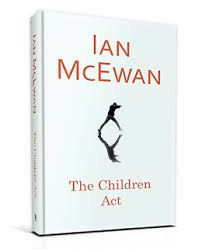
Ian McEwan’s The Children Act

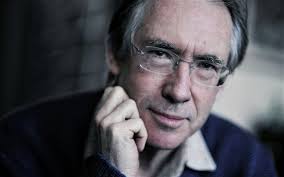
British novelist, Ian McEwan

Many decades ago a dear friend of mine gave me a little pile of novellas for my birthday. They were all by Ian McEwan. I had never heard of him but I devoured those little books hungrily. I liked the darkness, the little knot of evil in those novels. It’s become a trade mark of his and to this day I still think the first chapter of Enduring Love is the most thrilling opening to any novel I have ever read. I’ve read them all; well that’s not entirely true: I couldn’t read On Chesil Beach. I started it and almost got to the end of the first scene; in the hotel room, the honeymoon suite, with the two innocent newly-weds and the snickering staff bringing in their meal on a tray. I had such an overwhelming sense of foreboding and embarrassment for these two child-like people that I had to shut the book. I’ve never opened it again. That little dark nut at the heart of most of his work has faded over the years but he still has a talent for the unexpected except his use of the unexpected can sometimes be very subtle. I know a few readers who didn’t ‘get’ the twist that was behind the climax of his 1998 Booker Prize winning novel, Amsterdam.

After Atonement (2001) – his masterpiece, Saturday (2005) is the most representative of his latter work, and his latest, The Children Act, begins with a similar scene: a person alone at home contemplating their future, although Fiona in chapter one of The Children Act has just had the bombshell that will change her life, while Henry, in Saturday, has yet to meet it.

The Children Act

At the centre of The Children Act is a high court judge, her husband, and a case she has to decide: a case of life or death. A young underage man, three months before his 18th birthday, desperately needs a blood transfusion to save his life. He and his parents are Jehovah Witnesses, devout, and are refusing treatment. The hospital has taken the court action to allow them to treat the boy. The legislation, the Children Act of the title, is clear. The young man, Adam, is intelligent, articulate, and more than capable of understanding his situation. However just before this case is thrust upon her the judge, Fiona, nearing 60 and childless, is confronted by her husband who wants her permission for him to have an affair; he says he still loves her but his libido and masculinity want one last chance before they and he slide into an inevitable but comfortable twilight.

McEwan takes us through every detail of the hurried case, time is short, and Fiona decides to see the boy. The meeting is deftly handled, moving, real, and McEwan manages to keep the emotion from spilling into sentimentality, although a duet sung at a deathbed’s side is strewn with potential pitfalls. We are, however, along with all the parties in the case, made to wait for her decision from her high bench. There is a feeling of expectation and intrigue: what will she decide? It’s page-turning; but her decision is not the end of the story. Her decision has consequences that no-one could predict, and I won’t spoil it for you by revealing them.

Like all her decisions, separating conjoined twins, deciding which spouse gets the kids and/or the money, she listens to the arguments, does her research, decides, closes the book, and moves on immediately to the next case and another decision about the future of people’s lives. However the image of the dying Adam stays with her in both personal, and professional terms.

She is highly regarded by her peers but the means by which she makes decisions about other people are very different to the decisions she must make in her own life. How should she respond to her husband’s request? Is it reasonable? He’s being very open and honest with her. Professional decision-making has policies and precedents, but with personal decision-making you’re on your own. On impulse she demands he leave the apartment and she immediately changes the locks, which her legal mind tells her is NOT the thing to do.

These two strands of the personal and the professional are skilfully woven together around a third: music. Fiona is a very competent amateur pianist and every year she takes part is a concert among her legal fraternity and it’s as she is walking onto the stage, in the penultimate scene, her mind full of Mahler and Schubert, that news is unkindly whispered to her; news that in another circumstance may very well stop her in her tracks; but like every aspect of her life she has other responsibilities, and now, those responsibilities are to her fellow performers, her audience, herself, and especially to the composers she is interpreting. She gives an astounding performance but can’t bring herself to acknowledge the rousing applause: one set of responsibilities are fulfilled and extolled but another responsibility, one she thought she had executed, well and for the benefit of all, had just unravelled. It’s so like McEwan to defer a climactic revelation while the protagonist is intent on doing what is expected, and so like the character not to let a past failing interfere with her immediate duty.

The end is a soft, satisfying coda as she begins to tell the man lying next to her of her shame.

What I’ve learnt from writing a novel

Featured image

 This is my desk; and yes, that’s a peacock on the right, made out of sprite cans. I stare at it a lot.

What I’ve learnt from writing a novel
There is always a starting point but you don’t have to have an ending. The idea for Alex Miller’s Autumn Laing came from the sound of a voice in his head; a strong, determined, female voice. He had no idea where this would lead. The idea for Colm Toibin’s widow-novel, Nora Webster, came from the visit of a recent widow to his house and he married this idea to an autobiographical one; his father had died when he was twelve. In the first chapter of Nora Webster there is the seed that leads to his novel Brooklyn; he abandoned the widow idea for the immigrant idea, so strong it must have been. He didn’t come back to the widow idea for twelve years. However there has to be an idea, something, a seed, even though you may not know what it will grow into.

Next: try it. If the idea came from an overheard conversation then try to write the conversation; it might take you somewhere unexpected and stimulating. If it is a place, write about what makes the place so significant; how does the place feel? How does the place make your protagonist feel? No matter how you begin, at some point you must make it clear where you are, even if the location is nowhere; you know as a reader that you like to know where the narrator is, where the story is happening, or has happened.

There are many ways to tell a story, many points of view. Choose one. You could write it from the outside using the all-seeing, all-knowing god-like narrator; a narrator that knows everyone’s inner-most thoughts, actions, and desires, past, present, and future. (Anything by Jane Austen) You could write it from the outside using a narrator that ‘sits’ on the shoulder of one character so the story is told from that person’s point of view and no-one else’s. (My ebook Veronica Comes Undone) You could write it from the inside where the narrator is one of the characters in the story (F Scott Fitzgerald’s The Great Gatsby) There are many variations on these POVs. Christos Tsiolkas’ latest novel, Barracuda, uses two narratives: one in the recent past written in the first person; and one in the further past, written in the third person. Sometimes you don’t need to decide, sometimes one particular way just feels right. Trust what feels right and so write what feels right.

Next: just start. If you only have time to write 700 words a day, so be it. By the end of the week you’ll have 4,900 words; by the end of the month you’ll have 19,600. I wrote Veronica Comes Undone in a year and a half of Mondays.

What you write first may not be chapter one. You’ll work it out later. Write first what interests you first. Every idea you have while you’re writing something may not be suitable for that project, but it might. If you’re not sure, put it in. This is only draft number one, decide later if it is appropriate or not. Wait until you step back and look at it from afar. You can cut and add whatever and whenever you like. You’re god here. You’re creating worlds, lives, actions, and consequences. You are all-powerful.

Just spew it out. Whether you write in longhand in a note book (like Toibin does)or tap it out onto a screen, just blurt it out. Even grammar, spelling and appropriateness can be amended later. Everything and anything can be amended later. Draft 1 can be an utter mess; draft 1 should be an utter mess. No-one sees it but you.

You don’t have to be a slave to narrative time. The journey from one plot point to the next can be instantaneous even if months of story time have passed. If an important plot point is that your protagonist starts a business, or renovates a house, you don’t need to go into great detail writing about choosing tiles. Boring! Cut to the opening, the moving in. Time is your slave.

Of all the tools available to a writer the best one for developing a character is dialogue. Some writers eschew dialogue. I don’t understand this. People, and even nationalities, have conversational idiosyncrasies. Americans says things like “You like pizza, right?” Australians usually use the negative, “You like pizza, don’t you?” Once at a writer’s festival I heard an American writer read from his latest work. His book was set in Rome and one of his main characters was Mexican. The novel, of course, was written in English. He spent many pages vividly describing these people but when they spoke, all the time and ink expended on these characters went for naught: they all sounded the same, like the writer. I don’t know how a Mexican living in Italy might speak English but the writer should’ve thought about this and worked it out. Dickens, especially Dickens, James, Winton, Rowling, Doyle, Tsiolkas, Joyce, and St Aubyn, all paint life-like characters with the way they talk, or think. We all make grammatical mistakes, or different pronunciations but different characters can make different grammatical mistakes; and when we talk we rarely speak in compete sentences, and we rarely speak the same incomplete sentences as the next person.

Don’t underestimate the contribution of the reader. Let the reader do some of the work. Cólm Tóibín in Nora Webster lets the reader do a lot of work, all the work! Characters and places are never described. See my review of Nora Webster About grief: good grief on my blog posted November 2 for more about reader theory. However a succinct descriptive passage can spark the reader to paint his own version of the character. Describing a man as “oval with buttons fit to burst” is all that may be needed. The reader knows he is chubby, greedy, selfish; and uses his own experiences of like-looking people to complete the characterisation that the writer has only, but skilfully, hinted at.

Allow cooking time. Step away from your project for a week or two and write something else; read a novel, re-design the garden, re-organise the second drawer. When you come back to it you will read it with a reader’s eyes and as you’re reading if you ‘jump’ or feel a ‘jolt’ (That doesn’t sound right; How does he know that? Wasn’t she wearing jeans a moment ago? He wouldn’t say that…) then there is something wrong. Don’t let it pass. Fix it.

Ah, the pay-offs. The most exciting time is when you are deep in a scene and the creative juices are flowing, ideas tumble over each other, you can’t tap, or write, fast enough; time is irrelevant, and all your senses are honed in on the scene that you are creating, manipulating, describing, being a part of. That’s such a buzz! But of course, that you know, or you wouldn’t be reading this.

The next good bit is draft 2; when you have all this stuff and you shape it, cut and add, link and re-arrange, mould into the story that only months before was just an idea you had as you sat on the bus on the way home from work.

However the most liberating, the most powerful, and the most stimulating change in the writer’s landscape in recent years is the ability to self-publish digitally. I could paper walls with the number of rejection slips I’ve received over the years from agents and publishers, had I kept them; and the most usual reason for abandoning a work is the feeling of ‘why bother?’ The agent/publisher wall is too high, too thick, too impenetrable, but with digital publishing and the liberation it gives you there comes more responsibility. To self-publish digitally you must make sure the text is ready, edited, corrected, error-free, ‘jolt’ free and something you are proud of. You’re not only the writer, you’re the editor, mentor, agent, publisher, and marketer; and the last in that list is the most time-consuming and, at times, the most frustrating. But all this hard work is worth it when you get your first sale; and this happened to me within 30 minutes of pressing ‘publish’ on August 24th. (See my blog-post Veronica Comes Undone. How did this happen dated August 29). Now that’s the best buzz of all. Access to readers is now at our fingertips and although book-sellers are chiming about the survival of the paper-book and the plateauing of ebook sales, digital self-publishing is a reality no matter what portion of the market it’s claiming. It’s there; use it.