hOme by Frank Ronan

Irish writer, Frank Ronan

When a novel makes you laugh out loud it’s a great and wondrous thing.

Home, Ronan’s 6th novel from 2002, is a first-person narrative of a young boy, Coorg, born to an unwed teenager into the hippiest of hippy communes in 1963. These hippies throw the I Ching to decide if they should leave a rock concert early or not; they carefully remove a cabbage, roots, soil, and all, and carry it to a quiet place before chopping its head off so the other cabbages won’t get upset at the carnage; and their form of free love, wantonly and frequently exercised, is more about longevity than climax.

He spends his first six years with these people who care, stimulate and provide for him in a rural English paradise. They believe him to be the ‘messiah’ – also courtesy of the I Ching – or, as they call him, the ‘mage’. He is special and treated so. A boyish question about why a tree, next to a big rock, is dying will get an answer something like “The spirit of the rock and the spirit of the tree aren’t getting along at the moment.”

Then his grandparents suddenly show up and kidnap him (‘save him’) back to Ireland and plunge him headfirst into Catholicism, village politics, fish and chips, sausages, chocolate, and school with a new name: Joseph. The commune disbanded soon after this not because of the kidnapping of their ‘mage’ but because its self-styled mystic leader was caught eating a Snickers Bar in the High Street. Now for Joseph growing up in Ireland a boyish question would elicit an answer like “Stop asking such silly questions or the boogie man will cut your legs off and put you in his sack.”

He swaps one unreality for another.

“Is Baby Jesus Black?”
“Don’t ever talk about Our Lord like that.”
She raised her hand at me and I looked at it and realised what had caused the sting on the back of my legs when I vomited down the side of the car door.
“Baby Jesus couldn’t be black. He’s God.”
“Where is he now?”
“He’s on the altar. Behind the little curtain at the back there’s a gold door and he’s in there.”
“How do you know?”
“Because the lamp is lit.”
“Will he come out?”
“You have to wait for the priest to do everything, and the bell will ring and he’ll elevate the host, and if you’re good you can see God except if you’re good you’d be saying your prayers and not looking, and you have to make your Holy Communion first.”
“Is he a kind of wizard?”
“No. He’s God. He’s very, very holy.”
“Is that why you can’t see him?”
“Yes. And stop chewing that penny. A dirty black man might have touched it.”

Home is about belonging and it’s the first of a quartet although Ronan, on his website, warns us: “and the more you annoy me about it, the longer it will take to get on with the second”. He is obviously still being annoyed about it because nothing, novel wise, has appeared since 2002. However he is a keen gardener and talking about gardens and gardening will turn his usual laidback manner into one of wide-eyed enthusiasm. He also writes a monthly column in Gardening Illustrated and was a guest speaker at that magazine’s recent festival held in the Cotswold market town of Malmsbury last month; so gardening and writing about gardens, and not annoying readers, may be the reason the quartet is still only one book. His website (frankronan.com) seems equally unattended.

“I’m obsessed,” he says, “I can’t remember people’s names, but I can always remember plant names.”

For Ronan (born 1963) Ireland is ‘home’ but he lives in Worcestershire (“It’s the last bit of England worth living in”) where his partner commutes to London (“I hate London.”) but they spend weekends together.

His home town New Ross, not far from Colm Toibin’s home town of Enniscorthy, County Wexford, is where the young Coorg is taken and ‘rehabilitated’ and although the novelist swears he’s never stayed in a hippy commune there is enough evidence to suggest that the Irish growing-up of the young Joseph could be very much like the Irish growing-up of the young Frank; but then again there’s autobiography to some degree in every piece of writing.

Ronan’s humour, and there’s lots of it, doesn’t come from a child narrator’s misunderstandings and lopsided conclusions but from an adult narrator and so an adult’s sense of humour: “The pub turned out to be the manyplies of the village, where all the life missing from the street was being fermented into a state of contented excretability.”

Let’s hope that somewhere betwenn weeding, picking cabbages and writing about them he can find time for  books 2, 3, and 4. I’ll read them.
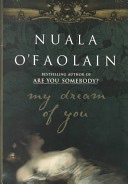
My Dream of You by Nuala O’Faolain (noola o fway lorn)

Nuala O'Faolain
Nuala O’Faolain

I loved this book!

After the international success of O’Faolain’s memoir Are You Somebody? this novel, her first, was published in 2001 and in a brief Afterward she acknowledges “splendid energetic advice” from fellow Irish writer Colm Toibin who recently opined that

“… in autobiographical writing your [the writer’s] job is to create illusion, to work with rhythm and image and detail to make the reader feel that whatever is on the page matters and must have happened.”

I would venture to say that this also applies to writing in the first person, memoir or fiction, since the first person point of view is meant to make the reader believe the protagonist is also the writer. I recently complained that in The Cast Iron Shore, Linda Grant’s debut novel, that I reviewed on this blog recently (posted January 27), Grant failed her first person POV responsibilities by inadvertantly creating a disconnect between the protagonist and the writer: they seemed like two different people.

O’Faolain does not make the same mistake. Although a novel (fiction), My Dream of You reads like a memoir, feels like a memoir; so skilfully does O’Faolain make you believe, using “rhythm and image and detail” that her story actually happened to her. Having read her first memoir there is a lot of O’Faolain’s past in Kathleen’s but autobiography and fiction are interwoven seemlessly. How do I know this? I cared about her.

Kathleen de Burca is an Irish travel writer fast approaching fifty, and with a waist to match, who travels the world, usually with her best friend, an gay American man called Jimmy, writing travel copy for her boss, and also close friend, Alex. These two men, and staff in the office in London, serve as her family, since she has all but abandoned hers, and her country, many years before. Then there is her boyfriend, Hugo, a law student, who interests her in a divorce case from the annals of Irish history: the young wife of an English aristocrat, on a forlorn Irish estate in the middle of nowhere, is accused of infidelity with her husband’s Irish groom, a very common man. In those days, the 1850’s, a divorce needed an act of parliament so the event is well documented although from a very English point of view. The wife is chastised, forsaken, deprived of her young daughter, and locked up in an asylum where she inevitably goes mad.

Kathleen is intrigued and fascinated by this tragedy and when Jimmy, her moral compass, suddenly dies she takes leave of her job (Hugo, the boyfriend, she betrayed and lost) and travels to Ireland to, maybe, write a book about this young wife and her passion for a comman man.

The book has three narrative arcs: Kathleen’s journey to Ireland, her adventures, and the brief reunion with her siblings and their families; her memories of her arrogant, distant, and emotionally violent father, her deeply unhappy and useless mother, and her friends and lovers; and the story from the 1850s of Marianne and her affair with the lowly William Mullen. Yes, there is a book within the book.

She thinks she is going to Ireland to research a story about someone else’s passion but what she actually does is confront passion in her own life and what she discovers is not what she expected.

The writing of the Marianne’s story (in the third person) begins confidently and the affair with Mullen is handled expertly: O’Faolain makes the reader understand how intense physical attraction can operate outside the realms of reason; but Kathleen discovers another document that proports to prove that … well, I don’t want to spoil it for you. There is here the flavour of a mystery to be solved.

O’Faolain’s literary skills are put to good use as she weaves the first and third narratives into a shared ending which also ends the book itself. Very satisfying.

My Dream of You is about love, sex, family, and aging, and it contains one of the best descriptions I have ever read of female friendship – how it works – and how emotional love with a woman can be far more rewarding and long-lasting than sexual love with a man. Mind you, Kathleen has a lot of experience with sexual love with men and she understands, and shows, that passion is far more complex and evolutionary than romantic books make out; and she comes to realize that her relationship with her body is also a part of the ‘passion’ equation and far from what she would like it to be, or thought it was. She is, or was, a beautiful woman and there are magic passages where a beautiful woman talks about being beautiful, without pride or sentiment, and when she believed it and when she didn’t. This is unusual stuff.

Nuala O’Faolain was engaged once but never married, had a fifteen year relationship with the Irish journalist, Nell McCarthy, but spent her latter years with a New York lawyer, John Low-Beer. She was diagnosed with metastatic cancer in 2008. Hugo Hamilton, whose memoir The Speckled People I recently reviewed on this blog (posted February 10), was a friend of O’Faolain’s and his 2014 novel Every Single Minute is a fictionalised retelling of a trip he took with the very ill O’Faolain to Berlin just before she died (May 9 2008).

She wrote two volumes of memoir Are You Somebody: The Accidental Memoir of a Dublin Woman (1996), and Almost There: The Onward Journey of a Dublin Woman (2003); another novel published posthumously in 2009 Best Love, Rosie; and a ‘history with commentary’ The Story of Chicago May (2005). Chicago May was the nickname of Mary Ann Duignan, an Irish criminal, who became famous in America, France and Britain in the beginning of the twentieth century.