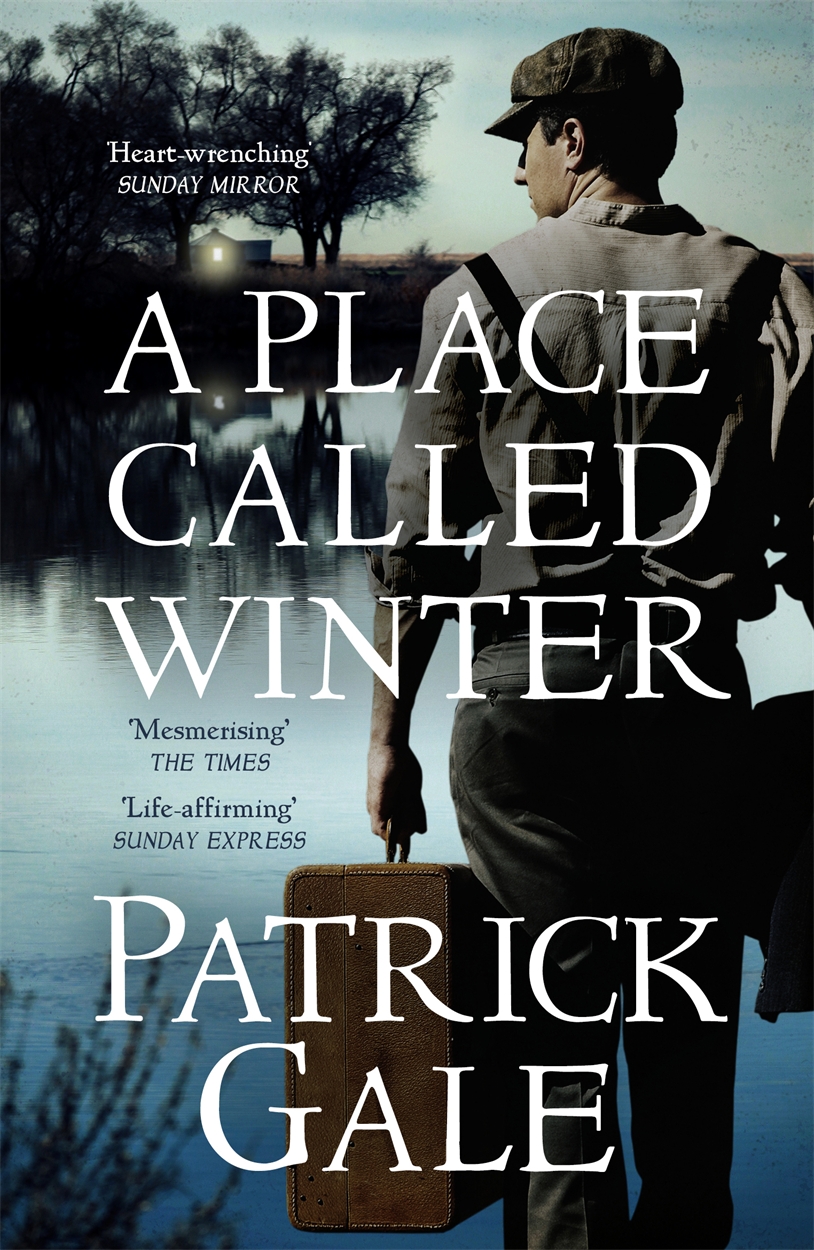
A Place Called Winter by Patrick Gale

patrick_gale_pic2
British writer, Patrick Gale

This is a very different book, Gale’s latest, from his other work which have usually been an insular look at a group of people in a localised area, usually a small Cornish community. A Place Called Winter is epic in its geography, historic in its time and language, and romantic in its tone. If you had to write a précis of this book it would read something like a historical romance, complete with abandonment of wife and family, a journey across the ocean to a strange and inhospitable land, the finding of love in the most unlikely place, a world war, murder, insanity, tragedy, and a villain of truly despicable proportions, but Gale avoids all the possible clichés that would otherwise render such a story fit only for the sensational shelves of suburban bookshops patronised by retired ladies.

“I didn’t decide, ‘Now for an historical novel!’ Rather I found myself more and more possessed by the material suggested by the fragments of my great-grandfather’s story,” and Gale has been reported many times as saying that for the purposes of fiction, and to account for surprising decisions from his ancestor’s known but sketchy life, he ‘turned’ his great-grandfather gay. This is not surprising for Gale readers, as Gale, an out gay man, writes often and well about sexuality. However “The great challenge in this novel was to write about sexuality while inhabiting the head of a man who realistically would not have had anything like the psycho-sexual vocabulary we take for granted now.” Indeed, in his first homosexual experience, which he, Harry Cane, subconsciously seeks out under the guise of a remedy for his stuttering from a handsome, but opportunistic actor and speech therapist, says, when it is obvious what is going to happen and without any stutter at all, “I have absolutely no idea what to do.”

Once his affair is discovered by a kind but firm brother he is forced to avoid a family scandal and possible imprisonment, and flees to the wild cold west of Canada where he is befriended, then abused, but finally set up by a land agent next to a shy and reclusive brother and sister pair, there for their own reasons of displacement. It is here, near a place called Winter, that he discovers what life, love, sacrifice and family really mean. Plot points of self-realization, murder and reunion are described in unsentimental terms and even the climatic act of …. No; no spoilers here.

For all of Gale’s extolling his attention “on the psychology and emotional life” of his characters I found A Place Called Winter, although enjoyable and sustaining, not as rewarding as his other works that focused on a domestic band of rural characters dealing with each other, and more importantly, themselves. The Cornish landscape, both emotional and geographic, he knows well and writes about it with, insight, force and understanding, while such considerations in A Place Called Winter are a little overshadowed by the grandeur of the plot. However, there is a lot to gain from this book; it’s probably the most commercial of his works and one that will gain him a new and, hopefully, loyal readership. He’s prolific: this is his 17th work and I eagerly look forward to what next he has to offer.


Ease by Patrick Gale

Patrick Gale Pic
British writer, Patrick Gale

I’m not a recipe-bound cook. I like recipe books for ideas not instructions. Generally due to this approach I produce eatable, sometimes interesting, but usually unmemorable dishes. However, sometimes I even amaze myself: my first soufflé was a triumph and I basked in my own pride, and praise from others. Usually, though, when I attempt a former triumph a second time, it is a disaster: my second soufflé was more like a biscuit.

I have seen evidence of this second-time-failure phenomenon in other human endeavours, and not just mine, but Patrick Gale’s second novel of 17, Ease (1985), is not one of them.

His first The Aerodynamics of Pork (1985) was a joy to read but Ease surpasses it: its simpler, clearer, better structured, and philosophically more interesting.

Domina (Dom, Min, Mina) Tey is a successful playwright, who lives with her long-time partner – too long to be a boyfriend, but not legal enough to be a husband – Randolf Herskewitz, (Ran, Rand, Randy – Gale loves to play with names). He’s a writer too, although an academic one, more truth-as-wonder than Domina’s truth-as-reality.

Min writes plays about “menopausal lecturers and novelists” for “the discerning Guardian-reading, professional-oblique-arty masses”, which Des (Desiree), her agent, loves and can sell, but Min is worried she’s getting bored, and therefore boring.

Min leaves Randy and leaves behind the loveliest ‘I’m leaving you/not leaving you’ note you have ever read: “I won’t be in for dinner for a few weeks but the freezer is well stocked,’ it begins. She goes to “visit herself” and “secrecy of whereabouts vital to success of spiritual growth” and she signs “Apologetic affec. Mxxxxxxx.”

She moves to “a top-floor bedsit by Queensway, with no view, in a house full of odd little men and an old-bag downstairs who used to be a mortician.” One of these little men is Thierry, a young, French, gorgeous, promiscuous, and very successful, homosexual who takes her on one of his sauna-searching escapades; another is Quintus, a young, sweet, naïve history student who is trying also to find himself but has just found God, well, not God really, more a church; and not just any church, the Greek Orthodox Church. He captures Min’s curiosity and she captures a few other little things of his as well. I won’t go on; no spoilers here, and there’s quite a lot I could spoil, but no.

No-one knows how this thing we call human life started, if only by a bolt of lightning in a pool of primordial ooze, but start it did, with or without a creative hand. It sounds unlikely but it only had to happen once in a multi-squillion or so years. Anyway, stuff happens and us humans have many diverting, equally unlikely, annoying, and definite views on how we cause or are affected by such stuff and what we then need to feel or do; but if you are of the philosophical bent of our protagonist, Min, (and Mr. Gale, I suspect) you may come away from reading this book with a more peaceful, uncluttered, and sanguine view of us, allowing you to get on with life, like washing the dishes, walking the dog, loving, reading and /or writing books.

Patrick Gale is a British novelist whose ebook editions of his many novels are published in the US by Early Bird Books, and marketed by Open Road Media.

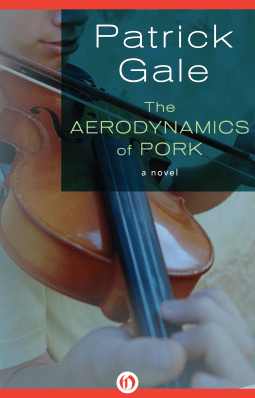
The Aerodynamics of Pork by Patrick Gale

Patrick Gale Pic
British writer, Patrick Gale

To begin a book review in a recent edition of The New Yorker (April 25, 2016), James Woods asserts that if there is such a thing as ‘late style’ in classical music then there must be such a thing in contemporary fiction; and then he describes what it might look like in the late works of Muriel Spark, Philip Roth, Saul Bellow, and Edna O’Brien. He’s right, of course, but then there must be such a thing as ‘early style’; and having read, and blogged about, two later works of Patrick Gale, Notes from an Exhibition (2007) and A Perfectly Good Man (2012) this one, The Aerodynamics of Pork his debut novel from 1985, is a perfect example of such an ‘early style.

There are no exquisite sentences nor the confident rearrangement of narrative time that characterise Gale’s later work. You can sense that Gale is testing the waters with this one; not just testing his own talent but flexing his literary muscles really, paving the way for more complex, more personal, and more adventurous writing.

Gale starts chapters and you find yourself in a maze. This isn’t as disturbing as it may seem; it just ups your trust in the writer a notch or two. (So you think, “This better be worth it”) But, as in a maze, you gradually find youself making sense of where you are, and who people are, their friends and situations and before you know it you find youself out of the maze – it’s only page three and you meet a before-mentioned character, say, from page one – and suddenly you’re into a plot. Gale allows the reader to do some of the work, to test assumptions and make predictions based on the information he gives you without spelling everything out which always halts the flow causing the narrative to plod rather than skip. Gale’s plots always skip.

It remains popular with the reading public even though Gale has somewhat dismissed it as over-written and under edited; I see it more as one of the work’s two narratives working better than the other.

Seth Peake, 15 going on 35, a musical prodigy and an extremely well-adjusted gay school-boy, blossoms artistically and romantically during a summer music festival; and a police inspector, Maude Faithe, a lesbian who’s let her sexuality slip in importance in recent years, discovers it again during her investigation into a bizarre series of burglaries of the homes of astrologists and popular fortune tellers and their soon to be announced prophecy of global importance. Seth is certainly ‘out’ while Mo is definitely ‘in’; as she is about her profession: she’s secretive of her sexuality among her work-collegues, but even more so about her job to potential friends and especially to potential lovers.

Seth’s narrative is more satisfying if only for the characters of his mother and sister; the former a progressive thinker but still a worrier, and the latter, an underachiever who finally understands that her lack of interest in sex is her own affair and her anxiety is solely due to her younger brother’s success at it even if he is underage.

The title is intriguing and there are cute little references to ‘pig’ and ‘piglets’ as euphemisms for members of the constabulary, although more benign than one might expect; and subtle inferences to the adynaton, ‘if pigs could fly.’ It would be a mistake to read too much into this; a memorable title need not be anything but a memorable title; but, of course, it means whatever you think it means.

If you are new to Patrick Gale why not start with this one, just like he did.

This and other Patrick Gale titles are being released in the US as e-editions through Open Road Media and you can find this title here.

http://www.openroadmedia.com/ebook/the-aerodynamics-of-pork

You can also find the book on Open Road Media’s affiliated sites:

Amazon:
https://www.amazon.com/Aerodynamics-Pork-Novel-Patrick-Gale-ebook/dp/B01FRQEVBK?ie=UTF8&SubscriptionId=AKIAIWK3GU7N4Y5GTA6Q&camp=2025&creative=165953&creativeASIN=B01FRQEVBK&linkCode=xm2&tag=httpwwwopen01-20

Barnes & Noble:
http://www.barnesandnoble.com/w/the-aerodynamics-of-pork-patrick-gale/1000208127?ean=9781504037624

Goodreads:
https://www.goodreads.com/book/show/30227509-the-aerodynamics-of-pork

A Perfectly Good Man by Patrick Gale

A Perfectly Good Man Cover Pic

In 1937 J. B. Priestley was – if not the first then one of the first – writers to use time as a plot point. His play Time and the Conways tells of the decline of a monied Yorkshire family between the wars. Act one is set in 1919 at the birthday party of one of the daughters; act two is set on the same night but in 1937 and we see how far the family and all its members have fallen; and act three continues from act one and we see all the misjudged decisions, wrong turnings, and false expectations that caused it all. It is a tragedy, not just of a family but of Britain as she unwittingly is drawn into war, a war that Priestly predicted; but because the audience knows what happens they are spared any melodramatic sentimentality at the Conway’s future and, instead, are left with the truly tragic knowledge that it is all their own fault, therefore teaching us that our future is all our own fault. Damn it!

By the end of the first chapter of Patrick Gale’s A Perfectly Good Man I was gasping at what I had just witnessed, as our hero, the perfectly good man, an Anglican vicar, Father Barnaby Johnson, had just witnessed and could do nothing to stop: a suicide in broad daylight at a kitchen table. Time jumps back twenty years for chapter two and by its end I was misty-eyed at a lonely farm girl who almost became a matinee spinster, and at her sudden and unexpected happiness that she grabbed with her heart and both hands, despite her mother’s selfish interference and her own self-acceptance of a lonely life; so that when she saw Barnaby, finally, and they kissed and kissed again I’m sure I heard an orchestra belting out a soppy Korngold score like anything starring Joan Fontain and Lawrence Olivier: emotional, yes, but not sentimental; there’s no time for that as the next chapter jumps forty years into the future with Barnaby at 60. We know the consequences of everything they see and do. As with Priestley’s time plays Gale reveals outcomes before their gestation which not only spares us sentimentality and underlines the folly of mankind but also provides the reader with a few delicious “Oh yes, of course!” moments. I love those little moments.

Gale’s clever narrative, not only doesn’t follow the linear life of Barnaby Johnson, but rather his life is painted not by what he does but by what effect he has on the people around him: Dorothy, his wife; Lenny, his young, lapsed parishioner; Carrie, his daughter; Phuc (Careful! It’s rhymes with look), his adopted Vietnamese son; Modest, an interfering, totally unpleasant and obese man, to whom Barnaby shows nothing but kindness; James, his gay uncle; and Nuala, his onetime Australian lover. We get to know Barnaby Johnson through his reflection in the lives of these Cornish people. Be assured that I have left out some important information in my descriptions of these characters: I don’t believe in spoilers.

It’s set in Cornwall and in the little parishes north of Penzance, the same location of the previous Gale novel I read and blogged about; and incidentally two characters from that book, Notes from an Exhibition (see my previous post) make an appearance in this one. A neat synchronicity but only because I read these two back to back.

He has a way with the nuanced phrase …”the sisterly happiness she felt for him was borne up on little upwells or erotic regret …  she could smell the disappointment of her, a passing sourness, as of stale sweat trapped in a dress sleeve … In a priestly way – all cheekbones and fine feeling – he was handsome, she considered … And there she was in his maths class like a princess sent to a rural comprehensive to learn humility… Even now they weren’t exactly alone because her parents were standing in the porch, like an advertisement for mortgages…she simply preferred to keep her feelings private and as reassuringly compartmentalized as the meticulously size-sorted screws in the trays of her tool box …”

These gems give you little jolts of joy, like finding a $20 note in a pair of jeans you haven’t worn for a while.

Notes from an Exhibition, along with A Perfectly Good Man are now available as ebooks and you can find them here.

Since my literary heroes (at the moment), Colm Tóibín, Tim Winton, and Damon Galgut are not very prolific I’m happy to add Patrick Gale to the list so now I have his whole body of work to explore. I hope you will too.

Notes from an Exhibition by Patrick Gale

Notes from an Exhibition Cover pic

I read, years ago, Patrick Gale’s Rough Music (2000) which is anchored in my mind solely because of the protagonist’s long-time lover who also happened to be his brother-in-law; familial relationships of the unusual kind are his specialty, and those of Pictures from an Exhibition (2007) add to that reputation. The Middletons, husband Antony, and children Garfield, Morwenna, Hedley and Petroc, are Quakers who live in Penzance on the warmish tip of England’s most southerly bit and who revolve imperfectly around the mother and wife, Rachel Kelly, whose mental instability is only ever mollified, cooled, and placated by her painting: her world is only true and real to her once she can represent it in paint, form, and, sometimes only, colour – on something, anything, flat and at hand.

Each un-numbered chapter is headed by a note; that which you see, read, and is placed usually on the wall at the bottom right of a painting in an art museum. They begin with the painting’s name and then its medium – pencil and crayon on particle board, for example, and a paragraph or two adding colour and depth to its creation, subject, and then its current owner. These notes, you should know, not only illustrate Kelly’s art works, there are also objects, clothing even, which like art works, can sign-post our lives. Gale adds novelistic detail to this museum icon giving him a wry and clever means to add momentum, depth, and suspense to the following chapter. It is in one of the early notes that we discover in passing that there has been an untimely death in the family; the text features the deceased and one is a little tense for expecting the death to occur at any moment. When it doesn’t the tension remains and the expectation of tragedy is all the more true the longer one is forced to wait for it. The result of this little suspense I’ll leave for you to discover.

Each chapter doesn’t necessarily extrapolate on the opening note (but sometimes it does, of course); Gale is never always that obvious, and the portrait of the Middletons is not linear – Rachel Kelly’s death is in an early chapter – so their life, loves and dreams, both dashed and fulfilled, are built up with flash backs and forwards like the accumulated image of a jigsaw puzzle and all the more truthful for this intriguing form, layer-upon-layer, like walking through a retrospective exhibition of your favourite, but recently late, artist.

Early in the book I read this,

She was superstitious of describing the process but if forced to put it into words by a trusted friend she would have likened it to taking dictation – if one could take dictation of an image – from a quixotic teacher who could never be relied upon to repeat anything one failed to catch.

This dense, neat sentence which shines some light on the artistic process – no mean feat in itself – made me jolt in my seat and forced me to read it again, and again, until its cleverness revealed itself: in the short final clause the subject jumps from the speaker to the listener, like a filmic panning shot from one person to another. I read it again, aloud, just for the simple pleasure of it in my mouth.

Then, in hospital, after a suicide attempt Rachel Kelly is visited by a recent stranger and saviour, Antony, whom she later marries.

“You brought me flowers.’

“Yes, sorry. They’re not very…”

“They’re hideous. You’re so sweet. Sweet Antony.”

There’s nothing that impresses me more than character building through dialogue: three little spoken sentences says more than a page of exposition; and a little later,

She didn’t sob or wail. Her grief was horribly discreet but as persistent and almost as silent as bleeding from an unstitched wound.

I was hooked, a fan, and wondered why I hadn’t garnered Gale’s output from my first exposure to him all those years ago.

Remembering Tolstoy’s famous opening line about unhappy families, all families, really, are unique in their own way; and the book although ostensibly about such a family is full of … well … interest. It hardly seems necessary for Gale to add an astonishing twist to the true identity of Rachel Kelly: she is literally someone else. However he handles this revelation with intimate historic detail, tone and a shift in the narrator’s allegiances that legitimises this remarkable plot swing and puts Gale firmly within the reader’s trust … but enough of that: no plot spoilers here.

Gale’s omnipotent narrator is of the free-wheeling kind: jumping from character to character with ease and intent to tell the story, to paint a family life; unlike some other, more popular writers – Dan Simmons, for example (see my blog post dated April 17), whose narrators are restricted: bound to one character.

I found myself scheduling reading time; always a sign of a good book.

Patrick Gale, was born on the Isle of Wright in 1962 where his father was the prison warden. He now lives near Land’s End with his partner, raising beef, barley and obsessively readable novels. Check out his website at galewarning.org.

Notes from an Exhibition, along with A Perfectly Good Man (2012), -my review will follow shortly – will become available on 31 May, 2016 and you can find them here.

A further release of titles, by Open Road Media, is scheduled for later in the year.