The Long Prospect by Elizabeth Harrower. 

Elizabeth Harrower pic
Australian writer, Elizabeth Harrower.


I am ashamed to admit that it took an American literary critic, James Wood, in a long, detailed, and inclusive article in The New Yorker dated October 20 2014 to inform me of an Australian writer who is not only still alive, but has always lived in Sydney in a suburb next to a suburb where I lived for twenty-five years. I had never heard of Elizabeth Harrower; and as if to make up for lost time, or as an urging to put things right, I found a book of hers, this book in the Text edition, praised by the New Yorker for re-discovering her, in a second-hand book shop on the little tropical island in Indonesia where I live. But to rub salt into the wound of my ignorance, when I mentioned her to my book-loving sister in the Barossa Valley Sis said, “Oh, yes! I read her years ago.”

Elizabeth Harrower was born in Sydney in 1928, spent her childhood in industrial Newcastle, New South Wales, north of Sydney, but lived in London from 1951 to 1959 where she wrote her first two novels, Down in the City (1957) and this one, The Long Prospect (1958); the latter was highly thought of by Christine Stead, a champion of Harrower’s work. When she returned to Sydney she worked in publishing and wrote three more books, The Catherine Wheel (1960), The Watch Tower (1966), considered her best, and In Certain Circles, which she withdrew from publication, sent it to the National Library and gave up writing. It was finally published in 2014 when Michael Heyward of Text Publishing re-discovered her and ultimately re-issued all her work. In 2015, a collection of stories, A Few Days in the Country: And Other Stories was published.

Her major themes are somewhat repetitive: a naïve woman, or women, trapped in their parochial and/or stifling circumstances come under the spell of a bully, usually a man, but in The Long Prospect, a woman: Mrs Lilian Hulme is particularly unpleasant, manipulative, and selfish, especially to her granddaughter, Emily.

Harrower’s women characters can be adequately summed up by this, said about Paula, Lilian’s daughter and Emily’s neglectful mother:  “And there, in the city, as far as one could tell, she had been content in her own quiet humourless way to sit with the resignation of a decoy duck in a fun-fair allowing things – life in this instance – to be thrown at her.”

Men were hated, described as old women or letches, but useful to humiliate. Girls thought they drowned little girls in sacks or pursued them through mulberry bushes, wanted more than they could get, had slippery hands and shiny foreheads, slapped other men on the back for just being men and trying to get what they wanted which was always what they couldn’t have.

“… she hates all men. So do I, so do you, eh, Thea? Still you’ve got to have some around.”

Yet women read magazines of true love stories where heroines, after much trouble, get the men they want, but such men never seem to be anywhere around where such women readers live; and others read real-life murder stories where men are fiends on the prowl just waiting for a young girl to be left alone when they leap through carelessly closed windows and do what everyone knows men do. All this causes little girls to dream that they are orphans or that their mothers are not theirs, especially when those mothers return from partying having left little girls all alone and frightened; those little girls run back up to bed and listen to giggles and someone being sick and it is all normal again and nothing is ever said: bad mothers know nothing of little girl’s fears and if they did, so what, it had happened to them, and they turned out alright, didn’t they?

And on these men and women, lay an attitude of “humourless endurance” which “had been imposed on most by parents like themselves, surroundings of monotonous ugliness, participation in wars the young could not remember, and by a brief education delivered with so little relevance to circumstance and ability as to be incomprehensible.”  And where female friendships, at best, are full of nothing but silent, sad contempt interspersed with moments of need disguised as affection.

Lilian – “dyed blonde hair and grey eyes” stated at her friend Billie – “dyed black hair and great cow eyes.” So ageing, they thought.

Such is the social landscape of Harrower’s characters in the late 1950’s Australia. In the muddle of all this Emily Lawrence grows up and one Christmas holidays she turns twelve and “made capable of objectivity. Overnight she had become all-seeing and all wise … which she incredibly, sometimes shockingly, and often to the dismay of her heart, knew what was true and what was not.”

Then Lilian takes in a boarder, Max. He not only looks at Emily, he sees her, “No one ever looked as if they saw her” and what excited her most was not all his books, or the gramophone, although that was indeed exciting, but that she was “conscious of his unconsciousness of her…and felt a small physical reaction on her spine to the suddenly strange, living humanity of the man…” In a world of men who had no control over their vices, tobacco, alcohol, pride, and the pity of women, here was a man who talked to her as if she was a grown-up and “she knew she would always have to be what he expected her to be.” Was it possible that there was such a thing as a good man?

The adults thought he taught Emily “high-falutin’ rubbish,” but “he was deep; he could do all that without looking silly or soft.” Max is indeed a very different kind of man. Can a genuine friendship between a grown man and a twelve-year old girl flourish in an atmosphere of gossip, small-mindedness, and stifling conformity?

Harrower is a master of language sometimes surprises you with her choice of words:

“His physical presence among them was a phenomenon, to which they accustomed themselves with the ease of savages”.

“The mild flowery smell preceded her into Max’s room, beginning another day in which he would be.” But her choice is always apt and enlightening.

There is little free indirect discourse (sometimes called close writing) here: the prose seldom reflects the language that each character would use – Emily sounds much older than she is, more like the narrator; but this was written in the 50s where such techniques were only sparsely used, but are now a common factor in contemporary fiction. However, The Long Prospect is still an effective portrayal of the narrow minded 50s of semi-urban Australia; no wonder most intelligent and ambitious people, like Harrower, left for London where civilisation and creativity dwelt, and a chance to be someone other than the person one was born as.

The Long Prospect is an intriguing read and recommended as an important work from an important ‘re-discovered’ Australian writer.

You can purchase the eBook through iBooks here or the paper book here from Text Publishing.


The Street Sweeper by Elliot Perlman 

Elliot Perlman pic
Australian writer, Elliot Perlman

Extraordinary. This is a word that we use too much. In fact, we use it so much that we have elided its pronunciation from ek-stra-OR-din-ai- ree to ek-STROR-din-ree; four syllables from the original six. English-speakers do this because, fundamentally, English speakers are lazy; and laziness elicits contractions. Therefore, the fact that this word has had two syllables, a third of it, elided from its pronunciation proves that we use this word a lot. I want to use this word, not only in its original six-syllable pronunciation but in its original compound word construction, before it became a word: its beginnings when the prefix ‘extra’, meaning ‘outside’ was joined to the word ‘ordinary’ meaning ‘normal’: outside normal, or not normal.

This is an extra-ordinary novel.

Imagine three novels of personal discovery by characters of varying nationalities, creeds, and circumstances – Polish, Australian, American, Jewish, African American, prisoner, ex-prisoner, displaced person, kidnapped child, holocaust survivor, trapped husband, abandoned wife, ghetto dweller, historian, oven-stoker, psychologist, and soldier  – written by a writer who is fundamentally obsessed with what connects one person to another regardless of time, place, and belief; and who advocates that a connection, whether it be via six or thirty six degrees of separation is still a connection; who then knits them together as one. This ‘knitting together’ is not so much a writer’s skill; it’s more an editor’s, but the idea of it, the concept certainly is Perlman’s.

But there’s more to a book that its contents. One of the other things a book is, is its narrator: who tells it? Usually, but not always, a novel’s narrator is a third-person, unnamed, genderless voice that is all-seeing, all-knowing, god-like. In The Street Sweeper Perlman proves this is all undoubtedly true. It takes Adam Zignelik, a major character, 25 pages to wake up. Don’t think this is indulgent or dull: far from it. In the moment this happens in real time we learn, via the Herculean and history-obsessed narrator, about Emmett Till, a fourteen year old black boy from Chicago, who, in 1955, while travelling to visit relatives in Money, Mississippi, is tortured and murdered for sassing a white woman; about what happened at Central High School in Little Rock, Arkansas, in September 1957 to a fifteen year old black girl, Elizabeth Eckford; about the reasons, racism,  and inconsistencies of the American Civil War, 1861 -1865; about what happened at the Coloured Orphan Asylum on the corner of 43rd Street and 5th Avenue in New York in the summer of 1863; about who is sleeping next to him as he’s waking, Diana; and even what will happen to her a couple of weeks after Adam wakes crying. Perlman doesn’t allow his narrator to tell you what happened, he shows you what happened; he takes you there. This is fresh history. But history that Adam Zigalick doesn’t know anything about, but could.

History is what excites Perlman and he explodes the idea that history is only a story that you’re not in.

            Listen carefully. A young man – a very young man – lived in a house with his elderly father whom he loved very much. His father had grown unwell to the point of being bed-ridden. The young man shared the responsibility of taking care of the ailing father both with his mother and with a long-time and loyal servant of the family. . . He took pleasure in this even though, being a serious student at the time, he might have been forgiven for begrudging time away from studying in furtherance of his own future. It was all the more remarkable given the added stresses on him as a newly married man living upstairs in the family home with his even younger pregnant wife. . . Is any of this true? How can you know? How can you possibly know? I haven’t given you enough information even to ask better, more sensible, more meaningful questions. The better question is “Having heard what I told you about the young man, is it likely to be true?” Let me suggest these categories: true, untrue, likely to be true, unlikely to be true, and, there isn’t enough known to answer likely or unlikely.

His novelistic techniques are simple but effective. To flavour the testimony of a holocaust survivor, a Pole and obviously not a native-English speaker, he does as little as necessary, a little word-choice ‘mistake’:

I fell asleep in their second floor what was not yet finished,’ Mr Mandelbrot continued. ‘The cold come in through the missing windows but I was exhausted and fell asleep very quickly. The next thing what I knew was the SA man standing over me in the dark.

The use of ‘what’ not ‘that’ gives Mr Mandlebrot’s voice all the foreignness it needs.

Perlman has Adam discuss things in his head, not with himself, but with Diane, his partner who loves him but who he forced out of his life through his own inadequacies, fears, and selfishness: dialogue is far more interesting to read than blank prose:

He opened the mirror cupboard and found the comb that Diane had left still entwined with strands of her hair and he wondered how he became the man who held that comb.

            ‘So that’s it, is it?’ Diane whispered to him in the middle of the night.

            ‘I looked everywhere I could, did everything I could do . . . everything I could think of.’

            ‘Check them, Adam.’

            ‘Will you forgive me . . . for what I’ve done  . . . to us?’

            ‘Sweetheart, check your notes.’

            Adam went to his desk as he’d heard her direct him to do and started flicking through the pages.’

These ‘conversations’ not only keep the reader rooting for Diane and Adam’s possible reconciliation (no spoilers here) but also furthers the plot; not usual for thought bubbles.

Sensitive men, she had always felt, were intimidated by her looks, thinking that rejection was so likely that, as rich as the prize might be, they were too flawed, too certain to fail, to do anything but admire from a distance. (And then from the narrator, but in light of what this character had then thought, a little use of free indirect discourse) Men like these pursued women just slightly prettier than plain and then married whichever of them they were next to when suddenly the music stopped to announce that graduate school was over.

            Immaculate, complex sentences with unusually expressed insight topped with a little poetry.  This is classic Perlman.

Ultimately this book is about history and, more specifically, truth even in the little things:

It was the honey-skinned woman with jet-black straight hair, the student who no longer attended his ‘What is History?’ lectures; the one who had correctly guessed Gandhi. True? It was unlikely to be true but beneath the palm fronds as the past and the present wilted, beneath the candlelight where shadows snuff the sidle of evening, beneath the tropical motifs, thatch-clad walls and thud of the speakers there to help drown out people’s private internal, soon-to-be-publicly-misunderstood celebration of themselves, it was true.  

There are no walk-ons in this story: a passing student has a goal, purpose, a history.

Elliot Perlman is a Melbourne barrister but has published three novels, Three Dollars (1998) which won the Age Book of the Year, and was adapted for film in 2005; his second novel Seven Types of Ambiguity (2004) was nominated for the Miles Franklin Award and the television adaptation will screen in Australia in 2017; and his third, The Street Sweeper (2011) was long-listed for the 2012 Miles Franklin Award. His short story collection The Reasons I won’t be Coming came out in 1999; the title story won the Age Short Story Award in 1994.

The Street Sweeper tells the stories, linked web-like through time and place, of a young African American man, Lamont Williams, and Adam Zignelik, a Jewish Australian historian, both living in Chicago and both trying to get their lives back on track: Lamont, after an unjust 6-year stint in prison, and Adam after his personal relationship and career starts to unravel.

Warning! The scenes set in the Nazi death camp of Auschwitz-Birkenau in 1944 are harrowing, detailed, vivid, and extremely disturbing. However, this book is also about memory, testimony, and what should not be forgotten; skipping these scenes is possible but not in the spirit of the work.

And the title? I’ll leave that for you to discover.

This is enlightening, intriguing, sometimes horrifying, but satisfying reading. Highly recommended.

You can get the hardback, paperback, and eBook editions here.


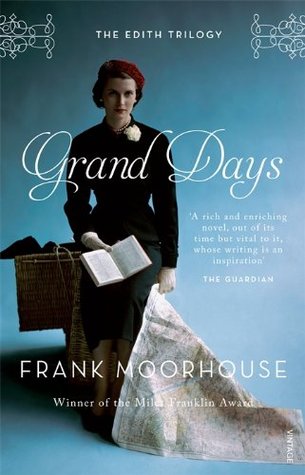
Grand Days by Frank Moorhouse

frank-moorhouse-pic
The Australian writer Frank Moorhouse

Here’s a little anecdote …

Frank Moorhouse and his girlfriend were lying naked in their back garden drinking wine and soaking up sunshine when the writer threw aside the book he’d been reading and exclaimed: ‘My God. Oh my God. Copyright is the key to all understanding. If you understand copyright theory, you understand the whole way the world works. It’s all there.’ 

It’s just a vignette. But in its composition and tone, it’s also a story which takes us to the heart of Moorhouse and his work. There’s the eye for sensual detail. The juxtaposition of the intimate and the abstract. The continuum between the big picture and the everyday. The intellectual energy at play amidst other pleasures. And, of course, there’s the delicious irony of a man lying next to his naked lover, inflamed with passion by legal prose.

         ‘Our man at cultural studies cliff face’, by Professor Catharine (2004): in Gleeson, Lumby and Bennett: Frank Moorhouse: a celebration, Canberra: National Library of Australia.

Nowhere is the above more illustrative than in this following scene, from page 198 of Grand Days (Volume 1 of The Edith Trilogy, The Vintage edition, 2011).

The Australian protagonist, Edith Campbell Berry, an administrative assistant with the League of Nations in 1920s Geneva, is in Paris with friends at a jazz club. She is enthralled by the music, especially scat singing which she perceives as a new kind of language with staggering potential; she’s a little drunk. She is also fascinated with one of the black musicians, Jerome in a bowler hat, who comes, invited, to the table and explains about scat singing. A little time later, on her way back from the Lady’s, Edith stumbles across the musician’s room and enters, discovering Jerome, alone. She offers him her hand which he takes and guides her onto his knee. Then this sentence…

Time and movement then become slippery, as she gracefully slid, seeing for the first time his caramel and cream shoes and without thinking too much at all about things, it seemed his warm dark hands were on her exposed and very alive breasts, which she felt she had delivered up to him; all seemed to happen in flowing fixed steps, something like a waltz, except they were not moving from where they were adhered together in this strange way, and without any guidance at all and in no time at all, and with no impediment, with no thought at all, warm, fleshy and flowing, it was finishing, and she took her lips, tongue, and gentle teeth away, opened her eyes and looked across the room to an open instrument case.

Here the mundane, ‘cream and caramel shoes’, ‘no thought at all’, and ‘an open instrument case’, juxtaposed with the sensual, ‘dark hands’, ‘breasts’, and ‘lips, tongue, and gentle teeth’ create something perversely human; although once the penny drops and you realise what she has just done the sensual flavours the mundane and ‘an open instrument case’ takes on a brand-new meaning entirely.

That quote is an apt example of free indirect discourse which has become the characteristic of literary modernism ever since Joyce knowingly used it, and understood it as a style, in his 1916 autobiographical work, The Portrait of the Artist as a Young Man. There are also examples of it in the works of Goethe and Jane Austin but it was Joyce who used it in such an obvious and effective way, as a literary tool, that it was subsequently taken up and experimented with by his contemporaries such as Virginia Woolf (To the Lighthouse, 1927), and now it is so widely used that it’s hardly noticeable anymore. Free indirect discourse, or experienced speech, or, as The New Yorker literary critic and academic, James Woods, calls it, close writing, allows the author two very useful authorial tools. Firstly, it gives the writer freedom to flit from character to character to give their different view of the scene, character, action, etc. A vivid modern example of this is Edward St Aubyn’s The Patrick Melrose novels (2012) where St Aubyn describes the (autobiographical) sexual abuse of his 4-year-old protagonist by his father from the boy’s and the man’s point of view. It’s as if the unnamed, god-like, all-knowing, third-person narrator flits from the mind of one character to the mind of the other. Secondly it allows the writer to use the language and tone of the character, the times, and circumstance to colour the narrative prose itself. Joyce’s opening to “A Portrait …” uses baby language – moocow, little tuckoo – not as dialogue for his baby protagonist, Stephen, but in the prose itself making it very clear, and without the necessity of saying it, that the boy is very young. By the end of the first chapter the narrative language is that of an intelligent, sensitive, and inquisitive school-boy which is what Stephen is at that time in the story.

If you read the Moorhouse sentence again – go on! Re-read it! – remembering that Edith is quite drunk, it is in language and tone (defensive) that she might have used if she was asked to explain what happened; the narrator’s prose is using the language of the circumstance, the situation, and the character.

Pre-Joyce, this rarely happened: the unnamed, god-like, all-knowing, third-person narrator was usually sage-like, mature, and distanced in time and character from the people and all the elements of the story. Dickens is a solid example of this.

Edith Campbell Berry is a sophisticated and complex creation, which was an entirely intuitive process, says Moorhouse, and her genesis began with his mother. Moorhouse has always been interested in social and personal politics, citing the liberation movements, both social and sexual, of the 60s and early 70s as having a transformative effect on him; and literary works such as James Baldwin’s Giovanni’s Room (1956) he found enlightening and greatly affected his understanding of his own sexuality. Edith is aware of her multiple histories, ambiguities, desires and even chaos in her personal life which is separate and guarded from her professional life which she is immensely proud and protective of. She is an idealist and believes “the League had the task of making the manners of the world.” Her personal life in Geneva is founded on her early meeting, on the train from Paris to Geneva as she travelled to take up her post, of Ambrose Westwood, a British diplomat who too works for the League and, with Edith’s knowledge and support, investigates his own predilections for cross-dressing – she loans him her best evening gown forcing her to wear her second-best on their first tryst to The Molly Club – and homosexuality, while remaining Edith’s lover and confidant. Moorhouse admits there is some of him in the character of Ambrose Westwood. Her exploration of her own desires is stimulated by his, but she is constantly aware of, and ruminates at length, on her perceived reputation at the League (Is she a ‘vamp’?) finding it imperative that both her personal and professional lives are kept separate, and rightly so: a consistent theme in Moorhouse’s work. However, while making little effort to curtail her exploits with Ambrose into the secret and steamier side of Geneva’s social life, she is in constant threat of being exposed. This tension propels the narrative where both fictional and real characters and events are mingled to create a fascinating picture of the personal, the political, and the professional in the early years of the League of Nations.

At every turn, Moorhouse suggests, the answer to the question of how to live lies in learning to live with ambiguity and resisting the impulse to bury the contradictions of being human behind reductive, authoritarian codes.

It’s a fascinating read and once you get to know Edith Campbell Berry you are even pleased with the novel’s length – it’s big – as are the two to follow – because you just want more of her, as do many of the characters in the books.

Dark Palace is next, followed by Cold Light. A lot to look forward to.

The ebook edition of Grand Days is available here through ibooks for $US10.99.


The Good People by Hannah Kent

Hannah Kent lic
The Australian Writer Hannah Kent

It is not all that long ago, 1994, that Frank Moorhouse’s Grand Days was disqualified from the Miles Franklin Award (Australia’s most prestigious literary prize because it was not Australian enough (he won the prize for its sequel Dark Palace (2000), which contains one scene set in Australia); apparently Australian literary sentiment has grown up since then, thank god – although the real problem lies from the rules of eligibility for the Prize . Here now is an Australian author, Hannah Kent, whose debut novel, Burial Rites (2013) was set in Iceland and now her second, The Good People, is set in Ireland: and still not a gum tree in sight. The only thing Australian about this book is its author; but that’s all that is needed, and rightly so, to herald Kent as a new, rising, and shining voice in Australian literature.

Kent paints time, place, and character through dialogue. The time is 1825 in rural, south-west Ireland where the Catholic Church is as powerful as ever but also where old Irish superstition and language is still rife and useful. All of this is established through how the characters talk: here a man comes to seek council from Nance Roche about his troubling dreams. Nance Roche is a wise woman who lives alone in a windowless, mud hut near the wood and who is said to have ‘the knowledge’.


‘Faith, what does it matter? I’d best be on my way.’

‘Sure, Peter, Go on home.’

He helped Nance to her feet and waited as she used the tongs to pluck a coal from the fire, dipping it, hissing, in her water bucket to cool. She dried the dead ember on her skirt, spat on the ground and passed it to him. ‘You’ll see no púca tonight. God save you on the road.’

Peter put it into his pocket with a curt nod. ‘Bless you, Nance Roche. You’re a good living woman, no matter what the new priest says.’

Here archaic English (“Faith, what does it matter?”), old Irish (púca means ghost) and Catholic salutation (”God save you on the road.”) all create the world of this novel: illustrative, complex, colourful, informative, and believable. The last because of Kent’s success at creating verisimilitude: the appearance of truth. You do not need to look up the meaning of púca; nor do you need to research the veracity of the use of the word ‘faith’ as an exultation in nineteenth century south-west rural Ireland; nor that the possession of a cool coal from the hearth of a bean feasa living in a mud-hut will soothe one’s dreams. As quickly as you read the lines the reader accepts this created truth because of the trust we readers place in the creator of such truth; when the real truth is that we are sitting in our reading chair scanning and finding shared meaning from little dark marks on a pale background. All hail our imagination and those that tickle it!

Kent has done her publisher proud: produced a novel with all the qualities of her first that prompted her global success and her publisher’s trust in her in the first place (it’s rumoured her earnings from rights, foreign publishers and the like, was $1 million); mid-nineteenth century far-western Europe in a valley of poverty, crime, women, faith, and fear, but with such differences that make it fresh and new, in tone, theme, crime, spine, and ending.

This is a story of three women: a new and bitter widow, Nora; a servant girl, Mary; and a feared and revered loner, Nance Roach; unwedded, unbedded, and therefore considered unworldly, but ironically, powerful despite the “fear of any woman who was not tethered to man or hearth.” In a society of family and neighbourily trust, tension and anger can boil quickly if livelihood is threatened: if cow’s milk is without butter, if a hen’s egg is yolk-less, or if a man falls suddenly dead, the inhabitants clutch at reasons, causes – be it four crows seen huddled together at a crossroads; lights seen bobbing on a fairy mound; or a cretinous child thrust on a widow who has no means to support it.

This is what happens to Nora whose motherless and afflicted grandchild is suddenly handed to her but who firmly believes it is the mischievous fairies, The Good People, who have taken her Micheál and left her one of their own. Her attempts to return the fairy to its own kind and see the safe return of her grandson is what propels the narrative to its tragic finale.

The belief systems, be it Christian or fairydom, give meaning to these ignorant people; the world is mysterious and explanations are needed for everything that ties them down, keeps them safe, or lifts them up. They need these causes of things to be certainties to allow them to get on with their poor and mundane lives; to keep planting their potatoes, milking their skinny cows, and harvesting turf to heat their hovels because their only other choice is to take to the road: the worst of outcomes.

Some readers have found the book depressing; yes, the story is sad, but the writing is evocative and succeeds is creating a vanished world, surreal almost, for the reader to get lost in so when the world of this valley is pushed into a civilized courtroom the reader too is confronted by the complexities and necessities of belief, survival, and what is true, good, and right.

I urge you to read this book. You can find it here.

My Brother, My Love & Other Stories

This collection of stories is now globally available here

This book is available for download with iBooks on your Mac or iOS device, and with iTunes on your computer. Books can be read with iBooks on your Mac or iOS device. Cost $6.99

This has been made possible through the Melbourne based publishing platform Tablo

In the coming months I will move my other publications from the American platform I’ve been using (smashwords) to this convenient and very user-friendly Australian platform.

If you are interested in writing and hassle-free self-publishing…

Give Tablo a Go.


Time Enough Later by Kylie Tennant


kylie-tennent-pic
Australian writer, Kathleen ‘Kylie’ Tennant.

There are many Australian writers that seem to have been forgotten: Miles Franklin, Christina Stead, Katherine Susannah Pritchard, Henry Handle Richardson, Ruth Park, and Kylie Tennant (Thank god Elizabeth Harrower has been resurrected from obscurity by Text Publishing).

Kylie Tennant (1912 – 1988) was hailed in 1935 as the new star of the Australian social-realist tradition with the publication of her first novel Tiburon, a three-pronged story of a small mid-west New South Wales country town and its life and loses. This was followed in 1939 with Foveaux, which translated the themes of Tiburon to the inner-city suburb of fictitious Forveau, identifiable as the Sydney suburb of Surry Hills. Her reputation peaked in 1941 with the publication of her best known work, The Battlers, which deals with the itinerant unemployed who tramp the back-roads of the countryside when war breaks out in Europe in 1939. It also secured her an international reputation and is still her best-known work among Australians. A television series of Ride on Stranger (1943), her fourth novel, in 1979, starring Noni Hazlehurst and Liddy Clark, sparked a brief revival but unfortunately Kylie Tennant has slipped from the literary landscape.

Her third novel, Time Enough Later (1942), is a departure, in that it is more light-hearted – almost (but not quite) a comedy – than her first three novels which were a serious look at the working underclass, but also a continuation of her development as a writer as it is the first to feature an independent woman and her unconventional choices, a theme she continues and masters in the novel that followed, Ride on Stranger.

 Time Enough Later is a light, slip of a story of a young girl’s discovery of an agreeable alternative to men: agriculture. Bessie Drew grows up in the inner-city Sydney suburb of Redfern. She is “unfashionably wholesome, sensible, and unselfconscious.” Her squabbling family, especially her hard-done-by mother and alcohol and temper ridden father, force her to set her feet on a different path to an unknown but adventurous future. She forms a tenuous relationship – part amorous, part professional – with a cad of a man, Maurice Wainwright: a theatrical, selfish, ego-maniac; a con-man who has a talent for photography, sets up a studio with Bessie’s self-sacrificing help, and establishes a reasonable living and reputation but without the work-ethic to make it a continuing success. Into Wainwright’s coterie of Bohemians, performers, and socialists comes Esther, a free-thinking loner who lives in the country and continually urges Bessie to come and see her place. This she finally does to house-sit for Esther as she travels on one of her botanical/zoological expeditions. Bessie takes the whinging and whining Maurice with her and all is set for what we would call in times between then and now, a ‘dirty weekend’. The seduction is a failure – a “disconcerting mixture” of Maurice’s self-possession; the normalities of the rural night – strange noises from out of the quiet, moths the size of dinner-plates, and a lumpy bed; and Bessie’s “unconventional matter-of-factness which strikes her would-be lover as exasperating stolidity”. But it’s Bessie’s plain-speaking that undermines Maurice and precipitates the slow and floppy end to their ‘affair’.

“I don’t see what you’re getting so mad about,” Bessie went on patiently. “If a thing doesn’t work, what’s the use of wasting time on it? Here’s twice we’ve had this hoo-doo on us. And it just looks like the idea is no good … Don’t think I’m not fond of you. But it just seems a waste of time getting all stirred up when it’s just as easy not to get stirred up.”

But what does grab city-raised Bessie’s interest is the countryside. Her eyes are opened to a possibility, and a place, that had never occurred to her. She had always thought of Esther as a “lonely and disappointed woman who put her passion into a wild hermitage, wilfully withdrawing into the desert.

Yet here was the desert flowering like paradise in a glory of red and gold. The trees, the earth, the smell of the leaves, stirred Bessie as none of Maurice’s ideas, none of his talk about beauty and art had done. This place talked a language of long thirst and survival, of struggle and rain and the bite of weather. Something in her knew this language; and the old restlessness clamoured as it had never done before – not Archer Street, not the studio – this place.”

Margaret Dick in her slight 1966 volume, The Novels of Kylie Tennant, almost apologises for the slapstick, the humour, and the ‘lightness’ of the theme, as if such novelistic considerations are beneath Tennant’s talent. However the success of Time Enough Later lies in the novelist’s expert handling of these difficult, and unlikely scenarios. It’s not easy making a believable failure of a sexual seduction by a selfish roué; nor is it a mere trifle to make the offerings of a rural existence, toil and thin-reward, a believable alternative for a young girl from a society which has already set her future: a future she sees as aprons, children, and the gray, grime, and gossip of Redfern. Tennant’s descriptive passages of the rural setting, nature, a threatening bushfire, and the simple rewards of husbanding chickens and ducks, rhubarb and radishes are beautiful, alive and even tantalising. You can well understand, and believe, Bessie’s attraction to such things. Light the story may be but the writing is assured, entertaining, and masterful.

Know Them While You Can

elizabeth_harrower_pic
Australian writer, Elizabeth Harrower

Recently I was alarmed by an article in The New Yorker (October 20 2014) entitled No Time for Lies: rediscovering Elizabeth Harrower by my favourite literary critic, James Woods. It was not the title that alarmed me, it was the opening line of Wood’s article:

“The Australian novelist Elizabeth Harrower, who is eighty-six and lives in Sydney … “

What!? Who!? I had never heard of Elizabeth Harrower, much to my shame, and the fact that she was still alive added, curiously, to the urgency to find out more.

Several of her novels were published in the 1950’s but she withdrew her last novel, In Certain Circles, in 1971 on the death of her mother. She was “frozen” by her loss, besides, as she says, I was “very good at closing doors and ending things. . . . What was going on in my head or my life at the time? Fortunately, whatever it was I’ve forgotten.” How quickly readers forget: by the 1990’s all of her work was out of print.

Then in 2012 Michael Heyward and Penny Hueston of Text Publishing ‘re-discovered’ her and began re-publishing her work, The Watch Tower (1966), considered by some to be her greatest novel; “Down in the City” (1958), her first work; then The Long Prospect (1958), her second; followed by The Catherine Wheel (1960); and then Heyward managed to persuade her to let him have In Certain Circles (1960), completing the re-issue of her entire work. To this collection Text added, in 2015, a small collection of short fiction, A Few Days in the Country and other Stories, which includes the story, Alice, published in The New Yorker in 2015.

“Harrower’s writing is witty, desolate, truth-seeking, and complexly polished,” writes Wood and although he admits her themes are somewhat repetitive (a young girl bends to coercion and cruelty in a stifling and misogynist era) “her sentences, which have an unsettling candor, launch a curling assault on the reader, often twisting in unexpected ways. And … her prose is full of variety.”

“I want to argue that Elizabeth Harrower is on a par with Patrick White and Christina Stead, who would be on anybody’s list of postwar literature giants in Australia.” Michael Heyward, Text Publishing.

The Watch Tower “reminded me of Zola in its unflinching depiction of two sisters entangled with a moody, violent man … It is a brilliant achievement.” Michael Dirda, Washington Post.

“I seized on Elizabeth Harrower’s The Watch Tower, originally published in 1966. What a discovery! Harrower’s voice in this book is disconcerting at first: almost fatigued, as though she knows that everything to come is fated to be so and there’s little to do but tell the story.” Nicole Rudnick, managing editor, The Paris Review.

“The writing is just fantastic. I couldn’t believe I had never heard of her before,” Irish writer Eimear McBride told The Guardian. “Australians have their F Scott Fitzgerald in Elizabeth Harrower.”

Elizabeth Harrower was born in 1928: know her while you can.

Elizabeth Harrower is published by Text Publishing

***

gerald_murnane_pic
Australian writer, Gerald Murnane

I recently set aside prejudices and inaction and knuckled-down and worked out how to use twitter; but, someone said, you’re a bit late, as usual, twitter’s on the way out. Is it? Anyway, I find it very useful. I follow all the literary magazines I can’t afford to subscribe to and whenever I get a tweet that interests me I click on the link and there is the article in full. Magic! This happened recently when I got a tweet from The Paris Review (despite its name it comes out of New York) about Gerald Murnane. I know that name, I thought. Why do I know that name?

He too is a mostly unknown Australian writer (although that is quickly changing) who lives in Goroke, a small Wimmera town in the west of the Australian state of Victoria.

Paul Genoni, Associate Professor, Faculty of Media, Society and Culture at Curtin University, Melbourne said in his 2014 review of Murnane’s The Plains (1982) that the opening could very well be the best in Australian literature:

“Twenty years ago, when I first arrived on the plains, I kept my eyes open. I looked for anything in the landscape that seemed to hint at some elaborate meaning behind appearances.

“My journey to the plains was much less arduous than I afterwards described it. And I cannot even say that at a certain hour I knew I had left Australia. But I recall clearly a succession of days when the flat land around me seemed more and more a place that only I could interpret.”

And here is Gurnane’s opening line from his latest work, Border Districts (2016),

“Two months ago, when I first arrived in this township just short of the border, I resolved to guard my eyes and I could not think of going on with this piece of writing unless I were to explain how I came by that odd expression.”

The first, “I kept my eyes open”; the second, “I resolved to guard my eyes…” Seeing or not-seeing is a recurring theme in Murnane’s work.

“Murnane’s work has always been a world in which what we see never exists in isolation, so that its reality is only fully understood in relation to what the writing tells us we cannot see.” Will Heyward, writer and editor, New York.

 Gerald Murnane won the Patrick White Award in 1999; the Melbourne Prize for Literature, 2009; and the Adelaide Festival 2010 Award for Innovation in Writing. His work has been translated into Swedish and Italian.

“The Australian Gerald Murnane, a genius on the level of Beckett, is known in Australia and Sweden but almost nowhere else.” – Teju Cole, an American writer of Nigerian parentage. He is currently the Distinguished Writer in Residence at Bard College.

“Murnane is a careful stylist and a slyly comic writer with large ideas. I know it’s the antipodes, but it’s hard to fathom why he isn’t a little better known here [the USA].” American critic and scholar, Robyn Creswell who joined the Comparative Literature Department at Yale in 2014.

“If you want the supreme triumph of Murnane’s method read Inland (1988), which he has admitted is the God-given book, a work that dazzles the mind with its grandeur and touches the heart with a great wave of feeling and brings to the point of maximum reality the grave and soulful preoccupations that run through every bit of fiction Murnane has ever written.” Peter Craven, Sydney Morning Herald, June 2014.

There are rumours that Murnane has never been in an airplane; he hasn’t watched a movie in decades; keeps meticulous files on his everyday life; and that Border Districts will be his last work of fiction.

Gerald Murnane was born in 1939: know him while you can.

Gerald Murnane is published by Giramondo Press and Text Publishing .