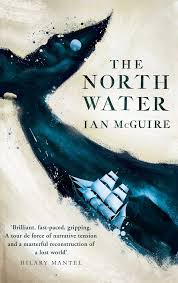
The North Water by Ian McGuire

Ian McGuire pic
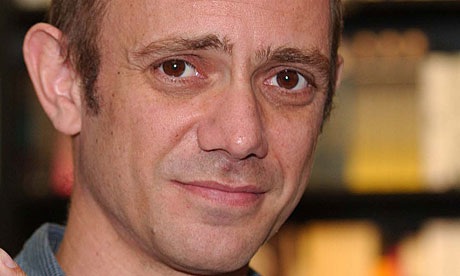
English academic and writer, Ian McGuire.

Since 1996 Ian McGuire has been at The University of Manchester initially as a lecturer in American Literature and more recently as a lecturer in Creative Writing. He now co-directs the Centre for New Writing. His first novel, Incredible Bodies, “very funny and disconcertingly sad” said The Times; a contemporary campus novel was published by Bloomsbury in 2006. He specialises in the American realist tradition; Melville, Conrad are evoked in The North Water, his second novel (2016), and not just because it is set on a whaler. However the tone is most-certainly modern, mainly because of the very modern ‘foul’ language: he pulls no punches.

McGuire’s notable reviewers of The North Water, Hilary Mantel, Martin Amis, and Colm Tóibín, have written repeatedly about his “narrative tension” and his “remorselessly vivid” prose but when the writer writes narratives, each stuffed with its own tense detailed vividness: the brutal murder, then rape of a street urchin; the evisceration of a screaming sepoy; a face blown away with musket-shot; an arm ripped from a man’s torso by a ravenous polar bear; that same creature killed with a harpoon to the spine; the slaughter, dismemberment, and carving up of whales and their blubber; the medical inspection of a ravished anus; oh, and a whoring piece of low-life who sniffs then sucks his filthy fingers just “getting his final money’s worth”, all one needs to do is describe all this simply and accurately and ‘remorseless vividness’ is what you’ve got. I’m not at all deriding McGuire’s work, quite the opposite, but when your material is as rich, rare, and image-encrusted as any material can get, describing it simply is what a talented writer must do; and he does.

The tale, circa 1859, is one of a whaling expedition from the sludge of the Humber estuary, northeast England, to the whiskey ‘n’ women – each at a shilling a pop – in Lerwick of the wind-blown Shetlands, then north, and north again, and as far north as one can possibly go, beyond the Arctic Circle to the North Water, northwest of Greenland, in a boat packed with foul-mouthed vagabonds, murderers, liars, rapists, brutish thugs, opportunists with grudges; where life is a drudge, full of excrement, gore, and blood; where death is as easy and as light as a penny; where killing is a chore after your porridge, and where one shits first or is forever shat upon. Get the picture?

All ye who must like your book’s characters keep well away from this one.

But, yes, it is one of the most pleasurable reads I’ve had in a long time. This is where literary fiction meets plot and the latter comes up trumps; ah, but oh how sweet a brutal plot can be when it’s dressed in literariness and style such as this!

There are two main characters, Henry Drax, a villain of “pure evil” if there ever was one – we see him in all his ‘gory’, literary; and Patrick Sumner, a disgraced surgeon from his days serving the Raj in India, where a simple miscalculation under fire shatters his reputation. These two misfits, one with a shadow of redemption, the other, with absolutely none, lock horns on a fatal voyage where whaling may or may not be the ultimate goal: no spoilers here.

McGuire uses an omnipotent third-person narrator with no literary qualms about swapping POVs; all for going where the narrative takes him. (See my previous post of The Filth Heart, where the writer, Dan Simmons, abounds in such undermining qualms). The pace is fast and engaging but for brief passage of short but dense and fascinating description. A great read!

Highly recommended.

Sherlock Holmes, where are you?

Sherlock Holmes, invented by Sir Arthur Conan Doyle in 1897 in A Study in Scarlet, keeps popping up again and again; a contemporary television series “Sherlock” (2010) starring Benedict Cumerbatch, and a movie franchise “Sherlock Holmes” (1: 2009, 2: 2011, 3: in development) starring Robert Downey Jr. and Jude Law. Now he appears in two celebrated novels.

The Fifth Heart by Dan Simmons

The Fifth Heart Cover pic

Fiction, by its very definition, is the process of “imaginative narration” or “a composition of non-factual events” and accordingly enables writers to create, to ‘make up’, whatever the hell they want. It is a little incongruous then that most readers seem to want to read stories that are familiar, plot driven (literary fiction is on the decline) and with an ending that is expected and therefore satisfying. I think it is fair to say that all stories can be whittled down to the good guy wins, the bad guy looses or, as Oscar Wilde has Miss Prism say about her three volume novel she wrote in her youth, in The Importance of Being Earnest, Act 2, Scene 1, “The good ended happily, and the bad unhappily. That is what Fiction means”.  However fantasy and science fiction, extremely ‘made up’ narratives, are among the top five most popular literary genres. Still within their contexts what is familiar (treachery, jealousy, love, betrayal, and relationships) is still what is expected.

Dan Simmons pic

Dan Simmons is one of the few novelists whose work spans the genres of fantasy, science fiction, horror, suspense, historical fiction, noir crime fiction, and mainstream literary fiction. His books are published in 29 counties.

I first encountered Dan Simmons with his novel, Drood (2009), his re-invention of Dickens’ last and unfinished novel, The Mystery of Edwin Drood. I didn’t finish it. It had nothing to do with Dickens and I have very little time for horror/fantasy. However, with The Fifth Heart (2015) I was prepared to ‘swallow’ whatever Simmons ‘made up’; and he makes up everything except the names of his two main characters, Sherlock Holmes, a made up character himself, and the novelist, Henry James, a real person.

It is clear from page one that the reader is well and truly in Dan Simmons territory: Henry James, the famous American expat novelist (and real person once upon a time) is approaching 50, in Paris, depressed, and plans to kill himself by throwing himself into the Seine under Pont Neuf. Not surprisingly he is thwarted in his suicide attempt (it doesn’t take such Holmesian logic to realise that Henry James’s name is on the front cover and this is only page 4) by a Norwegian explorer who James instantly recognises as Sherlock Holmes (you know, the literary character invented by Sir Arthur Conan Doyle) despite the disguise (wig and puttied nose); despite the dark and misty night; despite the fact that this is 1896 and Holmes, the fictional character, has been dead for 3 years, having been killed off in the last of the Holmes published mysteries, The Adventure of the Final Problem published in 1893 which saw Holmes tumble over Switzerland’s Reichenbach Falls in the deadly grip of his arch-foe Moriarty. The bodies were never found. Ha! Oh, Henry James shrugs off all these discrepancies, and Simmons expects us to do so too, since James remembers meeting Holmes at an afternoon soirée at the home of his good friend Mrs. O’Connor four years before. Holmes is also contemplating suicide because he is worried that he may not be a real person; he only “feels really alive” when he is on (read “written into”) a mystery. This is real fiction I keep reminding myself and I promised myself I would keep my disbelief at bay and go along for the ride…that is what readers of fiction are supposed to do.

The mystery, “The Mystery of the Century” as the quote on the jacket cover reassures us concerns a group of friends, known affectionately as The Five Hearts, and known well by Henry James. One of them, Clover Adams, The Fifth Heart, committed suicide two years prior to the action but on every anniversary of the death, the remaining members of the group all receive a type-written card announcing unsubtilely “She was murdered.” Holmes coerces James to accompany him to the USA to help solve the mystery.

A novel is within its own universe; and this universe may or may not be the universe of the reader. This is most obvious is the genres of horror, science fiction, and fantasy; in fact it is possible, and easy, to argue that the universe of a novel is never that of the reader.

In the same sense that the stature of David had always existed in the massive block of stone that Michelangelo and Leonardo da Vinci fought over and Michelangelo, who obviously won the fight, simply had to remove the outer, and superfluous, rock to reveal the image of the boy, a story can also be thought of as having happened in all its detail, nuances, and meaning and someone just needs to tell it; to write it down. This is exactly what happens in journalism, history writing, and memoir. There is also a sense of this in all forms of fiction

Let us assume that I write a story about an astronaut who develops bowel cancer. This would be a very rare, and unlucky, even ironic, occurrence since all astronauts, before donning their space suit, for rehearsal, training, and the actual space travel itself, must undergo an enema; if you wanted an occupation that would guarantee you a healthy bowel, especially if your family history was riddled with unhealthy ones, then astronaut would be the job for you. Now, my story hangs on this one event: the tragedy of my protagonist who contracts a life-threatening disease, the one he was convinced would never happen to him and how he comes to terms with his own mortality even though he is the healthiest, most positive, most enthusiastic, fearless, and life-loving person he knows; he’s walked in space, for Christ’s sake, to repair a faulty solar energy unit while conducting experiments on neutron absorption, and stood on the moon watching the Earth rise. He deserves to live.

The last thing I want my reader to do is to rush to his computer and Google ‘enema+astronaut’ to verify that astronauts do indeed undergo enemas before they don their space-suits. I want my reader to accept that in the universe of my story, which may not be his/her universe, astronauts do undergo enemas before climbing into their space suits. By the way, I have no idea if astronauts have enemas or not; I made it up, but it’s not a difficult idea to accept; it’s plausible, in the universe I have created for my story; but my point is that it doesn’t have to be plausible it just has to be acceptable.

In the universe of The Fifth Heart people that actually existed in the reader’s universe (Henry James, William Dean Howells, and Samuel Clemens – yes, Mark Twain makes an appearance) rub shoulders, have dinners and arguments, and go on mystery-solving adventures with made-up characters from other literary universes, ie, Sherlock Holmes, and even he doesn’t know if he’s a real person or not. I find this very hard to accept; I know I should, but I can’t; and that’s why I stopped reading it.

Mr. Simmons also makes a novelistic mistake: he breaks the ‘fourth-wall’ and has his narrator address the reader directly.

“Wait a minute. The reader needs to pardon this interruption as the narrator makes a comment here.” (Who is speaking here? If it is the narrator surely he would say “The reader needs to pardon this interruption as I make a comment here.” This is another narrator! (Oh, picky-picky!)

This would be fine, and normally acceptable, if it is necessary, but it is not. Simmon’s narrator is not a character in the story, he is an un-named voice and like most un-named narrative voices, is all-seeing, all knowing, omnipotent: god-like. Mr. Simmons allocates almost a whole chapter to his narrator to apologise to the reader for switching the narrative’s point of view from Henry James to Sherlock Holmes when it is an acceptable tradition in fiction writing that an omnipotent narrator can change the POV whenever it is necessary. There are many novels that do this, the Patrick Melrose novels by Edward St Aubyn for example (see my blog post of October 6, 2014): St Aubyn’s narrator jumps around all over the place. The reason for Simmons doing this is that he may have never done this before and he felt that he owed it to his loyal readers to explain what he is doing; or, maybe, that is what distinguishes literary fiction from other genres; or, maybe, it is the publisher/editor speaking. Oh! Never mind!

Mr Holmes by Mitch Cullin

Mr Holmes Cover pic

The universe of Mitch Cullin’s Mr Holmes is unsullied. We meet the ageing Holmes (a real person in the same universe first created by Doyle) in the twilight years of his life, in 1947. He lives in a little cottage in Sussex tended by a saddened widow, Mrs Munro, who lives next door with her young delightful son, Roger. Mr Holmes has become quite an expert at bee-keeping and despite his curmudgeonly demeanour forms an affectionate attachment to the intelligent lad who shares his fascination and love of bees.

The story has three narrative lines: his quiet and, seemingly, idyllic life in the country, tending bees with Roger; a trip to Japan, from which he has just returned, where he was invited by another bee-keeping enthusiast, Mr. Umezaki who lives with his dour mother and male partner in Kobe; and an unsolved mystery, from the zenith of his career, which Holmes has been writing, but which needs a resolution and which the young Roger finds buried on Mr. Holmes’ cluttered desk and begins to read: The Glass Armonicist.

An armonica is a musical instrument consisting of glass discs of increasing diameters on a single shaft which when spun produce, via friction, notes of calculated tones. An armonicist is a player of such an instrument.

These three seemingly unconnected narratives coalesce due to a tragedy that rocks not only the ageing detective’s sense of himself but also gives him an understanding of life and love that he didn’t know he needed. This is literary fiction at its best: intriguing, beguiling, and satisfying.

Mitch Cullin pic 3

Mitch Cullin is an American writer, born in 1968; he has written seven novels and shares his time between Arcadia, California and Tokyo Japan.

A screen adaptation, Mr. Holmes, was produced in 2015 starring Ian McKellen, Laura Linney, and Hiroyuki Sanada.

High Fidelity by Nick Hornby


Nick_Hornby_pic
British novelist and screenwriter, Nick Hornby.

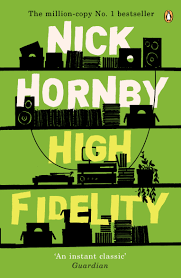
High Fidelity (1995) is about an English self-pitying dead-sh*t and pop music tragic called Rob Fleming, (sorry about the coy symbols but I suspect my blog master has a ‘language’ filter) who runs a second-hand record (as in vinyl) shop stocking music that no-one, well only 3 people actually, wants to listen to and treats sex with women as doses of analgesic for his bouts of self-loathing depression. I suspect that Hornby created Rob as a way to get real a*sehole straight hopeless pr*cks to read books. Considering Hornby’s success I might be right. So what is a 60-something gay man living on a tropical island doing reading old English popular fiction, lad-lit, about straight a*sehole losers? Hornby-curious. He’s successful and was recently Oscar-nominated for his screen adaptation of my literary hero, Colm Tobin’s novel, Brooklyn. He did a good job although it wasn’t Oscar material. Besides, I found it in a pile of books someone else was throwing away.

And if you haven’t heard of Nick Hornby you might just be back from 35 years on Mars.

In an attempt to find out why his life is so meaningless and lonely Rob Fleming embarks on a quest to find his five most devastating and sadistic dumpers (He’s into lists), Alison, Penny, Jackie, Charlie (no, a girl), and Sarah to ask them why they did it – he’s always the dumpee; oh, and why does he want to do this? Because his latest live-in, Laura, has just dumped him (See!) for his neighbour, Ray, he of the loud and long upstairs orgasms, and he’s worried a pattern is forming. “Doh!” as another straight, and also fictional, but animated, a*sehole loser would probably say. Yes, if Homer Simpson had a back story it would be a little bit like Rob Fleming’s, only funnier.

But Hornby did made me laugh, several times, but he confirmed my view of 30-something single straight men who navel-gaze without a clue what they’re looking at, as deserving to remain single and f*cked-up since the women they want are exactly the women who are sensible enough, or should be sensible enough, to avoid them.

Rob also thinks he’s a typical (and therefore acceptable) bloke because he doesn’t remember anyone’s birthday, except his own, and is so self-deluded that he imagines his most recent ex-lover, the sensible but messy Laura, getting together with his parents to organise a massive surprise birthday party and then literally gets upset that they didn’t tell him.

Hornby made me re-think the oft repeated, and usual female line (why is that?) that ‘you can’t like a book if you don’t like the characters.’ Rob Fleming isn’t nice. I would ‘run a mile’ if I found Rod Fleming sitting at my lunch table: I’d certainly seat him at the other end of it. Yet, Hornby, makes him self-deprecating enough and helpless enough to make you wish he would find some sort of redemption, some one to take him on, someone to pay his bills, and someone to wipe his nose and tell him that everything will be all right in the end.

And when he finally gets “a shag” with an American B-grade country-rock singer that people have actually heard of, no less, he worries all through the deed if he is doing it right: no-one ever told him about G-spots, nor those ‘tad-pole things’, and what ‘good in bed’ means … and then he worries about worrying. He’s f*ck’d!

Eventually he manages to get one of his dumpers on the phone.

“Have you got, you know, kids and stuff, like everybody else?”

“I could’ve had them if I’d wanted them. I’m too young, and they’re too …”

“Young?”

“Well, yes, young, obviously,” – she laughs nervously, as if I’m an idiot, which maybe I am, but not in the way she thinks – “but too … I don’t know, time-consuming, I guess is the expression I’m looking for.”

I’m not making this up. This is how she talks …

Well, Mr. Hornby, you are making this up, but giving the narrator, Rob, this to say is a little cute novelistic trick to make novelistic truth (verisimilitude) feel like real truth; the kind of truth that tickles and stimulates the reader’s suspension of disbelief so you laugh or cry at exactly the moment that the author wants you to. You may have also picked up the tone, a kind of skatz that makes you feel that all this must be true since it’s so ‘conversational’ and ‘who would make up stuff like this anyway?’ and, besides, he tells you everything! He makes you feel like you’re his best mate, so, therefore you have to like, and believe him; which is exactly what skatz is meant to do.

Does it all work? Yes! By the time he gets around to the proposal (and I won’t be mean enough to tell you which dumper gets it) I was with him all the way. It’s not the down-on-one-knee proposal (he’s never been that kind of guy, and if he was that kind of guy and found himself kneeling before her he wouldn’t be thinking of proposing, he’s be thinking of oral sex – and why not, while I’m down here) but it’s funny, cute, dorky, sweet, cringe-making, charming, and well-written, as is her reply, er, replies. Yes, it’s kind of a romance for blokes; and as the final scene unfolds, a bit like in a movie, you’ll be smiling all the way to the last page. Cue music, “Got to Get You Off my Mind” by Solomon Burke, as the ex-dumper smiles across a bopping music crowd at the ex-dumpee. A-a-h! Fade to black. The End.


Between You & Me: Confessions of a Comma Queen by Mary Norris

Mary-Norris-pic
Mary Norris, the New Yorker’s Comma Queen

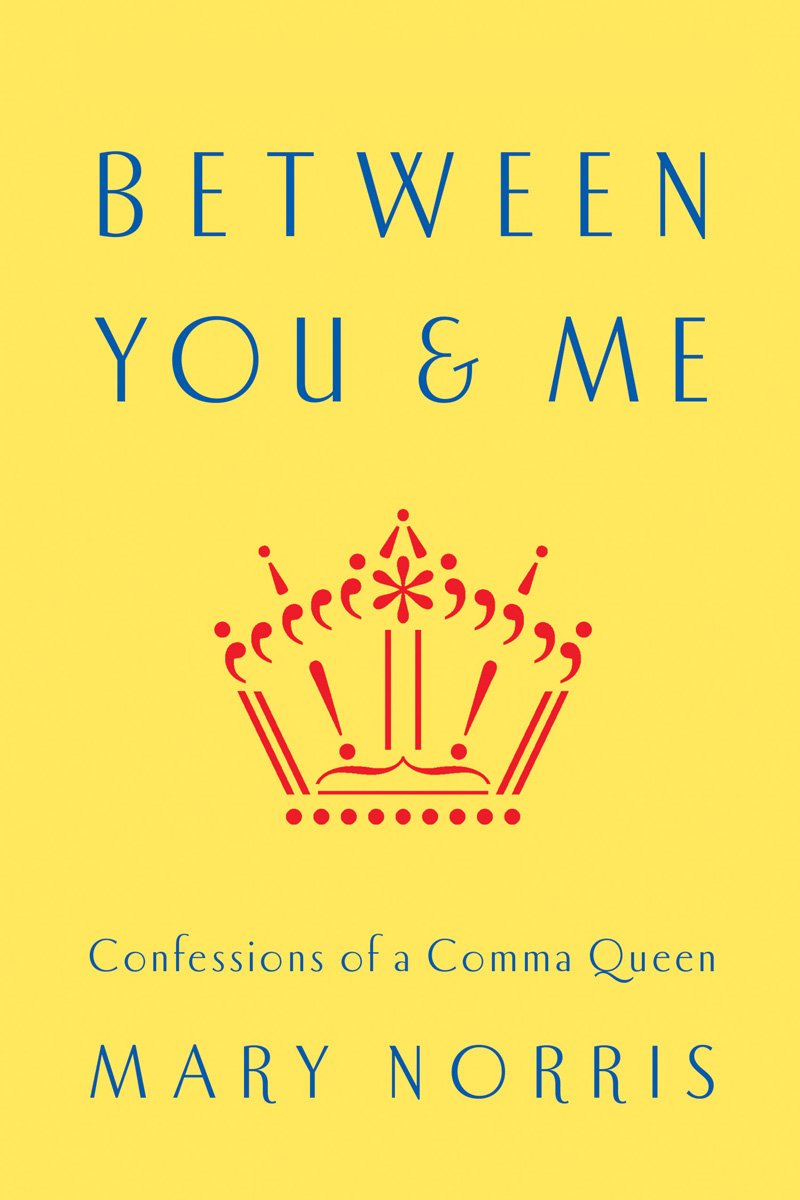
Punctuation may not be the most riveting of reading matter but for those of us who ‘get off’ on grammar, it’s a small diversion. Marry Norris has been working at The New Yorker since 1978 and her revelations of how the magazine works, and the characters who work there, are fascination enough. However with chapters called “Comma Comma Comma Comma, Chameleon” and “A Dash, A Semicolon, and a Colon Walk into a Bar” you know that her tongue is firmly in her cheek. However I do note that in her few pages on ‘the serial comma’ (some call it the Oxford comma, named by them who decreed it should be used, but it is used more by the Americans than the British), that’s the one before the ‘and’ in a series (or list), she is rather snobbish about its use:

Chances are that if you use the Oxford comma you brush the crumbs off your shirtfront before going out. The British get to have it both ways: they deride us Americans for our allegiances to a comma that they named and then rejected as pretentious.”

If you don’t use the Oxford comma you run the risk of the following, “This book is dedicated to my parents, Alan Jones and God.”

I didn’t “laugh out loud” as the jacket cover said I would (although you might in her chapter on symbols, F*ck This Sh*t), but I certainly had a constant smile on my face; except when it came to the hyphen.

I use these rarely except in a compound word (a made up word) like in the phrase ‘a comma-bashing critic.’

A bird-watcher is a watcher of birds; a bird watcher would be a bird that keeps an eye on things.”

As for the dash, a long hyphen, I never use it and never see the need to; commas will do very nicely.

I did enjoy finding out about something new: the diaeresis (pronounced ‘die heiresses’), also spelt dieresis. It is those two little dots over the vowel to denote the beginning of another syllable; for example, naïve, Charlotte Brontë, and coöperation (see Mary, I use the Oxford comma). Not to be confused with the German umlaut which denotes a change in the vowel’s pronunciation.

It is often said that texting will be the death of punctuation, if not spelling; but I don’t think so as long as there are people who punctuate their texts.

Punctuation was invented to facilitate reading aloud: from the pulpit originally. However we do this rarely these days and so the use of punctuation can often be individualistic; and if so all that Mary asks is that you be consistent.

Anyway the bottom line is that punctuation to prose is like music to film: it should never overpower that which it is there to enliven.

Brooklyn by Colm Tóibín

The Irish writer, Colm Toibin
Irish writer Colm Tóibín

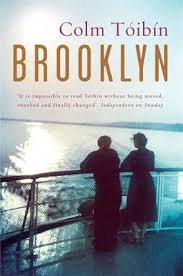
On Colm Tóibín’s website under ‘Essays” is a short story called “House for Sale.” It was written decades ago and attempts to recreate the atmosphere and situation of late 1967 when Tóibín’s father died and he and his brother were left alone in the house with his mother. Early in the story a nosy neighbour comes to visit and relates a story of two Irish men who meet in a hospital ward in Brooklyn. They discover not only that they are from Ireland, and not only from the same county, but from the same town. This obviously got Tóibín thinking about immigration and in particular the Irish kind of immigration: what is it you want by leaving and what is it that you leave behind? As a result of this digression another novel was born, Brooklyn (2010). This is the opening paragraph:

Eilis Lacey, sitting at the window of the upstairs living room in the house on Friary Street, noticed her sister walking briskly from work. She watched Rose crossing the street from sunlight into shade, carrying the new leather handbag that she had bought in Clery’s in Dublin in the sale. Rose was wearing a cream-coloured cardigan over her shoulders. Her golf clubs were in the hall; in a few minutes, Eilis knew, someone would call for her and her sister would not return until the summer evening had faded.

The language is simple – it is hard to imagine it being simpler – but contains a wealth of information. This is going to be a story about Eilis. Her sister works but she does not. Rose has her own money: she has taste and buys leather handbags in the sales in Dublin. She also plays golf, golf clubs are not cheap, and she is part of a crowd that Eilis is not; and the flit into the future makes it clear that this is a routine. Rose works but also parties, and parties late, eats and drinks at clubs, while Eilis does none of these things, she stays at home gazing at other people’s lives from a window.

By the way, the short story eventually became chapter one of his 2014 novel, Nora Webster.

What interests Tóibín is how the immigrant changes, not through any conscious decisions, but merely through contact with the strange and how that strange becomes normal by the immigrant adopting it as a matter of course; and this change is only evident if and when the immigrant goes back home. This is what happens to Eilis Lacey. She goes; she changes; she comes back; she is forced to choose. This provides a neat bi-line for the current movie adaptation of Tóibín’s novel: two loves, two countries, one heart.

Saoirse Ronan Brooklyn pic
Saoirse Ronan as Eilis Lacey in Brooklyn

The film, directed by John Crowley, with a screenplay by Nick Hornby, stars Saoirse (Ser sha) Ronan who you might remember as the 13 year old girl, Bryony, who gets it so so wrong in the film adaptation of Ian McEwen’s Atonement. Ronan, Hornby, and the film are all nominated for Oscars in this year’s awards announced on February 28th.

Having just read, and reviewed Marlon James’s A Brief History of Seven Killings (see previous blog February 6) I was curious to know why one award winning author left me unmoved (James) while another (Tóibín) had the opposite effect.

Tóibín places one character at the centre; his third person narrator describes her feelings, emotions, indecisions, prejudices, desires, faithfulness, and faithlessness in the simplest terms possible, even when the character herself is not aware, or does not understand them. He does this with no other character. Everything is seen through her eyes, her prism. It is as if the narrator is sitting close on her shoulder, spying on her thoughts, seeing everything from her point of view; it is the closest to a first person narrator as a third person narrator can get.

“When she returned she realised that Father Flood had heard about her job at Miss Kelly’s.” Tóibín could have left it up to the narrator to simply say ” Father Flood had heard about her job at Miss Kelly’s.” But he does not do this, we get the information through what Eilis does; how she sees it. His language is formal, no contractions, and straightforward which enhances his authority and leaves our emotions vulnerable and easily affected. However plot points are not obvious. We know all her misgivings, prevarications, fears and hopes; is she in love with Tony? She almost has to talk herself into it, but it is Tony’s reaction to her rehearsed confession that convinces her; but does she really?

 “…and the next time if you tell me that you love me. I’ll …”

“You’ll what?”

“I’ll say I love you too.”

“Are you sure?”

“Yes.”

“Holy shit! Sorry for my language but I thought you were telling me that you didn’t want to see me again.”

She stood beside him looking at him. She was shaking.

“You don’t look as though you mean it.”

“I mean it.”

“Well, why aren’t you smiling?”

She hesitated and then smiled weakly.

“Can I go home now?”

“No. I want to jump up and down. Can I do that?”

“Quietly, ” she said and laughed.

He jumped into the air waving his hands.

All of Tóibín’s Irish characters come from his hometown, Enniscorthy, in Wexford, southeast Ireland. He knows these people but by putting them into unusual surroundings (Eilis in 1950’s New York: Katherine Proctor in Spain, The South; Richard Garay in Buenos Aires, The Story of the Night; Nora in widowhood, Nora Webster) he delights in seeing them falter, challenged, confronted, but ultimately surviving; getting through it all, if not unscathed.

Tóibín is not long on descriptions. In Nora Webster, no descriptions at all! However a sense of place and time is effectively created through fashion and behaviour of the day: the prices and availability of things, the New York Irish attitude to Jews and Norwegians; when coloured women are first served in department stores; the morality of dating, dancing, and music; and what your job, clothes, and choice of words say about you.

It is a romance, a tale of dislocation, of loyalty and belonging, and the meaning of ‘home’. It is also a bloody good read. You may guess the ending but you will not guess how it happens.

A Brief History of Seven Killings by Marlon James.

Marlon James pic
Jamaican writer Marlon James; winner of the 2015 Man Booker Prize for his third novel A Brief History of Seven Killings.

When I heard that the Man-Booker Prize had been announced I quickly Googled it – I was between classes and so I had to be quick, then Googled “Marlon James”, found the ebook on Amazon, and read the first page; or as much as I could in the time that I had. I got excited and quickly texted my sister, a keen reader, in the Barossa Valley to tell her the news and share my excitement. It was a new voice. I downloaded the ebook as soon as I got home.

Reading A Brief History of Seven Killings is like paining the Sydney Harbour Bridge; as soon as you finish you feel an urge, yeah, a necessity, to start all over again if only to prove you have missed something. However there’s a bloody lot you can miss and not miss it.

 He didn’t have to put brief in the title (it so isn’t) nor seven killings (there are many more) in order for us to understand this is fiction; it is, but it is also based on fact (What fiction isn’t?), albeit, just a little bit.

It’s based loosely around the unsuccessful assassination attempt on Bob Marley (“the Singer”) in 1976. It is told through multiple points of view and voices, all in the first person, male and female: local gang members, hit men, enforcers, politicians, CIA station chiefs, journalists, lovers and wives, fixers, and even a dead man; and all in low American and Caribbean English in all its rough and street-wise disguises, Jamaican patois, dialects and accents that will send grammarians screaming from the room.

Shotta Sherrif killing him own now? Him no know say able-bodied man rationed? he say. Must be Eight Lanes birth control. Everybody laugh. I say Mama and Daddy and can’t say anything else but he nod and understand. You want to kill him back? he say and I want to say for my father but not my mother but all I say is y-y-y-y-y and I nod hard like I just get hit and can’t talk. He say soon, soon and call a woman over and she try to pick me up but I grab my Clarks and the man laugh.

 James is not a subtle writer. He’s brash, over the top, risky, outrageous, uncompromising, dangerous, fool-hardy even, but in the end you have to admire the final-effect; it’s like up-close thick ugly paint blotches that when you stand back it all merges into a beautiful attitude-altering scene; and it’s sometimes even funny.

I was inside a woman whose name I cannot remember but she stopped me complaining of thirst.

It’s rude, bloody, violent, numbing at times, annoying, rich, frustrating, sloppy, and self-indulgent.

And the boy mother shout, Lawd! Woi! Tek pity ’pon the boy, Papa. Is ’cause he no have no daddy fi teach him them things! And is lie, she lie, look how she pussy dry up. Josey Wales just hiss because Papa-Lo thinking too much these days, but then Papa rip off the boy clothes and yell out for a machete and beat the boy with the flat side, every whack slapping the air like a thunderclap, every whack slicing the skin a little. The boy bawl and scream but Papa-Lo big as tree and faster than wind. Do, Papa-Lo, lawd, Papa-Lo, but Papa-Lo, is caw she did want me buddy and me never give her, he say, which only make Papa-Lo worse.

To escape his lisp and a limp wrist “outing me as a fag” James as a boy hid away in Dickens’s London, Huck Finn’s Mississippi River or Professor Xavier’s School for Gifted Youngsters; as a young man he hid in the church but then he read Salman Rushdie’s Shame hidden between his leather bible covers:

“I had never read anything like it. It was like a hand grenade inside a tulip. Its prose was so audacious, its reality so unhinged, that you didn’t see at first how pointedly political and just plain furious it was. It made me realize that the present was something I could write my way out of. And so I started writing for the first time since college, but kept it quiet because none of it was holy.”            The New York Times Magazine March 10 2015

Marlon James (born 24 November 1970) is from Kingston, Jamaica. Both parents were in the police force; his mother became a detective, his father a lawyer. Three quarters of the university population were female; a literary or academic career for a man seemed foolhardy; James studied just that; and life off campus was also tricky: he was fearful of becoming a victim of the local rage against “batty boys” – gay men.

“I knew I had to leave my home country — whether in a coffin or on a plane.”

The men haven’t touched you yet but you’ve already blamed yourself, you stupid naïve little bitch this is how man in uniform rape a woman, when you still think they are there to take your cat out of a tree, like this is a Dick and Dora story.

 “The more I second-guess, the more afraid I get. The more overcorrecting I do, the more I second-guess myself, the less risky I get. Half of the risks that are in this novel would not have happened if I stopped to think about it.”

[Risking what?]

“Risking excess. Meaning: two back-to-back explicit gay sex scenes near each other, or seven-page sentences, or a climactic moment in a novel written in free verse. Things like that. It just felt right. I didn’t think about it. I just went into it.”

Well, Marlon, you should’ve thought about it, or at least your editor should’ve, someone should’ve. No, seven-page sentences are not enjoyable, and just because there’s no punctuation doesn’t make it a sentence; it’s just seven pages full of words that at the end of the seventh don’t mean anything. The free verse “climactic moment” works, to a point, but that it comes just before the half-way mark is annoying: what’s all that stuff that comes after it? I lost interest. Even the sex-scenes don’t make it worthwhile.

If you attempt it, sit up straight in good light; be alert; don’t you dare read it lying down; read it in large chunks; set yourself page goals; turn off your phone and TV; send away the kids and tie up the dog; turn off your grammar gene if you have one; better still, put on the alarm and get up in the middle of the night when everyone and everything is playing dead and sink yourself in it.

Marlon James is currently teaching literature at Macalester College in St Paul, Minnesota; writing a fantasy novel Black Leopard, Red Wolf, the first in a series; and working on the screenplay with Eric Roth (Munich, The Curious Case of Benjamin Button) for a TV series of  …Seven Killings to be produced by HBO, which is encouraging since they may be able to decipher the narrative and elide the vast cacophony of words that gets in the way of it. Television is narrative.

“I didn’t set out thinking, [like some say] I’m going to push the boundaries of what is a novel. If anything, I did the reverse. I’m like, “I’m going to stop thinking about the novel and just write and go wherever feels right at the time.” Yeah, right, Marlon.

A Little Life by Hanya Yanagihara

Hanya Yanagihara Pic
American novelist Hanya Yanagihara. A Little Life was short-listed for the 2015 Man-Booker Prize

This is a novel about friendship; no, it’s more than that, it’s about love-ship. It’s a solar system of people, with planets, Willem (an actor), JB (a painter), and Malcolm (an architect), and their hugging friends who hover like moons as they all circle in ever-decreasing orbits around Jude (a lawyer), the sun-like centre; where a career is as important as sex, where sex is fluid and non-defining, where who you think you are can be a million miles away from who others think you are, and where desire is unhinged from the brain and is a simple bodily necessity.

Yes, on one level it is a hymn to this love-ship but it is also a harrowing account of the affects of child sexual abuse and “how far a body will go to protect itself, at all costs. How hard it fights to live. But then the fact is,” she suggests, “our bodies don’t care about us at all.”

Yanagihara puts omnipotence back into the qualities of the third-person narrator: her narrator is fluent in the intricacies of pure math[s] – zero must exist but has it been proven to exist; the legal arguments that define the difference between what is fair and what is right; the architectural pitfalls of urban interior design; the sexual ambivalence of well-heeled twenty-somethings as opposed to the sexual certainty of the under-educated; and the life-threatening aspects and the psychological roller-coaster ride of a physical and emotional retard whose depths of self-loathing are bottomless, but who is, by every account, the most intelligent of the lot of them. This character, Jude St Francis, whose little life this book is about, is the emotional heart of this group of friends living in and around New York City, and we are not spared any of the tragic, horrific, and dehumanising aspects of his existence and upbringing and it is all due to Yanagihara’s skill that his life is so enthralling. She makes it very clear that intelligence can overcome even the most debilitating consequences, while at the same time proving that, in regards to the self, intelligence has very little traction.

Yanagihara’s prose is informal and chatty (conjunctions often begin new ideas, just like a chat with your neighbour), dense (a paragraph can contain the past, the future, and the present – she loves dashes and brackets), and of course her characters are flawed (after-all there are no novelistic perfect characters) but her description of them is pure, true, but non-judgemental; unlike her characters’ descriptions of each other.

And even though it is difficult at any given moment to understand where the narrative is on its own timeline there is a feeling of moving forward; that despite the rich characterisation and back-story anecdotes a narrative is unfolding. She pulls no punches so even as you are enjoying a moment of happiness in Jude’s chaotic, damaged, but professionally charmed life, there is a dread in your guts that it could all come tumbling down disastrously, on the next page. Sometimes you feel like you want to skip a bit, so detailed and horrendous are the descriptions of moments in Jude’s life but the skipping moment is always voyeuristically delayed and finally when the dread is over you can feel that lump in your throat slowly melting away and you can breath evenly again.

Hanya Yanagihara is an American writer and editor of Hawaiian extraction and currently works as the deputy editor of The New York Times Style magazine. Her first novel, The People in the Trees, was considered one of the best in 2013.

I wrote my second novel, A Little Life, in what I still think of as a fever dream: for 18 months, I was unable to properly concentrate on anything else … but if the actual writing of the book was brief, it’s only now that I realise that I had been thinking of this novel for far longer. I began collecting photography when I was 26, 14 years ago; and when I actually began writing, it was these images I returned to, again and again: they provided a sort of tonal sound check, as it were … Now that the book is done, I realize that these images are now so inextricable from the book — and my experience of writing it — that looking at them again is somehow jolting: they’ve become a visual diary of that year and a half, and I find myself unable to look at them without thinking of the life of my novel.

Hanya Yanagihara (http://www.vulture.com/2015/04/how-hanya-yanagihara-wrote-a-little-life.html)

Yanagihara is not interested in marriage; it is not for her, nor for her friends, nor for her characters. A Little Life makes us aware of the meaning of the word, family: how we create them, keep them, succour them, honour them, even when there are no blood-ties, the lack of which seemingly makes this family stronger, truer, safer, more honourable.

This is the first book I can remember reading that made me cry (there are also a lot of laughs, mainly of recognition) well before the half-way mark; it is however, despite the title, a big book. If you find the first fifty pages just a blur of dense information persevere, it is very much worth it.

A great book!

In a Strange Room by Damon Galgut


image
The South African writer, Damon Galgut

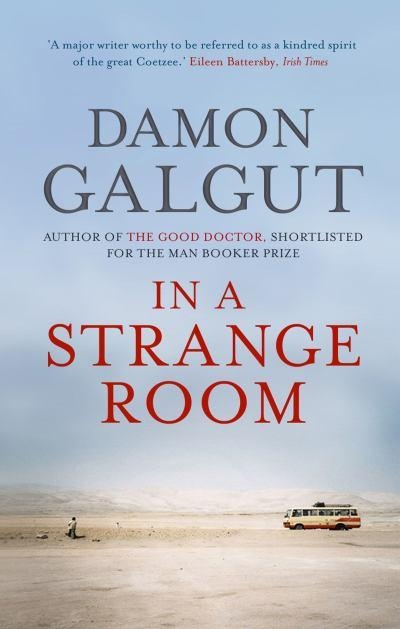
It is about a South African man called Damon; it may be Damon Galgut, or it may not.

He is only passing through … he doesn’t carry any abstract moral burdens, but their absence is represented for him by the succession of flyblown and featureless rooms he sleeps in, night after night, always changing but somehow always the same room.”

 He is a walker, a little lost, a little directionless, a little uncertain of his own motives; a sojourner. He is walking in Greece where he meets, on the road, an enigmatic, and attractive German, Reiner – “He knows that he is beautiful and somehow this makes him ugly”. They travel together but the relationship never grows beyond the casual, despite the sexual tension in the air. Galgut is good at sexual tension. Yet even the casual becomes a disaster.

His second journey, Lover, involves meeting a mixed bunch of people, Jerome, Alice, Charles, and Rodrigo and following them over half the African continent. He doesn’t know why. He sometimes is surprised at what his legs are doing, at what direction they are taking him. Jerome seems interested in him but Damon does nothing. He leaves them, regrets leaving them, plans to follow, but doesn’t then eventually does. This ‘action’ is by no means boring; it is the most intimate of prose, deeply interesting, deeply personal, almost uncomfortably so at times. “It is a story of what never happened, the story of traveling a long way while standing still.”

 The third part, Guardian, is concerned about his traveling companion, Anna, on a trip to India. She is teetering on the edge and threatens to drag him over with her. She relies on a trove of pills which, if taken as directed, will reboot her life but if taken all at once will take it away, and what’s he to do in India with a corpse?

There is something about this book that I must tell you; it is the most unusual fiction, although thrilling too, I have ever read. I was in two minds about telling you about it; it may put you off, I can think of two people that it would put off, but it is so essential to the tone of it, the flavour of it that I could not not tell you. It is told in the third person, and begins, “He sets out in the afternoon on the track that has been shown him….” and very soon he sees a figure in the distance walking towards him. Eventually they approach each other; both watching each other. The figure is described, all dressed in black; “Even his rucksack is black”, and then at the bottom of the first page, there is this, “What the first man is wearing I don’t know, I forget.” I felt a jolt. What? There is the walker, and the man dressed in black, and now another man? “I”? I read the first page again; maybe I had missed something. No I had not missed something. I read on and peppered sparingly are these first person references, and I realised that the third person narrator is referring to himself: the ‘he’ and the “I” are the same person, Damon; so, yes, maybe Damon is Damon Galgut. The writer is his own character. This is a little alarming only if you aren’t prepared for it; hence my telling you. Galgut is also free with punctuation especially of conversation:

Where are you from. He has an improbable English accent, very overdone. South Africa, goodness me, how did you get up here. Through Malawi, my word, I’m off to Malawi in a few days. Look around, yes please, be my guest. What did you say your name was.”

My same two friends would be equally put off by this, but it is surprisingly clear; or maybe it is only a thought of conversation, an expectation; a fictive chat.

Despite the title of the book what action there is takes place as far away from a room as you can get: the open road. Whether it be Greece, Malawi, Switzerland, India, or Kenya he is a traveler and his life is about the people he meets and journeys with, but the drama of this book is in the man himself, the ‘he’, the ‘I’ and in a sense this is a stronger form of autobiography: Galgut (I) is standing apart from himself, watching himself (he), describing his actions, trying to work out what it is about himself. “I am writing about myself alone, it’s all I know, and for this reason I have always failed in every love, which is to say at the very heart of my life. He sits in the empty room, crying.”

Lines like “I don’t remember what they do for the rest of that day” meaning ‘what I did for the rest of the day’ give the feeling of truth; ironically the admission of no action makes it all the more believable.

“In the morning his actual departure will be an echo of this one. He has already left, or perhaps he never arrived.”

Yes, in the first two parts of the book the action is languid, undefined, unimpressive; where the drama is all internal: a personal journey to try and work out why Damon is like he is; fascinating it its novelistic skill. Part three begins as expected but suddenly a life hangs in the balance and Damon is forced to act. The pace is frenetic, the action white-hot, and Galgut doesn’t pull any punches. It hits you in the guts just like it did him, and I read and read ’til the end, redefining the term ‘page-turner’. His skill at internal drama is eclipsed with his mastery of fast-paced action. It’s head-spinning stuff!

I wait with heightened expectation for Galgut’s next work.


Go Set a Watchman by Harper Lee

Harper Lee
Harper Lee

In 1993 Joanne Woodward was the narrator in Sorcese’s film of Edit Wharton’s The Age of Innocence. Her voice was measured and melifuous, full of American cadences of the time; a formal English suggesting refinement, wisdom, and good behaviour.

I was just over two pages into Go Set a Watchman, Harper Lee’s new/old novel (and if you’re a reader and haven’t heard of it you’ve probably been living on Mars), when I realised the voice in my head I was reading with was that of Woodward’s with the same measurement and melifuousness perfect for phrases like “a family example not Iikely to be discountenanced” and “Love whom you will but marry your own kind was a dictum amounting to instinct within her.”

The mood of life in Maycomb is set by annacdotes of the people in it. Tales of loyalty, family pride, and self reliance pepper the opening pages so by the time I met the aged Atticus Finch I was already steeped in small-town life and flavour. I expected, hoped for, a slow reveal of Atticus Finch but Go Set a Watchman was written before To Kill a Mockingbird and how could the author know what an indelable image her creation would leave on the minds of her readers; not to forget the looks and fatherly masculinity of Gregory Peck, from the 1962 film, that couloured it. Over a million copies have been sold in July: the month of it’s release, on the 14th. It’s been ringing tills all over the world and some critics have sharpened their knives and honed their sarcasm to firmly put it back in the bottom drawer.

It certainly isn’t as good as To Kill a Mockingbird but then no-one really thought it would be as part of the marketing campaign was to explain that the original publisher remarked to a young Harper Lee that the most interesting parts of the book were the flashbacks to Scout’s early years and being a novice, Lee took his advice and went back to her desk and, as we know, wrote Mockingbird, which has become a modern classic loved the world over. What is interesting in this book is its role as the precursor to that iconic text. You feel a sense of privilege to discover the germs of scenes that grew into those we know so well: the courtroom scene, for instance, that forms the climax of Mockingbird is a simple reminiscence Jean Louise (Scout) has when she visits the same courthouse.
However what is a surprise is that her father, Atticus Finch, is not the same man as the Mockingbird hero. In Go Set a Watchman ( from Isaiah: 21, 6) Atticus is a respected member of the Maycomb community but his attitude to race relations is totally different to those of the younger Atticus who Lee portrayed as a hero of tolerance and rational thinking; here he tries to justify racist attitudes as necessary to deal with, and live peacefully within, his chosen home. These ideas confound and horrify Scout, and us. However the climax, the confrontation between father and daughter, is very shallow and under-written with an outcome that has more to do with blood than sincere argument; the threat is weak and the ending is therefore disappointing.
It is remarkable to realise that not only was race still a devisive issue 20 years after the story of Mockingbird but today, in 2015, it is still an open wound on the face of American society: still as raw as a fresh cigarette burn.

As the mature woman Scout realises that her upbringing rendered her colour blind; but how can that be now that the model of her raising has turned against her? or was he always like he is now? If she is to stay in this world she needs a guide, a Watchman, to lead her through this place where she doubts she belongs or understands.
The writing is not as sharp and reliable as in Mockingbird but there are flashes of brilliance that set up images that stay with you; and most of them to do with the flashes back to Scout’s teenage years and before. The third person narrative is of the ‘close writing’ kind that sometimes gets so close to Scout that it often slips into the first person, a device that effectively creates the feeling of personal truth.
Go Set a Watchman as a companion piece to To Kill a Mockingbird is its strongest attribute; it may be thin and embryonic but to those who value artistic endeavour and its evolution it’s a valuable text.

The Moons of Jupiter by Alice Munro

Canadian writer, Alice Munro, Nobel Laureate for Literature, 2013.

How’s this for a scenario; an artistic projectory: shy student marries as soon as she graduates, scared that she is old-maid material; wants to write novels but has children instead; still wants to write novels but time is limited so writes short stories while the babies are napping; when they reach school age has more time to write but has to stop writing mid-afternoon to do housewife and mother duties before family gets home; keeps writing short stories until she’s 82; wins Nobel Prize for Literature.

When told of her win, “It just seems impossible,” she said.

She is the 13th woman to win the Literature Prize and the second Canadian (after Saul Bellow), and therefore the first Canadian woman.

She writes about the internal drama of relationships usually from the female point of view; about simple country people, but also academics. She is often called ‘the modern Chekhov’ which is not entirely true: Chekhov is more interested in behaviour, Munro in the thoughts behind behaviour.

This collection, The Moons of Jupiter, came out in 1982. It contains eleven stories. One of them, Barton Bus, written in the first person describes a brief love affair in Australia but all the other scenes, like scenes from a bus window that pass you by, describe what it might be like if she, the narrator, bumps into the once brief lover. What will she say? What will she do? She doesn’t use his name only a letter;

“I call him X, as if he were a character in an old fashioned novel, that pretends to be true. X is a letter in his name, but I chose it also because it seems to suit him. The letter X seems to me expansive and secretive.”

In the brief final scene a female friend, Kay, describes to the narrator a man who is a friend of her husband’s and after dinner he sighed and laid his head in Kay’s lap. She thought it was a ‘nice simple’ thing to do. She mentions his name. I gasped! It was him! and the narrator does not say a word.

I’ve probably spoiled this story for you but when you read it, it will undoubtedly mean something different to you as meaning is always in the mind of the reader.

In Visitors a couple welcome the husband’s brother, his wife, and her sister to stay in their house which is so small that no room can accommodate them all at once. If the fifth person enters someone has to stand in the doorway. Sleeping arrangements are a bit like camping. They go for a drive – they can all fit in the car … just. They talk, they drive, they look for the site of the birth-house of one of them. It’s no longer there, but they imagine it. The talk is simple, personal, clichéd like small-talk. The three visitors finally go back home, a very long way away. The couple are back in their own small bed and Mildred realises Wilfred is crying: he will never see his brother again. They could visit. Will they? Probably not but she says ‘maybe’ and he says ‘not next week’.

I was left with a feeling of regret, mixed with helplessness wound around with sorrow leaving these two people in their cramped space forced to cling to each other as some sort of protection from the miseries of the world.

“When I write about something happening in this setting, I don’t think that I’m choosing to be confined. Quite the opposite. I don’t think I’m writing just about this life. I hope to be writing about and through it.”

All her stories are set in the country to the east of Lake Huron, Canada because she loves it; she understands the people, she likes its climate, its falling down barns, its “occasional farms that have swimming pools and airplanes.” She speaks the language.

Alice Munro, who doesn’t write any more (there are many published collections), reads and sometimes she doesn’t start to read a story from the beginning. She starts anywhere and reads forward a bit and sometimes goes back a bit. To her a story

“is not like a road to follow, it’s more like a house. You go inside and stay there for a while, wandering back and forth and settling where you like and discovering how the rooms and corridors relate to each other, how the world outside is altered by being viewed from these windows … and you can go back again and again, and the house, the story, always contains more than you saw last time.”

Having a volume of Alice Munro short stories by your bed is comforting as well as enlightening and entertaining no matter how many times you read one.