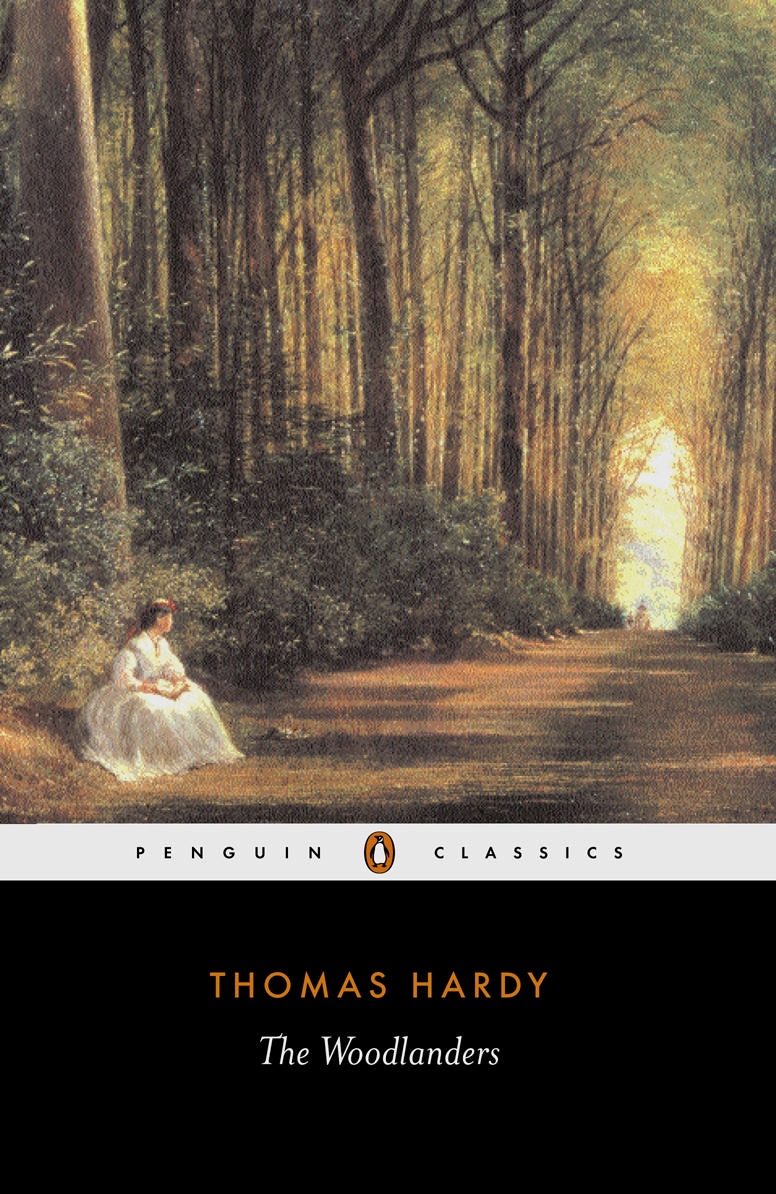
The Woodlanders by Thomas Hardy

Thomas Hardy pic
English writer Thomas Hardy (1840 – 1928)

There once was a time when romance meant novels about gallant itinerant horsemen, stressed long-haired girls, castles in need of a paint-job, and sour land-owners who really only needed a bit of understanding; think, The Mysteries of Udolpho (1794), Ivanhoe (1820), and Lorna Doone, – “Sit doon Lorna, sit doon!” (1869). Today a romance means boy meets girl – boy looses girl (through a silly misunderstanding) – boy gets girl; think almost anything. However there also was a time when the old story of romance was transplanted to the lower, sometimes the very low, echelons of society, which over the eons has transmogrified into modern stories where teenage dreams, parental misunderstandings and happy endings revolve around tainted gossip, what a pretty girl – usually called Kimberley or Kylie – said or didn’t do, and a brave stance taken by a handsome boy – usually called Steve, Lance, or Duke; but it’s in that transference of action to the working class, and lower, that our modern romance stories find their roots. Works like Hardy’s Far From the Madding Crowd and The Woodlanders.

The Woodlanders (1886) has all the trappings of a modern day soap opera. I know that term has a sour taste but the mechanics of the action are the same mechanics that make up the plots of tales in modern day prisons, hospitals, schools, country towns, white houses, and space.
There is a poor girl, Marty South whose long beautiful hair is craved by the gloomy rich lady, Mrs. Charmond, of the gloomy big manor, Hintock House, and the poor girl succumbs to selling it once she learns that the man she loves, Giles, loves another; a mysterious, but handsome, doctor, Mr. Fitzpiers, takes up residence in the house on the hill; a local – but well educated beauty, Grace, – feels obliged by family promises to marry beneath her; and a young but honest youth finds the choice of a wife far more difficult than scratching a living from a village, Little Hintock, in a dent in the woods. The names alone go far in setting the tone, time, and place.


It seems that, ironically given the title, what joins these human stories of a low society, and the actions they choose, revolve around the mortal threat, ownership, and spirit of one particular tree; but the forced fate of which has the opposite effect of that intended. As indeed do other actions of other characters: how soap-opera-ish is the denial of something which causes the want of it? This story set on a beach could be an episode of Home and Away if it were not for the language. Here is Hardy’s description of Mr Fitzpiers, the doctor who “descended, as from the clouds, upon Little Hintock”:

“His face was rather soft than stern, charming than grand, pale than flushed; his nose — if a sketch of his features be de rigueur for a person of his pretensions — was artistically beautiful enough to have been worth doing in marble by any sculptor not over-busy, and was hence devoid of those knotty irregularities which often mean power; while the double-cyma or classical curve of his mouth was not without a looseness in its close. Nevertheless, either from his readily appreciative mien, or his reflective manner, or the instinct towards profound things which was said to possess him, his presence bespoke the philosopher rather than the dandy or macaroni — an effect which was helped by the absence of trinkets or other trivialities from his attire, though this was more finished and up to date than is usually the case among rural practitioners.”

A modern novelist might translate this classic – as modern playwrights feel obliged to do to theirs- like this;

His face was soft, charming and pale; with a nose that a local sculptor, with time on his hands, might feel inspired to chisel, more elegant than powerful; and a mouth that was full and kissable. In short he looked more like a raconteur than a spiv, a look that was helped by him wearing clothes with no decoration which in this town labeled him a medical outsider.

But what an immense amount of pleasure would be lost. Go on! Give it a go! Read Hardy’s version out loud even if it takes two or three goes to get the unfamiliar intonation and punctuation right to reflect the meanings he intended.

Actually if you are a modern novelist of the Colm Tóibín kind you wouldn’t, or rarely, describe people, or places, at all. In Tóibín’s latest novel Nora Webster (2014) the only description of a person occurs on page 2: “May Lacey, wisps of thin grey hair appearing from under her hat…” which is hardly a description, more the flavour of the woman. Such novelists leave the detailed descriptive work up to the readers’ experience which has its compelling justifications; but there is also something to be said for stretching your literary experience, reminding ourselves how the language was – and can be – used, and relishing the way little dark marks on a pale background can paint pictures in your head.

Of course the stories of these people in the woods end as you would expect or as Oscar Wilde has Miss Prism deliciously say in The Importance of Being Ernest, “The Good end(ed) happily, and  the Bad unhappily. That’s what fiction means.” However Hardy wasn’t a popular and lauded novelist in his day for sticking rigidly to the form; he adds a few very intriguing surprises and “OMG” moments that would do very nicely today just before an ad-break.

Hardy is at his most entertaining, and prickly at times, when two people are caught in a room and what they want to say is stymied by custom, clothing, religion, morality, and social class; so what they actually say is layered and fraught with all kinds of meanings. Modern writers can learn a lot from Hardy’s use of dialogue: it propels the action, paints character, exposes hypocrisy, uncovers hidden motives, makes you laugh, and sometimes makes you weep.

A go at the classics now and again sharpens our literary minds to tackle and appreciate more clearly the literature that’s written and read now; it brings depth and experience to what we need when we read a modern novel.

It doesn’t have to be Hardy; it can be Dickens, Franklin, Collins, Hemingway or Twain, Stevenson or Woolf, Richardson or White. You won’t regret it, I promise.

A Perfectly Good Man by Patrick Gale

A Perfectly Good Man Cover Pic

In 1937 J. B. Priestley was – if not the first then one of the first – writers to use time as a plot point. His play Time and the Conways tells of the decline of a monied Yorkshire family between the wars. Act one is set in 1919 at the birthday party of one of the daughters; act two is set on the same night but in 1937 and we see how far the family and all its members have fallen; and act three continues from act one and we see all the misjudged decisions, wrong turnings, and false expectations that caused it all. It is a tragedy, not just of a family but of Britain as she unwittingly is drawn into war, a war that Priestly predicted; but because the audience knows what happens they are spared any melodramatic sentimentality at the Conway’s future and, instead, are left with the truly tragic knowledge that it is all their own fault, therefore teaching us that our future is all our own fault. Damn it!

By the end of the first chapter of Patrick Gale’s A Perfectly Good Man I was gasping at what I had just witnessed, as our hero, the perfectly good man, an Anglican vicar, Father Barnaby Johnson, had just witnessed and could do nothing to stop: a suicide in broad daylight at a kitchen table. Time jumps back twenty years for chapter two and by its end I was misty-eyed at a lonely farm girl who almost became a matinee spinster, and at her sudden and unexpected happiness that she grabbed with her heart and both hands, despite her mother’s selfish interference and her own self-acceptance of a lonely life; so that when she saw Barnaby, finally, and they kissed and kissed again I’m sure I heard an orchestra belting out a soppy Korngold score like anything starring Joan Fontain and Lawrence Olivier: emotional, yes, but not sentimental; there’s no time for that as the next chapter jumps forty years into the future with Barnaby at 60. We know the consequences of everything they see and do. As with Priestley’s time plays Gale reveals outcomes before their gestation which not only spares us sentimentality and underlines the folly of mankind but also provides the reader with a few delicious “Oh yes, of course!” moments. I love those little moments.

Gale’s clever narrative, not only doesn’t follow the linear life of Barnaby Johnson, but rather his life is painted not by what he does but by what effect he has on the people around him: Dorothy, his wife; Lenny, his young, lapsed parishioner; Carrie, his daughter; Phuc (Careful! It’s rhymes with look), his adopted Vietnamese son; Modest, an interfering, totally unpleasant and obese man, to whom Barnaby shows nothing but kindness; James, his gay uncle; and Nuala, his onetime Australian lover. We get to know Barnaby Johnson through his reflection in the lives of these Cornish people. Be assured that I have left out some important information in my descriptions of these characters: I don’t believe in spoilers.

It’s set in Cornwall and in the little parishes north of Penzance, the same location of the previous Gale novel I read and blogged about; and incidentally two characters from that book, Notes from an Exhibition (see my previous post) make an appearance in this one. A neat synchronicity but only because I read these two back to back.

He has a way with the nuanced phrase …”the sisterly happiness she felt for him was borne up on little upwells or erotic regret …  she could smell the disappointment of her, a passing sourness, as of stale sweat trapped in a dress sleeve … In a priestly way – all cheekbones and fine feeling – he was handsome, she considered … And there she was in his maths class like a princess sent to a rural comprehensive to learn humility… Even now they weren’t exactly alone because her parents were standing in the porch, like an advertisement for mortgages…she simply preferred to keep her feelings private and as reassuringly compartmentalized as the meticulously size-sorted screws in the trays of her tool box …”

These gems give you little jolts of joy, like finding a $20 note in a pair of jeans you haven’t worn for a while.

Notes from an Exhibition, along with A Perfectly Good Man are now available as ebooks and you can find them here.

Since my literary heroes (at the moment), Colm Tóibín, Tim Winton, and Damon Galgut are not very prolific I’m happy to add Patrick Gale to the list so now I have his whole body of work to explore. I hope you will too.

Notes from an Exhibition by Patrick Gale

Notes from an Exhibition Cover pic

I read, years ago, Patrick Gale’s Rough Music (2000) which is anchored in my mind solely because of the protagonist’s long-time lover who also happened to be his brother-in-law; familial relationships of the unusual kind are his specialty, and those of Pictures from an Exhibition (2007) add to that reputation. The Middletons, husband Antony, and children Garfield, Morwenna, Hedley and Petroc, are Quakers who live in Penzance on the warmish tip of England’s most southerly bit and who revolve imperfectly around the mother and wife, Rachel Kelly, whose mental instability is only ever mollified, cooled, and placated by her painting: her world is only true and real to her once she can represent it in paint, form, and, sometimes only, colour – on something, anything, flat and at hand.

Each un-numbered chapter is headed by a note; that which you see, read, and is placed usually on the wall at the bottom right of a painting in an art museum. They begin with the painting’s name and then its medium – pencil and crayon on particle board, for example, and a paragraph or two adding colour and depth to its creation, subject, and then its current owner. These notes, you should know, not only illustrate Kelly’s art works, there are also objects, clothing even, which like art works, can sign-post our lives. Gale adds novelistic detail to this museum icon giving him a wry and clever means to add momentum, depth, and suspense to the following chapter. It is in one of the early notes that we discover in passing that there has been an untimely death in the family; the text features the deceased and one is a little tense for expecting the death to occur at any moment. When it doesn’t the tension remains and the expectation of tragedy is all the more true the longer one is forced to wait for it. The result of this little suspense I’ll leave for you to discover.

Each chapter doesn’t necessarily extrapolate on the opening note (but sometimes it does, of course); Gale is never always that obvious, and the portrait of the Middletons is not linear – Rachel Kelly’s death is in an early chapter – so their life, loves and dreams, both dashed and fulfilled, are built up with flash backs and forwards like the accumulated image of a jigsaw puzzle and all the more truthful for this intriguing form, layer-upon-layer, like walking through a retrospective exhibition of your favourite, but recently late, artist.

Early in the book I read this,

She was superstitious of describing the process but if forced to put it into words by a trusted friend she would have likened it to taking dictation – if one could take dictation of an image – from a quixotic teacher who could never be relied upon to repeat anything one failed to catch.

This dense, neat sentence which shines some light on the artistic process – no mean feat in itself – made me jolt in my seat and forced me to read it again, and again, until its cleverness revealed itself: in the short final clause the subject jumps from the speaker to the listener, like a filmic panning shot from one person to another. I read it again, aloud, just for the simple pleasure of it in my mouth.

Then, in hospital, after a suicide attempt Rachel Kelly is visited by a recent stranger and saviour, Antony, whom she later marries.

“You brought me flowers.’

“Yes, sorry. They’re not very…”

“They’re hideous. You’re so sweet. Sweet Antony.”

There’s nothing that impresses me more than character building through dialogue: three little spoken sentences says more than a page of exposition; and a little later,

She didn’t sob or wail. Her grief was horribly discreet but as persistent and almost as silent as bleeding from an unstitched wound.

I was hooked, a fan, and wondered why I hadn’t garnered Gale’s output from my first exposure to him all those years ago.

Remembering Tolstoy’s famous opening line about unhappy families, all families, really, are unique in their own way; and the book although ostensibly about such a family is full of … well … interest. It hardly seems necessary for Gale to add an astonishing twist to the true identity of Rachel Kelly: she is literally someone else. However he handles this revelation with intimate historic detail, tone and a shift in the narrator’s allegiances that legitimises this remarkable plot swing and puts Gale firmly within the reader’s trust … but enough of that: no plot spoilers here.

Gale’s omnipotent narrator is of the free-wheeling kind: jumping from character to character with ease and intent to tell the story, to paint a family life; unlike some other, more popular writers – Dan Simmons, for example (see my blog post dated April 17), whose narrators are restricted: bound to one character.

I found myself scheduling reading time; always a sign of a good book.

Patrick Gale, was born on the Isle of Wright in 1962 where his father was the prison warden. He now lives near Land’s End with his partner, raising beef, barley and obsessively readable novels. Check out his website at galewarning.org.

Notes from an Exhibition, along with A Perfectly Good Man (2012), -my review will follow shortly – will become available on 31 May, 2016 and you can find them here.

A further release of titles, by Open Road Media, is scheduled for later in the year.

The Illuminations by Andrew O’Hagan

The Scottich writer Andrew O'Hagan
The Scottich writer Andrew O’Hagan
“There’s an art to telling the truth.”

My first instinct was to say that The Illuminations, O’Hagan’s latest novel, is about the past; but then every novel is about the past, even one written in the present since the actual present is only on the page you’re on. It is more accurate to say that The Illuminations is about the little lies of the past that make the present bearable.

The two main characters are Anne, a grandmother sinking slowly into dementia, but once a well known pioneeing documentary photographer with an inner artistic life that her family only vaguely acknowledges, and her grandson Luke, a Captain with the Royal Western Fusiliers fighting the dirty war in Afghanistan. He witnesses a horror that he could’ve prevented if it were not for his weak, and tormented commander. On his return to Britain he takes Anne on a trip to Blackpool to see the famous light show at the end of summer, the Illuminations, hoping she will remember more about the romance she had there with Luke’s grandfather, the photographs she took, and the reason that his family is like it is. He craves enlightenment to make sense of the past which he can only vaguely see: the facts that don’t add up; the questions unanswered.

I first discovered O’Hagan via his 2006 novel Be Near Me which turns on a moral mistake of the protagonist, a Catholic priest, Father Anderton. When he is finally brought to account for his ‘sin’ by his religious  superiors, the answer to the question he is asked only explains half the sin; and he is faced with a truely moral dilemma: should he simply answer the question knowing that the answer will satisfy his superiors and that will be the end of it, or should he, given the vows to his God, confess to ‘all’ the sin, and therefore end his vocation? The ‘action’ of the book is in the mind of Father Anderton, small compared to most novelistic plots, but I remember the feeling of the monumental challenge the man is asked to face; this is a ‘big’ story, or O’Hagan made it seem so.

The Illuminations isn’t quite as successful although the awkward scenes of a family get-together where the past and the present, old ideas and new, clash and bump are handled with insight and cringing recognition. O’Hagan is a master of the minutiae of the undercurrents and whirlpools that swirl beneath a family’s, and any personal, exterior. He also successfully describes that ellusive but sometimes debilitating feeling parents have of loving the family to visit but joyous when they leave.

O’Hagan is a well respected writer and his early novel, Our Fathers (1999) won the Winifred Holtby Memorial Prize and it was shortlisted for the International IMPAC Dublin Literary Award (2001) as well as the Man-Booker Prize for Fiction (1999).

However his most intriguing work is a lengthy article in the London Review of Books, Ghosting Julian Assange in March 2014 which tells the fascinating story of the time he spent shadowing the Wikileaks founder with the contracted intention of ghosting an ‘autobiography’ of the man. I should explain that the book, not yet written, had already been bought by Canongate for £600,000 and sold-on to a range of big publishing houses including Knopf of New York. The book never happened but a lot of legal battles did; the article explains why, and at the same time gives a detailed picture of Assange, his behaviour: paranoid and, to some degree, his motivation: selfish. You can find the article at http://www.lrb.co.uk/v36/n05/andrew-ohagan/ghosting which also includes an audio file of O’Hagan speaking about Assange. 

He is also a playwright and his latest work for the stage is a doco/drama, Enquirer, staged by the National Theatre of Scotland in 2012 that deals with the machinations of the British press.

O’Hagan is a wonderful writer and there is a lot to enjoy in The Illuminations. I recommend it and Be Near Me as well.