Sea of Poppies by Amitav Ghosh

Indian writer Amitav Ghosh

This is what novels can do: take us away from what we know and set us down in other worlds, at other times, to see the universe from another angle and hopefully reassess our choices and privilege. Yet, we still, usually – well, I do – continue to read books about and written by, English-speaking muddle-class whities.

What is most remarkable about Sea of Poppies (2008) is the language:

A quartermaster lured the boy into the ship’s store with a mind to trying a bit of udlee-budlee. But chota as he was, young Benjamin didn’t lack for bawhawdery – set upon the old launderbuzz with a belaying-pin and beat him with such a will that his life-line was all but unrove.

He also assigns formal speech peppered with malapropisms to paint an innocent, although well-meaning, young Caucasian character through her attempt at what she thinks to be  proper conversation.

Also the wonderfully colourful Indian-English of yesteryear full of jangled word-order and inappropriate gerunds “too much not time to be arousing and uprising…’ juggling accents and idiolects from the lowest poverty-stricken rice farmer to a Zamindar, the Rajah of Raskhali who looses everything to indignant hubris.

And it isn’t just his wild, wonderful, and inventive lexicon but it’s also the exotic time and place full of words for staff, house geography, clothes, food, ship-craft, and colloquialisms.

You would think all this verbal unfamiliarity would send you rushing to the dictionary; a tiresome task if all too necessary – although reading it as an eBook allows this to be less so. But no. The overall meaning of a sentence, conversation, or paragraph is always clear even if some individual words are not.

One of the joys of the writing here is it’s inventiveness and possible authenticity. Ghosh acknowledges his debt to several publications, including Thomas Roebuck’s An English And Hindoostanee Naval Dictionary Of Technical Terms And Sea Phrases As Also The Various Words of Command Given In Working A Ship, &C. With Many Sentences of Great Use at Sea; To Which Is Prefixed A Short Grammar Of The Hindoostani Language (1813).

However, whether it is authentic or inventive doesn’t matter, it’s a joy to read, and reading some sections out loud is a very pleasurable thing to do.

The book, and it’s a big one, the first of a trilogy, is set prior to the first Opium War (1839-1842) when the British successfully came to the aid of the opium merchants when the Qing Dynasty of China banned the drug from its shores. It is divided into three sections: Land, River, Sea and centres around a schooner, the Ibis, and the exotic collection of humanity that find themselves on and below its decks as it sails from Calcutta to Mauritius.

The characters are varied, three-dimensional, and extraordinary. There is Deeti, a widowed poppy farmer saved from her husband’s funeral pyre by a handsome ‘untouchable’, Kalua; Zachary Reid, a mixed race American sailor; Serang Ali, the leader of the lascars and colourfully mangles the English language along with various other tongues; Neel Rattan Halder, a Raja convicted of forgery; Ah Fatt, a Parsi-Chinese opium addict; Paulette, a French orphan raised in India; Jodu, her childhood friend; and the extraordinary Nob Kissin Baboo, a would-be priest. All of these major characters, and many minor ones, have colourful backstories, some comic, some tragic, some heart-thumping, some tear-jerking but by part three of the novel they are all on board the Ibis, bound for Mauritius and their various destinies.

As well as all the above there is Ghosh’s descriptive, rich, and luminescent prose: describing the love in a young girl’s heart along with its negative opposite, not hate but cowardice for saying nothing for fear of rejection; describing the effect of the first lungful of opium smoke in a man’s breast, nulling the gravity in his limbs and creating delusions clean of doubt; to untying a knot on a bowsprit as it plunges a sailor into a mighty wave and out the other side, like threading a needle with courage.

It’s a great read and reinforces what novels do best: carry us away.

Sea of Poppies was shortlisted for the Booker Prize, 2008.

The epic story, The Ibis Trilogy, continues with River of Smoke (2011), and Flood of Fire (2015).

-oOo-

You can buy the book in various formats here.

Here you can watch an interview with Amitav Ghosh as he explains his sentiments behind Sea of Poppies.

And here is a little documentary with Ghosh as he talks about the background to his iconic Ibis Trilogy.

The Absolutist by John Boyne

Irish writer, John Boyne.

“You can’t judge a book by its cover” goes the old saying, but of course we do. The cover of John Boyne’s 7th adult novel, The Absolutist (2011), tells us a lot: WW I, soldiers, a white feather, trench warfare. So here’s the opening lines,

Seated opposite me in the railway carriage, the elderly lady in a fox-fur shawl was recalling some of the murders that she had committed over the years. ‘There was the vicar of Leeds’s she said, smiling a little …

This is one of the things I like about Boyne: he sparks curiosity, intrigue, interest at every turn.

In 1919, Tristan Sadler, on the eve of his twenty first birthday, is going to Norwich to deliver a bunch of letters to a woman he’s never met. In a pub he thinks about getting drunk, causing a scene, getting arrested, and being put back on the next train to London, then … I wouldn’t have to go through with it.

The woman is Marian Bancroft, the sister of Will Bancroft, the man he met in army training, served with in the trenches of France, who refused to fight anymore, and who was court-martialed and shot. He was also the man Tristan Sadler fell in love with.

There is a melancholic tone to this story, but one in which Boyne trickles out important information and intriguing details which adds to the vivid characterisations and keeps your interest high.

There are two narratives: Tristan’s tough journey in 1919 to see the sister of his secret lover and public traitor, Will Bancroft, and interspersed with this, the events of 1916/17 when he first met Will at army training, and then in the rat and mud infested trenches of France where the devastating climax is revealed. But there is a coda: Tristan and Marian meet 60 years later, in 1979, when he is a famous novelist, and she a prickly woman still, widow, and grandmother, who had never liked reading novels. “Actually, I came around to them in the end. Just not yours.” It’s a bold but satisfying end to “a wonderful, sad, tender book,” says the quote from Colm Tóibín; another bit of truth on the front cover.

Boyne’s adult writing is literary fiction but his style isn’t dry or over written or weighed-down by internal musings. This one, in essence, is a story of a man going on a train to visit a stranger. The interest is why he is going, how (if) he will tell her, and what will happen then? This, of course, depends on Tristan’s backstory which is where the real plot is. Boyne is fundamentally a storyteller and he always does this admirably by putting the plot in the hands and minds of three-dimensional, flawed, but brave characters. The structure also seems right. It’s neat and satisfying and not surprising that the film rights have been bought by Ridley Scott. Although there has been no news about the production since the cast (William Moseley, Jack O’Connell, Derek Jacobi, Joely Richardson, Colin Firth, Vanessa Redgrave) and director (Stephen Daltry) were announced in 2013.

This 2011 work is up there with Boyne’s best.

Highly recommended.

Here is a short video of John Boyne talking about the inspiration for The Absolutist.

You can buy the book in various formats here.

Infinite Splendours by Sofie Laguna

Australian writer, Sofie Laguna.

The first thing that struck me about this book was the marketing quotes on the covers, back and front: they were all for Sofie Laguna’s previous novels, not this one. I found this curious, particularly the quotes on the front cover. Were there no advanced critical readings? Maybe not. I have not read her previous work. However, I certainly know about her prizes and acclaim.

The title, Infinite Splendors (2020), is an uncommon collocation, and therefore very difficult to remember but when you realise it refers to the craft of painting it makes sense.

Lawrence Loman is an intelligent 10 year old growing up in Western Victoria in the shadow of the Grampians in the early 1950s. He lives remotely with his war-widowed mother, Louise, his younger brother, Paul, and next door to Mrs Barry. These people, and his teachers, Mrs St Clare and Mr Wade make up his world. They define everything he knows.

Mrs St Clare introduces him to splendors he had never imagined. One Friday afternoon she asks her students to don smocks, to stand in front of easels with paint and brushes, and to look at the large blank pieces of white paper on each one. She then directs their gaze towards the windows. What do you see? Lawrence does as he is bid, picks up the brush, dabs it in paint, and attends to what he sees out the window. Minutes later he looks at what he has done and gasps: Ah! Who did that?

From that moment he is attune to paint and light. He notices shadows on wet moss and wonders how to put them on paper; he notices the light on the mountains that loom over his world; he sees the light change and how it changes each peak; he understands how light on a face can change its expression, can change feelings. His teachers and mother are astounded at his intuitive skill, as is he. His future seems assured. These early chapters are wonderful to read and expertly described as a young bright boy discovers creativity, and more remarkably that that creativity is his own.

When his much-admired, and anticipated, batchelor uncle comes to stay everything changes, as did my expectations.

We are living in the golden age of television. Drama, particularly crime drama has been abundantly produced for the last few decades or more. Streaming services are many and the product they stream is excellent in every possible way. My only complaint at times has been the subject matter; too many crime dramas have relied on crimes against women: kidnappings, murders, rapes, mutilations, terror, and abandonment. This trend, I believe, is waning, much to my relief, but for a long time I lamented the apparent limited scope of television writers in their search for a plot. These crimes are horrific and spotlight the worst of our species and, of course, we can’t look away but as fodder for scripted drama I found it repetitive and predictable.

Similarly, was my reaction to this novel: a pedophile uncle? Oh no, not again! But yes. Lawrence Loman’s life is destroyed without any understanding, interference, or support from the adults around him: he has never told, can’t tell, anybody. His personality changes, he loses the ability to verbally communicate, he retreats within himself, and after all the adults in his world die or move away he is alone and we, as readers, are only left with his internal monologue and sparse meetings with strangers that scare him, abuse him, and think him crazy. That crazy old hermit who does nothing but paint. And paint he does, until the house is overrun with canvases, still lifes and the objects that inspire them, portraits, landscapes and cloudscapes. Anything that can capture light.

This is a great challenge for the writer: a protagonist that cannot effectively communicate and the 1st-person narrative combine to leave the writer with little but an internal monologue to work with. Laguna takes on the challenge head-on but is not completely successful. The latter half of the book is strewn with patches of repetitive purple prose that left this reader cold.

I also noticed that on her Acknowledgement Page no initial readers are thanked. So there were no advanced critical readings. This is a pity; such previews are invaluable and I’m sure this novel would’ve benefited from such a process.

Here is a short video of Sophie Laguna introducing her new book, Intimate Splendors.

You can buy Sofie Laguna’s Infinite Splendors, and her other novels, in various formats here.

A Suitable Boy by Vikram Seth

British-Indian author Vikram Seth

The story begins:

‘You will marry a boy I choose,’ said Mrs Rupa Mehra to her youngest daughter, Lata.

Seth doesn’t waste time, which is well to remember as you turn from page 1276 to page 1277 with several hundred to go.

It is a novel of rich history, set in the years 1949 to 1951 in the fictional city of Brahmpur on the banks of the Ganges, only a few years after the separation of the subcontinent into India, West Pakistan and East Pakistan (now Bangladesh): Hindus from Muslims. It has been reported that 2 million Muslims were killed in the violence that resulted from partition. There is little evidence of the bloodshed; Muslim and Hindu families feature prominently in the story; they mix socially and even politically but their social and political differences are only as severe as those of the other stratas of society: caste, employment, race, and education.

The three Hindu families: the Mehras, Chatterjis, and Kapoors are all connected by marriage. The Muslim family, the Khans, are linked to the other families through politics, friendship, and wealth.

Through the course of the story three suitors emerge, Kabir Durrani, a fellow student, whom Lata Mehra, the potential bride, befriends over their love of literature; Amit Chatterji, a poet and the brother of Lata’s sister-in-law, and Haresh Khanna, an ambitious and enterprising young man and the one favoured by Mrs Rupa Mehra as the most suitable boy. However, Kadir, whom Lata really loves, is Muslim.

There is also a subplot – the main among many – of Maan Kapoor, the son of the respected state Minister of Revenue and his relationship with Firoz Khan and with a beautiful singer and courtesan, Saeeda Bai.

It would be foolish to precis the plot as it may end up far longer than a precis should ever be. However, Seth uses these interconnected characters and families, history and society, time and custom, to weave a colourful diorama as entertaining, instructive, and dense as the book’s size suggests. Religious observance, sexuality and desire, hypocrisy, infidelity, colonialism, independence, tragedy, humour, parental and social power, love, and duty are all interwoven and treated with honesty and skill by a writer whose command is never in doubt.

The language is plain and sometimes surprising in its forthrightness. Standout scenes: a highly comic cocktail party with the remaining but slightly bewildered British and the newly empowered locals; the description of the near-tragic religious festival (Kumbh Mela called Pul Mela in the book) where hundreds of thousands of pilgrims bath in holy rivers all over India; and the consequences of a wayward condom.

Seth has been working on a ‘sequel’ called A Suitable Girl but as of 2019 it was unfinished; a suitable ending has proved elusive.

A Suitable Boy has been on my to-read list for years. If you decide to tackle it, give it your best. It deserves it.

Highly recommended.

Here is a charming interview with Seth from 2015, mainly about poetry and writer’s block filmed at his home in England.

The BBC produced a 6 part television series released in 2020. Directed by Mira Nair with a teleplay by Andrew Davies, you can watch the trailer here. The series is available on Netflix.

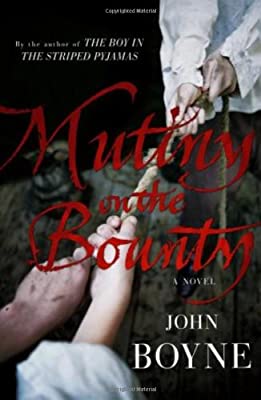
Mutiny on the Bounty by John Boyne

Irish writer, John Boyne.

It’s a rollicking ride of the story that we think we all know, and we do know the basic facts: the Bounty was captained by William Bligh to sail to Otaheite (Tahiti) in 1789; it’s mission was to collect seedlings of breadfruit to then transport to the West Indies as a cheap food source for slaves; his first mate, Fletcher Christian, led a mutiny a few days after leaving Tahiti; William Bligh and a few loyal followers were set adrift in a small launch; they sailed, rowed, and finally made it to West Timor and the Dutch settlement of Kampung; the survivors, including Bligh, were repatriated to England. Later Bligh became Governor of the colony of New South Wales.

But Boyne’ story is told from the point of view of the cabin boy, John Jacob Turnstile, christened unkindly by the crew as ‘Turnip’. He’s fourteen years old, smart, opinionated, and roughly educated; the offer to sail saved him from his life of poverty and as a member of a group of boys in Portsmouth lorded over by the vile Mr Lewis who not only trained them in the art of pickpocketing but also made them available to entertain the particular proclivities of Portsmouth’s wealthier gentlemen.

It’s a fascinating and adventurous account of life on board a small sailing vessel in the sixteenth century and Boyne sticks to the story as history; but what is different is the characters of the main players: Mr Bligh, captain in name only, not in rank, (fact) is a strict commander but kind to Turnip and in return the boy is loyal to him; Christian, a well educated son of a wealthy family fallen on hard times, is a charismatic and handsome specimen who is the only man on board who owns a mirror, uses pomade in his hair, and is noted for his body odour because of his lack of it.

While on Otaheite, Bligh allows the men freedom to reside on the island and fraternize with the natives; many of the men, including Turnip, form relationships with the local women whose culture isn’t burdened with social and sexul mores as is the Englishmen’s.

When two sailors foolishly desert their posts and hide in a remote part of the island with their women, Bligh is outraged and regrets his original leniency and commands all the men to ‘live’ back on board the Bounty. This, in Boyne’s version, is the deed that sows the seed of the eventual rebellion. The deserters are finally caught and Bligh, lenient again, has them flogged, rather than hanged. This is only the second flogging on the entire voyage, something of a record and one that Bligh is extremely proud of, but now, again, regrets his leniency and tries to impose his authority once again.

While on their way west towards the Caribbean the men were so depressed and angry at their having to leave the climate, freedom, lifestyle, and their newfound relationships that their mutinous mumblings are stoked by Christian into mutinous deeds.

Turnip remains loyal to Bligh and joins the other 18 men on the tiny launch Christian confines them to, as they watch Christian’s men sail away tossing all the one thousand breadfruit plants into the sea as they go.

The 42 day journey in an open boat to Timor is harrowing; some men don’t survive and some men succumb to the ordeal even after reaching Timor, so malnourished and mentally exhausted were they that medical assistance couldn’t save them. Turnip survives and we learn of his return to Portsmouth and … sorry, no spoilers here.

It’s an entertaining, accomplished, and a satisfying read. Boyne’s choice of vocabulary and syntax is appropriate to time, character, and social position. The story has been filmed five times and written about more, each with Bligh as the villian; this story is different.

You can buy the Kindle version, along with other formats, here.

The Outside Boy by Jeanine Cummins

American writer Jeanine Cummins

Like a lot of readers I discovered Jeanine Cummins via the controversy over her mega-selling fourth book, American Dirt (2020), which is a flight story of a mother and child fleeing the wrath of a drug cartel – they had murdered her journalist husband and 16 members of her immediate family – in Acapulco, Mexico for the safety of the USA. You can read my blog post about that book here. Latinx writers got very upset that a ‘white’ woman should deem to write, and successfully so, a Latina story; the phrase ‘cultural appropriation’ was used a lot in the ensuing brouhaha. I’m not completely sure why, but I usually tend not to read American writers; British, Irish, European, and Australian writers keep pushing the Americans down on my to-read pile. I’ll need to address this in a future post. A friend kindly sent me the book in the mail during the Melbourne lockdown – I was caught in Australia for most of 2020. I was surprised at how good it is: a cracking good read. Yes, it was a commercial success – helped along, no doubt, by Oprah Winfrey – but the writing is also good, authoritative, and compelling.

My lock-down host then gave me this, Cummin’s second book, The Outside Boy (2010). Although this too is a book set in a different culture to her own: Ireland, and a different time: 1959, no controversy erupted over this one. Cummins identifies as ‘white’, although she has a Puerto Rican grandmother; her husband is Irish which may account for the inspirational spark here.

It is a coming-of-age story of a 12 year old boy, Christy Hurley, a tinker’s son, a traveller, a pavee, told through his eyes, his words. The mashed grammar, misplaced syntax, and sometimes literal spelling all add up to the acceptable sound of a traveller’s boy, a gypsy youth who sees the world without any city notions of blame, cause & effect, and obligation.

“She’s my mother,” I said, and even though I was whispering, my words fell into the quiet room likes stones into a pond. They rippled out til I could see them on Missus Hanley’s face. She knew the weight of them words; she took them serious.

Cummins explains in an Author’s Note that she has not been entirely true to the traveller’s voice; a truly authentic pavee voice “would have rendered the book almost impenetrable to the American reader.” Her close writing and vocabulary choices are fundamentally apt and effective, although I think an unschooled gypsy boy in 1959 Ireland would not know the words ‘precarious’ or ‘choreography’, but this is a small point.

Christy is motherless. All he has of her is a mysterious photo from a partly burnt newspaper article. She died at his birth. “I killed her!” he often says. His father is frustratingly mute on the subject of the boy’s mother, but finding the truth of her becomes his, and the book’s, quest and narrative force.

The colourful world, language, and culture of the Irish travellers are major reasons that the book is such a joy to read. Like all good fiction a novel can take you out of your own world and show you how other people live, think, and carry-on regardless.

This is a highly entertaining and moving work. Highly recommended.

Here is a short video of Cummins talking about the inspiration and the writing of The Outside Boy.

You can buy various editions of the book here.

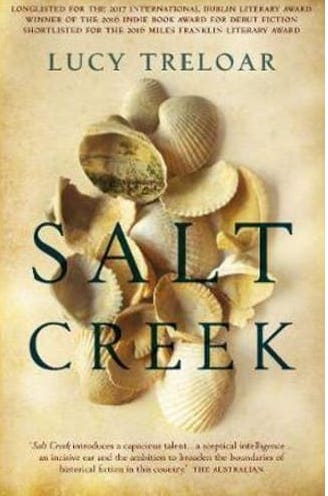
Salt Creek by Lucy Treloar

I started reading Barbara Kingsolver’s The Poisonwood Bible, but put that aside to read this, Lucy Treloar’s Salt Creek. I was reminded of the similarity in both books of the rigid fathers, each obsessed with Christianity and its dictates so wholly against human biology, psychology, and behaviour bringing pain to their families and perpetuating ignorance of human nature. It reinforced my belief that it is not the religion itself that breeds such misguided fervour and obedience to unshakable rules of behaviour and social relationships but the administrators of religions, who have been for millennia, men, and who for the most part have been, by their own dictates, denied many of the human emotions and subsequent relationships that they have tried so hard to mould. Men have a lot to answer for. 

Salt Creek (2015) is the story of fifteen year old Hester Finch, and her large family, down on their luck in 1855, who are forced to abandon their relatively comfortable existence in Adelaide and move to a scrap of land in the remote South Australian south east bordering the Coorong: a long narrow lake, one of many lakes at the mouth of the Murray River. Lording over this family is Stanton Finch, a failed dreamer and ever hopeful, but inadequate, business man whose financial failings have forced the move. He is a devout Christian and, of course, runs his life and dealings with an indefatigable belief that god is on and at his side and a man whose good intentions are forged by a religion so irrevocably in an English manner that it seems almost incomprehensible that this religion, that Stanton Finch wants to implant onto the land and the people he inhabits, was founded in poverty, heat and dust by a poor Judean carpenter with lofty ambitions for his neighbours. Such a craftsman has more in common with the natives of Salt Creek than the white Englishmen who deem to claim him as theirs.

Life is hard, and his wife, Bridget, feels like a rib in her heart, the family’s fall from society. Her husband, thinking he was doing her a favour managed to retain two of her prized possessions: a chaise lounge and piano. But they fit uncomfortably in the shabbily built wattle and daub house her husband has built and she is reminded daily of their fall as she has to sweep and clutter around such out-of-placed furniture.

Being a good Christian man, Stanton Finch, tries to deal fairly with the local Ngarrindjeri people but his understanding is tainted by white civilisations’s attitudes coloured by ignorance of what is ‘right’, ‘natural’, and in god’s image. A young Ngarrindjeri boy called Tully, joins the family but not because of Mr Finch’s civilising influences, no mater how much the man would like to claim, but because of the boy’s innate intelligence and courage. There is a bible in the house but also a book by Charles Darwin, brought into the house by Fred Finch, a younger son, a sensitive artist and naturalist who sketches Tully as a young man sitting in a chair by the wood stove reading Darwin: an memorable and apt image of the traditional and modern that lies at the heart of the novel.

Hester, tall, independent, and competent is the book’s first-person narrator and its moral backbone; Adelaide, Addy, her younger sister is the tear-away and at the centre of the moral dilemma of the clash of cultures. There is humour, love, tragedy and the tension between god, family, and safety.

The writing is accomplished, impressive, and moving. Highly recommended.

One day I will leave here, and it will not be with another man or because of a man … How could I respect such a person … It was as if he had been wounded and I was nothing but salt.

Here is Lucy Treloar talking about Salt Creek, writing from landscape, literary prizes, and reading from the text.

You can buy the book in various formats here.

A Gentleman in Moscow by Amor Towles


Amos Towles author pic
American novelist, Amor Towles

I heard a lot about this book before I read it: everybody loved it. So much so that my expectations were high. I didn’t realise what it was I was expecting until it didn’t happen. There is a point in most novels, usually between pages 50 and 100, sometimes earlier, sometimes in the first line, that you realise what kind of story you are reading, or about to read. I call it the 1st plot point. Here there didn’t seem to be one. By page 150 I had to make a decision: stop or reassess my expectations. I chose the latter.

The story is set in 1922 in Moscow where a minor aristocrat, Count Alexander Rostov, is saved from death by an obscure poem he penned in his youth; a poem that the authorities deemed to contain revolutionary sentiments, but he is an unapologetic aristocrat and therefore a threat to the new society; so instead he is sentenced to house arrest in the Metropol Hotel. He had been living there in some comfort but was now relegated to an attic room the size of a cupboard. What follows is his colourful life over thirty years lived entirely inside the hotel. There is not a narrative arc which a plot point would foretell but rather a series of episodes, almost a series of interconnected short stories. However, narrative tension does surface in the last chapters that propels the story to a satisfying conclusion.

The language is ‘old fashioned’, which feels entirely appropriate, reflecting the formality and social mores of a well-educated man of some means in the early twentieth century and in a country of historical turmoil; but it is also light-hearted, almost whimsical at times, subtle humour is always just below the surface.

Turning about, he walked down the hall to the card room and quietly opened the door, assuming he would find four middle-aged ladies exchanging cookies and profanities over tricks of whist – as an attentive spirit held her breath her breath in a cupboard. Instead, he found the object of his search sitting at the card table alone. With two stacks of paper in front of her and a pencil in hand, she appeared the very model of scholastic enthusiasm. The pencil was moving so brightly it looked like an honor guard – parading across the page with its head held high then pivoting at the margin to make the quick march back.

This attention to detail, but detail that informs, is a particular skill of Towles and is the main reason for the novel’s veracity.

The count loves conversation and themes of history, philosophy, art, and music pepper his conversations with his acquaintances, the guests and staff in the hotel. He forms alliances, both romantic and platonic, he befriends a young idiosyncratic girl, Nina, who also lives in the hotel, and eventually joins the staff of the hotel as the head waiter in the hotel’s prestigious restaurant. However, he is surprised, at the age of forty nine, when Nina, now married and in search of her husband, who has been exiled to Siberia, leaves her daughter, Sofia, in his charge. He becomes the girl’s ‘father’ figure and then just her father. Nina is never seen again. Sofia is a prodigy at the piano and her success propels the account of the Count’s confinement to its conclusion.

The pleasure of this book is in the writing, not the plot, which is soft, episodic, and character-building. It would not make a good movie, but it would make a good TV series which seems very likely. On August 18, 2017, Entertainment One, a Canadian production company optioned the book for development. On April 4, 2018, Towles tweeted that Kenneth Branagh had joined the project as producer and star, with Tom Harper (Peaky Binders, War & Peace) as director. In July 2019 Towles admitted publicly that he was working on the adaptation but there has been no news since.

You can watch an interview with Amor Towles about this book here.

And here you can purchase the book in various formats.

Days Without End by Sebastian Barry

Sebastian Barry pic
Irish writer, Sebastian Barry.

The first thing you know about this work is the person, the narrator. Thomas McNulty is seventeen and has escaped the Irish famine to find himself in the wilds of the American west, not for fame and fortune, just a life. Barry has been mining the lives of the McNulty family for inspiration for many of his works, plays and novels; but what stands out in this book is Barry’s close writing: sometimes more academically called free indirect discourse, the use of language that the character might use when speaking; and he is speaking, speaking directly to the reader in the first person. The words – like ‘knowed’ instead of knew, ‘drear’ instead of dreary, ‘swole’ instead of swollen; the punctuation – nothing fancier than a comma or full stop; and the grammar – double negatives and wrong articles, all help to paint a picture of this boy. Uneducated, naïve, but smart, observant and handsome; no, not handsome, young Thomas is pretty. It is John Cole who is handsome, ‘handsome John Cole’ he is called. They meet in the wilds of Missouri, Thomas seeks shelter from a rain-storm in a hedge and there he is, handsome John Cole.

Their relationship is tender, romantic, sexual, and strong and is at the core of the book. There is hardly any descriptive detail about this partnership, no pink-rosed romance or comfortable sex; it’s just like the scenery, the killing, the survival, it’s just there.

And there is a lot of killing. The two boys get enlisted into the army and take part in the Indian Wars and then the Civil War. There is murder, mayhem, scalpings, scrotums removed to be dried out for bakky pouches, vaginas pinned on hats, children hacked, heads blown off Confederate soldiers not men yet; and all described with the plane observation and simple descriptive language gleaned from Thomas McNulty’s short little life, like he describes the glorious sunsets and the mountains ‘as black as burnt bread’ in the lands that don’t have names yet.

When the boys aren’t killing Indians or gray-boys they are play-acting to earn a dollar. First in a prairie hotel, they don frilly dresses and dance with the miners to offer a bit of pseudo-female company. No hanky-panky mind, just dancin’ and polite conversation including drunken but demure marriage proposals that are gently refused; and later in a grown-up theatre where Thomas sings romantic ballads in makeup and a dress to make grown men cry. Eventually Thomas and John and their adopted ‘daughter’ Winona, an Indian child saved from a bullet by Thomas’s quick thinking, settle down in post-war Tennessee growing tobacco. However, Thomas’s past deeds catch up with him and a happy ending is in doubt. No spoilers here.

But it’s Barry’s writing that is the star. You feel the need to re-read sentences and passages, the joy and innocence of them is captivating. Here is his description of the Major’s new wife:

There’s something sleek about her, like a trout moving through water. Her hair is glossy as pine-needles, pitch black, and she wears a diamond-spangled net over it, like she was ready for business. She carries one of those new Colt guns in her belt. She’s better armed than we are. Guess we think Mrs Neale is top-notch alright. It warms my heart to see how much she is kind to the major. They link arms about the place and she talks like a geyser. Every little thing she says has grammar in it, she sounds like a bishop.

The book is dedicated to his son, Toby:

Years ago, when he was 16 and I was doing the reading for this book, Toby was very unhappy, and when a young man is unhappy we must take note. I was desperately trying to find out what was wrong, but you can’t ask him directly. You have to be a sleuth, a kind of Sherlock Holmes of his unhappiness … Then one morning he came into our bedroom and said, ‘The thing is Dad, I’m gay.’ I can’t describe to you the immense sense of relief and freedom in the very speaking of the words. His unhappiness fell away, my unhappiness fell away, and from that moment on we entered into this extraordinary period where he was instructing me in the magic of gay life … I was very impressed by the subtlety, the delicacy and the intricacy of the love between Toby and his boyfriend. People talk about tolerance, but it’s not really about tolerance. It should also be about emulation and reverence and learning from.”

Barry won the Costa Award, for an unprecedented second time, with Days Without End; it is also long-listed for the current Man-Booker Prize. The winner will be announced in October.

This is an unsentimental work full of violence but anchored by deep love and commitment that is all the more powerful for its simple existence and unwavering certainty.

You can purchase the book in various formats here.

Cold Light by Frank Moorhouse

frank-moorhouse-pic
The Australian writer Frank Moorhouse

The most remarkable thing about Cold Light, the last in the Edith Trilogy (Grand Days 1993, Dark Palace 2000, Cold Light 2011), and indeed the trilogy itself, is the woman, Edith Campbell Berry. She is the type of woman who, while working at the League of Nations in Geneva in the 1920s and visiting a Paris nightclub, slips lightly from the lap of a lone black musician and puts his penis in her mouth; falls for and marries a bi-sexual, cross-dressing, English diplomat but only after mis-marrying an American journalist who turns out not to be whom he seems; masturbates a mutilated war veteran as her deed for post-war reconstruction; hates the smell of keys, and who kisses her brother’s girlfriend on the lips. This is Edith Campbell Berry who in 1950 finds herself, aged in her 40s, living in Canberra “…about as far from the centre of the modern world as you can get without being in a desert … a slap-dash country of such unhappy food.”

If this mismatch isn’t mismatched enough Cold Light opens with Edith discovering her long-lost brother, Frederick, who is now a working member of the Communist Party which is about to be banned by the new Prime Minister, Robert Menzies. How’s a girl, with a lavender husband and a red brother supposed to get a job in this town? This is particularly galling for Edith who wants – believing she deserves it –  a status-riddled diplomatic post, which was something then a married woman could not have no matter what colour her husband was.

Because of a few pulled strings, she gets an invitation to dinner at the Lodge, where she airs and wears her Chanel, but diplomatically tells the other wives ‘it’s a copy’, and gets a hand up her dress from the man on her left, something she relishes, and offered a job by the man on her right, something she despises, because it’s only a job of sorts: as ‘special’ assistant to Canberra’s Town Planner. However, despite its low status, really no status as all, she is inspired by the sketches of the Canberra dream made by Marion Mahony Griffin, wife of Walter Burley Griffin, and takes the job but insists on her own office, gets one, but one with no windows, and decorates it with bespoke furniture from Melbourne and a cumquat tree. She drinks Scotch, is a fastidious dresser, wears stockings under slacks, a Tam o’ Shanter, when necessary, and does her husband’s nails and lets him wear her silk nightie to bed.

Edith Campbell Berry is a hotel cat: mistrusted by a few, loved by most, but belonging to no-one. Her wish for a Bloomsbury life leads her to recognise a man for her, and so marries again, but after years that began passionately, her marriage slips into one of normality and routine (wonderfully and insightfully described by Moorhouse) and when confronted by a new Prime Minister, Mr Gough Whitlam, whose lieutenants know nothing of her, her ideas, or what she has to offer, she is then unemployed, discarded, and emotionally alone. However, her past does not desert her, and her experience as an officer of the League of Nations in Geneva (Grand Days), her work in Spain during the civil war and her position on a UN committee (Dark Palace), and her reputation in Canberra, mainly fuelled by incorrect gossip about MI5, ASIO and her truthful but unconventional life, comes to the attention of Whitlam. She is offered a position as an ‘eminent person’ to be a pair of eyes for the new Australian government in areas of international diplomacy and unease. She is delighted. This takes her to the Middle East where the book ends, surprisingly, dramatically, but really, so appropriately. No spoilers here.

Frank Moorhouse is a living Australian writer who deserves to be better known. He has won the Miles Franklin Award (for Dark Palace) and many state and national awards as well. The Edith Trilogy is a major contribution to Australian literature where trilogies are rare: Henry Handle Richardson’s The Fortunes of Richard Mahoney (1917 – 1929) and Ruth Park’s Harp in the South (1948 – 1985) are ones that spring to mind. The books are big, Cold Light, is very big, but where Moorhouse excels is his tone and insight into love and all its shades, romance, sex, politics, human frailty, personal ambitions, and inevitable failures. All three books can be read in isolation but once you taste Edith Campbell Berry you will want to taste her again, so read them all. You won’t regret it and you won’t forget her.

You can buy the eBook here for $10.99, as well as the others in the trilogy.