I'm an Australian writer living in Bali. I recently took the plunge to self-publish, and to blog which was liberating, to say the least. Writing has never been so immediate and so rewarding.
First of all, the title Old Filth (2004) isn’t about anything untoward: it’s the acronym for Failed In London Try Hong Kong; and if it’s about anything it’s about how our childhoods create us adults.
We first meet Sir Edward Feathers, Old Filth, in his very latter life: a statuesque man, private, handsome, charming, brusque, and mildly famous. Gardam then cherry picks events from his life: birth, schooling, the War, but saves the most tantalising bit of news for the end. No spoilers here.
The book is a delight! Gardam’s economical prose – where most of the humour lies, and there’s a lot of that – and her wry eye for the eccentricities of the British character and, in particular, the blatant indifference and cruel incapacity of the British to care for their young make you smile, grown, laugh, sigh, and then shake your head in disbelief, all in the same paragraph. Children seem to appear by magic, get sent away from home as soon as possible and then become exactly like their parents whom they hardly know, but are expected to love and obey. Blood may be thicker than water, but water is far more versatile and doesn’t leave stains.
I was impressed with Gardam’s complete control over the reader, her confidence in her authorial voice: I would’ve followed her everywhere, anywhere and I believed whatever she wanted to tell me. Her close writing and sparse dialogue do most of the characterisation – dialogue is good at that – and Gardam also has a healthy respect for the reader. Time jumps around but she never lost me.
Highly recommended.
She has been quite prolific since she was first published in the early seventies, in her forties – she is now 92 – and her nine novels and ten short story collections (she also has written thirteen children’s books) leave a lot of searching, collecting, and reading to look forward to.
In 2015, a BBC survey voted Old Filth among the 100 greatest British novels.
” I hate the idea of sequels,” Jane Gardam told The Guardian in 2011. “I think you should be able to do it in one book.” Nevertheless her The Man in the Wooden Hat came out in 2013 which is more of a companion piece and focuses on Filth’s wife Betty, a shadowy figure in this book. And then in 2013 came Last Friends, and again not really a sequel but another companion piece focusing this time on Filth’s arch-rival and later neighbour, Veneering, again briefly mentioned in Old Filth.
Here is a charming video of Jane Gardam reading the opening of Old Filth.
Here you will find Old Filth and other Gardam books in various formats including a boxed set of the so-called Old Filth Trilogy.
Just after the book was released in late January 2020 Oprah Winfrey announced her latest Book Club pick, American Dirt. Professional critics and some Latinx writers criticized Cummins for telling this migrant story in an American voice for American readers sparking a literary and Twitter debate about who can write what. More white and Latinx reviewers got in on the act creating another debate about not only who should write them but who should review them. The design of the blue and white cover includes shiny silver barbed wire; Cummins had her nails emblazoned with the design AND the barbed wire motive was also used in the table decorations at a book launch event: a symbol of oppression being used as ‘pretty’ decoration. Flatiron Books, the publishers, expressed dismay at the reaction, acknowledged ‘serious mistakes’ including announcing that Cummins’ husband was an ‘undocumented immigrant’ without revealing he is Irish, and cancelled the book tour for ‘safety’ reasons.
It could be argued that the Latinx writers were annoyed that it took a white American woman to tell one of their stories when it should be left up to them; to make it authentic. No Latinx writer had written this story. Cummins did.
A letter to Oprah Winfrey, signed by 142 writers of varying ethnicities, asks her to ‘reconsider’ her endorsement of American Dirt. It states;
Cummins’s book is, yes, a work of fiction. Many of us are also fiction writers, and we believe in the right to write outside of our own experiences: writing fiction is essentially impossible to do without imagining people who are not ourselves. However, when writing about experiences that are not our own, especially when writing about the experiences of marginalized people, still more especially when these lived experiences are heavily politicized, oppressed, threatened, and disbelieved—when this is the case, the writer’s duty to imagine well, responsibly, and with complexity becomes even more critical.
Cummins book The Outside Boy (2010), a coming-of-age story set in Ireland in the 1950s received no such criticism from Irish writers.
When a writer writes fiction they create an entire universe in which the story lives. This universe is usually the same universe as the reader; usually but not always. Science fiction and fantasy novels exist in an entirely different universe, and some fictions, like Alan Ball’s television series, True Blood, exist in a universe similar to ours but not the same: vampires exist in its universe and are treated similarly to the way gay people are treated in ours. Similar but also fictitious.
American Dirt is in a universe created by Cummins and it is her job to make the reader believe it. It could be argued that the universe of American Dirt is its own, and noone elses.
So, what about the book itself? It’s terrific. Well written and utterly believable. The action begins in the very first line with a bullet through a bathroom window. Its violence is not overt but, at the same time, terrifying. Lydia, a middle class bookshop owner and wife of an investigative journalist, and her eight year old son, Luca, are the only survivors of a cartel massacre of her entire family. Sixteen bodies are strewn around what was a family barbecue. Lydia and Luca run. But always with the threat of the cartel assassins not far behind.
They seek out friends but don’t want to implicate them. They hide, but cannot rest, ride on the top of trains, risk their lives at every turn, at every jump. They meet other refugees and immigrants who all are susceptible to rape, kidnapping, and extortion, but it is entirely possible that one or more of the allies they attract are also in the pay of the cartel they are running from. They cannot trust anyone, but of course, they do; they have to.
But immigrants spend a lot of time waiting: for darkness, for decisions, the right person, the right moment to run again. These moments are where the humanity, relationships, and back-story play out enriching the story and rewarding the reader.
This reader is not a Mexican middle-class bookshop owner with a massacred family so I can’t vouch for the accuracy of Cummin’s invention but that does not concern me. What concerns me is that the universe of Lydia’s world, the universe created by Cummins, is believable. It is. The story therefore has veracity. I went with it all the way.
Highly recommended.
Here is an American television panel discussing the American Dirt controversy.
English author Jane Austen (1775 – 1817)
on the 2017 British 10 pound note
I once stumbled on a television series, Lost in Austen (2008) in which a modern young free-talking young woman, Amanda, finds, in her tatty London bathroom, Elizabeth Bennet in a nightgown. When the apparition disappears Amanda thinks that perhaps her Pride and Prejudice obsession is, well, sending her loopy; but when it happens again, this time Lizzy is dressed for travel, Amanda steps though the ‘door in the wall’ (portal loo?) leaving poor Miss Bennett in modern day London (2008) and Amanda in Longbourn, the Bennet’s residence, in Hertfordshire, 1813. Amanda passes herself off as Lizzy’s friend while Lizzy is said to have gone to the ‘city’; how true! I may not have knowingly chosen to watch a program like this but it was extremely well done, funny, and pulled no punches.
Pride and Prejudice has become an industry. There have been several film adaptations as well as a very popular TV series; the story has been sequel-ised and pre-quelised, with and without zombies; as a graphic novel and a serial vlog; the writers of a scientific paper were inspired to name a pheromone in mouse urine as darcin, after Mr Darcy, because it strongly attracted females; and in 2016, a scientific paper published in the Journal of Inherited Metabolic Diseases speculated that Mrs Bennet may have been a carrier of a rare genetic disease, to explain why the Bennets didn’t have any sons, and why some of the Bennet sisters are so silly, although Mrs Bennet seems more like a sufferer than a carrier.
The famous first line:
It is a truth universally acknowledged, that a single man in possession of a good fortune, must be in want of a wife
could easily have been written as
It is a truth universally acknowledged that a single girl in possession of no fortune, must be in want of a husband
without any loss of artistic veracity.
However, what is obvious from the short first chapter is how effective dialogue is at painting character; and that reminds me of a Sydney writer and creative writing teacher (who shall remain nameless) who told her students to stay clear of dialogue. A foolish assertion in my opinion.
Yes, the prose style is dense, the characters manipulating, and the plot well known but what is notable is the tone. It’s slightly sarcastic, ironic, but dry: the basic formula for all romantic comedies ever since.
Just out of interest, Jane herself had three romances: 1) Tom Lefroy was a nephew of her close friend Anne Lefroy. Knowing that Tom would lose his inheritance if he married a nobody Anne put a stop to the romance by getting Tom to Ireland, where, many years later he became the Chief Justice; 2) Jane had a seaside romance with a clergyman but before he got a chance to meet the family he died; 3) Jane accepted a financially rewarding marriage proposal from a much younger and inappropriate young man called Harris Wither. After a sleepless night she broke it off in the morning causing a scandal.
It could be argued that Austin’s 6 novels are really 6 variations on the same plot: girl meets boy; girl hates boy because of (insert specific reason from each novel); girl comes to her senses; girl marries boy; the end.
I’m tempted now to read Emma (1815) considered by some to be her best.
You can download a free eBook here. All of Jane Austen’s work are available free online.
You can watch a very entertaining video about Pride and Prejudice from Crash Course Literature here.
I love a first page. Page one of a book is like turning a corner in an art gallery and seeing the painting you’ve come all this way and spent all this money and used all this time to see. Enright on page one of Actress makes two things very clear about the first person narrator: she’s the daughter and she’s cynical.
And, yes, I have her eyes … indeed, whole paragraphs were penned about bog and field, when journalists looked into my mother’s eyes.
Not limpid pools, corn flowers, or the depth of her soul, but bog and field, which comes, fascinatingly enough, not at the end of the sentence but in the middle; I loved that, and had I not known anything about Anne Enright or her work and this book I’d picked at random from a bookshelf, that line alone would’ve demanded I buy it. And then on page 7 this
…and I was already in love with you.
So it now appears that the daughter, Norah, is writing to someone. A lover, or seemingly, a past lover. A husband as it turns out.
However, I had to adjust my expectations; this is not a linear narrative, more like a cable-knit sloppy-joe of a book. Nameless and numberless chapters constructed as riffs on a memory, a character, an event with Norah sometimes daughter, sometimes omnipotent narrator. Character and place are important but not time; action and detail tumble over each other, Norah a child and then older than her mother would’ve been had she been alive. But anchoring everything is her mother, Katherine O’Dell, the famous Irish actress, but not her real name, and not Irish: she is her own self creation and from the moment she pops out of her mother, literally, on the most theatrical of sets: a staircase, to her most self-absorbed act, and the central event of the book, her shooting of Boyd O’Neill in the foot, she is a force.
Fundamentally it is a story of the interplay between stardom and domesticity told by Norah, a key player in both who is trying to understand how both came to make her the person she has turned out to be AND the truth about her mother.
One of the joys of Anne Enright’s writing is the writing itself. Here she describes her mother’s curtain call technique:
Her lingering, luvvie curtain call never changed – that clearing of her gaze as though realising the audience had been there – oh my goodness! – all along … It is all so surprising, Oh, there you are, a hand to the crowd. And, Yes! Here Iam, the same hand at her breast.
(Although, her most memorable appearance, and the one that immortalised her, is not in a play or film but in a butter ad)
And here Norah describing one of her own sexual partners:
He had a way of swallowing a joke, with a little bobbing lift of his chin, as though agreeing with himself while tossing down a peanut.
The reader has all the freedom in the world to picture Enright’s characters in their size, clothes, and expressions but little descriptions of their eccentricities like this anchor them in your mind.
Detail has always been, and remains, the writer’s tool to elicit believability, but what works better is forgotten detail:
The ‘treatment’ [LSD] happened some time after the butter ad, apparently, but rack my brains though I might, I can not say it made any difference to her level of eccentricity at the time.
but then writing about not remembering something is detail nonetheless, just more effective.
This book is actually like a letter and like all letters it is in the 2nd person and it allows Enright to employ conversational aspects: asides, self-reflection, and pent up confessions. But it is also a novel and these peculiarities of letter writing could explain why the readers I’ve talked to said they didn’t like it or didn’t finish it, which is the same thing really, because they were expecting a story. But, although it isn’t written as a linear story, it is a story, and a satisfying one, you end up with, a bit like it’s a picture you end up with when you finish a jigsaw puzzle, you just don’t know what the story is while you’re reading it.
Enright’s last book The Green Road (2015) was her best thus far, although, surprisingly, it traced the same form and content of her Booker Prize winning novel, The Gathering (2007). Actress, is hewn with the same skills but it’s a very different creation, and I recommend those who didn’t finish it to try it again; just adjust your expectations.
Here is an interview with Enright talking about the creative process;
and here is an interview, back in March, hosted by Andrew O’Hagan for the London Review of Books about this work.
I started reading Barbara Kingsolver’s The Poisonwood Bible, but put that aside to read this, Lucy Treloar’s Salt Creek. I was reminded of the similarity in both books of the rigid fathers, each obsessed with Christianity and its dictates so wholly against human biology, psychology, and behaviour bringing pain to their families and perpetuating ignorance of human nature. It reinforced my belief that it is not the religion itself that breeds such misguided fervour and obedience to unshakable rules of behaviour and social relationships but the administrators of religions, who have been for millennia, men, and who for the most part have been, by their own dictates, denied many of the human emotions and subsequent relationships that they have tried so hard to mould. Men have a lot to answer for.
Salt Creek (2015) is the story of fifteen year old Hester Finch, and her large family, down on their luck in 1855, who are forced to abandon their relatively comfortable existence in Adelaide and move to a scrap of land in the remote South Australian south east bordering the Coorong: a long narrow lake, one of many lakes at the mouth of the Murray River. Lording over this family is Stanton Finch, a failed dreamer and ever hopeful, but inadequate, business man whose financial failings have forced the move. He is a devout Christian and, of course, runs his life and dealings with an indefatigable belief that god is on and at his side and a man whose good intentions are forged by a religion so irrevocably in an English manner that it seems almost incomprehensible that this religion, that Stanton Finch wants to implant onto the land and the people he inhabits, was founded in poverty, heat and dust by a poor Judean carpenter with lofty ambitions for his neighbours. Such a craftsman has more in common with the natives of Salt Creek than the white Englishmen who deem to claim him as theirs.
Life is hard, and his wife, Bridget, feels like a rib in her heart, the family’s fall from society. Her husband, thinking he was doing her a favour managed to retain two of her prized possessions: a chaise lounge and piano. But they fit uncomfortably in the shabbily built wattle and daub house her husband has built and she is reminded daily of their fall as she has to sweep and clutter around such out-of-placed furniture.
Being a good Christian man, Stanton Finch, tries to deal fairly with the local Ngarrindjeri people but his understanding is tainted by white civilisations’s attitudes coloured by ignorance of what is ‘right’, ‘natural’, and in god’s image. A young Ngarrindjeri boy called Tully, joins the family but not because of Mr Finch’s civilising influences, no mater how much the man would like to claim, but because of the boy’s innate intelligence and courage. There is a bible in the house but also a book by Charles Darwin, brought into the house by Fred Finch, a younger son, a sensitive artist and naturalist who sketches Tully as a young man sitting in a chair by the wood stove reading Darwin: an memorable and apt image of the traditional and modern that lies at the heart of the novel.
Hester, tall, independent, and competent is the book’s first-person narrator and its moral backbone; Adelaide, Addy, her younger sister is the tear-away and at the centre of the moral dilemma of the clash of cultures. There is humour, love, tragedy and the tension between god, family, and safety.
The writing is accomplished, impressive, and moving. Highly recommended.
One day I will leave here, and it will not be with another man or because of a man … How could I respect such a person … It was as if he had been wounded and I was nothing but salt.
Here is Lucy Treloar talking about Salt Creek, writing from landscape, literary prizes, and reading from the text.
Writing historical fiction has many pitfalls, writers and writing guides will tell you, the most dangerous is, undoubtedly language. To the people of the eastern Mediterranean in the first and second century CE there were several languages: Latin for the military administration of the Roman invaders, Hebrew for schools and prayers, Greek for civil administration, and Aramaic for the person in the street, plus local languages and dialects. Rendering all this into English for readers in the twenty first century needs decisions. Traditionally, using modern expressions of the potential readers has been considered wrong; although Hilary Mantel took no heed of that with Wolf Hall where the dialogue is decidedly modern.
Tsiolkas too has made decisions. He uses the word ‘sex’ to refer to genitalia and ‘rutting’ to refer to sex; he notes what language characters use, Greek, Syrian, Latin etc.; his chosen lexicon contains many words of the extreme: death, light, darkness, heavens, honour, hades, blood, hate, etc.; and old words and phrases, like ‘beloved’, ‘betrothed’, ‘begetting’, ‘we have much to be thankful for’, ‘he is wondrous’; no negative contractions; and violence, lots of violence. Life is cheap, monstrous, and death – as well as life – is slow, bloody, and full of pain; and it is dotted with modern expletives, ‘fuck’, ‘cunt’. There is no smiling while reading this book.
Generally his decisions work. Any frowns I found myself making over his use of language were minor and, as readers must, I went with him and tried to give in to his choices. However, as the story progressed I found this more and more difficult; phrases as ‘… he is singing the light’ , ‘he betrays the light’,’…the God is rapturous …’, ‘I am blinded in white flame’, ‘he has to bring him towards the light,’ ‘to never again be in light.’ So many uses of this word ‘light’ that such phrases, as they peppered the pages more and more in the later stages of the work, became meaningless. The language reminded me of second-rate TV evangelists who use generalisations and ambiguity to hide uncertainly, to impress, not to inform. I lost trust in the writer; I thought Tsiolkas himself did not know what he meant. And the editors must take some responsibility for this.
It is the story of the adult Paul, St. Paul, the Paul who has been credited with writing a large chunk of the New Testament, also known in Hebrew as Saul. Tsiolkas doesn’t tell the tale linearly, but in seven sections, each one concentrating on characters in Paul’s life, some in the 1st person, some in the 3rd: a young mother, Lydia, from Antioch whom he converts; his jailer, the crippled soldier, Vrasas, in Rome; his disciple Timothy. But also around Paul himself: his early persecution of Christians; his blindness, his imprisonment, his death? jumping decades back and forth between 35, and 87 CE twenty three years after his death.
As a piece of imaginative writing it is astounding in its detail but the writer’s attempt to build the tale’s veracity for a modern readership failed for this reader. I was outside of the story, watching it, knowing it was just a story with no emotional involvement. He made too many little decisions but not enough big ones. Too many times I was told how a character feels, never shown. Tsiolkas lost me, disappointed me, but I read it, well, skimmed it, through to the end.
Australian Alhalkere artist Emkily Kame Kngwarreye (1910? – 1997)
Whenever I think about abstract art prompted by a conversation, TV program, newspaper article, or question I always think of that painting. I saw it only once in a commercial gallery so I’m not sure if this is the actual painting, but if not it was very similar; Kngwarreye painted many like this: yam dreaming.
She was an extraordinary woman, tiny but forceful, born around 1910 in the Utopia community in the Northern Territory, 230 kilometres north-east of Alice Springs, and was raised in the artistic Anmatyerre tradition. She began painting on canvas in 1988 and for only about eight years produced an extraordinary bulk and variety of work, over 3000 paintings, recognised and collected nationally and internationally. She was unmarried and childless which was unusual and so had a hint of outsider about her. She died in 1996.
I have a soft interest in art and no more knowledgeable about it than the next person; but what I’m trying to do now is describe how this painting made me feel, because it was the feeling that I remember as the strongest. I wish I had had the sense to write it down then; remembering it now renders it difficult to put into words. The best and simplest way to describe that feeling is that it felt – right: it couldn’t be any other way than what it is. Along with this feeling of right came an equally strong feeling of wonder that right it most definitely was and that I had felt it. Art had never affected me like this before or since. It was close to a revelation but without the what!
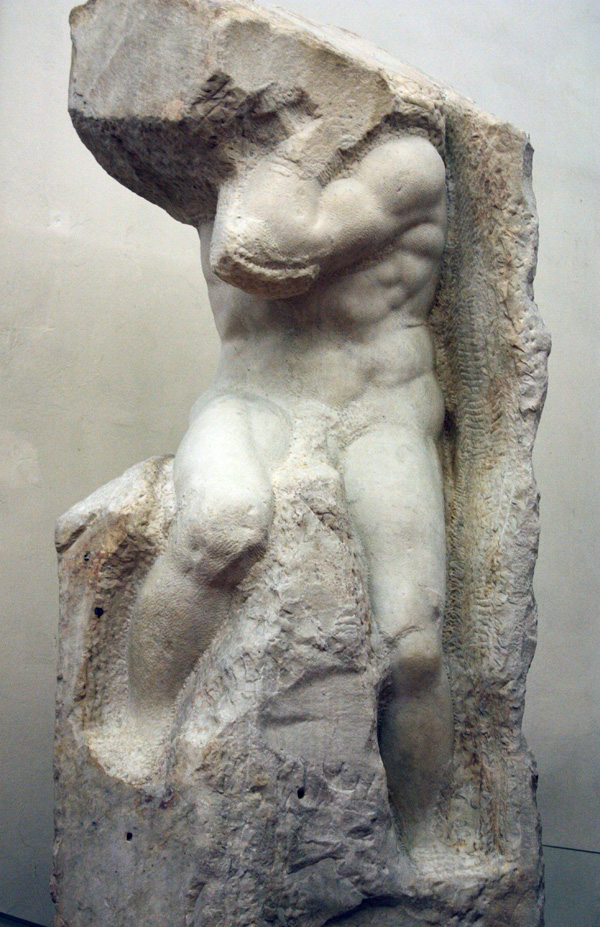
Prisoner (slave) by Michelangelo
On a visit to Florence many decades ago I went to see Michelangelo’s David at the Galleria dell’Accademia which was a memorable experience, but even more memorable was the Hall of Prisoners one has to walk down to get to the famous statue. On either side of this hallway are incomplete statues of male nudes looking as if they are emerging out of the stone and giving credence to Michelangelo’s reported utterance that he always saw the figure in the stone and all he had to do was discover it, chip away the extraneous stone, set it free. Michelangelo and Leonardode Vinci both coveted the same piece of marble; Michelangelo won. We will never know what di Vinci saw in it.
I’ve grown to believe that this idea can be applied to all works of art, be it music, painting, sculpture, or story: they have the quality of existence, before the artist discovers them and makes them known to us. I saw Michelangelo’s five hundred year old discoveries eleven years before Kngwarreye discovered for us her Linear Bush Yam.
Knowing a piece of music or story well can create this feeling of inevitable existence but this same feeling hit me the moment I saw Kngwarreye’s painting; the mystery of it is still palpable after all these years. It wasn’t something in me, it was something in the painting. I still don’t know what it really is.
Antigone, of Greek mythology, offspring from the incestuous relationship between Oedipus and his mother, Jocasta, has been, over millennia, the subject of books, plays, films and operas.
When Oedipus, King of Thebes, finds out his tragic truth – he murdered his enemy not knowing he was his father, and then married the man’s wife – he plucks out his eyes and wanders in the wilderness accompanied by his dutiful daughter, Antigone. After his death, her brothers, Polynices and Eteocles fight over their father’s realm and both are killed. Their uncle, Creon, takes the throne and buries Eteocles with full royal honours but decrees that Polynices, who he labels a traitor, remain unburied as food for jackals and crows. Antigone, defies her uncle, despite her sister, Ismene, urging her not to, escapes the city, and buries her brother. She is arrested and sentenced to entombment, but hangs herself instead. Creon changes his mind and sends his son, Antigone‘s fiancé Haemon, to retrieve her, but he is too late. He also kills himself; as does his mother (grandmother), Jocasta, when she hears of the demise of the last of her children.
Despite the convoluted relationships, lust, greed, ambition, and the body count Antigone‘s story, at its core, is about sibling love and devotion. And it is around this theme that Shamsie composes her modern version of Antigone, her eighth novel Home Fire (2017), setting it among a contemporary British muslim family. It’s not a re-invention of the book; the Antigone story is not “in the skeleton of the book, but in the marrow of it”.
I thought reading during the pandemic lockdown would be a pass-time that would fit the circumstances snugly, as did many friends and contemporaries, but settling into a book hasn’t been easy, for me or them, and Home Fire was the fifth I tried and the one that finally grabbed my attention.
Shamsie’s novel is set in 2014-15 and her principle characters are three siblings, Isma Pasha, the eldest, who raised her younger paternal twins, Aneeka and Parvaiz after their mother died. Their father was a notorious jihadist fighter who died on his way to Guantanamo Bay. Isma, the only child he ever saw is on her way to a brilliant academic career in the US; Aneeka, the ‘beauty’, is serious about her Muslim faith and is studying to be a lawyer; Parvaiz, radicalised by his peers, follows in his father’s footsteps and ‘escapes’ to Raqqa, the ‘capital’ of ISIS, in Syria.
Isma meets Eamonn Lone, and then he, almost accidentally, meets Isma’s sister, Aneeka. He falls hopelessly in love, and it appears Aneeka returns his love; but she has another motive: Eamonn’s father is the highly public British Home Secretary, Karamet Lone, and she needs his help to get her repentant brother safely, and unnoticed, back to England at, of course, great political risk. Aneeka arranges to meet her brother at the British Consulate in Istanbul.
The stakes are high and Shamsie allows them to gradually gain their strength and danger through a very intimate love story. This is her strength. But she, understandably, lets in the public and media outcry when the ‘plot’ is revealed (no spoilers here), in the form of newspaper stories, including salacious tabloid exposés of a sex scandal involving Aneeka ‘Knickers’ Pasha, twin sister of the Muslim fanatic Parvaiz ‘Pervy’ Pasha, and her ‘seduction’ of the Home Secretary’s son for political motives. This strengthens the plot but weakens the personal and causes the heat of the story to drop a few degrees. Quite a few, in fact.
There’s an argument here for the necessity of the public story taking centre stage but, for this reader, public tragedies are daily, and usually unemotional, events, thanks to the persistency of the media; what I missed here was the intimacy of the narrative that had, up until the public narrative took over, swept me up in its poignancy, emotion, and the oozing into it of looming tragedy. I wanted to read the climax on the page, not read about someone watching it on television. There must have been structural decisions made about this; a different structure could’ve worked better for me.
However, what I will remember are the extremely effective domestic and romantic scenes between people working out their decisions between each other in dangerous circumstances, and I am interested to read Shamsie’s previous and future work.
In September last year, Shamsie was awarded, among others, the Nelly Sachs Award for Literature from the German City of Dortmund for her contribution to fostering understanding between peoples, and I can see how Home Fire could support this. However the City rescinded the prize because of her support for the Boycott, Divestment, and Sanctions (BDS) movement for Palestinian rights, and seen as anti-Israel, causing outrage from the global literary community and over 250 writers signed an open letter in the London Review of Books in September 2019 attacking the City of Dortmund for its decision. Shamsie is unrepentant and still believes that “the demonising of BDS, which is a peaceful movement asking for international law to be upheld, is an outrage“.
You can watch a BBC4 interview with Shamsie about the controversy here.
Here you can hear Shamsie talk about her experiences as a Muslim Briton and her writing of Home Fire; and it’s a particularly ‘pure’ interview since the interviewer’s questions have been edited out.
And for the more deeply interested, here is an hour-long presentation by Kamila Shamsie about Home Fire given at the Politics and Prose Bookshop on Connecticut Avenue, Chevy Chase, Washington D.C. in September 2017.
You can buy Home Fire in various formats, and other works by Kamila Shamsie, here.
Now, during a time of self-isolation (March 2020) due to the CV19 pandemic I took a short walk with armfuls of rubbish to the re-cycling depot around the corner in Clifton Hill, Melbourne. There I found, to my joy, an old book cabinet overflowing with books of all descriptions and sizes, lots of dictionaries, ‘best-sellers’, wrecked copies of bibles and unfashionable cookbooks, and a copy of this novel which, of course, I had to rescue. Now all his editions have been given a uniform design but this one, from 1996, is curiously coy but suggestive.
The ‘strange house’ on the cover, and central to the book, is based on A La Ronde, a 16-sided house located near Lympstone, Exmouth, Devon, England, and in the ownership of the National Trust. The house was built for two spinster cousins, Jane and Mary Parminter in 1796 and passed down only through the women of the family.
Yes, Patrick Gale is a master of intimate relationships and the story of the marriage between a German evacuee Edward Pepper, a composer, and his doctor, Sally Banks, is rich in character and incident, including a kind murder. The first half of the novel is about their life together, but the story, over three generations, skips the middle one and continues with Edward’s grandchildren; his daughter, Miriam has given up her hippy lifestyle, having given birth to two children, Jamie, and Alison, fathers unknown, and seemingly incongruously married an accountant. Jamie works successfully in insurance and Alison is an editor at a prestigious literary agency.
The second half opens with a detailed and almost shocking description of a feature of Jamie’s life: uninhibited anonymous sex which firmly sets the action towards the centre of the AIDS crisis of the 1980s.
Again Gale fills their lives with incident and detail and characters clearly and intricately drawn. Sam, a rough and sexually ambiguous young man with an unsettling honesty and plain-speaking seriousness is one of Gale’s most effective creations. Sam rescues Alison from an attempted rape and provides Jamie with a reason to change his life; in fact Sam changes both their lives.
Edward grows into a celebrated composer and like most men of his age is solidified in his thinking of years before, so much so that when reminded of his past missteps appears to blame the times, rather than himself, for any insult or harm caused; but he too is affected by Sam’s view of himself and how things should be.
This novel is indeed a family saga, with all the joys and triumphs, jealousies and tragedies that make up family life and peopled with characters whose romanticism Gale so cleverly pricks, encourages, and celebrates.
The book is dedicated to Tom Wakefield (1935-1997) a British novelist and short story writer, a friend of Gale’s and a co-contributor to a trio of novellas, Secrete Lives (1991), to which Gale also contributed a novella called Caesar’s Wife, now seriously hard to find.
You can buy the kindle and paperback editions of The Facts of Lifehere.
Two introspective young people, Connell and Marianne, find a mutual attraction, sexual and psychological, at school but their socio-economic differences, other people’s perceived opinions, and their own view of themselves, keep them apart. As they mature and they cross paths, along with new partners, they still feel the attraction: one that they don’t fully understand.
The dialogue is simple, sparse, inarticulate like the speakers – belying their intelligence. The narrator carries all the nuances, the real meaning, and the narrative.
It’s this role of the narrator that struck me as unusual. In genre fiction the narrator’s role is very narrow: an isolated voice, in the 3rd person, past tense, with god-like abilities – seeing into everyone’s mind, their desires, regrets, and intentions, the past, present, and future, genderless, as if one minute sitting on the shoulders of characters gaining intimate knowledge of what they are thinking, planning, the next sitting on a drone just above the action seeing what is unfolding from all angles and from all points of view.
In literary fiction the role of the narrator is more varied; not only using the usual 3rd person voice, sometimes the 1st and even the 2nd, mixing past and present tense; or multiple voices, different narrators, some reliable, some not.
Rooney uses a narrator, yes with god-like abilities, but also as interpreter, explaining what the characters are thinking but do not know how to express. They are proto-adults, unaware of what is happening to them, and also unaware of why they do things, highly-strung and sensitive, feeling at odds with their surroundings and peers.
He tells her that she is beautiful. She has never heard that before though she has privately suspected it of herself, but it feels different to hear it from another person. She touches his hand to her breast where it hurts, and he kisses her. Her face is wet, she’s been crying. He kisses her neck. Are you okay? he says: It’s alright to be upset, you know. She lies with her face against his chest. She feels like a soft piece of cloth that is wrung out and dripping.
You would never hit a girl, would you? she says.
God, no. Of course not. Why would you ask that?
I don’t know.
Do you think I’m the kind of person who would go around hitting girls. he says.
She presses her face very hard against his chest. My dad used to hit my mum, she says. For a few seconds, which seems like an unbelievably long time, Connell says nothing.
Connell and Marianne are sensitive to each other although Connell hurts her deeply, unaware of what he is doing; and she accepts the rebuke as indicative of how she sees herself: unworthy, unlovable, and possibly mentally disturbed. This ugly duckling turns into a beautiful duck but with all the feelings of ugliness she grew up with just under the surface. Her mother and brother were, and are, her greatest enemies, whom she gives into as her way of surviving them; just like she does to the various men in her life. Connell rescues her on several occasions only letting her drift away again, usually because of their educational opportunities. Academically they are both exceptional. As readers, onlookers to this on-going train crash of a relationship, we hope they will one day survive it and stay together. This is where the dramatic momentum comes from fostered by the time line: each chapter is several months into the future, although one chapter is five minutes into the future and the tension this creates is remarkable.
The joy of reading this book is the insight into her characters Rooney gives us. We’re watching them along with the narrator wishing them well, cursing their decisions, cheering with their triumphs. We desperately want them to be happy.
I loved this book.
“I found Henry James almost unreadable five or six years ago, and now I love him! Who knows what I might get into next?” Yes, we’d all like to know that.
Sally Rooney, at 29, has had two novels published, Conversations with Friends (2017) and Normal People (2018), which was long-listed for the Booker 2018 and won the 2019 British Book Awards and will soon be on our televisions this year with a Hulu, BBC production penned by Rooney and directed by Lenny Abrahamson.
Here you can watch an interview with Sally Rooney from the London Review Bookshop in May 2019.