I'm an Australian writer living in Bali. I recently took the plunge to self-publish, and to blog which was liberating, to say the least. Writing has never been so immediate and so rewarding.
Somewhere in the dim, dark, past of the very late twentieth century, two books, I read and loved, had an influence on the development of one of my own: John Irving’s A Prayer for Owen Meany and Mario Vargos Llosa’s Aunt Julia and the Scriptwriter. The former for a great page one. Browsing bookshops has always been one of my favourite pastimes; and that means reading a lot of page ones. A good opening page, a good opening paragraph, can grab you; it can be the best marketing tool ever, and Irving’s is one of the best openings, rivalling, Ian McEwan’s Enduring Love as THE best. At about this time I was dabbling with writing an autobiographical fiction and I got it in my head that the opening paragraph had to be a doosy. I had a name for my fictional me: my father, who died, when I was five wanted to call me Johann Wilhelm, he lost out. This would become the name of my hero. I first began an investigation, that continues today, into truth v’s fiction when I heard that the Australian commentator and writer, Clive James, had written something autobiographical. His Unreliable Memoirs were published in 1980. I found the title confusing, a contradiction, but as my reading education continued and as I discovered that my recollections of my own past differed from those who were also there, I developed a concept of fictional truth: every time we speak about the past something in the telling changes depending on who is listening AND the more we tell it the firmer those changes become part of our believed past. We are creatures whose desires, dreams, and fantasies can take root, grow, and evolve under favourable conditions, like mould, into memories. (Oo! That’s good. I might use that). Now I am of the view that anything that is written cannot be true: what is true is that we are looking at little black markings on a white page, or screen, and those markings, although we all share a common pool of meaning regarding those markings, the different arrangement of those markings can signify different meanings for different people.
LLosa’s great book I cherish, among many things, for its great title. The title of a book, the title for any piece of literature, needs to be specific, not general. Had Tolstoy consulted me about titles I would’ve said “Yes” to Anna Karenina, but “No” to War and Peace. I also would’ve poo-poohed Lawrence for Sons and Lovers. Oh well, I still like a specific title, like, The Prince of Norwood, and The Lavender-Hill Mob. Aunt Julia and the Scriptwriter is very specific (it’s about an aunt called Julia and a man who writes TV scripts – how specific can you get?) but also intriguing: ‘Aunt Julia’ is familial, ‘Scriptwriter’ is vocational. There’s a mismatch that leads you to mentally ask a lot of questions: it sparks curiosity. I like that in a title. I worked for months on my biographical piece on my very first lap-top; but then in the late 1990s – it must have been after 1997 because I was living in Liverpool Street, Darlinghurst, Sydney – my computer blew-up. Clouds of smoke, SMOKE! began billowing from the thing and my computer repair man, in a back lane off Bourke Street, just, school-m’amishly, shook his little head, at me. He was no use at all. Fifty thousand words gone! I had backed everything up but not on a different device. Well, actually, not completely gone. I had worked on the opening so much I had memorised the opening sentence. It was all I had. I remember it now. Here it is.
“If at any time you had grabbed him by the shoulders, made him sit, looked him in the eye, and asked the right questions, even he would have to admit that it was not possible for him to have killed his step-father three times.”
This was, is, my killer opening and so, finally, last week, after nearly two decades, (and with my sequel to Veronica Comes Undone, Veronica Spreads It Around, at the proof-reader’s) I started anew and so JohnnyWilliam and the Cameraman rides again.
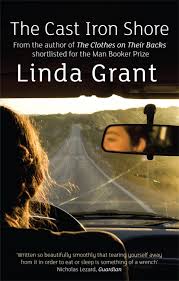
I must have read the name Linda Grant at some time in 2002 but definitely in 2008 since I always read the Man-Booker Prize short list when it comes out and Grant was long-listed in 2002 for her third novel Still Here, and short listed for her fourth novel The Clothes on Their Backs in 2008, but the name only impinged on my brain last month when her first, The Cast Iron Shore was gifted to me.
It’s the first read of my ‘to read’ pile for 2015 (see previous blog).
It’s the story of Sybil Ross, the only daughter of a Jewish furrier from Liverpool and his German wife, who was born and raised before and during the Second World War. Her mother is crazy about fashion, taste and style; her father equally so but in particular about furs: a woman isn’t a woman without a fur. The young Sybil is raised to be a fashion plate with little time or space for her brain.
Her life is dominated, and determined by men; first her father, or more aptly, her mother’s attitude to her father; then a bi-sexual sailor and baker, “a tearaway”, an opportunist, Stan, with skin the colour of milk coffee; and Julius, a reformed African-American hood who becomes immersed in the work, ideology, and expectations of the Communist Party. She has always liked men of a darker hue.
She first met Stan in Liverpool’s Sefton Park, late summer 1938, “I wore a shantung jacket over a mauve box-pleated skirt” with hair styled like Veronica Lake making her, “as usual” older than her childish years. Stan had a camera pointed at her. She always likes to be admired. Even in her sixties, when she crosses her still-shapely legs, in company and notices men looking, she stays exactly where she is and lets them. She goes where Stan goes; she has sex with him because he asks. She goes with him to America.
Julius is cut from a very different cloth and because he’s a communist, she becomes a communist and her middle years are defined by gestetner machines, rallies, leaflet-runs, and drop-in centres and when asked to speak about her working experiences as a shop-assistant in a fashion house she has no idea how to do it; no understanding of what she does, intellectually, when she sells something. She’s a worker without a voice and ripe for the CP who want to do nothing except give workers one.
“I myself have done as much as I can, all my life, to skate along on the surface of things.”
When Stan walks back into her life she goes off with him, because he asks, to Canada where Sybil has an affair with Stan’s best friend.
Her later years take her to the world “buying things cheap, selling dear” – antiques, jewellery, houses. She does alright for herself: a capitalist at heart.
“I know exactly what I am. A vain and shallow woman, though as far as I am concerned, it could have been so much worse.” A sensualist, in her dotage she gives a homeless boy, crouched in a doorway, a ten pound note because he is so handsome.
A distant relation asks her to take in a second cousin because she has the room. The idea of a man again living in her house, at 62, fills her with delight and so she fills her flat with freesias and does her yoga exercises in the nude. Twice.
In the final scene, Stan and Sybil, meet back in Liverpool, both in their 70s, she wearing furs again and both confessing to using the other: while Sybil was having an affair with Stan’s best friend, Stan was having an affair with the best friend’s wife. They were cut from the same cloth.
It’s a grand story of a woman’s life in the second half of the twentieth century, but like most people history, politics, and missed opportunities, travel in the background as people deal with their own kitchen events, justify their mistakes, and hope something better is just around the corner.
If our final years amount to a collection of outcomes prescribed by our choices made when we were younger then who we are in those final years is who we really are. For Sybil furs, a perm, matching accessories, and money in the bank is who she really is despite what she tried to make of herself because some man suggested it.
Grant writes in the first person, the most reader-friendly voice writing gurus will tell you, but in this work there is a disconnection. Sybil, the character, is forever described, even by herself, as “dumb”, “shallow”, and “vain” but the narrator is none of these things. However, by using the first person, the narrator IS the character: it is the character telling her story. How can the narrator be intelligent, insightful, and understanding when the character is not? This is a drawback to the reading of this book. There’s a feeling of unease that the writer is creating an unauthentic character and not the character telling her story.
However, finally, Sybil makes an appeal to the reader, “I am an atheist. I cannot appeal to God, only my fellow man. I set out my life before you, for judgement. Three injunctions. Self-awareness, social justice, the longing of every Jew in exile to find a home. Have I succeeded in any of it? You know my story now. You decide.”
My ‘to read’ pile. The other book is Colm Toibin’s essays on Henry James. Toibin is never far away.
Happy New Year and welcome to 2015: another year of reading and writing; but first the reading. As you can see from the picture my reading for 2015 begins with rather an eclectic batch. This was not planned, well, not all of it was planned. Here’s a little run-down on the list – to be read in no particular order – gleaned from the covers, a little Google search and information I’ve acquired through osmosis.
The Dinner by Herman Koch
I have a dear friend, an Irishman living in Brussels, who visits the island where I live twice a year and being a book-worm himself he brings me novels I wouldn’t otherwise have heard about. My to-read list contains several of his gifts, and The Dinner is one of them. I like to think of him as my Book Fairy. Herman Koch is a Dutch writer and actor and his sixth novel, The Dinner (2009), is his most successful, having been translated into 21 languages; it came out in English in 2012. Two couples meet at a stylish restaurant in Amsterdam for dinner. Each has a teenage son who, together, have committed a horrific act, caught on camera and beamed into living rooms all over the country. The New York Times reviewer called it “a clever, dark confection, like some elegant dessert fashioned out of entrails.” Australia’s Christos Tsiolkas, who, by the way, is doing very well in Europe since the great success of The Slap, is quoted on the jacket, “A riveting, compelling and deliciously uncomfortable read… This novel is both a punch in the guts and also a tonic. It clears the air. A wonderful book.” Can’t wait!
Home by Frank Ronan
Another from the Book Fairy, but this time from an Irish author, Frank Ronan who also writes a monthly column for the magazine Gardens Illustrated; Home is his 7th book and came out in 2002. “Born into a cabbage-growing, peace-loving 1960s commune, Coorg is declared, courtesy of a favourable reading of the I Ching, to be the new Messiah… startling and often hilarious,” says the blurb on the back courtesy of the Irish Times.
The Long Prospect by Elizabeth Harrower
I was shocked when a recent New Yorker edition arrived, and as usual, I checked out the “Books” section first, and I saw my favourite literary critic, James Woods, devoting a whole article to the re-release of the five novels of an Australian writer called Elizabeth Harrower, who, according to Woods, was alive and well and living in Sydney. She’s 84. I had never heard of her! The very next day I found The Long Prospect in my local second-hand book shop and in the new re-released edition by Text Publishing. Apparently she thinks of her fiction as something abandoned long ago and now can’t be bothered with writing. She wrote 5 novels between 1957 and 1971 but withdrew the last, In Certain Circles, some months before publication, lodged the manuscript with the National Library of Australia and washed her hands of the whole writing thing; until, Michael Heyward, of Text, came along and persuaded her to let him re-publish the lot in 2012. All five are about female characters trapped in tempestuous relationships with a charismatic bully; all male except for this one where the bully is female, the hateful Lillian Hulm.
The Cast Iron Shore by Linda Grant
Linda Grant is a British novelist and journalist and her first novel. The Cast Iron Shore (another from the Book Fairy) was her first, published in 1995. She has won numerous prizes (The Orange Prize for Fiction in 2000 for When I lived in Modern Times) and was on the long-list for the Man-Booker Prize in 2002 for her third novel Still Here and short listed for the same prize for her fourth The Clothes on Their Backs in 2008. Again, I’m ashamed to say, her name was new to me when the book landed in my hands only recently. It looks historical with a female protagonist who is raised ‘as an empty-headed fashion plate’ but a secret revealed during the Liverpool blitz of the Second World War changes her life and leads her to ‘a seedy hotel room in Hanoi’ and ‘a potato-chip factory in the prairies’, among many other locations, and ultimately to ‘a final choice’.
After Dark by Haruki Murikami
I’ve always been a little afraid of Murikami. I don’t read fantasy or science fiction – I’m a literary realist, I think – but I’ve always been drawn to him, curious, as well – he’s on everyone’s lips – but his books are so big. This one isn’t: I’m putting my toe in the water. It’s his 11th and came out in 2004. “A sleek, gripping novel of encounters set in Tokyo during the spooky hours between midnight and dawn.
My Dream of You by Nuala O’Faolain
I’ve just read Nuala O’Faolain’s (Noo la O fway lorn) famous memoir Are You Somebody? and fell in love with her way with words. This is a novel which came out in 2001 after her memoir and is about an Irish travel writer who leaves all that she has behind and returns to Ireland to write a book based on an old scandal of the mid-nineteenth century: an affair between the wife of an English landlord and her Irish servant, but what she really wants to understand is passion itself. I’m curious to read her fiction having only experienced her memoir.
The Moon of Jupiter by Alice Munro
Although I write short stories occasionally I don’t read them very often but when Alice Munro, a Canadian, was awarded the Nobel Prize for Literature in 2013 I thought it’s time: she is a prolific short story writer, mainly because, as she explains in her introduction to the Vintage edition of her Selected Stories, “When you are responsible for running a house and taking care of small children … it’s hard to arrange for large chunks of time … so I got into the habit of writing short stories.” I’ve read several since BF brought me this collection of her work, and she is not so much interested in the interior life of her female characters but more in the heady and extravagant thoughts around that interior life. One of her characters, Lydia, in a story called Dulse is forever judging, pitting, herself against pleasing the men in her life. Every man she meets she thinks in terms of what would it be like to be with that man; and then she meets a man who is nothing like any other, who is so self-contained ‘alone’ is all he can be. She envies him. “What a lovely durable shelter he has made for himself.” And yet another man, one she has fantasised about, gives her a parting gift “Yet look how this present slyly warmed her, from a distance.” The gift? Eatable seaweed: dulse.
The Sheltering Sky by Paul Bowles
When my partner and I left Australia in 2010 we shipped 25 boxes of books, this one included, and not much else, but lost the lot so it’s good to get another copy to take its place. Thank you BF. I came to Paul Bowles via his extraordinary wife, Jane Bowles, whom Tennessee Williams called the ‘greatest writer of the English language’. Paul started out as a serious composer – studying with Aaron Copland – in New York in the 1940s (I’m playing his music as I write this) and this, his first novel, and most successful, came out in 1949. He died in Tangiers in 1999 aged 88. A story about three American travellers in the deserts and cities of North Africa after World War II, but it is really about how the American incomprehension of alien cultures ultimately destroys such cultures. It was filmed by Bernardo Bertolucci in 1990 starring Debra Winger and John Malkovich, and in which Bowles appears. Looking forward to revisiting this one.
Zeitoun by Dave Eggars
Every since Dave Eggars, an American writer, began his career with his memoir, A Heartbreaking Work of Staggering Genius in 2000, I believed the title. He’s a writer, publisher, screenwriter, editor, designer, philanthropist, journalist … Smarty Pants! He looms large. His books are so dense, heavy – in weight I mean, important, significant, worthy. Anyway, this one is non-fiction about a Syrian-American, a Muslim, who rides out Hurricane Katrina in New Orleans in 2005. The theme is similar, I’m led to believe as Bowles’, The Sheltering Sky: the inability of white Americans to mentally process ‘the other’.
The Speckled People by Hugo Hamilton
Hugo Hamilton is another Irish writer and this is a memoir that came out in 2003 but apparently free of the Catholic victim-hood, poverty and misery of the Irish memoir popularised by the likes of Frank McCourt of Angela’s Ashes fame, and as Hermione Lee says in The Guardian, “it’s shaped like a fiction, told, as if naively, in the language of a child.” “To read The Speckled People is to remember why great writing matters,” adds Joseph O’Connor in the Daily Mail.
The Poisonwood Bible by Barbara Kingsolver
I’ve always wanted to read this book but have never got around to it. I would always pick it up in book shops, hold it, flick through it. An American, she began publishing in 1988 and this one came out in 1998, her eighth work and, I think, her most famous. I mentioned to a friend that I had seen it in the local bookshop. “Get it,” she said. “It’s great.” So I did. That’s all it took. I was primed. Another book about a white American NOT dealing with ‘the foreign’ but as told through the eyes of the women in the family of a stubborn missionary in West Africa in the 1950s.
Many decades ago a dear friend of mine gave me a little pile of novellas for my birthday. They were all by Ian McEwan. I had never heard of him but I devoured those little books hungrily. I liked the darkness, the little knot of evil in those novels. It’s become a trade mark of his and to this day I still think the first chapter of Enduring Love is the most thrilling opening to any novel I have ever read. I’ve read them all; well that’s not entirely true: I couldn’t read On Chesil Beach. I started it and almost got to the end of the first scene; in the hotel room, the honeymoon suite, with the two innocent newly-weds and the snickering staff bringing in their meal on a tray. I had such an overwhelming sense of foreboding and embarrassment for these two child-like people that I had to shut the book. I’ve never opened it again. That little dark nut at the heart of most of his work has faded over the years but he still has a talent for the unexpected except his use of the unexpected can sometimes be very subtle. I know a few readers who didn’t ‘get’ the twist that was behind the climax of his 1998 Booker Prize winning novel, Amsterdam.
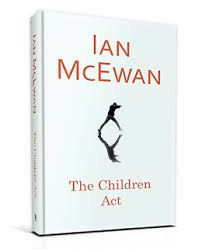
After Atonement (2001) – his masterpiece, Saturday (2005) is the most representative of his latter work, and his latest, The Children Act, begins with a similar scene: a person alone at home contemplating their future, although Fiona in chapter one of The Children Act has just had the bombshell that will change her life, while Henry, in Saturday, has yet to meet it.
At the centre of The Children Act is a high court judge, her husband, and a case she has to decide: a case of life or death. A young underage man, three months before his 18th birthday, desperately needs a blood transfusion to save his life. He and his parents are Jehovah Witnesses, devout, and are refusing treatment. The hospital has taken the court action to allow them to treat the boy. The legislation, the Children Act of the title, is clear. The young man, Adam, is intelligent, articulate, and more than capable of understanding his situation. However just before this case is thrust upon her the judge, Fiona, nearing 60 and childless, is confronted by her husband who wants her permission for him to have an affair; he says he still loves her but his libido and masculinity want one last chance before they and he slide into an inevitable but comfortable twilight.
McEwan takes us through every detail of the hurried case, time is short, and Fiona decides to see the boy. The meeting is deftly handled, moving, real, and McEwan manages to keep the emotion from spilling into sentimentality, although a duet sung at a deathbed’s side is strewn with potential pitfalls. We are, however, along with all the parties in the case, made to wait for her decision from her high bench. There is a feeling of expectation and intrigue: what will she decide? It’s page-turning; but her decision is not the end of the story. Her decision has consequences that no-one could predict, and I won’t spoil it for you by revealing them.
Like all her decisions, separating conjoined twins, deciding which spouse gets the kids and/or the money, she listens to the arguments, does her research, decides, closes the book, and moves on immediately to the next case and another decision about the future of people’s lives. However the image of the dying Adam stays with her in both personal, and professional terms.
She is highly regarded by her peers but the means by which she makes decisions about other people are very different to the decisions she must make in her own life. How should she respond to her husband’s request? Is it reasonable? He’s being very open and honest with her. Professional decision-making has policies and precedents, but with personal decision-making you’re on your own. On impulse she demands he leave the apartment and she immediately changes the locks, which her legal mind tells her is NOT the thing to do.
These two strands of the personal and the professional are skilfully woven together around a third: music. Fiona is a very competent amateur pianist and every year she takes part is a concert among her legal fraternity and it’s as she is walking onto the stage, in the penultimate scene, her mind full of Mahler and Schubert, that news is unkindly whispered to her; news that in another circumstance may very well stop her in her tracks; but like every aspect of her life she has other responsibilities, and now, those responsibilities are to her fellow performers, her audience, herself, and especially to the composers she is interpreting. She gives an astounding performance but can’t bring herself to acknowledge the rousing applause: one set of responsibilities are fulfilled and extolled but another responsibility, one she thought she had executed, well and for the benefit of all, had just unravelled. It’s so like McEwan to defer a climactic revelation while the protagonist is intent on doing what is expected, and so like the character not to let a past failing interfere with her immediate duty.
The end is a soft, satisfying coda as she begins to tell the man lying next to her of her shame.
To you who love reading and writing I hope you have a happy Christmas with your family and friends and a safe and exciting 2015.
Up-coming blogs in 2015; posts on Alice Munro, Ian McEwan, Elizabeth Harrower, Christos Tsiolkas, and Veronica Streads It Around, the sequel to my dedut novel, Veronica Comes Undone. I hope to have it published on smashwords.com by the end of February 2015. Cheers!
In the early stages of my mother’s relationship with my step-father, when she could get what she wanted – don’t think she was asking for diamonds, she wanted a good sized bathroom, a good sized laundry and a flushing toilet and those she got – she also got me a piano.
Unfortunately the means to teach me to play it were limited. There were two possibilities: I could go to the nuns or I could go to the Shefte College of Music; but being a good Lutheran family, going to the nuns was completely out of the question and therefore not a possibility at all, so the Shefte College of Music it had to be.
This turned out to be the wrong choice since the teachers at the Shefte College of Music were sloppy and extremely unmusical. They travelled up from the city to my small country town every Monday so I stayed with Auntie Ivy in town on Monday nights since the music lessons were after school and I would miss the school bus back to the farm. I liked staying with Aunty Ivy on Monday nights because my Latin teacher, Miss Linke, boarded with my Aunty Ivy and it was Miss Linke on whom I had an enormous crush.
But back to the music. The music teachers from the Shefte College of Music taught piano and piano-accordion. I actually wanted to learn to play the harp as another crush of mine at the time was on Harpo Marx. No-body had a harp but I had a piano so the piano it had to be.
We already had a piano-accordion player in the family. One of my step brothers learnt to play the piano-accordion from a local girl. He was so good at it that he married her. They used to play piano accordion duets in his room where my mother insisted they play with the door open. It was understood but never said that they might do things to each other that my mother disapproved of. This puzzled me because if the door was closed I couldn’t understand what they could possibly do to each other while both had piano-accordions strapped to their chests and all four hands energetically engaged in pushing and pulling, keying and buttoning piano-accordion arrangements of songs from South Pacific. If you haven’t heard a piano-accordion duet of “I’m Gunna Wash That Man Right Out of My Hair” then your musical upbringing is sadly lacking.
The teaching method of the Shefte College of Music was based on the belief that all young people were interested in pop songs. Therefore they taught their students to read music only in the treble clef. They completely ignored the bass clef but trained our left hand to vamp the guitar chords which were always printed in a little box above the treble bars. This worked well for songs like “Beautiful Beautiful Brown Eyes,” “If I Were a Rich Man,” and “The Impossible Dream.” My earliest public performance was in the Glenelg Town Hall, in the big city, at the end-of-year concert where I was part of an ensemble of 10 pianos and 15 piano-accordions all bashing out “Lady of Spain” almost at the same time. The noise was … remarkable. It was my first taste of public acclaim. The audience applauded very loudly when it was finished.
When I asked could I learn the piano piece that accompanied a popular TV commercial about fabric conditioner they were a little surprised but they found the music which didn’t have guitar chords on it and that’s how I learnt to play a piece called “Fur Elise.” I only learnt the first page; it was a very short commercial.
My mother made me practice every day which I did after I came home from school. It was at this time of the day when everyone in the house was out of the house doing the evening chores. They all assured me that they could still hear me practicing and I was doing very well. I was particularly good, I thought, at “Sadie, The Cleaning Lady.”
During one Christmas holidays in another little country town I was baby-sitting my sister’s children. After the kids went to bed I decided to listen to some of my sister’s LPs. We didn’t have any music player on the farm. Music was more closely related to church, the organ, and Sundays. There was a pile of records in my sister’s very modern and very long HiFi unit, made of polished wood and glass with speakers at either end. It was a stereo system and you could stack on the central spike several records at a time and each one, and only one, would drop down after the previous record was finished. It was very mechanical and very modern and had a built in cocktail cabinet. Their record collection consisted of the James Last Band and Herb Alpert & the Tijuana Brass. That was it. But on this particular night I went right to the bottom of the pile and came across an LP that I had never seen before. It was red and written across the top were the words “The Original Motion Picture Soundtrack.” The name of the motion picture was incorporated into the design; red on red, so it took me a few moments to find it. It was called “West Side Story.” I had no idea what it was so I played it. I watched as the black disc dropped down and the arm came across and lowered itself on the first track; and I listened. I was mesmerised. I had never heard anything like this before. It was so surprising. You could tell that there were a lot of musicians playing a lot of different instruments all at the same time. It sounded like there were hundreds of them; and no-one was vamping. There wasn’t even a piano. For the next hour or so, while I sipped Creme de Menthe from a very little glass I played the first song – it was called “Overture” – over and over again. It was the most exciting music I had ever heard.
Those same Christmas holidays were my last on the farm. In February I went to the big city, to boarding school, to do my matriculation year before going to university. I left home. On the first weekend I took my horde of pocket money, I’d been saving for months, and I went into the city on the bus, by myself, and found a music shop. I wanted to buy some orchestral music but I had no idea what to buy. I found a little music shop in a little lane-way that sold not only LPs but cassettes and cassette players. I bought a cassette player about the size of a small type-writer. Then I searched for music cassettes of orchestral music. I spent hours in that shop. I only had enough money for two cassettes. After much deliberation, based on nothing but the picture on the front, I bought a cassette with music by someone called Saint See-ens; a piano concerto it was called, Number 2. I searched for number 1 but couldn’t find it. It was clear to me that although the composer was a saint I was sure it wasn’t religious music. I knew I didn’t want religious music. I also bought a cassette of music by someone called De-vor-rak. It was called “From the New World” and I bought it because of the word “New”. I liked the fact that it was new.
My musical education, taste, and the pronunciation of European composers have all improved, wandered, and grown over the decades since. I played Saint-Saëns Piano Concerto No 2 only yesterday which sparked my wish to write the above. It’s still one of my favourite concertos. However I cannot listen now to Dvořák’s From the New World, his Symphony No 9. I’m not sure why. It makes me cringe.
Little pieces like this have occurred to me lately, I suppose, because I have just finished reading a memoir. However the above was a little experiment on how to convey my naivety and wide-eyed wonderment at discovering orchestral music. Short and simple sentences, something that an eight year old might write, was my way of trying to achieve this; but it was also an experiment in meaning. I hope it was clear that when I wrote, “I was particularly good at “Sadie, The Cleaning Lady”” you understood that I meant the exact opposite and that despite my description of 10 pianos and 15 piano-accordions playing “Lady of Spain” you understood that it was probably the most hideous noise a pair of ears could endure. But, successful or not, I’m sure you’ll tell me.
I don’t often read memoir, or biography, or autobiography. I have read those of, or about, Tennessee Williams, W Somerset Maugham, Jane Bowles, Maurice Ravel; heroes of mine at the time; but yesterday I was reading Nuala O’Faolain’s remarkable memoir Are You Somebody? and suddenly this popped into my head …
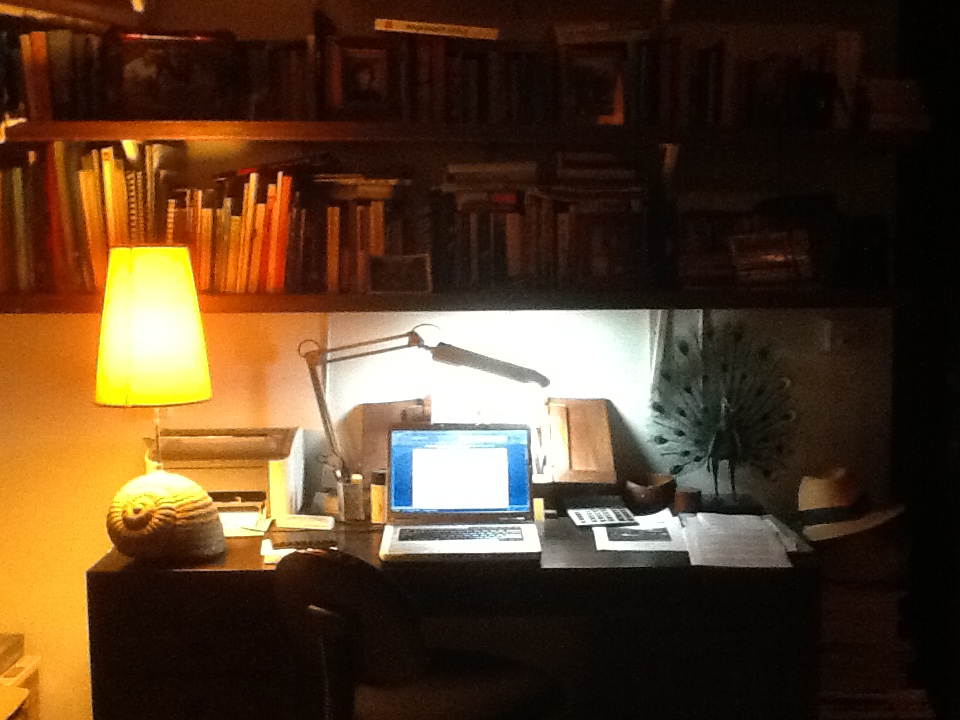
I put down the book and sat down at my desk.
For Mrs Paterson
My earliest proud attempt at writing, at completing something, has stuck in my mind. I have thought about it often.
We were asked to write an essay on any subject but I chose to write a short story: completely made up. It was 1969, that year at Immanuel College, my last hurdle before University, boarding school, the best year of my education, when the Americans stepped on the moon; the first thing I wrote for the wonderful and sensual Mrs Paterson.
It went something like this, not the story itself, but my recollection of it.
In an unnamed little country town, every Sunday morning, an old widower, leaves his low-verandered cottage, a cottage with a frown, and takes a little bunch of flowers, whatever he can find in his garden, to his wife’s grave at the far end of the town; at the other end of the single street. Along the way he passes his neighbours and fellow towns-people pottering in their gardens or sitting on their porches, people he hardly ever speaks to except on Sunday mornings. He chats absent-mindedly to old Mrs So-and-so; to Mr and Mrs This-an-that. These people speak fondly of his dead wife, which is something he expects them to do; they knew her and they know where he is going and so they talk about her. They mention the time when she…; or the day they saw her ….; or even the time she told them about …; that sort of thing. They never mention much about him because he was always there and would, of course, know exactly what they are talking about. Like most people they speak in unfinished sentences where new thoughts interrupt the flow, or old thoughts occur to them again. He nods his head in recognition and chuckles when they chuckle, shakes his head at the likeness of her, at an anecdote he doesn’t remember but makes out that he does. And he shuffles on past the next house, the next garden, admiring the zinnias (he hates zinnias), getting a response or sometimes not. These little stories remarked on by the people he meets are sometimes the same as the Sunday before, and sometimes they are not; but on this particular Sunday, on this particular walk with this particular combination of familiar stories and unfamiliar stories, some he believes and some he thinks are pure humbug; on this particular Sunday morning with the clouds and the wind making these particular shapes against the blue, he gets to the little rusty gate of the little church cemetery and it dawns on him. They all hate him. They all hate him, and they loved his wife. She was the good one, he is the fool; she was the one who put up with his cantankerousness, his petty complaints about them, his way of blaming her for things he thought she had done. They talked behind his back and still do, he realises. If he looks back down the street now; if he turns his old fading body around he would see them all standing on their porches, amongst their silly zinnias, looking at him, whispering to each other about him. And that’s what they do every Sunday. It was her they loved. But he doesn’t look back because he is not brave enough to do that, not now. He shuffles on to do what he came to do. He stands on the damp earth by his wife’s neat little grave; and as he takes out the flowers from the little jam jar in its little concrete hollow his heart gives a jump because he knows his realisation is true: these are not the flowers he put there last Sunday. Other people tend her grave; these are other flowers, better than his. His old legs give way and he sinks to his knees still clutching his pathetic little posy, a daisy, a thistle, a piece of fern. As he feels the cold tears running down his cheek and feels the damp oozing through his trousers, he begs his wife to forgive him, she who was the good one, she who was loved more; and how can he get up and walk back to his little cottage when he now knows the truth: she is loved, he is not. What is he going to do? How can he possibly go on?
I was very proud of my story; god knows where it came from. I sat in my seat as Mrs Paterson gave back the stories to her students. I sat wondering how I was going to deal with the praise that I was sure would follow. Someone is always mentioned as the best. What would I say? Mrs Paterson, speaking in generalities about the stories, about her student’s work, paced up and down the aisles between our wooden desks and then she put my story down in front of me. I hesitated to look at the top of the page where the mark was sure to be, savouring the moment. Then I looked. I saw the mark, in red ink, at the top of the page and my heart stopped. Sixteen out of twenty. Is that all? I was devastated. There must be some mistake. I read the first line, “On a Sunday morning, like every other Sunday morning…” Yes, it was my story. But my story was a work of genius from one so young. Didn’t she realise? But by then Peter Fitzner was standing up receiving the praise that I was sure would be mine. Peter bloody Fitzner. Didn’t she understand? That was it. I had decided. It was as simple as that: she just did not understand. Genius can be so overlooked, you know. It had happened before, I was sure.
I’ve always had a love-hate relationship with poetry: I love mine but hate everybody else’s.
In the part of my brain where poetry lies there are only four (see below) rattling around like lost beach-balls, Robert Browning’s Porphyria’s Lover, Robert Frost’s Out Out …, William Carlos Willimas’ To a poor old woman, and Les Murray’s An Absolutely Ordinary Rainbow: the first because of the lines “ … and all her hair / In one long yellow string I wound / Three times her little throat around,/And strangled her, …”; the second because it’s about the poetics of a fatally amputated limb in a milling accident; the third because of the line “a solace of plums” and its punctuation: there is only one punctuation mark, a full stop, that happens to be in the middle of a line; and the last because of the image, “There’s a fellow crying in Martin Place.” I swore once never to read any Les Murray because he described prose as poetry to the edge of the page. I thought it trite, a lazy thing to say, absolutely untrue, and completely missing the point of the question, but then maybe even he resorts to triteness when he doesn’t know the answer. Anyway, a fellow writer, Katherine Thomson, told me I should read it; I did and it stayed.
What these four poems have in common is that they are all narrative poems. They are all remnants of a poetic tradition that was once lauded and common place but we don’t value narrative poems any more. Today poetry is praised for imagery, and the more personal the better. Spring seems still to be a popular subject.
I would never write a poem about spring. I might write a poem about a murder in spring. I could very well write a poem about amputations in autumn (“limbs falling like leaves” Ha!).
I took heart when I discovered Howard Stewart’s and James McAuley’s attempt, in 1943, to debunk ‘the modern’ with the invention of Ern Malley. They won the battle but lost the war. Even George Bernard Shaw got into the act and put an end to the jape by declaring that Stewart and McAuley, by abandoning their rigid poetic rules had ‘accidently’ written good poetry. Ern Malley was taught, up until the 1970’s in American colleges and universities and in the Penguin Book of Modern Australian Poetry (1991 ed. John Tranter and Philip Mead) Malley’s entire oeuvre is included. I would like to see the Malley poems attributed to Stewart and McAuley; they were, after all, their creators.
The lesson from The Ern Malley Affair is that everybody can write poetry; everybody should and everybody does. The four poems mentioned above were written with an audience in mind: that’s probably why they have stuck with me. Modern poetry is, generally, not. Modern poetry is written with only the poet in mind: it’s poetry as therapy, which is as good a reason as any.
So, here’s a therapeutic poem with an audience in mind; it’s called, funnily enough, Poetry.
Poetry
Poetry poetry
What is it you are
A house made of cards
A heart in a jar
Poetry poetry
Get out of my hair
I’d rather play golf
Give birth to a chair
Poetry poetry
Leave me alone
There’s dishes to do
And people to phone
Poetry poetry
Get out of my sight
It’s not about you
I’ve novels to write
Poetry poetry
You’re a pain in the neck
A stacked deck of hopes
But wait just a sec
Poetry poetry
You’re dead as din Laden
Dead as a coffin
Dead as a rhyme
I indulge in Google alerts. I have one email alert for Cólm Tóibín. Every time his name is mentioned, anywhere, I receive an email and a link to the article. In this way I have read every English language review of his latest book, Nora Webster. I had one for Virginia Woolf but all I got were picky reviews of Albee’s play so I deleted it; and I have a Google news alert for ‘literature’ (as well as Books and Writing).
Because of this I received recently in my ‘personalised Australian Edition of Google News’ an item called “What makes the Russian Literature of the 19th Century So Distinctive?” It came from a New York Times column called Bookends where two writers ‘take on questions about the world of books’. It was in this article that I encountered for the first time, Francine Prose. I had never heard of her. I hadn’t heard of the other writer either, Benjamin Moser, but it was the name ‘Francine Prose’ that caught my attention. It sounded pretentious. Is there a poet called ‘Phoebe Poetry’? I could google it and find out but instead I googled Francine Prose. That is how I came to know the book “Reading Like a Writer” which, since my blog is ‘writing about reading and writing’ I thought I should have so I downloaded it as an ebook; it took less than a minute and I didn’t have to leave my desk. The fact that it was billed as a ‘New York Times Bestseller’ may have also had something to do with it. When on a wet and warm Ubudian Friday afternoon I delved into it I came upon a chapter on Chekov and in particular her line “as my bus pulled out of New Rochelle, I began Chekhov’s “The Two Volodyas.” I immediately went to ebooks.adelaide.edu.au (click the link and you can go there too) where everything out of copyright – i.e., all the classics – is available for free, and read “The Two Volodyas” and so I was prepared for whatever she was going to relate about the writing of Chekhov and in particular this story. Ms Prose is, or was, also a creative writing teacher and the point of this chapter in her book was to explain that Chekhov undermines every creative writing rule she had confidently confided to her students. “Don’t listen to me,” she shouted, “read Chekhov”.
From a Google alert on my screen in Ubud, Bali, I travelled to a sleazy bus station in New Rochelle, New York, to a scatty young 19th century Russian bride in love with two men, but never at the same time, and back to you, my friends, with a message – although one of Chekhov’s lessons is that you don’t need one – that modern technology has never been so supportive of our creative and entertaining lives.
If you take nothing from this little rant take this: set up Google alerts for whatever tickles your fancy; armchair travelling has never been so easy, so informative, and so entertaining.
If you would like to know more about Google alerts you can email me at michaelkfreundt@gmail.com or ask Google.
“I took it for granted that like most of the billions of people who are born and die on this planet I was just an accident. There was no reason for me.” Are You Somebody?
– Nuala O’Faolain.
I often find books on my shelves that I have never seen before. Where do they come from? They pile up, literally, and having lost an entire life’s library of books and music CDs when we moved overseas four years ago I am not as attached to them now as I once was. Occasionally I pick out some of these volumes that I know we will never read and swap them at a bookshop in my new hometown for ones that we might. I did this recently with five and came back with two: Barbara Klingsolver’s The Poisonwood Bible and Nuala O’Faolain’s Are You Somebody? The first I chose because a very good friend recommended it and the second because the author was Irish and my literary hero at the moment is that other quintessential Irish writer, and very much alive as O’Faolain is not, Colm Toibin.
This morning, a writing morning, has not begun well. An attack of mild stomach-ache, and the resulting consequences have not inspired any creative juices; until I read O’Faolain’s introduction to her memoir and the above quote jumped out at me.
I thought immediately of my mother.
I have a favorite photo of my late parents taken about the time I was born. They were at a party although they were by no means party-people. My father liked a drink but not insurance so when he died suddenly when I was six the family suffered greatly. The party may have been at Christmas time or New Year’s Eve; I was born in late September. You do the maths. This family joke has been bandied about all my life and I am quite willing to believe it is true. The combination of the word ‘accident’ and the phrase ‘no reason’ sent me scurrying to my laptop; it is after all a writing day and if I cannot make headway with my current project (Veronica II) I must write something.
This is it.
From my early adulthood, but, really, for as long as I can remember, I’ve always had the feeling that I wasn’t born by accident, but raised by accident. There didn’t seem to be a plan, a policy, of what to do with me. I wasn’t particularly upset by this; all kids, I think, just accept their life as their life. What could possibly be the alternative?
I was the last of four children and all my siblings were in their teens when I came along.
Parental decisions seemed to be made on the spot, depending how they felt at the time. When I received good marks, which was usual – I was the teacher’s pet kind of child – my mother’s reaction was usually stern and her parental guidance went along the lines of ‘be careful not to get too big for your boots’; ‘the higher you climb, the harder you fall.’ This was normal I thought. Years later I understood this fear of being noticed came from her German background and that both sides of my family did not have a nice time during the two world wars when Germany was the enemy. She would like report card phrases like, ‘fits in well’, ‘never a nuisance in class:’ don’t stand out and all will be well.
My mother remarried when I was nine. My step-father never spoke to me. Nobody thought to tell me what I was to call him so I didn’t speak to him either, which was easy; he was deaf. I had four very much older step brothers, the youngest two were still at home, working the farm. Then the transition from teens into adulthood (late 60s South Australian wheat belt) followed a predictable path. You left school and there was a party. You got your driver’s license and there was a party. You had all your teeth out and there was a party. You got engaged and there was a party. You got married and there was a really big party.
Dentures were considered necessary and modern. The four adults on the farm went to bed each night with their teeth in a Vegemite jar full of murky Steradent water. We were a ‘with it’ family. When I came home from school one day having been subjected to a dental examination, courtesy of the government, I told my mother I had to have 4 teeth removed and 16 fillings in order to save them. She thought this unnecessary and uneconomical. ‘Get them all out while you’re at it; I’ve got plenty of empty Vegemite jars in the cupboard’ was her thinking.
I was still at school and I was already breaking the party line.
During my high school years when my step-siblings had successfully followed the party line and left the farm my music lessons by lazy teachers, spurred on by a belief that young people wanted to play pop songs, were scheduled for a Monday night which meant staying with a relative in town as I would miss the school bus back to the farm. I wouldn’t understand until I was much older that for my parents, having the house to themselves, at least for one night a week, had its own rewards.
Childhood memories can be strong but usually rest on shaky ground. I would not be surprised if science one day unequivocally discovers that childhood memories are a complete adult fabrication. However these are my memories, my fabrications, and what I have just done, it seems, is delve, briefly, for the first time into memoir.
I have plans for an autobiographical work, covering much of the above material, but written as fiction. Fiction is a great way to tell the truth, but in order to make it clear you have to lie about it a little. Not the truth of plot but of behaviour, feelings, and the reasons for things.
It would be interesting to write the above ‘report card’ scene or the ‘dental’ scene from the mother’s point of view. That would explain a lot: close writing (free indirect discourse – see previous blogs about this) would do more to colour the inner life of the mother that simple reportage would not permit. Fiction allows such literary devices, memoir does not.
So, I passed, what I thought was going to be, a fruitless day, literarily speaking, by writing a piece of memoir; and inspired by a piece of reading. There’s a lesson in that.


















 Michael K Freundt