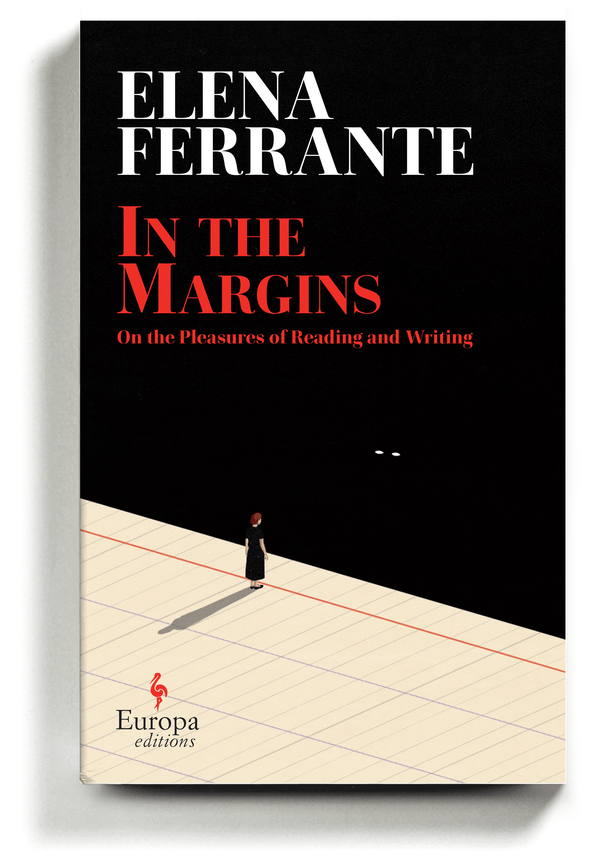
In the Margins: of the pleasures of reading and writing by Elena Ferrante

Elena Ferrante has always said that once a book is written it has no further need for its writer. She has never been seen in public. Some have even suggested that she could be a man, but the general consensus is that ‘Elena Ferrante’ is a pseudonym for an unknown female writer.

This slim volume of essays is a very personal attempt to put into words what happens when a writer writes and a reader reads. No mean task. The first three were presented in November 2021 at the Teatro Arena del Sole in Bologna, Italy as the 2021 instalment of the Eco Lectures produced by Umberto Eco International Center for Humanities. They were read by the actress Manuela Mandracchia ‘in the guise’ of Elena Ferrante. The fourth and last essay, Dante’s Rib, concluded the conference Dante and Other Classics in April 2021 to celebrate the 700th anniversary of Dante’s death. It was read by the scholar Tiziana de Rogatis.

Ferrante vividly reimagines her early school days when she was compelled to write on black lined paper but between two vertical red lines, one positioning the left margin, the other the right. She was diligent to recognise the ease to honour the left margin but recognising “that if your writing didn’t stay between those taut lines you would be punished,” she found the right margin difficult to obey.

I was punished so often that the sense of the boundary became part of me, and when I write by hand I feel the threat of the vertical red line even though I haven’t used paper like that for years.

There is, and always has been, a mysterious element to the creation of fiction. If you as a reader are surprised by what someone does or what someone says in a book, the writer probably was too. Most writers are pantsters: they fly by the seat of their pants. You can begin a scene not knowing where it’s going until you get there.

By mysterious I mean that which makes a writer re-read yesterday’s work and think, ‘Did I write that? Where did that come from?’ When a writer is in the heat of creativity and the keys (or pen) are jumping with energy and excitement, and the little black marks – typos misspellings galore – are coming lickerty-split onto the pale background there isn’t time to think, ‘What did Stephen King say about this situation?’ ‘Passive or active here?’ ‘Maybe I should re-read that Ferrante lecture’ and ‘I’d better ask what’s-his-name? that YouTube guy’. No, there isn’t time. If I stop I’ll lose it. One has to hope-to-god that all that advice, those corrections, mistakes, answers, instructions, and trial & errors have somehow, by osmosis perhaps, made it into my subconscious and are now flowing creatively through my fingertips shoving those little black marks all over that pale background and will coalesce into something worthwhile, giving me a rich and productive resource on which to later manipulate, via several drafts, into a good book. What is that magical force? (muse? imagination? the holy spirit? creative fire?). I don’t think we’ll ever know, because it’s an amorphous product of our imagination that our measly 26 man-made letters – no matter in what order we put them – are just too limited, or too few in number, to give it meaning we can understand.

She quotes Virginia Woolf, from A Writer’s Diary (1953):

“And your novel?

“Oh, I put in my hand and rummage in a bran pie*.”

“That’s what’s so wonderful. And it’s all different”

“Yes, I’m 20 people.”

*a bran pie = a tub full of bran in which treats are hidden: a lucky dip.

Ferrante believes there are two kinds of writing, the first compliant, the second impetuous; the first from the ‘outside’, the second from the imaginary ‘inside’ which is by its nature fleeting.

The thought-vision appears as something in motion – it rises and falls – [it’s not unlike watching TV in your mind] and its task is to make itself evident before disappearing.

And fleeting it certainly is. Many times between being hit by an exciting idea and racing to my nearest device with its Note App – it’s gone! And when I try to retrace my thoughts to whatever it was that sparked the thought train in the first place – the caption on a photo, a news article, a phrase – it’s nowhere to be found. Many writers have expressed this mysterious aspect of fiction writing:

Alexander McCall Smith: (writing fiction is) allowing the sub-conscience to escape.

Wole Soyinka: (writing fiction is) a kind of creative reportage.

John Irving: writing a movie is like swimming in a bath and writing a novel is like swimming in the ocean.

D. H. Lawrence: I am doing a novel which I have never grasped …there I am at page 145 and I’ve no notion what’s it about.

Jonathan Safran Foer: when writing non-fiction I always know in the morning what I’m going to work on; when writing fiction I get up in the morning NOT knowing what I’m going to work on.

Virginia Woolf again: writing is camping out in your brain.

There are quotable quotes in almost all of Ferrante’s paragraphs, ideas that will spark your own thought trains. If you are interested in this stuff please read it and re-read it as re-reading is wonderfully necessary; it will delight, amuse, and amaze you. If you’re not, don’t bother.

You can buy the ebook or hard cover edition here.

Mother’s Boy by Patrick Gale

British writer Patrick Gale lives in Cornwall

Patrick Gale is a very busy man. He is a cellist, lives in Cornwall and plays in a local string quartet, a keen gardener, artistic director of the North Cornwall Book Festival and a Patron of The Causley Trust. Oh, and, of course, a best selling novelist. Mother’s Boy is his 17th novel released in March 2022. He may be British, but he is also most definitely Cornish. Who else then to novelise the early life of another Cornish hero, the poet Charles Causley.

This is a mother-son story; Gale is particularly good with mothers.

Laura is in service when she meets Charlie Causley, also in service to the local doctor. He is a dashing lad and their romance is brief but strong. All is set for a happy married life together, but WW1 takes him away and returns him a broken man; his life is cut short leaving Laura a single mum with a baby to keep. She takes in laundry, the wine stained alter cloths of St Thomas’s church as well as the other-stained bed linen from the local ‘boarding’ house where the proprietress’s children, Aggie’s brood, all look surprisingly different. A stain is a stain to Laura Causley and each deserves her expert attention.

Charles grows into a concave-chested studious little boy, more at ease with a book than a ball. As a teenager he plays the piano in several dance bands, writes and directs plays, and occasionally takes girls to the pictures and shakes their hands good-night. Laura may be a little disappointed in her son but would never show it. A boy is a boy to Laura Causley and each deserves a mother’s love and protection.

The book is a gentle read; Gale is a master of wry observations while plunging into serious emotional depths. It is as much about Laura Causley as her son, Charles. Gales evocation of a mother’s love is particularly moving:

He had woken already and was straining to look about him. Seeing her approach, he cried out with something like a laugh and reached a hand towards her. She kissed his tiny palm, then scooped him up, furling him in her shawl to hold him against her shoulder where he sucked noisily at her neck. She rocked gently from foot to foot, loving the warm weight of him against her. ‘You,’ she said. ‘Oh, you.’

Another major theme is forbidden sexuality. We first become aware of it when Charles lets his best friend Ginger inveigle them up to Charles’s room where Ginger …

persuaded him to hold him close to demonstrate the steps of the foxtrot and then had taken advantage of the moment to kiss him full on the lips while doing things with his tongue Charles was fairly sure never happened on screen to Claudette Colbert.

But later Ginger takes Charles to the nudist section, men only, of the Plymouth Lido and disappeared for a time only to be seen later exiting a single change room only moments after a big half dressed man had emerged, who then finished dressing, and left. While walking home …

‘You do know,’ Charles wanted to tell him, ‘that what you were doing, or what I suspect you were doing, could have you up in the courts in Bodmin and wreck your prospects, even send you to prison?’ But he said nothing about it because what he longed to do was ask questions instead, and he knew the answers Ginger might give would change the dynamic of their friendship for ever in ways for which he wasn’t ready.

The Second World War sees Charles called up. He was too slight and weak-eyed for active duty so trained as a coder: sending and receiving coded messages usually on board ship but never-ending seasickness had him transferred to land: Gibraltar, and Malta. It was in the Navy that he experienced his sexuality, one relationship slightly abusive, another almost loving. But outside the flimsy protection of a male dominated existence such indulgences could not be contemplated. This is the tragedy that happened to thousands of homosexuals over thousands of years: their man-made social environment precluding their natural natures; in some parts of the world it continues still.

I was a little disappointed that a writer writing about a writer didn’t spend a little more time investigating writing itself, but this is a minor and picky response to an otherwise very enjoyable and evocative read.

Here you can purchase the book in various formats.

Charles Stanley Causley,
(1917 – 2003) British poet, teacher, and writer.

Here you can find a short biography of Causley and a short essay on the poet by fellow poet and author, Kevin Crossley-Holland.

And here you can watch a trailer for the Boatshed Films’ Cornwall Native Poet, Charles Causley which as screened on BBC 4 in 2017 to celebrate the centenary of Causley’s birth.

To Paradise by Hanya Yanagihara

Hawaiian- American writer, Hanya Yanagihara

Yanagihara’s third novel To Paradise (2022) is in three parts:

Book 1 is set in New York, in 1893

Book 2 is set in the Hawaiian Islands in 1993

Book 3 is set in Lower Manhattan in 2093

There are many things Jamesian about Book 1, and not just the style and lexicon. The Bingham family lives on Washington Square, New York; and like Henry James’s novella, Washington Square (1880), it is about a rich but ageing heir, a tenacious lover who may or may not be a fortune-hunter, and an intractable and controlling guardian who opposes the match. This may not be so remarkable if it wasn’t for two other potent features. Firstly, the America of Yanagihara’s imagination is very different. What we know as the United States of America is unrecognisable in that it is divided into five separate zones of nations : The American Union (the central north), The Western Union (comprising the nations of Washington, Oregon, and California), The Kingdom of Hawaii, The United Colonies (the south east), The Free States (the north east including New York), and The Republic Of Maine (the far-north east). The south west is still uncharted territories. Secondly, the lovers in James’s story are Catherine Sloper and Morris Townsend; those in Yanagihara’s are David Bingham and Edward Bishop. Same-sex relationships are legal and tolerated in The Free States but are quite the opposite in other parts of the continent. Fundamentally and curiously, the love stories, written by James and Yanagihara, are the same.

Book 2 is set in Manhattan and on The Islands – The Kingdom – of Hawaii and concerns members of the royal family who live under greatly reduced circumstances. The main characters share the names of the main characters in Book 1 – as well as in Book 3: David, Edward, and Charles. This technique acts as a linking device throughout the novel linking the three parts but in names only. Yanagihara’s concern here seems to be an acknowledgement of Hawaiian disenfranchisement; with a post-colonial literary edge, giving the displaced and sidelined locals a voice. Young and insecure David works as a para-legal in a law firm in Manhattan where his immediate boss, and lover, is the much older Charles. David is of mixed Hawaiian and American descent. This relationship is told in the third person but from David’s point of view. His lack of confidence, his heritage, and past all conspire to work against him. The second half of Book 2 is a long first-person narrative written to David by his father, medically and emotionally tied to his bed. It contains a yearning tone for the glories of the Hawaii of the past, pre-invasion, although there have been uprisings and counter-revolutions. It’s not clear in this section where the story is going and it is the weakest part of the whole book. However, all is forgiven once you get to Book 3.

This is set in 2093 and divided into 10 parts, opening in 2093 but incorporating the back story from fifty years earlier and following each decade until the threatening and page-turning climax in the last days of the century. It’s impossible to outline the plot here because it’s not only convoluted but I would need to create too many spoilers to do it justice. However, I will simply say it involves the story of Charlie, a pandemic survivor and therefore a greatly changed human being, and her relationship with her grandfather, David. The grandfather-grandchild relationship is an important theme of this book and is explored in many ways.

What is remarkable is that what lies at the core of the novel, and the three books it contains, are deeply personal narratives about love, loss, and empowerment even though the book’s political and social universe that house these individual stories is so totally different to our own; dystopian certainly. Yanagihara has not only imaginatively created an alternative American continent, only keeping to its geographical shape, but also has generated its own inevitable and deeply disheartening future.

This is scary.

It’s scary because given the recent three years of the history of the USA – the one we know: the threat of climate change, the global alteration to our lives due to a pandemic – with the threat of more to come, and the beginnings of the corrosion of American democracy and way of life makes Yanagihara’s novel dangerously prophetic. But all of this information the reader gleans from the asides, dialogue, and explanations of the central very personal narratives.

In Yanagihara’s 2093 pandemics are commonplace. Climate change has happened: cooling suits have been invented and are being improved to allow people to go outside; falling ill puts the individual and their families into permanent isolation (containment centres); building crematoriums is a growth industry. Good nourishment is scarce, food and water are rationed via coupons or can be won through lotteries, tea is powdered, honey is artificial, and all fruit growing on trees is owned by the state. Marriage is mandated since most of the victims of pandemics have been children and those who survive, like Charlie, are sterile. The birthrate has plummeted.

It takes a special kind of cruelty to make a baby now, knowing that the world it’ll inhabit and inherit will be dirty and diseased and unjust and difficult.

All urban areas are surveyed by drones called Flies. It is therefore unwise to show distress, anger, or alarm and if noticed the offenders are plucked from the street by troopers in passing vans. Lives are strictly controlled. Tuscany is no longer inhabitable. Bowing has become the universal form of greeting; touching is therefore avoided.

The people who worked for the State and the people who didn’t were united in their desire to never encounter each other.

Hania Yanagihara started writing this book in 2017 and when the pandemic was raging outside her window the latest pandemic in her invented world was about to override the previous one. She talks about this serendipitous aspect of her book in the video below.

Although there are some flaws, this is a truely remarkable work of creative writing. A must read. I just hope its story stays in the world of her and our imaginations.

Here is a very candid and fascinating interview with Yanagihara primarily about the writing of this novel.

You can buy the book in various formats here.

Short Cuts by Raymond Carver

American short story writer, Raymond Carver,
1938 – 1988

One of the enemies of sleep is an overactive brain, which is why there are many pieces of advice that all aspire to getting a light-sleeper ready for sleep: listening to your own breathing, concentrating on a mantra, counting sheep, or reading a book; give the brain one thing to do, and not let it buzz around thirty eight.

I’m reading Hanya Yanagihara’s latest, and third novel, To Paradise, but I’m reading an ebook edition on my tablet and since modern medical advice is that reading on an electronic device before sleep is not a good idea – it tends to inhibit sleep, not encourage it – I usually have a paper book by my bed for those many minutes of bedtime reading.

Note! I’m not at all advocating choosing a dull read for bed-time reading; not a book to put you to sleep but one to prepare you for sleep.

Short stories are good. Raymond Carver’s short story collection, Short Cuts (1993), has been my recent and decent bedtime read.

The famed American filmmaker, Robert Altman, praised Carver for capturing “the wonderful idiosyncrasies of human behaviour … that exist amid the randomness of life’s experiences.” That paints a very general picture of what Carver wrote about; what he mainly wrote about was far more specific.

Carver was born and lived in the American North West and as a young married man – he was married and the father of two while still in his teens – he worked odd jobs, from picking tulips to sweeping floors to managing an apartment building. He knew all about unplanned responsibilities, the threat of unsatisfying work and unemployment and the mysterious chicanery of personal relationships. This is the stuff of Carver’s characters. They are lorry drivers, traveling salesmen, waitresses, the badly educated, disillusioned, the down-and-almost-out, alcoholics, quickly bored, easily distracted, and equally likely to be the betrayed as the betrayer. Their lives are beyond their control and since God has everything to do with it they don’t blame him since he doesn’t seem to care, but anyway, that’s okay because they aren’t that far away from believing they deserve everything they get.

Carver’s stories are usually cautionary tales, highlighting casual moments as the causes of distrust, treachery, and the erosion of tenuous human standards. His characters and situations may be dark and seemingly mundane but they contain a wealth of understanding and insight into the human condition and are told in bold and sparse prose.

Most fiction is told through an omnipotent unnamed third-person narrator who knows everyone’s, and the world’s, past, present and future; they know what everyone is thinking, needing, and planning and tells the reader what they say and do and what they think and want. Carver’s third-person narrators aren’t that powerful. His third person narrators have the same power as everyone else: they just report what is said and done, like his first person narrators. What the characters may be thinking at any one moment is either of no consequence or completely incomprehensible.

His writing is reader-focused: you fill in the gaps, the spaces for psychological insight that each reader brings to such texts which makes these stories so personal and endearing.

Short stories are not the most popular form of fiction but writers who do them well, Anton Chekov, Alice Munro, Katherine Mansfield, Sir Arthur Conan Doyle, W Somerset Maugham, James Joyce, Nam Lee, and Raymond Carver do them very well indeed.

These nine stories and one poem that make up this volume were the inspiration for Robert Altman’s multi-award winning film Short Cuts released in 1993.

Here is a feature-length documentary on Altman, the making of Short Cuts, the movie, and his reverence of the work of Raymond Carver.

You can buy the book in various formats here.

Crossing to Safety by Wallace Stegner

American writer Wallace Stegner 1909 – 1993

In this semi-autobiographical novel, a classic of American Modern Literature and set during the Depression at the University of Wisconsin, it isn’t surprising that the first person narrator, Larry Morgan, is a writer and so there are many references to the art, misuse, difficulties, and frustrations of such a profession.

Are writers reporters, prophets, crazies, entertainers, preachers, judges, what?

Is the gift, the talent, its own justification?

The process of writing fiction is an expression of  self-discovery: being free and relaxed enough to let the sub-conscious out. And when it comes out you grab it and write it down. All the experiences of the world, the good, the bad, the insignificant, and the inferred make up one’s past life and the sub-conscious arranges them into memories which may or may not be accurate and can sometimes be perverse.

From these memories, the talent springs – the activity of imagining – but most of us, when the ‘talent springs’, do nothing about it. Scenes, conversations, ideas, rehearsed retorts, and wishful decisions occur to everyone all the time but only the writers write them down. But to write it down, you need to be practiced at writing things down, putting the products of your senses into words, and knowing the difference between a gerund and the infinitive.

Writing takes talent but it also takes practice. You can teach the practice but you can’t teach the talent.

Crossing to Safety (1987) tells the story of the remarkable friendship between Larry (the narrator) and Sally Morgan, young, poor, intelligent, and curious and a slightly older couple, Sid and Charity Lang, already ensconced in the English Department, and to the Morgans, a wonderfully urbane, astute, fascinating, devoted, and wealthy couple who take the newbies under their luxurious wings.

It’s easy for a first person narrator to slip into the third – they could tell a story, just like Terry Hayes does in I Am Pilgrim, – just as it is equally easy for the third person to get so close to a character that it a-l-m-o-s-t becomes the first. That’s why this more usual knack is sometimes called close writing. In more literary circles it’s called free indirect discourse. I prefer the less formal.
What is unusual here is that Larry, Stegner’s  first-person narrator, has only just met Sid and Charity and knows nothing about how their past unfolded, nor do they tell him. This is not a problem for Stegner. He imagines the meeting and early courtship of Sid and Charity;

“Who is this boy?” I can imagine her mother asking. “Do we know him? Do we know his family?” Suppose they are sitting …”

Yes, an audacious technique but one that works given that imagining is what fiction writing is all about.

It’s also audacious to let a character, Charity’s sister, keep the name Comfort. It’s likely Stegner didn’t choose it; it just happened. Things like that often occur when writing fiction. I know of a novelist who, at 83,000 words, thought he had nothing but a pile of poo until out of the mouth of a young character came, out of the blue, the title of the thing. Not only did the phrase give the thing a name, and its theme, it also turned the pile of poo into a novel and out of relief and gratitude the author burst into tears.

It’s moments like these that one could easily believe that fiction comes unbidden, from another place, from another being: fate, a muse maybe, or even a spirit or god. It’s also the reason why you might hear young writers foolishly say, “Oh, actually it wrote itself.” That’s nonsense of course, but the feeling is real.

Being a semi-autobiographical novel, the events may be part of the writer’s past but the intimate moments, the conversations, and minute-by-minute thoughts must rely on imagination; imagined and written down.

The fulcrum of this quartet of characters is Charity Lang. She is forceful, controlling, opinionated, always right, passive aggressive, and never backs down. Two major scenes stick in my mind and will for some time to come. I can’t describe them as that would give too much away but the first revolves around preparation for a camping expedition and whether a packet of tea-bags was packed, or not. Seemingly a trite scenario but in the hands of Stegner it’s a pivotal moment in the building of Charity’s character. The second, the devastating climax, is about who should or shouldn’t go on a family picnic. Here the character of Charity is at its most prickly, unbending, and cruel. However, the reader understands her point of view, and it’s a tribute to Stegner that you also understand the three other points of view. It’s a shattering scene.

This is a book of rich language with a commitment to nature, happiness, and the human foibles that shatter or uplift our lives.

Here you can view an interview with Stegner from the early 1970s.

And here is an hour long documentary “Wallace Stegner: A Writer’s Life,” narrated by Robert Redford and produced only a few years before the writer’s death in 1993.

The book in various formats can be bought here.

I AM PILGRIM by Terry Hayes

Terry Hayes, English-Australian screenwriter and novelist

I think it was John Irving, the winner of both the National Book Award for a novel and the Oscar for a screenplay, who said that writing a movie is like swimming in a bath and writing a novel is like swimming in the ocean. T.H.

I Am Pilgrim has to be the holiday read to top all holiday reads!

And despite living up to the hype slashed all over its covers, it is also not what I expected. But it is long: 888p.
It begins traditionally enough with a baffling crime seemingly unsolvable and then several chapters of interconnected back stories. Then in Part 2 another novel begins: the development of a young jihadist, simply known as The Saracen, and his decades long quest to bring down America and so similarly destroy its ally, the Saud family, rulers of Saudi Arabia, whose leaders murdered his father.
It reads like a film script; not surprising since Hayes is a noted screenwriter, with short chapters, each like a single-set scene with usually a stinger of a last line; I call them waterfalls: they link smartly into the next scene, or, in a writing trope, they lead you to hastily turn the page. Lines like, ‘I was in the North Tower when it came down’ and ‘It was time to enter the dark and brooding house’ and ‘… it was a terrible thing I ended up doing to him.’

And then there’s the simple lists of what he plans to do and the outcomes he expects, to be followed by another page turning device: predicated hindsight – lines like “but I couldn’t’ve been more wrong” or “I should’ve taken more notice of the photo but I didn’t.” And the interest level goes up a notch or three.

The plot is international: Manhattan, Bodrum, Berlin, Jeddah, and the mountains of the Hindu Kush. The threat is not nuclear, or extraterrestrial, but, ironically for the times, viral. Firstly there is the murder in a sleazy hotel in Manhattan: a woman’s body is found in a bath full of acid, face down but because of the acid she has no face, and her fingertips have been removed as well as all her teeth. She is unidentifiable.

There is the first-person hero: a spook, an intelligence officer, a spy, a detective, and all-round nice guy who isn’t adverse to doing unspeakable things but only because he has to. He has many names so you are never sure which name is real. The villain, The Saracen, you know as a teenager and understand why he becomes the deliverer of evil; you almost like him. However, his unspeakable deeds are worse.

But then there is a death in Bodrum, Turkey, which the local authorities are convinced was due to misadventure. Our man knows it’s murder but needs to prove it. And all the while we jump back to The Saracen who is consolidating his self-manufactured weapon of mass destruction, starting with medical school. His is a very long term plan.

The faceless woman in Manhattan. The Saudi teen with revenge via mass-death on his mind. And a drug dazed tourist falling over a cliff to his death in Bodrum. Are they linked? Of course they are but for most of the book it’s hard to see how. But the deadly virus is manufactured, tested, packaged into 10,000 vials, and posted; the Saracen’s job is done. Our man’s task is to find out how and where the shipment is and when it will land. The climax is unputdownable!

Terry Hayes was born in Sussex in the UK but his family moved to Australia when he was five. As an adult after working as a journalist and investigative reporter he was hired by George Millar to do the novelisation of the original film, Mad Max (1979) and then subsequently several other Mad Max reincarnations and worked as a producer and/or screenwriter for TV shows like The Dismissal (1983), Bodyline (1984), Vietnam (1987) and Bangkok Hilton (1989) and several movies, including The Year My Voice Broke (1987), Dead Calm (1989), Payback (1999), and From Hell (2001). I Am Pilgrim (2013) is his debut novel and his second The Year of the Locust is yet to be released. MGM has acquired the film rights to Pilgrim with Hayes as writer but I wouldn’t be surprised if the project is re-done as a TV series; a far more suitable format for such a sprawling yarn, in my opinion.

Here is a very interesting, although over an hour long, interview with Hayes about writing I Am Pilgrim and where the inspiration came from.

You can buy the book in various formats here.

from a low and quiet sea by Donal Ryan

Irish writer Donal Ryan

Right from the beginning I should tell you that the writing is assured and fine, but for those of you who want signposts to tell you who says what to whom you’ll be disappointed: the dialogue is imbedded in the prose, unpunctuated, so this one may not be for you.

This is proving to be popular with contemporary writers: the last three books I’ve read have been written with minimal punctuation and certainly no  dialogue punctuation. I was skeptical at first but once you read it, reading it as if it’s being read to you, it’s clear what is dialogue and what isn’t.
 

  It’s about three men: Farouk, his country torn apart by war attempts to save his family and then can’t believe the worst of reality; Laurence, Lampy, a young man with an old chip on his shoulder the size of the bus he drives, a bastard but there’s absolutely nothing he can do about that – but it might be why Chloe doesn’t love him; and John a man bewildered and damaged by idle patents and left with ‘a filthy soul’. The final chapter begins enigmatically and these three men and their relationship to each other become clear only in the last pages. It’s really three back stories before the final chapter sews them all together; a very different form of a novel.

Farouk’s and Lampy’s chapters, and the final one are written in the third person but with many a patch of close writing: third person writing that’s  a-l-m-o-s-t in the first; but John’s chapter is all in the first. I don’t think there’s anything significant about that; it’s just how it turned out. 

The prose, in every chapter, is strewn with very long, sometimes beautiful, sentences full of clauses separated by conjunctions that create a tense tone of urgency as if the speaker has to rush and get as much information into the sentence as possible before they run out of breath because there’s a full stop coming up and there’s more and more important things to say and there’s unease in the voice, which sets the tone, as if there might be failure ahead and the rush is to beat it before the full stop comes into view and there, it’s almost upon you but there’s just another very important thing to say and yet another one and here it comes and there it is.

Alex Clark in The Guardian in mid-2019 acknowledged the boom in Irish contemporary fiction writing and credited its rise to fearless publishers and writers. However, writers have always been fearless; it’s the publishers alone that should now deserve the credit. Lucy Ellmann’s Ducks, Newburyport (2019) which takes eight sentences to fill over a thousand pages, was on the Booker shortlist that year, and was picked up by a small publisher Galley Beggar Press (GBP) which also took Eimear McBride’s A Girl is a Half-formed Thing (2013). That took nine years to find GBP and is considered a ‘difficult’ book. Form and style have broadened literary fiction’s borders and I don’t just mean with the diminishing use of punctuation. Colum McCann’s Apeirogon (2020) on the Booker shortlist for 2020 is called ‘a novel’ on the cover but isn’t: it’s a great read but it’s definitely creative journalism. The only thing made-up about it is its form. 

from a low and quiet sea was shortlisted for the Costa Novel Award and long listed for the Booker Prize (2018).

If it’s writing with characters deeply drawn and language that makes you read sentences out loud just for the joy of it then this one is for you. 

Here you can watch Donal Ryan reading from this book from a low and quiet sea.

You can buy the book here in various formats. 
 

Sea of Poppies by Amitav Ghosh

Indian writer Amitav Ghosh

This is what novels can do: take us away from what we know and set us down in other worlds, at other times, to see the universe from another angle and hopefully reassess our choices and privilege. Yet, we still, usually – well, I do – continue to read books about and written by, English-speaking muddle-class whities.

What is most remarkable about Sea of Poppies (2008) is the language:

A quartermaster lured the boy into the ship’s store with a mind to trying a bit of udlee-budlee. But chota as he was, young Benjamin didn’t lack for bawhawdery – set upon the old launderbuzz with a belaying-pin and beat him with such a will that his life-line was all but unrove.

He also assigns formal speech peppered with malapropisms to paint an innocent, although well-meaning, young Caucasian character through her attempt at what she thinks to be  proper conversation.

Also the wonderfully colourful Indian-English of yesteryear full of jangled word-order and inappropriate gerunds “too much not time to be arousing and uprising…’ juggling accents and idiolects from the lowest poverty-stricken rice farmer to a Zamindar, the Rajah of Raskhali who looses everything to indignant hubris.

And it isn’t just his wild, wonderful, and inventive lexicon but it’s also the exotic time and place full of words for staff, house geography, clothes, food, ship-craft, and colloquialisms.

You would think all this verbal unfamiliarity would send you rushing to the dictionary; a tiresome task if all too necessary – although reading it as an eBook allows this to be less so. But no. The overall meaning of a sentence, conversation, or paragraph is always clear even if some individual words are not.

One of the joys of the writing here is it’s inventiveness and possible authenticity. Ghosh acknowledges his debt to several publications, including Thomas Roebuck’s An English And Hindoostanee Naval Dictionary Of Technical Terms And Sea Phrases As Also The Various Words of Command Given In Working A Ship, &C. With Many Sentences of Great Use at Sea; To Which Is Prefixed A Short Grammar Of The Hindoostani Language (1813).

However, whether it is authentic or inventive doesn’t matter, it’s a joy to read, and reading some sections out loud is a very pleasurable thing to do.

The book, and it’s a big one, the first of a trilogy, is set prior to the first Opium War (1839-1842) when the British successfully came to the aid of the opium merchants when the Qing Dynasty of China banned the drug from its shores. It is divided into three sections: Land, River, Sea and centres around a schooner, the Ibis, and the exotic collection of humanity that find themselves on and below its decks as it sails from Calcutta to Mauritius.

The characters are varied, three-dimensional, and extraordinary. There is Deeti, a widowed poppy farmer saved from her husband’s funeral pyre by a handsome ‘untouchable’, Kalua; Zachary Reid, a mixed race American sailor; Serang Ali, the leader of the lascars and colourfully mangles the English language along with various other tongues; Neel Rattan Halder, a Raja convicted of forgery; Ah Fatt, a Parsi-Chinese opium addict; Paulette, a French orphan raised in India; Jodu, her childhood friend; and the extraordinary Nob Kissin Baboo, a would-be priest. All of these major characters, and many minor ones, have colourful backstories, some comic, some tragic, some heart-thumping, some tear-jerking but by part three of the novel they are all on board the Ibis, bound for Mauritius and their various destinies.

As well as all the above there is Ghosh’s descriptive, rich, and luminescent prose: describing the love in a young girl’s heart along with its negative opposite, not hate but cowardice for saying nothing for fear of rejection; describing the effect of the first lungful of opium smoke in a man’s breast, nulling the gravity in his limbs and creating delusions clean of doubt; to untying a knot on a bowsprit as it plunges a sailor into a mighty wave and out the other side, like threading a needle with courage.

It’s a great read and reinforces what novels do best: carry us away.

Sea of Poppies was shortlisted for the Booker Prize, 2008.

The epic story, The Ibis Trilogy, continues with River of Smoke (2011), and Flood of Fire (2015).

-oOo-

You can buy the book in various formats here.

Here you can watch an interview with Amitav Ghosh as he explains his sentiments behind Sea of Poppies.

And here is a little documentary with Ghosh as he talks about the background to his iconic Ibis Trilogy.

Winifred Falls

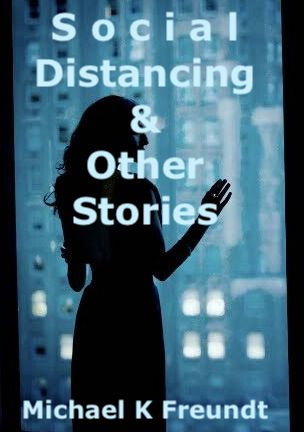
A recent short story, part of the collection Social Distancing & Other Stories available here

‘So where are ya off to today?’ Jennifer asked. Marian’s next-door neighbour was sitting in her usual place, on her porch. She dropped her right hand out of sight; Marian did not approve of smoking.

Marian was a stylish woman. She dressed and groomed herself immaculately, not in the latest fashion, which had gone off the rails as far as she was concerned, but in a style, a rather expensive style, suitable for her age. She was proud of the way she looked. Today she wore a pale blue summer blouse with a blue and grey tartan skirt. At her front door she had looked at herself in the full length mirror, turning this way, then that. Fine. She had walked out of her front door to wait for the car.

‘Elsbeth and Mal are taking Mia and me on a picnic.’

‘A picnic!’

‘Yes. Is that so strange?’

‘Have ya ever been on a picnic?’

‘Of course.’

‘Dressed like that!’

‘Of course not. Don’t be silly. I think I was thirteen when I last went on a picnic. Why? What’s wrong with how I’m dressed?’

‘Well, first of all, Luv, those shoes! You can’t wear heels on a picnic.’

‘Why not?’

‘Luv, you’ll be walking through grass and stuff. You’ll sink in. Don’t ya have a pair of nice flatties?’

‘But then I will have to change my dress.’

‘And that too. Won’t ya be sitting on the grass?’

‘Why ever for?’

‘That’s what ya do at a picnic.’

‘Oh, I don’t think so. We’ll be on one of those wooden outdoor settings. The ones with the seats attached and supported on a slab of cement, installed and maintained by the local council.’

‘But ya still have to get to the thing. What about those beige trousers I’ve seen you wear?’

‘My gardening clothes!’

‘Well Luv, you’ll be far more comfortable in a pair of trousers, I reckon.’

Marian always thought of Jennifer as over friendly, but the kind of over friendly that could be construed as common. ‘I’ll be fine. Mia likes to see her Grandmother looking smart.’

‘Suit ya self Luv. How’s Mia’s leg?’

‘Oh, Jennifer, you keep mentioning that. That was ages ago.’

‘Was it?’

‘Yes. She’s almost ten now and not so clumsy. Quite the little lady.’

‘Jeeze she made me laugh!’

‘I’ve never seen the need for humour at someone else’s expense.’ Marian would’ve chided herself if she had been aware of the corners of her mouth sliding down in hoity disapproval.

‘Oh, I know. It’s just that when someone is being so serious like and then falls on their mush, it just cracks me up. I can’t help it. I’ve always been a sucker for a banana skin.’

Neighbourliness sometimes forced Marian to invite her neighbour into her apartment, although she would always try to arrange things so that it was Jennifer’s they chatted in, but when it was her place she would always, once Jennifer had left, use a soft disinfecting cloth to wipe down everything Jennifer came in contact with especially if she had used the bathroom. Marian knew it was snobbish but that wasn’t a problem as long as other people didn’t see or hear it.

The little round table and two chairs that sat on all the little verandahs in the line of self-contained units came with each unit. They were identical; Marian thought that was a pity. On Marian’s table was a pretty blue and white ceramic pot on a matching saucer, containing a large blooming red gerbera; on Jennifer’s there was a black plastic pot full of dirt.

‘Ah! Here they are!’ Marian exclaimed as Elsbeth, Jamal, and Mia pulled up in their car. ‘Bye Jennifer!’

‘Bye Luv!’ She waved at the car.

Marian walked down her little path past her neat beds of carnations – she had a lovely crop this summer – well aware of her tartan skirt swishing as she went. All women need to know exactly what their skirt is doing at any given moment, she liked to think.

‘She looks like she’s going to a party, not a picnic,’ Jamal said quietly behind the wheel. Elsbeth smiled at her husband.

Marian stopped at the car’s back door and waited for Mia to open it for her. ‘Morning darling, Mal, and you, you pretty thing!’ she cooed, smoothing her skirt under her as she sat.

‘Morning Grandma! Morning Marian! Good Morning Mum!’ they all chorused.

‘You must always open a door for a lady, Mia,’ Marian chided kindly.

‘Sorry Grandma.’

‘Aren’t you a little over-dressed for a picnic, Mum?’ Elsbeth said as kindly as she could manage.

‘Oh, you know me, Elsbeth. Doesn’t she, Mia,’ and she tapped Mia on the nose. Mia smiled. Elsbeth and Jamal shared a look. ‘So where are we off to today?’

‘To a pretty little spot on the banks of a creek in the Royal National Park, Winifred Falls,’ Jamal said as he maneuvered out of the drive-way and into the traffic.

‘Oh! Is it maintained by the council?’

‘I suppose so,’ Jamal said.

‘Didn’t you check?’

‘It’s where Jamal took me for our first date,’ Elsbeth said.

‘We want to show Mia.’

Oh, so I’m just along for the ride, am I? ‘How sweet,’ she said. ‘Look at all this traffic!’ She commented on the traffic five times before they got to the park turn off. ‘I thought your first date was to see that film, you know, something about chocolate.’

‘That was Chocolat,’ Jamal said realising too late that he seemed to be correcting her pronunciation. He made a sorry-face meant only for his wife.

‘Oh, sorry,’ Marian said turning to look out the window at the bland and uninteresting suburbs.

‘No, Mum. That was our second date.’

‘Dad was expecting there to be other people there, but there wasn’t,’ Mia said cheekily. ‘They were all alone,’ and then added, ‘Ooooooo!’

Marian turned sharply to look at her grand-daughter. ‘What’s that supposed to mean?’

Mia ground the backs of two fingers against her lips and closed her eyes, ‘Mmmmmm.’

‘Oh stop it, Mia! You don’t know anything about it.’

‘I do so too,’ she said with confidence.

‘You’re only ten,’ Marian said looking askance at Jamal in the rear-view mirror.

‘I’ll be eleven soon,’ Mia countered. ‘Nearly a teenager.’

‘But not yet!’ Marian said. ‘You’re too young,’ she added while frowning again her disapproval at the back of Jamal’s head.

‘So, how is that neighbour of yours, Mum? Jenny, isn’t it?’ Elsbeth asked to change the subject.

‘Jennifer,’ Marian corrected. ‘She’s fine. Still smoking.’

And that seemed to be the end of the conversation as Marian returned to the nondescript view of grey-green bush now that they had left suburbia behind. Elsbeth rested her hand on Jamal’s thigh.

Marian Schiller, a third generation German Australian is fifty eight and a grandmother for the first time. Her daughter, Elsbeth (Elly) at twenty two married a journalist, Jamal (Mal) Aboud, a handsome second generation Lebanese Australian.

Marian had said nothing about her disappointment at her daughter’s choice of a husband, just like she chooses a hat, she thought, she fell in love and just had to have it; but she was self-aware enough to know that she had to control this feeling and that it was possible that other similar feelings might be lurking in her subconscious and that surfaced, like twinges in her lower back, when she least expected them. She wanted to be good. She had not been so good in the past, and at each slip the disapproving look from her daughter cut her deeply. Such looks were meant to only come from parents to children.

It wasn’t long before Jamal pulled into a small, graveled parking area.

‘Are we there?’ Marian asked with some alarm. The bush didn’t look anything like the park she was expecting.

‘Almost,’ Jamal said. We’ve got a little walk to the falls.’

‘A walk! How far?’

‘Only a few hundred meters,’ Elsbeth said. ‘Come on!’

‘Will we see a kangaroo?’ Mia asked as they all got out of the car.

‘We might,’ Marian said.

‘They’ll be asleep,’ Jamal said, opening the boot. ‘Pre-dawn and dusk are the best times to see them.’

How would you know? You’re not even Australian. ‘Where’s the path?’ Marian asked instead.

‘There,’ Elsbeth said, pointing across the road to a low gate. Jamal took the esky out and handed a bag of supplies to Elsbeth. ‘We might see some deer.’

‘It’s closed!’ said Marian with some hope. ‘Are we allowed to go down there?’ Recent summer rain made the path look extremely uninviting.

‘Just no car access,’ Jamal was carrying the esky and picnic bag. ‘I can help you over it, if you like.’

‘No, thank you. You never said we were going bush-walking.’

‘I said there’d be a little walk to the park.’

‘This isn’t a park.’

‘It’s the Royal National Park!’

‘I was expecting a park with grass, Mal, and a normal cement path not a bush-track. It’s just rocks and mud.’

‘I could piggy-back you.’

‘You will not!’

‘Come on Gran,’ Mia said. ‘It’ll be an adventure. Like explorers.’

‘It’s Grandma, young lady. One shortening is more than enough. There’s no need to shorten it again.’

‘Come on Mum,’ Elsbeth said with the rug and a bag of supplies. ‘We don’t have to hurry. We don’t have a train to catch.’

The four picnickers crossed the tarmac and stepped over the low gate. ‘If I break a heel ….’ Marian said with some force but then she needed all her concentration to navigate through and over, mud filled furrows, caked ruts, puddles and patches of gravel, leaf litter, and deer dung. The two adults and child had to wait for her many times.

‘Mum, take it easy’ Elsbeth said more than once.

‘Don’t you worry about me,’ Marian called back with eyes fixed on the treacherous ground. ‘You just keep your eyes open for snakes.’

‘Look Grandma!’ Mia shouted as she crouched by a layered clay bank at a patch of mossy soil. ‘There’s lots of sundews here.’

‘What!’ shouted Marian from a few meters back.

‘Insectivorous plants, Grandma! Sundews!’

‘That’s nice, dear,’ Marian said without looking up.

‘Can you see Dad?’

‘Yes, you’re right.’

‘But, they’re so small.’

‘And delicate. I wonder what they eat.’

‘Come on you two!’ Marian said having caught up with them. ‘If we don’t get there soon we’ll get there and have to turn around and come straight back again.’

‘You’re doing very well, we’re nearly there,’ Jamal said.

‘I’d believe you if it wasn’t for that smirk on your face.’

‘It’s just around the next bend, Mum,’ Elsbeth was ahead.

‘So is Christmas.’

Less than fifteen minutes later they came to a clearing overlooking a creek running over a low cliff of layered granite ledges. Little waterfalls cascaded into a wide, clear, and still pool, soft looking and tea-colored from the surrounding melaleucas and leaf detritus in its shallows.

‘It’s beautiful!’ Mia exclaimed.

‘We knew you’d like it,’ Jamal smiled at his wife.

‘Look Daddy! Caves under the waterfalls! Can I go look!’

‘You be careful Mia!’ Marian cautioned. ‘There could be things in there. And don’t get wet!’

‘Oh, Marian, I don’t think a little water will hurt,’ Jamal said as bright-eyed Mia headed for the shadowy caves.

Marian looked at her son-in-law askance. ‘Well, there’s definitely no picnic tables.’ And no grass.

‘Look Mum!’ Elsbeth said. ‘Over there’s a low ledge in the shade. You can sit there quite comfortably, I think.’

‘That’s a great spot!’ Jamal confirmed.

‘Getting there is the problem.’

‘Marian, you may have to take off your shoes,’ Jamal said.

‘What?’

‘Stay here. We’ll take everything down and Elsbeth can come back with my walkers for you.’

‘Your feet are much bigger than mine.’ And your walkers aren’t the cleanest either.

‘It’s just to get you down to the ledge. You can’t do that in heels.’

Marian waited. ‘Mia!’ she called. ‘Don’t go too far.’ She had to say something.

Elsbeth laid out the rug on the ledge and emptied the esky: chicken and mayonnaise sandwiches, drumsticks, bottles of juice and water, a container of cherry tomatoes, half a watermelon, cheese and crackers.

Marian sat on the edge of the ledge fanning herself with a plastic plate.

‘Mia!’ Jamal called. ‘Lunch is ready.’

‘Coming!’

‘Elsbeth,’ Marian whispered. ‘I can’t see any toilets.’

‘No,’ Elsbeth said. ‘But I‘ve bought a toilet roll.’

Marian stared at her, then at the surrounding bush, and back to her again. ‘You can’t be serious.’

‘M-u-m,’ said Elsbeth. She handed her mother a drumstick wrapped in a napkin.

Marian lowered her make-shift fan and glanced around for the cutlery but saw none and so let Elsbeth put the drumstick on her plate. Marian picked it up like a non-smoker taking a cigarette.

‘Isn’t this wonderful!’ cried Mia as she joined her family on the rug. ‘Can we go swimming later?’

’Oh n …’ began Marian.

‘Sure,’ Jamal said.’

‘You can see right to the bottom,’ said the excited girl.

‘Do you know what creatures live in that water?’ Marian asked to suggest caution.

‘Fish and small crustaceans I expect,’ Elsbeth said.

‘There may be glass,’ Marian continued. ‘You know how people can be.’

‘Don’t worry, Grandma, I’ll leave my shoes on. They’re made for water. You can use Dad’s and come in with me.’

‘No, thank you very much!’

‘Would you like some juice, Mum?’ Elsbeth asked.

‘No thank you.’

‘Water?’

‘No thanks, Mal.’

Elsbeth smiled at her husband. ’Do you remember where we sat?’

‘In that cave, I think.’

‘Did you bring a picnic like this?’ Mia asked.

‘No,’ he said. ‘I think we had a bottle of wine, though’.

‘That’s right. Koonunga Hill Shiraz. It was your favorite, remember?’

‘I certainly do. Still is my favorite. But,’ he said to Mia, ‘we made sure we took the empty bottle back with us.’

‘You drank a whole bottle?’ Marian’s raised eyebrows were at their limit.

‘Between the two of us.’ Marian caught the cheeky look he shared with Elsbeth and then checked if Mia had seen it.

There was silence for a while as all four people took in the surroundings.

‘Isn’t it gorgeous, Mum?’ Elsbeth said.

‘Yes, it’s very nice,’ Marian said to maintain the peace.

After everyone had eaten enough Elsbeth packed away the left overs while Mia took off her shorts, she had red swimmers underneath, and leaving her sneakers on she waded into the water.

‘You be careful now, Mia,’ Marian warned. “Shouldn’t she wait at least half an hour after eating?’

‘That theory was debunked years ago.’

‘I think, Mum, that only applies for physical exertion. She’s just cooling off.’

‘Ooooo!’ shrieked Mia, ‘it’s so cold and so soft. It’s like silk,’ and she ducked under the water.

Marian stiffened but took some comfort as both parents were watching their daughter. All three had that shaky investment in an only child. After about five minutes Mia came back and lay spread-eagled in the sun on the ledge. ‘That was great!’ she said.

‘Shouldn’t she have some sunscreen on?’ Marian suggested.

But Mia preempted any reply by jumping up and asking, ‘Can I go for a walk in the bush?’

Marian, tight lipped, looked at her daughter.

‘Sure,’ Elsbeth said. ‘Do you want us to come too?’

‘No. I can manage.’

‘You can walk around the pool,’ Jamal said, ‘just keep us in sight.’

‘As long as you can see or hear us,’ Elsbeth added.

‘Goody!’ said the girl as she jumped up and picked her way across several ledges and into the grey-green foliage.

Marian looked concerned. ’Shouldn’t she be wearing a hat.’

‘She’s in the shade,’ Jamal said.

All three adults kept their eyes on the flashes of red through the distant foliage. ‘I can’t hear you!’ the girl called from the undergrowth.

‘But we can see you!’ her father shouted back.

‘You look like an explorer!’ added Elsbeth.

‘You know, Marian,’ Jamal said, ‘we’re so proud of her and how she’s recovered from that silly accident.’

‘She’s regained all her confidence and then some,’ Elsbeth said. ‘She’s been chosen to captain the netball team. Six months ago that would’ve been impossible.’

The chat continued with proud parents explaining the advances and set-backs of Mia’s fall outside Marian’s apartment almost a year ago. Each parent occasionally checked on Mia as they talked.

Mia had got to the head of the pool where another little creek entered but she couldn’t get across because of the steep drop to sticky mud so she took a fallen and jagged tree truck to get over the creek and jagged rocks some meters below.

Marian had only taken her eye from her grand-daughter for a second to find a napkin and take a piece of watermelon but when she looked up …. it was her sharp intake of breath that alerted Jamal who, in an instant, turned, clasped a firm hand over Marian’s open mouth and forced her, with both hands, onto her side onto the rocky ledge. He held her down keeping her silent – her eyes bulging with surprise, shock, and indignation – as both parents held their breath as they watched their daughter, deep in concentration, maneuver her way over the rickety log to the safety of the other side.

When Marian felt Jamal’s grip on her weaken she struggled against him; he let go of her, and she staggered to her feet and with all the outrage she could muster growled, ‘How dare you!’

‘Mum…’ began Elsbeth.

She turned to her daughter and spat, ‘Shut up!’

And all three watched Mia pick her way back to them on the opposite side of the pool but before she got there Marian retreated as quickly as was possible to a flat rock away from the family.

‘That was great!’ Mia said. ‘I saw a lizard! Where’s Grandma going?’

‘You need a medal,’ said her father. ‘We don’t have any gold, but we have some watermelon.’

Mia laughed and took a wedge.

‘I’ll be back in a minute,’ Elsbeth said and headed off after her mother.

She found her leaning against a boulder brushing her clothes down.

‘Mum,’ Elsbeth spoke in as conciliatory a tone as she could muster. ‘Just a minute.’

Marian turned to face her daughter. Her face pink with rage. She had a twig in her hair. ‘That man attacked me!’

Elsbeth’s face lost all its attempt to pacify. ‘What do you mean ‘that man’?’

‘Your husband!’

Elsbeth matched her mother’s vehemence. ‘Yes, he’s my husband, your son-in-law, the father of your grand-daughter and he has a name.’ The two women glared at each other. ‘Well, go on!’

‘ … what?’

‘What is his name?’

Marian just stared at her daughter. There was fear and uncertainty in her eyes.

‘His name is Jamal,’ Elsbeth said.

‘I know that.’

‘Then why don’t you use it?’

‘What do you mean?’

‘You call him Mal. No one calls him Mal, except you. And I know exactly why you call him Mal: because it sounds more white!’

Marian stared at her daughter and she could feel terror creep into her veins. She turned and headed into the bush. ‘I’m going back ….’ she began but her throat closed up and deprived her of air and fight.

‘Is Grandma alright?’ asked a worried little girl.

‘She’s a bit upset,’ Elsbeth said as she started to tidy things up and repack the esky.

‘I explained a little bit,’ Jamal said.

‘She’s gone back to the car. We’ll have to go,’ Elsbeth said.

‘But, what …?’

‘Darling. We’ll explain when we get home. Let’s just pack up and save all your questions until then. You know we’ll answer them all, don’t you?’

‘Alright.’

‘And, Mia, that means not asking in the car,’ Jamal said. ‘It will really upset Grandma. It’s going to be a very quiet trip home.’

And it was. The atmosphere in the car was tense. Elsbeth turned the radio on but it didn’t help. Mia glanced over at her Grandmother who stared out the window, and saw her hair in disarray and a brown smudge on her cheek. She only glanced at her Grandmother once.

As soon as the car came to a stop outside Marian’s unit she opened the door and said with great difficulty, ‘I have to go to the bathroom. Thank you for a lovely day.’ She left the car door open and hurried to her front door, fumbled with the keys, opened it, left it open, and disappeared inside.

Jamal turned off the engine. ‘I’ll go and talk to her.’

‘Is that wise?’

‘I think so.’ Jamal got out of the car.

‘I don’t understand. Why is Grandma so cross?’ Mia began to cry.

‘Oh, darling,’ Elsbeth got out of the car and into the back seat to comfort her daughter. ‘It will all get better. Bad things always get better.’

Jamal entered Marian’s unit, closed the door, and waited in the middle of the neat living room. There was a framed photo of a smiling Mia and Marian on a little lace-covered table beside her chair. A bud-vase held a red carnation and next to it a pile of books whose spines were arranged in ascending order of size and all aligned with the table edge. He heard the toilet flush and then waited to hear the bathroom door open and close.

Marian appeared in the doorway and stopped. Surprise and then anger flashed across her face.

‘I want to explain,’ Jamal said.

‘There is nothing to say.’

‘Yes, there is. Will you let me try?’

Marian sat in her chair.

Jamal sat on the couch. ‘You were going to warn Mia.’

‘She was in danger.’

‘She was managing on her own. Concentrating.’

‘She could’ve fallen!’

‘Yes, if she had been distracted.’

‘I was only thinking of her.’

‘I know. So was I. I wasn’t thinking of you, Marian. Like you, I was thinking of Mia, maintaining her concentration.’

‘You attacked me.’

‘Yes. Because I was thinking of Mia.’

‘So I did the wrong thing.’

‘… yes; about to do the wrong thing.’

‘I see. I’m a danger to my own grand-daughter now, am I?’

‘Today. Yes, you were. Had you had time to think about it you would’ve remained silent. I’m sure of that; and hoped like us, that she would make it. But there wasn’t time. Reaction always comes before reason. Your reaction was wrong. I had to stop you. I had to. I hope I didn’t hurt you.’

‘Not that anyone can see.’

‘Mia is safe. No harm done. Not to her. Now, my focus is on you.’

Marian flashed a look at him.

‘I’m very sorry I did what I had to do. If I had time for reason I would’ve done it differently. But, like you, I reacted before thinking. We both reacted before thinking.’

Marian looked at him again, but only briefly.

‘I’m sorry. I’m sorry, Marian, for what I did to you. But I don’t regret it. I was only thinking of Mia.’

‘So you’ve said.’

‘As you were. And I don’t want what happened today to be like a never-healing sore on this family. So, if there is anything I can do to make things right; like they were. I will do it.’

Marian looked at him. And looked longer this time. And her back slowly straightened. Finally, she spoke. ‘Yes, there is something you … something I would like you to allow me to do.’

‘Anything.’

She stood.

Jamal stood as well.

She walked over to him and slapped him hard across the face.

As Jamal closed the door on Marian’s unit, Elsbeth and a much calmer Mia, watched him walk down the path, around the car, and slide into the driver’s seat.

‘How did that go?’ Elsbeth asked.

‘ … fine,’ Jamal said without looking at his wife. ‘Everything’s fine.’

‘Well that’s a relief. Let’s go home.’

‘… naeam.’
Homo Deus by Yuval Noah Harari

Yuval Noah Harari, Israeli historian and author

Yuval Noah Harari is not a historian of centuries, epochs, or nations. He is a historian of ideas.

“According to current scientific dogma, everything I experience is the result of electrical activity in my brain, and it should be therefore be theoretically feasible to simulate an entire virtual world that I could not possible distinguish from the ‘real’ world. Some brain scientists believe that in the not too distant future, we shall actually do such things. Well, maybe it has already been done – to you? For all you know, the year might be 2216 and you are a bored teenager immersed inside a ‘virtual world’ game that simulates the primitive and exciting world of the early twenty-first century. Once you acknowledge the mere feasibility of this scenario , mathematics leads you to a very scary conclusion: since there is only one real world, whereas the number of potential virtual worlds is infinite, the probability that you happen to inhabit the sole real world is almost zero.”

His delving under the covers of what makes things happen is usually about the compromises Homo Sapiens has made in order to get what it wants.

Modernity is a deal: “humans agree to give up meaning in exchange for power.”

He doesn’t explain how and why a country emerged, floundered, revived, and then flourished; he explains how the Dark Ages persisted for so long – the future was thought unnecessary – but then evolved into the Renaissance and eventually into modernity because of the invention of trust and its consequence, credit. And it is this expansion of ideas that maintains and powers our modernity, and although we are looking down the barrel of an environmental disaster, it is the evolution and development of ideas, and their consequences, that may be our salvation. Not God or the return of one, but our own endeavours.


Europe for centuries was a hotbed of conflict, disasters, and battlegrounds. Now, just sixty years after the last great conflict, World War II, Europe is the most stable, cooperative, and progressive region on Earth; mainly thanks to two other ideas: democracy and capitalism. Yes, at the moment there is an energy crisis, but no hint of war.


We once asked God to help us recover from illness; now we ask science whose credo is humanism. Religion still exists. Sapiens hasn’t completely lost faith in God, but we have found our faith in humanity.
It was thought for centuries that if Sapiens stopped believing in God law and order would vanish. But the greatest threat to global law and order today is not the secular nations, the Netherlands, Sweden, Vietnam, but god-fearing nations, Syria, Afghanistan, and bands of god-warriors, Boko-Haram, Islamic-State.

“Religion is any all-encompassing story that confirms super-human legitimacy on human laws, norms, and values. It legitimises social structures by arguing that they reflect superhuman laws.”

Religions: Hinduism, Christianity, Islam, and the like, but also Buddhism, communism, Nazism, and liberalism.
And humanism is the current one.

“If modernity has a motto, it is ‘shit happens’ so since there is no cosmic plan we can do whatever we want. We can even create paradise here on earth; we just have to find a way and overcome a few technical difficulties.” This is at the heart of the book.


Islam says do what God says, you servants, and you will be rewarded in Heaven; Christianity says even though you were created bad, you sinners, you must strive to be good; Humanism says create meaning, you humans, for a meaningless world.

This book was written pre Covid, 2015. But when referencing the Ebola epidemic in West Africa on 2014 prayers weren’t sent to Heaven (as was done as late as 1918 during the deadly Spanish Flu pandemic) but calls were made to stockbrokers, and shares of pharmaceutical companies working on anti-Ebola drugs increased to up to 90%. Now shares in Pfizer, Johnson & Johnson, and Moderna, and the rest have skyrocketed. They have the money to work on a cure, a vaccine in record time.

“For the stock exchange an epidemic [pandemic] is a business opportunity.”


If a woman in mediaeval Britain had sex with her married neighbour and worried later about her actions she would go to a priest, tell her story, and ask what should she do. The priest would say she must atone for her sin, say twenty Hail Mary’s, go on a pilgrimage, go without meat for a month, and put a lot of coins in the collection box. Today the woman would go to her therapist, tell her story and ask what should she do. The therapist will say “How do you feel about what you have done?”

What next? What comes after Humanism? … Dataism.

You must read the book to find out what that means.

You can buy the book in various formats here.

Here is a lecture given by Harari at the University of California in 2017 about this book, Homo Deus.

And here is a shorter TED talk from 2015 on “Why Humans Run the World.”