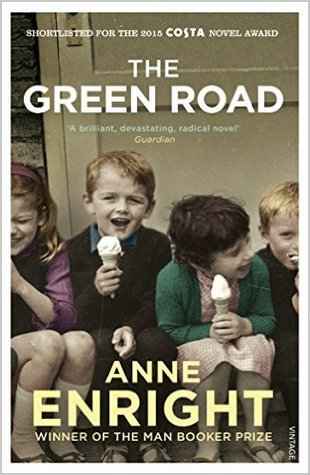
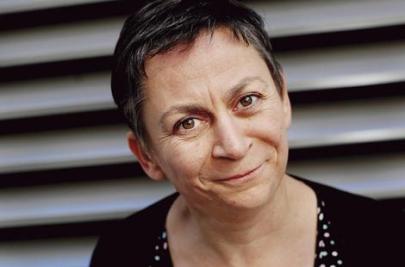
Irish writer, Anne Enright, won the Man-Boooker Prize for The Gathering (2007)
After the last page is turned, after you’re full to overflowing with this book you’ve just read, Anne Enright writes an Acknowledgements page, and she starts it like this: Thanks for the information used and cheerfully misused in this book are due to: and she lists a whole swag of people. That is the branding mark of a writer: once she knows something, then and only then, can she choose to change it.
With the very first sentence she grounds the story in the domestic:
Later, after Hanna made some cheese on toast, her mother came into the kitchen and filled a hot water bottle from the kettle on the range;
but it’s the very first word ‘later’ that made me jump: what?, this uncertainty, tension; something happened before the cheese on toast and the filling of the hot water bottle. But what was it? What?
And then on the 2nd page, this
He took them for rides in fast cars, up over the bridge, bang, down on the other side.
It’s the word, ‘bang’ that hit me this time. With that one out-of-place word, not a word, a sound; no quotation or exclamation marks, nothing but surety about the picture it conjured: a too-fast car, over a bump, where you hit your head on the roof and the sound of the car bouncing back to earth with the woop and cheer of kids, out where they shouldn’t be. Such a big picture from such a small sentence.
I smile to myself and think: I’m in the hands of a master, and I breathe a little sigh of relief: a very good feeling at the start of a read..
But then Chapter 2 opens 11 years later in the East Village, New York, with a gay male narrator among gay men torn between their right to be promiscuous and a stalking, discriminating death.
What Billy wanted was big, shouty unafraid sex with someone who did not cry, or get complicated, or hang around after the orange juice and the croissant. Billy was across the threshold and cheerfully out and he wanted men who were basically like him; sweet guys, who lifted weights and fucked large, and slapped you on the shoulder when it was time to swap around.
Where did an Irish 50-something mother of 2, who looks like a little housewife from Central Casting, find authentic language like that? I was now severely impressed with this writer; and she can do that relaxed but spiky gay table-talk; sassy, arch, and funny.
I don’t want to give too much away because there is too much to enjoy about this novel; but it is neatly constructed. Divided in two, the first half assigns a chapter, each with a different narrator, at a different time for each of the four beautiful children of the difficult woman Rosaleen; and at the end of which is the reason that all of them are lured home to Ireland, County Clare, for Christmas in the family home that their prickly mother has decided to sell.
Bring on Part 2.
In a London Review Bookshop interview she describes the first half of the book, a ‘proper’ book, as getting to know the four siblings in a way that none of them could ever know about each other; in a sense this is dramatic irony on a large scale. We readers know more about each of them than any other family member knows about each other. They have gone off elsewhere (New York, Asia, Africa, Dublin) to care for, or sleep with, the lost, the undernourished and come back home full of themselves, their adult selves; but to the childhood home where their mother, Rosaleen, is waiting to be empathised with. That’s all she’s ever wanted. They go off to look after big-bellied African babies, or dribbling disease-ridden men but here she is not being looked after at home … alone. She has a point. The trouble it she doesn’t know how to accept it, or express it.
I foolishly avoided Anne Enright’s books, even though there they were on my bookshelf, and even though I’ve met the woman (twice!), I thought her books were all about families collected together at a funeral, a wedding, a last Christmas, and I thought, yes, I know what they’re like. I’ll get to them … one day. And this book is like that. Exactly like that; but at the same it is so unexpected, unpredictable and therefore rewarding, satisfying, and oh-so wise.
She got her hair done in a place so posh it didn’t look done at all,
and this is one of those rare books where you can believe what’s written on the cover: ‘brilliant’, ‘radical’ – don’t let that put you off, ‘beautiful’, ‘virtuosic’, and ‘hugely readable.’
Some years ago at the Ubud Readers and Writers Festival I was intrigued and entertained by a British writer called Jill Dawson who had the audience at her session in the palm of her hand, so I checked out one of her volumes in the festival bookshop. I place a lot of importance and insight into a book by its first page. It wasn’t long, still on page one, that I heard a faint gasp from my own mouth and a thunk as I put the book back immediately. Both actions were involuntary. I was alarmed; not by the content but by my reaction to the content: she was writing in the first person as a man. I was not aware that I held this prejudice. Since then I have tried several times to write as a woman; I mean, in a first person (and third person) female voice with mixed success. So, when it was clear that Barry’s first person narrator was a woman I did not act as before but thought it was time I faced my prejudice, although weakened since by my own efforts, and continued reading.
The narrative is, in fact, in two voices: one the old woman, Roseanne Clear, the dominant voice, and the other, Dr Grene, the psychiatrist who tends to her at the Roscommon mental hospital, St Malarky’s, where Roseanne has been living for as long as anyone can remember. Roseanne Clear is very old, maybe even a hundred.
I am only a thing left over, a remnant woman, and I do not even look like a human being no more, but a scraggy stretch of skin and bone in a bleak skirt and blouse, and a canvas jacket, and I sit here in my niche like a songless robin – no, like a mouse that died under the hearthstone where it was warm, and lies now like a mummy in the pyramids.
She writes out her life on “unwanted paper” and stashes it under a loose floorboard; not unusual as the building is falling apart. Barry gives her language that is poetic, articulate, melancholy, and wise but seemingly uneducated at times: “no more”, although this could be her Irish-ness peeking through. Yet she is in a mental hospital. This is usually a theatrical device, a character being one thing to the other characters, and someone else to the audience; a form of dramatic irony. This is reinforced by conversations she has with Dr Grene where she gives simple answers or sometimes no answer at all, while telling the reader her reasons.
Her aim is to try and remember why she is where she is and whether memory, about a husband, then a non-husband, abandonment, expulsion, and a child, has any relation to reality. Is memory trustworthy?
Her story is one of Ireland: beginning with political unrest and genteel poverty as the daughter of a Presbyterian gravedigger in Sligo, western Ireland in the 1940s. Almost half of the book is devoted to her memory of her childhood with a father she adored, and you will too – even when be is reduced to work as a rat-catcher – but with a mother who is as distant and silent as a housemaid, which she resembles. Dr Grene has a similar wife, blank, distracted, lonely and you wonder at times whose memory is the more reliable.
The themes here are literary-Irish through and through: the slap-dash care, easy-bitterness, and bloody-mindedness of family; the down-right intractability of a mean-spirited Church hiding behind the skirts of a dour and silent god; secrets of paternity; the hyper-critical branding based on any sexuality that isn’t church-condoned, but done in the dark, and never mentioned; and the dis-empowerment, subordination, and denigration of women. It’s a very long way from the Ireland of today with its diminished religiosity, liberalism, and political leadership by an openly gay young man whose paternity is from India. However, as long as there are Irish writers who were damaged, but survived, their Irish past, as holocaust survivors survived theirs, there will be books like this.
The writing is luscious, and sometimes you need to re-read aloud a line, a paragraph, just to wallow in the words, to delight in the feel of them in your mouth; and since we read for pleasure – like we listen to music – there’s no need to engage the memory, this is a book for reading again.
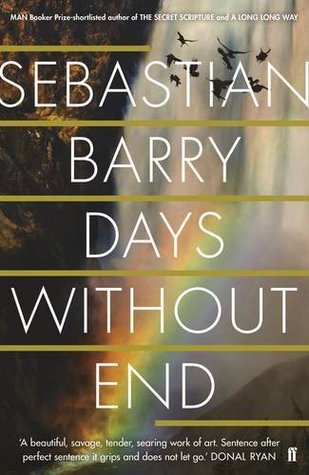
The Secret Scripture was short-listed for the Man-Booker, won the Jame Tait Black Memorial Prize, and the Costa Award in 2008; which Barry won again in 2016 for Days Without End.
You can find the book in various formats, including audio book and audio CD, here.
The film version, directed and co-written by Jim Sheridan with Johnny Ferguson, was made in 2016 starring Rooney Mara (the love interest to Cate Blanchett’s title-character in Carol, from 2015) as young Rose, Vanessa Redgrave as old Rose, and Eric Bana as Dr Grene; it was released in the USA in October. It will be in cinemas in Australia from December 7, 2017.
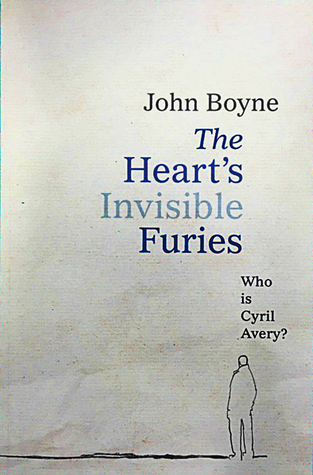
Many years ago, on a small plane trip – the plane was small, not the trip – as we were about to land in a provincial Queensland town, I continued to assiduously read my book. I was laughing so much, trying not to, but not succeeding, that my eyes were streaming, my nose running, and my face felt hot and red; the flight attendant broke the rules, unbuckled, and hurried to my seat to ask if I needed medical assistance. I just held up the book; I was unable to speak. She understood. Maybe she’d read it too. It was the hit of the season. The hysterical section was the Nativity Scene from A Prayer for Owen Meany by John Irving. The next time I laughed out loud, many decades later (yes, decades), was with this book, and the (highly illegal) Dinner Party Scene, from early on in The Heart’s Invisible Furies by John Boyne. Ironically Boyne has dedicated this book to Irving.
Making people laugh via the written word, and only the written word, is an extremely difficult and hazardous task. You can’t under play it or over sell it, and you certainly can’t ‘back-explain’ it; it’s all to do with tone, and tone is like a law of physics: it only happens when the universal conditions are absolutely right. It’s as if you need to foster a certain psychological state of mind, and write the episode with as much truthfulness and sincerity as you possibly can – don’t elaborate – just tell it, and if the tone is right, it will be hysterical. If it isn’t you can’t go back and make it right, edit it funny, you have to delete it all and start again. A plane will only fly if all the necessary preparations and current circumstances, weather, wind, mechanical health, operational skill, and power source, are perfect.
The dinner party – and it’s impossible to explain why it’s illegal, you’ll just have to read it to find out – is on page 92, but the preparation for it, and the other laugh-out-loud bits, preparation for the tone, I mean, in true Irving-esque fashion, begins right from the first killer sentence; and by the way, the opening sentence of Owen Meany has to be the killer-opening-sentence in all literature. There was a time when I knew it by heart and it became my dinner-party piece for some time after. I can’t sing, tell a joke, or play the piano, you see.
Boyne considers Irving a mentor, and Irving should be chest-thumpingly proud.
It’s impossible for Boyne to escape the moniker of “author of The Boy in the Striped Pyjamas” which he understands only too well, and he’s certain it will appear on his grave stone, so internationally popular was the book and film; but it changed his life making writing full time not only a possibility but a happy necessity.
Boyne was born in 1972. Ireland brought him up but the Church brought him down. He still suffers from its cruelty and hypocrisy. He’s not alone. His anger is present in this book but, much to his credit, he’s fashioned it into a cutting humour without lessening the truth of his understandable hatred.
The Heart’s Invisible Furies explains the life of Cyril Avery, although not a real Avery, from his pre-birth to two months before his death; from 1945 to 2015; and it is also the story of Ireland over that time; from a society dominated, straightjacketed, and suffocated by the Catholic Church, under the guise of strengthening morality, to one that legalises same-sex marriage. It’s a hell of a journey.
It’s full of surprising events, fashion, villains, extremely bad behaviour, political unrest, beauty, deception, selfishness, redemption, tears – yours as well as the character’s, death, forgiveness, love, birth in the midst of murder, politicians behaving badly, coincidences, literature, weddings, doctors behaving courageously, dreams – both fulfilled and dashed, sentiment, laughter, bigotry, violence, and even the ludicrous; in fact the entire palette that paints our lives that all conspires to prove that age-old adage, nobody’s perfect. And all these elements are wound around a cast of characters you won’t easily forget, and nor would you want to.
Boyne skillfuly uses many literary devices to tantalise and seduce his readers: he drops in an outcome before explaining how it happened; he triggers the reader’s memory before the character’s; and, best of the lot, dramatic irony: when the reader knows more that the characters do.
I love this book and I’ve recommended it to others, who too have loved it. I’m preparing a space on my bookshelf, between Jane Bowles and Peter Carey. You can get the book, in various formats, here.
The first thing you know about this work is the person, the narrator. Thomas McNulty is seventeen and has escaped the Irish famine to find himself in the wilds of the American west, not for fame and fortune, just a life. Barry has been mining the lives of the McNulty family for inspiration for many of his works, plays and novels; but what stands out in this book is Barry’s close writing: sometimes more academically called free indirect discourse, the use of language that the character might use when speaking; and he is speaking, speaking directly to the reader in the first person. The words – like ‘knowed’ instead of knew, ‘drear’ instead of dreary, ‘swole’ instead of swollen; the punctuation – nothing fancier than a comma or full stop; and the grammar – double negatives and wrong articles, all help to paint a picture of this boy. Uneducated, naïve, but smart, observant and handsome; no, not handsome, young Thomas is pretty. It is John Cole who is handsome, ‘handsome John Cole’ he is called. They meet in the wilds of Missouri, Thomas seeks shelter from a rain-storm in a hedge and there he is, handsome John Cole.
Their relationship is tender, romantic, sexual, and strong and is at the core of the book. There is hardly any descriptive detail about this partnership, no pink-rosed romance or comfortable sex; it’s just like the scenery, the killing, the survival, it’s just there.
And there is a lot of killing. The two boys get enlisted into the army and take part in the Indian Wars and then the Civil War. There is murder, mayhem, scalpings, scrotums removed to be dried out for bakky pouches, vaginas pinned on hats, children hacked, heads blown off Confederate soldiers not men yet; and all described with the plane observation and simple descriptive language gleaned from Thomas McNulty’s short little life, like he describes the glorious sunsets and the mountains ‘as black as burnt bread’ in the lands that don’t have names yet.
When the boys aren’t killing Indians or gray-boys they are play-acting to earn a dollar. First in a prairie hotel, they don frilly dresses and dance with the miners to offer a bit of pseudo-female company. No hanky-panky mind, just dancin’ and polite conversation including drunken but demure marriage proposals that are gently refused; and later in a grown-up theatre where Thomas sings romantic ballads in makeup and a dress to make grown men cry. Eventually Thomas and John and their adopted ‘daughter’ Winona, an Indian child saved from a bullet by Thomas’s quick thinking, settle down in post-war Tennessee growing tobacco. However, Thomas’s past deeds catch up with him and a happy ending is in doubt. No spoilers here.
But it’s Barry’s writing that is the star. You feel the need to re-read sentences and passages, the joy and innocence of them is captivating. Here is his description of the Major’s new wife:
There’s something sleek about her, like a trout moving through water. Her hair is glossy as pine-needles, pitch black, and she wears a diamond-spangled net over it, like she was ready for business. She carries one of those new Colt guns in her belt. She’s better armed than we are. Guess we think Mrs Neale is top-notch alright. It warms my heart to see how much she is kind to the major. They link arms about the place and she talks like a geyser. Every little thing she says has grammar in it, she sounds like a bishop.
The book is dedicated to his son, Toby:
“Years ago, when he was 16 and I was doing the reading for this book, Toby was very unhappy, and when a young man is unhappy we must take note. I was desperately trying to find out what was wrong, but you can’t ask him directly. You have to be a sleuth, a kind of Sherlock Holmes of his unhappiness … Then one morning he came into our bedroom and said, ‘The thing is Dad, I’m gay.’ I can’t describe to you the immense sense of relief and freedom in the very speaking of the words. His unhappiness fell away, my unhappiness fell away, and from that moment on we entered into this extraordinary period where he was instructing me in the magic of gay life … I was very impressed by the subtlety, the delicacy and the intricacy of the love between Toby and his boyfriend. People talk about tolerance, but it’s not really about tolerance. It should also be about emulation and reverence and learning from.”
Barry won the Costa Award, for an unprecedented second time, with Days Without End; it is also long-listed for the current Man-Booker Prize. The winner will be announced in October.
This is an unsentimental work full of violence but anchored by deep love and commitment that is all the more powerful for its simple existence and unwavering certainty.
You can purchase the book in various formats here.
When trying to describe the writing of Colm Tóibín it is easier to point out, not what he does, but what he does not do. He does not use contractions which gives his writing formality, gravitas, and weight; he does not use many adjectives and rarely long and compound sentences making the writing plain, stark, and bold; he does not describe places, people, or the weather unless it is absolutely necessary; and he does not use many adverbs or sentimental phrases to steer the reader into an emotional reaction. It is like watching a movie without a soundtrack (and if you would like an example of such a movie try Maren Ade’s superb comedy/drama Toni Erdmann, 2016 – no soundtrack).
Tóibín asks a lot of his readers; he allows readers to supply the detail: he simply says
‘she walked slowly along the corridor of the palace to her room,’ and leaves it up to us to provide the detail: the decorations, the floor tiles, the guards and their uniforms, drapes, and statues. We all have an idea of the a corridor in a pre-christian palace. Our thoughts may not be accurate, but interior design has nothing to with Tóibín’s story. Our imaginative efforts are all he needs.
All of these elements are in his latest work, House of Names, Tóibín’s retelling of the pagan Greek tragedy of the turbulent family of the House of Atreus, headed by Agamemnon who prepares to besiege the city-state of Troy and return his kidnapped sister-in-law, the beautiful Helen, and return her to her husband, his brother, Menelaus. There is also no sense of good and evil, there is just what must be done to get what you want. Revenge, rape, human sacrifice, incest, matricide, kidnapping, imprisonment, and murder by any means are par for their daily lives as they are for the gods they worship and from whom they seek guidance.
She [Cassandra] had come to us in glory and now, in ignominy, she was running through the palace seeking Agamemnon, having divined that something had happened to him. Aegisthus followed her at a slow pace. When I saw her, I calmly ushered her into the bathroom, where she could see my husband bent over naked, his head in the bloody water. As she howled, I handed Aegisthus the knife I had used on Agamemnon and indicated to him that I would leave him to his task.
Tóibín has used the bones of the story garnered from the Greek playwrights, Sophocles, Euripides, and Aeschylus but has also relied heavily on his own imagination, especially in the Orestes section. The book is divided into parts each focusing on one of the three main characters, Clytemnestra, wife of Agamemnon, Orestes, their son, and Electra, their daughter. The sections labeled Clytemnestra are told in the first person, the others in the third. However, Tóibín uses free indirect discourse (also known as ‘close writing’) where the words used are similar to those the protagonist might use giving the third person narrative a taste of the first; so, whether told in the first or third person this tale is very personal to the murderous trio.
The story opens the day after Clytemnestra has slit the throat of her husband Agamemnon just after he slipped into a warm bath,
I gave orders that the bodies should remain in the open under the sun a day or two, until the sweetness gave way to stench
but quickly takes us back to the reason for this: the death of Iphigenia, Clytemnestra and Agamemnon’s eldest daughter; rather than marrying Achilles, her father’s famed warrior, which she thought was happening that day, she was sacrificed to the gods, with Agamemnon’s approval, to enable fair winds to take him and his fleet to Troy. Clytemnestra plots her revenge which never fades while Agamemnon is away fighting the decade long Trojan War.
This novel, his eleventh work of fiction, is a departure for Tóibín, which may have been his attraction to the idea. Usually his family stories are more about the emotional geography of everyday life of everyday people: the inability of a father to confess love to a lonely son; a recently widowed mother’s attempt to regain her life on her own terms; or how a writer, used to success, copes with failure; rather than the murderous shenanigans of the rich and powerful. However, in the first-person narrative of Clytemnestra, there are similarities with Tóibín 2012 novel, The Testament of Mary. Here too the tone is confessional: a woman, a character from our ancient past, confessing to the reader her inner thoughts, motivations, and decisions.
To facilitate her murderous plans, Clytemnestra has her son, Orestes, still a teenager, kidnapped and sent away along with other young men – to garner silence from their fathers – and guards who might get in her way. Orestes, with two others, the strong and decisive Leander, and the weak and sickly Mitros, escape and in this third-person narrated section there exists, eventually, a taste of domestic happiness, rural contentment, and even romance. But Tóibín only hints at such human pleasures with the same distanced control he uses to describe filial treachery, pride, and murder.
Electra, a sad and rather pathetic character does not have the beauty of her dead sister, Iphigenia, nor the cunning and charisma of her mother, or the courage of her brother, but she hovers over the story biding her time, making plans, until she is able to set up the matricide for her brother to commit.
I enjoyed this tale – it’s a quick read – but I hanker for Tóibín to get back to what he does best and to the promise he made post Brooklyn (2009), that after three novels about women he would tackle a story about men; his previous, The Heather Blazing (1992), The Story of the Night (1996), and The Master (2004), where a long time ago.
You can obtain this work in various editions here.
The first-person narrator, a boy, walks past the house of his dying priest night after night, wondering whether he is dead yet, but this night knows it to be true.
“Every night as I gazed up at the window I said softly to myself the word paralysis. It had always sounded strangely in my ears, like the word gnomon in the Euclid and the word simony in the Catechism.”
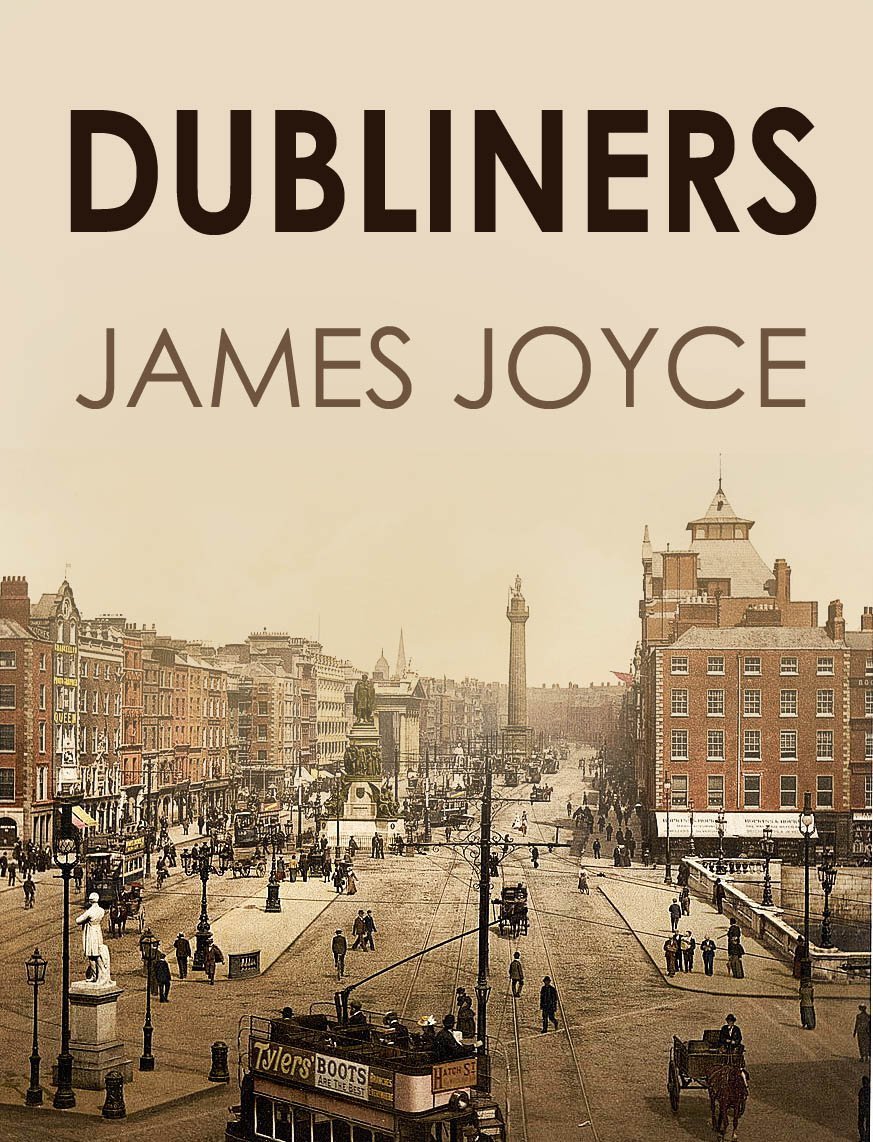
So begins the first story, The Sisters, in James Joyce’s collection Dubliners (1914) but in it is a clue to the theme of the book itself. Joyce wanted to write about the people of Dublin because to him it was the “city of paralysis” and the shadow of this word permeates the whole collection. For Joyce “paralysis” meant the inability to life meaningfully. Joyce spent most of his life on the continent, far away from Dublin, so strong was his belief that the city was tainted.
Here the “paralysis” is both literal, in the case of a dying priest after his third stroke, and moral: “simony” takes aim at the Catholic church’s corrupting stranglehold on Irish society; “gnomon” is somewhat different, being more about form than content (a gnomon is a parallelogram with a section removed, as well as the shadow-casting part of a sundial). The word is a cryptic warning to the reader that these stories contain many absences, not least traditional plot, character and scene-setting. These absences are part of what Joyce referred to as the style of “scrupulous meanness” with which he wrote Dubliners, meaning the frugality he applies to language, image and emotion.
Freytag’s pyramid, or dramatic arc or structure, suggests that a clear beginning consisting of a proper introduction of the setting and the characters, a middle discussing the conflict that would lead to a climax, and an end that ties the story together with a denouement are indispensable to any written work of fiction.
So was the literary thinking in 1914 – and in some circles it still is today. Joyce ignored it all, which may be why it took him 6 years to get this collection published.
In the story A Little Cloud, a shy and fragile clerk, known as Little Chandler, since “he gave one the idea of being a small man” meets in a bar, after 8 years, his friend Ignatius Gallaher, who once “known under a shabby and necessitous guise had become a brilliant figure on the London Press.” Little Chandler yearns of becoming a famous writer and dreams about the rave notices he would get for his work. He is delighted to see his old friend and Gallaher shouts him several whiskeys and regales the little man with innuendo and suggestions of his racy experiences in London and Paris: no married life for him. Of course, Little Chandler is late getting home to his young wife and child and had not brought the tea and sugar she had urged him not to forget. “She was in a bad humour and gave him short answers” and decides to go out and get the tea and sugar herself. “She put the sleeping child deftly in his arms and said: ‘Here. Don’t waken him’.” Little Gallaher cradles the child and stares at a photograph of his wife wearing an expensive blouse he had bought her. The image of his wife weaves no comparison to the “rich Jewesses” with “dark Oriental eyes” of Gallaher’s salacious plans and stories. Little Chandler feels nothing but entrapment, paralysis, in his mean little cottage with debt-laden furniture and no way of writing the book that “might open the way for him.” He reads some melancholy verse by Byron while nursing the child and wonders where he can find the time to write like that; he has so much to say. The baby wakes and cries and will not stop no matter how hard he tries to sooth him. Everything is useless. He is “a prisoner of life!” He loses his temper with the child and shouts at him which scares the infant and causes him to scream and “sob piteously”. His wife arrives and rescues the babe and glares at her useless husband and he listens to the child’s sobbing grow less and less in the arms of his loving mother. The story ends with Little Chandler just standing there as “tears of remorse started to his eyes.”
The reader is left with a feeling of pity and yearning for this little man who did the right thing, that every man should do, marry, start a family, and work to keep and protect them; while his friend did the other thing: travelled, wrote and became famous and whored around in London and Paris. This is the ending that Freytag’s pyramid espouses but it is a thought, not on the page but in the mind of the reader.
This was radical for 1914, when this collection first appeared. However, is it true today that more and more writers of fiction are leaving aspects of descriptive, consequential, and circumstantial narrative out of the text and up to the reader. This is so true that it is not the writer’s place any more to answer the question, “And what did you mean by writing that?” After a story is in print – or, for that matter any creative work that is finally in the public domain – the meaning of what the reader reads is all to do with the reader – it means what the reader thinks it means – and has nothing to do any more with the writer and what was meant by the writer in the first place.
Although Dubliners is considered one of the greatest short story collections ever written, it is Anton Chekhov, the Russian playwright, who is generally considered the father of the modern short story. “The revolution that Chekhov set in train – and which reverberates still today – was not to abandon plot” – or Freyberg’s Pyramid – “but to make the plot of his stories like the plot of our lives: random, mysterious, run-of-the-mill, abrupt, chaotic, fiercely cruel, meaningless”. Chekhov’s short stories had been available in English since 1903, but Joyce didn’t get Dubliners published until 1914. He claims not to have read them. Many critics think this a little implausible since Dubliners seems to owe a lot to the work of the Russian. However, Joyce finished the collection by 1907, and with Chekhov’s work having been available in English only for a few years when Joyce was working as a teacher in Europe, it is entirely possible that he did not read it. Although William Boyd, American novelist and short story writer asserts that Chekhov liberated Joyce’s imagination as much as Joyce liberated writers that followed and “that the Chekhovian point of view is to look at life in all its banality and all its tragic comedy and refuse to make a judgment”. The Joycean view seems to look at life from the inside of his characters: to chart his country’s “moral history” in Dublin; and he does this by turning the plot inwards. It’s the landscape of dreams, desires, hopes and disappointments that bind the 15 stories together into a whole, which in itself is unique, creating a form of a novel in fifteen disparate but morally interconnected chapters: the early stories are from childhood, the centre charts the middle years, and the final devastating story, The Dead, his masterpiece, culminates in a mature realisation of man’s insignificance in the universe. In fact, the first image of the first story: a boy looking up at a window behind which lies a dead man, is reflected in the last image of the last story where a man looks out of a window contemplating all the dead that have gone before him and which one day he will join. Images like bookends.
Joyce’s narrator varies from story to story: first person in the first, but usually in the third-person but not of the omniscient kind:
“…as he set himself to fan the fire again, his crouching shadow ascended the opposite wall and his face slowly reemerged into the light. It was an old man’s face, very bony and hairy.” (Ivy Day in the Committee Room). The narrator doesn’t know the face until it is seen as everyone else sees it, including the reader. It’s like the narrator and the reader see and know everything at the same time; as if you and he are watching the scene together.
It is the final story, The Dead, that marks Joyce a masterful writer and it is easy to argue that it is the best short story ever written. It is the quintessential modern story although it’s structure is almost classic. It opens with a scene featuring minor players in the story; a device used by Shakespeare in the opening scenes of many of his plays: it’s a way to introduce the scene and action before the principle players emerge, creating setting, background, and expectation. The bulk of the story is the colouring of the situation: the interconnecting relationships, the characters, the party as life’s metaphor, building tension and expectation, preparing the reader for what will happen.
Lily the house maid is “run off her feet” tending to guests as they arrive for the annual dance party given by the aging Misses Morkan, Kate and Julia, and their niece Mary-Jane, a music teacher to some of the “better-class families on the Kingstown and Dalkey line.” All eyes and ears are attuned to the arrival of Gabriel Conroy, the old ladies’ nephew, and his wife, Gretta, but they are also worried that the local drunk, the course-featured Freddie Mullins, might make a too-soon appearance and spoil the party. All arrive as expected and the party is in full swing; shoes shuffle and skirts swish and sway to the dance music on the polished floor of the upstairs parlor under the chandelier and a piano recital is given by Mary-Jane and songs are sung by the talented tenor, Mr Bartell D’Arcy. The strata of Dublin society are represented: the proud and successful Gabriel and his unhappy wife, Gretta; the Morkans drenched in their good-natured, middle-class hospitality cocooned in their well-established morality; and the likes of Freddie Mullins who prizes a drink over employment, filial duty, and nationalistic pride.
And then there are the galoshes. Gabriel wears them and urges his wife to, but she refuses. They are a symbol of modernity, recently arrived from London and “Gabriel says everyone wears them on the continent”. They are a sign of progress but, of course, the locals don’t wear them, much to Gabriel’s disappointment, thinking that he may have been able to bring the modern world into the lives of his community and family; Aunt Julia isn’t even sure what they are; Gretta thinks they’re funny and “says the word reminds her of the Christy Minstrels”. The social boundaries are clearly drawn.
On the dance floor, Gabriel, preoccupied with his forthcoming speech and worrying that his planed quotes from Browning “would be above the heads of his listeners”, is half-jokingly harassed by his dance partner, Miss Ivors, who “has a crow to pluck” with him. She chastises him for writing book-reviews for an English newspaper; refusing to holiday in his “own land” among his “own people” and to speak his “own language” and therefore labels him a ‘West Briton”.
Gabriel is a dignified man. He is angered by Miss Ivor’s assertions regardless of her light-hearted tone; considers Dublin, like Joyce, a back-water of pseudo-happy and ignorant people; looks to England and Europe for artistic, fruitful, and intellectual sustenance; but, despite all this, tonight he is excited by the idea of Gretta and he spending the night, without the children, in a local hotel. Their marriage has soured over the past few years into something that he sees as all too common in this society. He is hoping for, maybe even lustful, but at least an intimate night alone with his wife.
After all the singing, dancing, and a minor ruffle between the Catholics and “the other persuasion”, the goose is carved at the head of a fine, happy, and plentiful supper table. Gabriel’s speech is a great success. The champagne flows freely. The annual party is drawing to a close and Gabriel while putting on his coat asks after his wife. He finds her standing high on the landing in the semi-darkness gazing at nothing in particular but seemingly listening to something. There is a plaintive singing voice “in the old Irish tonality” and distant chords on a piano that seemed to render his wife transfixed. This is the peak of the drama. What is happening to Gretta, what is going on in her mind, will bring down the story’s protagonist. But Joyce stretches the tension. There is the walk with others into the city, then to the hotel, then to their room, and their preparation for the night. Here, he, all expectant and eager, is willed finally to ask why she is so melancholy. Her reply, his reaction, and the devastating realisation because of it, ends the story.
What begins as a classically structured tale of Dublin life, full of Chekhovian realism bolstered by detail, humour, character, emotional connections, and social hierarchy, the epitome of life itself, ends as a modern fable, not based on action, but internal thought. And like all good writers, Joyce ends with an image: a disappointed and humbled man gazing through a window on to a darkened city as snow gently begins to fall all over Ireland.
“His soul swooned slowly as he heard the snow falling faintly through the universe and faintly falling, like the descent of their last end, upon all the living and the dead.”
-oOo-
The works of James Joyce, Dubliners, Portrait of the Artist as a Young Man, Ulysses, and Finnegan’s Wake, are out of copyright and can be downloaded, via various formats, for free here.
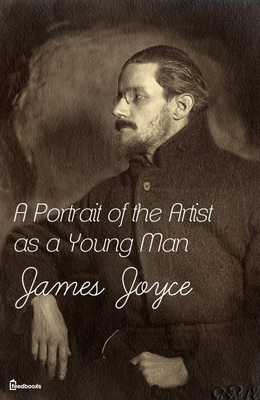
The Irish writer, James Augustine Aloysius Joyce (1882-1841).
The opening of “A Portrait …” is one of literature’s most famous:
Once upon a time and a very good time it was there was a moocow coming down along the road and this moocow that was coming down along the road met a nicens little boy named baby tuckoo.
His father told him that story: his father looked at him through a glass: he had a hairy face.
He was baby tuckoo.
There are several remarkable things about this opening. Firstly, the title has set up the idea that what you are about to read is going to be an autobiography, of the writer, the Artist, Joyce, about himself as a young man. But this is not what we read, this is not an autobiography in seems, since, if it was, the pronoun would be ‘my’ not ‘his’; so, it is not told by the Artist, the author, it is told by a third-person narrator. Secondly, it is written in the past tense, fine, as expected, but the moment you read the word ‘his’ you know that ‘his’ refers to the Artist, James Joyce. We only use a pronoun when it is clear who ‘his’ refers to and the only name prior to this pronoun is the author’s. It is him. This is confirmed by the line “He was baby tuckoo.” Again the pronoun and still only one name, the same name, the author’s, so, he is not the author. Well, yes, he is the author, we just choose to ignore that: we willingly accept what the author has written in order to enjoy the story. We play along. A few pages on this third person narrator, to confirm his existence, gives baby tuckoo a name, Stephen Dedalus. This is a story about a boy called Stephen Dedalus that we understand is the young James Joyce. Why has Joyce chosen to write his own story narrated by a third person god-like narrator? Because it is a much more useful novelistic tool. Writing in the first-person disallows the writer access to the minds, thoughts, tastes, dreams, wishes, and desires of all the other characters in the story. The first-person “I” can only describe what he feels, sees, tastes, dreams, and desires. The third-person god-like narrator has access to everyone and everything, but more importantly, the past, and the future. Also, the ‘baby’ language is the manifestation of yet another novelistic tool, new for 1914 and used here for the first time; so effective and now so widely used: a device that allows the narrator to adopt vocabulary, vocal mannerisms, colour, and tone of the character’s own speaking voice. In literary terms this is called free indirect discourse, or as critic James Wood likes to say, close writing. This is familiar to us now, (Edward St Aubyn’s The Patrick Melrose Novels, 2012, for example, and almost any novel written in the last 100 years) but innovative then. Also, usually for his times, early twentieth century and before, in novels of coming of age (Dicken’s David Copperfield, 1849 for one), biographical, or auto-biographical, the narrator wrote from the perspective of adulthood; there was a distance from the narrator to the subject. But here, as Stephen grows on the path to maturity, so does Joyce’s language. In 1916 Joyce’s text was radical. It’s as if Joyce, with this opening, was writing about Stephen at 6 years old when he, the narrator, was 6 years old. The action and tone are far more immediate, compelling, and authentic, and along with the non-judgemental narrator sets the ground-work for modernism which would be experimented with and adopted, not just by Joyce but by his contemporaries as well.
However, we know from this opening that this is going to be a story about a person called Stephen Dedalus (James Joyce) and that we are starting at the time when he was a very young boy and that his father wore spectacles and a beard. The original title of this book was another name, Stephen Hero, but he changed the title and the hero’s name.
In Greek mythology Daedalus was a skilled inventor and architect who built the labyrinth for King Minos of Crete to house the Minator, a monster, half man, half bull. He was also the father of Icarus. After Theseus killed the Minator, with Daedalus’s help, and fled with Ariadne, the king’s daughter, Minos imprisoned Daedalus and Icarus in the labyrinth but they escaped – after all, Daedalus built it – and flew the island by making themselves wings of feathers and wax.
The Fall of Icarus by Jacob Peter Gowy, 1637
Despite his father’s warning, Icarus, excited by the thrill of flying, flew too close to the sun god Helos as he rode his flaming chariot across the heavens, and the waxed wings melted, and Icarus fell and perished in the sea. Daedalus, after surviving another vengeful plot by Minos, escaped and finally settled in Sardinia where he joined a group led by Iolaus, nephew of Hercules; and as far as we know lived to a ripe old age.
In Romanticism, Icarus came to denote impetuousness, rebellion, and hubris, while Daedalus represented the classic artist, skilled, mature, and successful.
The young Stephen Dedalus is an observer, a listener. Early in the narrative he describes in great conversational detail a heated argument at the family Christmas table; an argument about Parnell, an Anglo-Irish politician, who by shrewd but steadfast political decisions became the figurehead of the Irish nationalistic movement in the nineteenth century; he renounced violent anti-Parliamentary action, but he was a protestant. Colm Tóibín writes that this scene could easily have been refracted around the tables of Irish dinners in the 1970’s and 80’s as family members argued over what was going on in Northern Ireland. And the scene where Stephen is unfairly punished resonated with Irish readers and writers: corporal punishment in Irish Catholic schools continued until the 1980’s. The influence of this book overshadowed generations of Irish long after it was published in 1916.
The young boy is also a thinker:
Was that a sin for Father Arnell to be in a wax or was he allowed to get into a wax when the boys were idle because that made them study better or was he only letting on to be in a wax? It was because he was allowed, because a priest would know what a sin was and would not do it. But if he did it one time by mistake what would he do to go to confession?
He asked the kind of questions Irish Catholic schoolboys have been asking themselves – and no-one else – for decades.
The first chapter ends with Stephan ‘reporting’ to the rector his unjust punishment at the hands of the prefect of studies, Father Dolan. This was a brave thing to do and his classmates hoisted him up, carried him along and shouted “Hurroo!” and threw their caps into the air. A stirring chapter-end of vengeance, courage, just fulfilment, and Joyce’s poetic language, not in a character’s words but from the narrator’s prose.
The fellows were practising long shies and bowling lobs and slow twisters. In the soft gray silence he could hear the bump of the balls: and from here and from there through the quiet air the sound of the cricket bats: pick, pack, pock, puck: like drops of water in a fountain falling softly in the brimming bowl.
Stephan has grown up a lot since moocow and baby tuckoo.
Chapter 2 is a portrait of a disillusioned young man in search of something profound which even he does not know what it is: “He wanted to meet in the real world the unsubstantial image which his soul so constantly beheld.” This “it” became “her” as if they would “make their tryst … in some secret place … and in that moment of supreme tenderness he would be transfigured … Weakness and timidity and inexperience would fall away from him in that magic moment.” This “her” in his mind (his muse?) is mingled with the heroine from Dumas’ novel The Count of Monte Cristo, Mercedes, or maybe its Ellen who, after a family bit of singing and dancing, comes with him on the tram where he is aware of her closeness, her wish for him to catch hold of her, “nobody is looking. I could hold her and kiss her” but he did neither and “stared gloomily at the corrugated footboard.”
This, a constant battle between the developing Artist and the developing Young Man.
And when he finally writes something about the tram, and Ellen and the kiss not made he “thought himself into confidence” over “a new pen, a new bottle of ink and a new emerald exercise” and “there remained no trace of the tram itself nor the tram-men nor of the horses” but only “of the night and the balmy breeze and the maiden lustre of the moon” and the kiss not given became a kiss “given by both.” Finally, the Artist at work; and, so often, his muse, his Art is so confounded with women, with sex. Women “demure and innocent” he sees by day, but by night “her face transfixed by lecherous cunning, her eyes bright with brutish joy” and he is left by morning nothing but a “humiliating sense of transgression.”
At school, he is studious but aware of voices urging him “to be a good gentleman”, “to be a good catholic above all things”, “to be strong and manly and healthy”, “to be true to his country,” “to raise up his father’s fallen state by his labours”, and “to be a decent fellow.” All this bidding by voices all around, “but he was happy only when far from them, beyond their call, alone or in the company of phantasmal comrades.” The battle continues. Even in his own existence. From 1904 he lived with a Dublin chambermaid who had little education nor any understanding of Joyce’s work and felt that he made his life more difficult by writing so strangely. She was vivacious, humerous, loved music, bore him two children, and stuck by him through intense poverty in Zurich and Paris while writing his most famous work, Ulysses. He was a husband and father, a Man, but then inside something else something separate, an Artist.
He is cast in a school play but his part humiliates him, “A remembrance of some of his lines made a sudden flush rise to his painted cheeks” but, surprisingly, the excitement and youth around him “entered into and transformed his moody mistrustfulness.” On stage he was amazed that the play during rehearsals that seemed a “disjointed lifeless thing” had taken on a life of its own and it was a success. He is amazed and confused by this and “his nerves cried out for further adventures” – this is Art and it is Alive! I want more! When he meets his family in the excited crowd outside the theatre he feigns an errand he annoyingly says he has to make and leaves them all before they can say a word. He strides alone through the city, his mind a “tumult of sudden-risen vapours of wounded pride and fallen hope and baffled desire” until he finds himself in a “dark cobbled laneway” where he “breathed slowly the rank heavy air.” Then this …
That is horse piss and rotted straw, he thought. It is a good odour to breathe. It will calm my heart. My heart is quite calm now. I will go back.”
*****
Here the close writing of the third-person narrator (“he thought”) in the past tense gets so close that it slips from the past tense into the first-person (“my heart…”) present tense (“… is calm”) – truly radical for literary 1916 – and suddenly Stephen Dedalus is James Joyce. But only for these three short sentences. After the ***** the third-person narrator and the past tense returns.
Stephen was once again seated beside his father …
There is no linking action between Joyce’s scenes; this stream-of-consciousness would be picked up by his peers and by writers even to the present (Marlon James, The Brief History of Seven Killings, 2015). The dialogue is sparse but realistic, but Stephen’s internal thought patterns are poetic and constantly at battle with the world around him. He feels he is alien from his family, “mythical kinship of fosterage” and burdened with a “savage desire … to defile with patience whatever image had attracted his eyes.” Joyce transformed the narrative into isolated scenes, the paragraph into pictures of feeling, and the sentence into impressionistic bits; like the painters were doing to landscape and interiors in studios and fields all over Europe.
But it is in part 3 that Joyce’s major theme, his Christian faith, is described and exalted in a lengthy sermon as his sinful, lustful, self is set against it and painted as on a slippery but vengeful slope to hell and damnation. The Christian parable is given in a naturalistic and almost movie-like narrative; the glory of heaven rent asunder by the treachery and downfall of the once “shining angel’, Lucifer, who is cast from heaven along with his “rebellious angels” into their fiery haven of Hell; and to fill the gap in Heaven left by these fiends, God created Adam and Eve and gave them a wondrous garden to live in; but Lucifer was jealous of these clay-born creatures and tempted them to disobey God and eat the forbidden apple; so the archangel Michael cast them out into the “world of sickness and striving, of cruelty and disappointment, of labour and hardship to earn their bread in the sweat of their brow;” but God is pitiful and promises a redeemer that will take on all the suffering of the fallen people and give them a way to salvation. It’s a heady and powerful text to the developing mind of a teenage boy who sees nothing but poverty and temptation all around.
He came down the aisle of the chapel, his legs shaking and the scalp of his head trembling as though it had been touched by ghostly fingers. He passed up the staircase and into the corridor along the walls of which the overcoats and waterproofs hung like gibbeted malefactors, headless and dripping and shapeless. And at every step he feared he had already died, that his soul had been wrenched forth of the sheath of his body, that he was plunging headlong through space… Flames burst forth from his skull like a corolla, shrieking like voices: Hell! Hell! Hell! Hell! Hell!”
Alone in the darkness of his room, curled up on his bed, hands covering his face his fear of Hell becomes manifest with images of reeking dung and weeds and “goatish creatures with human faces … trailing their long tails behind them … soft language issued from their spittleless lips … circling closer and closer to enclose;” and so terrified he springs up, vomits, cries, prays and walks the city streets always conscious and fearful of his blackened and sinful self but fearing more the idea of confession: saying aloud what he has done, the seven deadly sins – he lost his virginity at 14 with a whore – he knows them all; the thought of saying it all to a goodly priest; shame fell on him like ash.
There has never been a more vibrant, terrifying description of a young boy’s idea of hell fostered by effective and horrific mind-altering descriptions from a pulpit, feeding the limited but hungry imaginations of those who listen. The Church knows how to do it.
But he does confess and is absolved of all his sins and the chapter ends with Stephen “sitting by the fire in the kitchen, not daring to speak for happiness” and dreaming of a glorious altar with fragrant masses of white flowers as he awaits among other communicants for the body and blood that will soon be his.
Stephen Dedalus, our 16-year-old hero, is now pious and as blameless as any person can be: his intricate piety and self-restraint – he allocates a rigorous discipline to all his senses – even surprised himself but they failed to eradicate “childish and unworthy imperfections” and he felt the “flood of temptation many times” but always eluded them like jumping back from an incoming wave which threatened to engulf him. His piety and dedication grows until the possibility of a priestly life is offered and his contemplation of it is many faceted in poetic language of the mind and the soul and the landscape and the image of an innocent girl standing island-like in the river shallows of the beach. Her skirts and petticoats are hitched up above the waves and “her long slender bare legs were delicate as a crane’s and pure save where an emerald trail of seaweed had fashioned itself as a sign upon the flesh.” He runs from the idea of her and has to eventually admit that his “inherent sinful nature” makes a religious life impossible.
The fifth and final chapter sees him a university student, living at home and still existing on watery tea and fried bread crusts soaked in yellow dripping. He is not a punctual student and misses more classes, English, French, Physics, than he attends. He, instead, seeks out compatible priests and peers and discusses with them his theories and definitions, based on Aristotle and Aquinas, of truth, art, and beauty. Such dissertations are punctuated by scenes of the everyday streetscape: passing students, argumentative men, noisy vehicles and pretty girls, “holding the umbrellas at cunning angles…their skirts demurely”, who were his only distraction. There is always a connection between women, art and sex: each can dislodge the over but it is always art that has the strongest power but which is the most hidden but aches to be exposed; he aspires to “the highest and most spiritual art,” literature.
The penultimate scene is a long conversation with fellow students culminating in a more intimate discussion with his friend, Cranly, about freedom, art, and escape. Finally, the third person gives way to the first, Dedalas is Joyce, in the form of diary entries from March 20 to April 27 1904 where his mother is putting his second-hand books in order and dreading the inevitable: the loss of her son’s love that enables him to learn his own life “away from home and friends what the heart is and what it feels.”
Welcome, O life. I go to encounter for the millionth time the reality of experience and to forge in the smithy of my soul the uncreated conscience of my race.
But it is his oath and his confession to Cranly, a few pages earlier, that rings the loudest and the most true:
I will no longer serve in that which I do not believe, whether it call itself my home, my fatherland, or my church: and I will try to express myself in some mode of life or art as freely as I can and as wholly as I can, using for my defence the only arms I allow myself to use – silence, exile, and cunning.
And that is what he did.
-oOo-
You can find the free ebook here, along with all his other works published by www.ebooks.adelaide.com a wonderful resource of texts out of copyright established and maintained by the University of Adelaide.
In a pub in the little cross-road town of Cullaville, just two fields north of the border between the United Kingdom and the Republic of Ireland, the bar has two till-drawers: one for Euros (Irish currency) and one for the British pound. More than 200 formal and informal roads (tractor and foot paths) cross the border and it isn’t often clear for travellers which country they are in; sometimes it may only be the change of the speed-limit that may give them a clue, sometimes nothing at all.
Alastair McDonnell, an MP from Belfast has been flooded with queries, following the Brexit vote, from his constituents about what will happen if the border becomes ‘hard’ again. It’s possible that come the reality of Brexit (2019 says British PM, Therese May) little border towns like Cullaville will potentially become the EU’s back door to Britain.
Anne Devlin, a resident of the North who buys her petrol in the South where it’s cheaper, said, “Brexit got everyone talking, that’s for sure. It reminds everyone who is who, where is where, north or south, the Troubles, all of that.” It’s been only 18 years since the last bomb exploded during the religious-based conflict that claimed more than 3,500 lives.
With the signing of the Anglo-Irish Agreement in 1985 between the UK and the Irish Republic the path was finally set for peace but which didn’t come for another 13 years with the signing of the Good Friday Agreement in 1998. In the summer of 1986 Colm Tóibín walked the border in preparation for his account of the feat published the following year: Bad Blood: a walk along the Irish border. Actually it was more like a ‘drink’ along the Irish border: Colm likes his ale.
For a border that may now need to be re-fortified, given the European refugee problem that doesn’t look like slowing down – certainly not within the next two years, its ‘hardness’ may have many other repercussions. Sometimes it runs through the middle of someone’s field; in South Armagh (the North) there is a shop whose “doorway itself was the border, the outside of the shop being in the North, every entry and exit involved smuggling”; and not only that, where the border separates County Fermanagh (the North) from County Caven (the South) there is a house where “the border went right through like a slicer through a block of cheese.
The house was a small, modest, old-fashioned cottage. When I knocked on the door a man in his sixties came out. His name was Felix Murray, I discovered, and the border ran through his house in which he and his two brothers lived. These days, he said, all three slept in the North, but there was a time when one of them had slept in the South. ‘Only an odd time now,’ he said, ‘we sleep in the State’. There was a sofa in the kitchen, he pointed out through the window. Where you could sit and let the border run through you.”
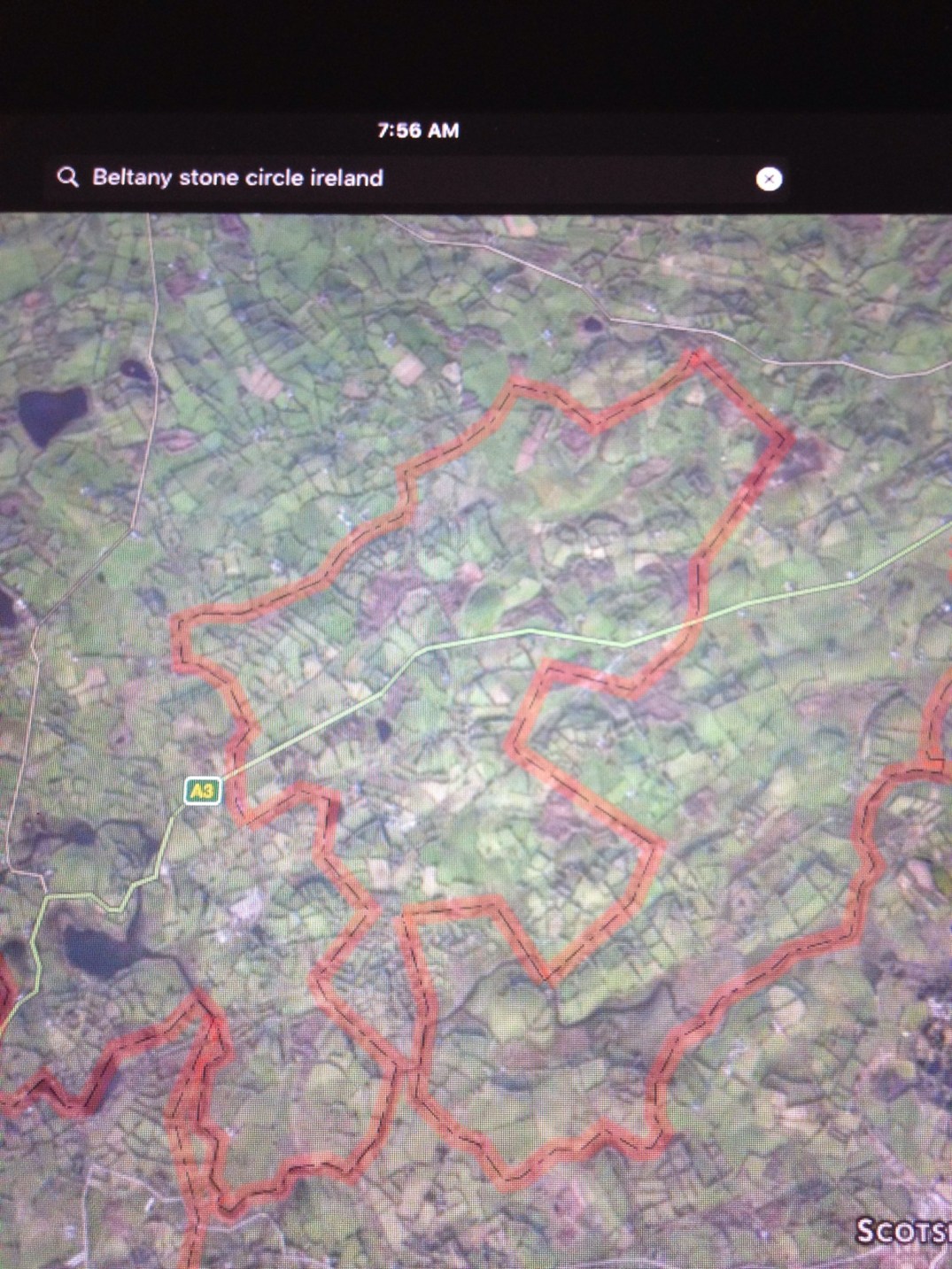
This was 20 years ago and things may be a different now but as you can see from the image below, the border to this day, seems a long way from logical.
His early non-fiction shows the development of Tóibín’s style later employed, to some extent, in his novels; his first novel, The South, was published in the following year, 1990. His fiction shows his debt to journalism with his plain unadorned prose, seen here in Bad Blood.
“I told him I was writing a book. He invited us in. He didn’t say anything. The front room of the house was small and comfortable. There was a fire lit. A television and a video machine stood in the corner.”
Compare this is a passage from his second novel, The Heather Blazing (1992),
“His grandmother was in the kitchen with his Aunt Margaret and his Aunt Molly who was married to his Uncle Patrick. Two of his cousins were in his the back room in cowboy suits. They all stood round as Eamon distributed the presents. Stephen sat by the fire, huddled in against the wall with his legs crossed. He opened his parcel slowly and smiled when he saw the book.” Short, bald, unadorned sentences.
Tóibín trusts his readers to do most of the descriptive work and gives them great responsibility to fill in the detail, so much so that in his latest novel, Nora Webster (2014) no place or person is described: every reader has a hometown, its feel and smells, and every reader knows a nosy neighbour or a favourite aunt and Tóibín relies on this reader-experience. In this way Toibin’s work, for readers, becomes very personal. A reader from Melbourne, Australia, on finishing reading The South, slept with it under her pillow for two weeks.
In 1989, even though the border may have been on the map it wasn’t, in a lot of places, on the land (large white crosses had to be painted on roads to make the border visible to British helicopter pilots), but it was in people’s hearts. Back then it was all about tension in the air but a stiff upper British lip, this is in the North, was still the way people behaved.
At dinner in a hospitable family house in the North the first course served was beetroot soup. Toibin, from the South, innocently commented that it was called borscht, and it was a great favourite of the Pope’s. That word hung in the air like a fart. Everyone stopped listening and became immensely interested in their soup and the care it took to not let it spill on the white tablecloth. No-one spoke.
Religion was not at the heart of it but at the bottom of it.
“Yes, one of them said, the older people maintained that the accidents were a sort of revenge for what was done to the Grahams. God, you know, did I understand? It was God. It seemed like a large number of young people from the same area, I said, to be killed in accidents. They nodded grimly. I said I didn’t think it was God. No, they agreed, they didn’t either. It was just something which was said.”
Since Brexit the talk now is again about Irish re-unification: Gerry Adams, leader of Sinn Fein (once a terrorist organisation, now a major political player), said that since the vote by the North against Brexit (56%) a referendum over unification was necessary, Michael Martin leader of the main opposition party in Ireland agrees; Arlene Foster, first minister of the North, thinks such a move would be ‘a folly’.
When Tóibín walked the border the air was still tense. Now a lot of golf is being played and it’s a nice place to be a cow. In people’s lives now the border is a shadow: it’s crossed for shopping, for school, for selling. No-one wants it to become a frontier again. What everyone wants is for the leaders in London, Brussels, Dublin and Belfast to manage Brexit while preserving the peace and allowing the economy to flourish. They’ve got 2 years.
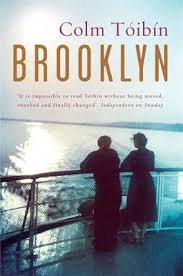
On Colm Tóibín’s website under ‘Essays” is a short story called “House for Sale.” It was written decades ago and attempts to recreate the atmosphere and situation of late 1967 when Tóibín’s father died and he and his brother were left alone in the house with his mother. Early in the story a nosy neighbour comes to visit and relates a story of two Irish men who meet in a hospital ward in Brooklyn. They discover not only that they are from Ireland, and not only from the same county, but from the same town. This obviously got Tóibín thinking about immigration and in particular the Irish kind of immigration: what is it you want by leaving and what is it that you leave behind? As a result of this digression another novel was born, Brooklyn (2010). This is the opening paragraph:
Eilis Lacey, sitting at the window of the upstairs living room in the house on Friary Street, noticed her sister walking briskly from work. She watched Rose crossing the street from sunlight into shade, carrying the new leather handbag that she had bought in Clery’s in Dublin in the sale. Rose was wearing a cream-coloured cardigan over her shoulders. Her golf clubs were in the hall; in a few minutes, Eilis knew, someone would call for her and her sister would not return until the summer evening had faded.
The language is simple – it is hard to imagine it being simpler – but contains a wealth of information. This is going to be a story about Eilis. Her sister works but she does not. Rose has her own money: she has taste and buys leather handbags in the sales in Dublin. She also plays golf, golf clubs are not cheap, and she is part of a crowd that Eilis is not; and the flit into the future makes it clear that this is a routine. Rose works but also parties, and parties late, eats and drinks at clubs, while Eilis does none of these things, she stays at home gazing at other people’s lives from a window.
By the way, the short story eventually became chapter one of his 2014 novel, Nora Webster.
What interests Tóibín is how the immigrant changes, not through any conscious decisions, but merely through contact with the strange and how that strange becomes normal by the immigrant adopting it as a matter of course; and this change is only evident if and when the immigrant goes back home. This is what happens to Eilis Lacey. She goes; she changes; she comes back; she is forced to choose. This provides a neat bi-line for the current movie adaptation of Tóibín’s novel: two loves, two countries, one heart.
Saoirse Ronan as Eilis Lacey in Brooklyn
The film, directed by John Crowley, with a screenplay by Nick Hornby, stars Saoirse (Ser sha) Ronan who you might remember as the 13 year old girl, Bryony, who gets it so so wrong in the film adaptation of Ian McEwen’s Atonement. Ronan, Hornby, and the film are all nominated for Oscars in this year’s awards announced on February 28th.
Having just read, and reviewed Marlon James’s A Brief History of Seven Killings (see previous blog February 6) I was curious to know why one award winning author left me unmoved (James) while another (Tóibín) had the opposite effect.
Tóibín places one character at the centre; his third person narrator describes her feelings, emotions, indecisions, prejudices, desires, faithfulness, and faithlessness in the simplest terms possible, even when the character herself is not aware, or does not understand them. He does this with no other character. Everything is seen through her eyes, her prism. It is as if the narrator is sitting close on her shoulder, spying on her thoughts, seeing everything from her point of view; it is the closest to a first person narrator as a third person narrator can get.
“When she returned she realised that Father Flood had heard about her job at Miss Kelly’s.” Tóibín could have left it up to the narrator to simply say ” Father Flood had heard about her job at Miss Kelly’s.” But he does not do this, we get the information through what Eilis does; how she sees it. His language is formal, no contractions, and straightforward which enhances his authority and leaves our emotions vulnerable and easily affected. However plot points are not obvious. We know all her misgivings, prevarications, fears and hopes; is she in love with Tony? She almost has to talk herself into it, but it is Tony’s reaction to her rehearsed confession that convinces her; but does she really?
“…and the next time if you tell me that you love me. I’ll …”
“You’ll what?”
“I’ll say I love you too.”
“Are you sure?”
“Yes.”
“Holy shit! Sorry for my language but I thought you were telling me that you didn’t want to see me again.”
She stood beside him looking at him. She was shaking.
“You don’t look as though you mean it.”
“I mean it.”
“Well, why aren’t you smiling?”
She hesitated and then smiled weakly.
“Can I go home now?”
“No. I want to jump up and down. Can I do that?”
“Quietly, ” she said and laughed.
He jumped into the air waving his hands.
All of Tóibín’s Irish characters come from his hometown, Enniscorthy, in Wexford, southeast Ireland. He knows these people but by putting them into unusual surroundings (Eilis in 1950’s New York: Katherine Proctor in Spain, The South; Richard Garay in Buenos Aires, The Story of the Night; Nora in widowhood, Nora Webster) he delights in seeing them falter, challenged, confronted, but ultimately surviving; getting through it all, if not unscathed.
Tóibín is not long on descriptions. In Nora Webster, no descriptions at all! However a sense of place and time is effectively created through fashion and behaviour of the day: the prices and availability of things, the New York Irish attitude to Jews and Norwegians; when coloured women are first served in department stores; the morality of dating, dancing, and music; and what your job, clothes, and choice of words say about you.
It is a romance, a tale of dislocation, of loyalty and belonging, and the meaning of ‘home’. It is also a bloody good read. You may guess the ending but you will not guess how it happens.
When a novel makes you laugh out loud it’s a great and wondrous thing.
Home, Ronan’s 6th novel from 2002, is a first-person narrative of a young boy, Coorg, born to an unwed teenager into the hippiest of hippy communes in 1963. These hippies throw the I Ching to decide if they should leave a rock concert early or not; they carefully remove a cabbage, roots, soil, and all, and carry it to a quiet place before chopping its head off so the other cabbages won’t get upset at the carnage; and their form of free love, wantonly and frequently exercised, is more about longevity than climax.
He spends his first six years with these people who care, stimulate and provide for him in a rural English paradise. They believe him to be the ‘messiah’ – also courtesy of the I Ching – or, as they call him, the ‘mage’. He is special and treated so. A boyish question about why a tree, next to a big rock, is dying will get an answer something like “The spirit of the rock and the spirit of the tree aren’t getting along at the moment.”
Then his grandparents suddenly show up and kidnap him (‘save him’) back to Ireland and plunge him headfirst into Catholicism, village politics, fish and chips, sausages, chocolate, and school with a new name: Joseph. The commune disbanded soon after this not because of the kidnapping of their ‘mage’ but because its self-styled mystic leader was caught eating a Snickers Bar in the High Street. Now for Joseph growing up in Ireland a boyish question would elicit an answer like “Stop asking such silly questions or the boogie man will cut your legs off and put you in his sack.”
He swaps one unreality for another.
“Is Baby Jesus Black?”
“Don’t ever talk about Our Lord like that.”
She raised her hand at me and I looked at it and realised what had caused the sting on the back of my legs when I vomited down the side of the car door.
“Baby Jesus couldn’t be black. He’s God.”
“Where is he now?”
“He’s on the altar. Behind the little curtain at the back there’s a gold door and he’s in there.”
“How do you know?”
“Because the lamp is lit.”
“Will he come out?”
“You have to wait for the priest to do everything, and the bell will ring and he’ll elevate the host, and if you’re good you can see God except if you’re good you’d be saying your prayers and not looking, and you have to make your Holy Communion first.”
“Is he a kind of wizard?”
“No. He’s God. He’s very, very holy.”
“Is that why you can’t see him?”
“Yes. And stop chewing that penny. A dirty black man might have touched it.”
Home is about belonging and it’s the first of a quartet although Ronan, on his website, warns us: “and the more you annoy me about it, the longer it will take to get on with the second”. He is obviously still being annoyed about it because nothing, novel wise, has appeared since 2002. However he is a keen gardener and talking about gardens and gardening will turn his usual laidback manner into one of wide-eyed enthusiasm. He also writes a monthly column in Gardening Illustrated and was a guest speaker at that magazine’s recent festival held in the Cotswold market town of Malmsbury last month; so gardening and writing about gardens, and not annoying readers, may be the reason the quartet is still only one book. His website (frankronan.com) seems equally unattended.
“I’m obsessed,” he says, “I can’t remember people’s names, but I can always remember plant names.”
For Ronan (born 1963) Ireland is ‘home’ but he lives in Worcestershire (“It’s the last bit of England worth living in”) where his partner commutes to London (“I hate London.”) but they spend weekends together.
His home town New Ross, not far from Colm Toibin’s home town of Enniscorthy, County Wexford, is where the young Coorg is taken and ‘rehabilitated’ and although the novelist swears he’s never stayed in a hippy commune there is enough evidence to suggest that the Irish growing-up of the young Joseph could be very much like the Irish growing-up of the young Frank; but then again there’s autobiography to some degree in every piece of writing.
Ronan’s humour, and there’s lots of it, doesn’t come from a child narrator’s misunderstandings and lopsided conclusions but from an adult narrator and so an adult’s sense of humour: “The pub turned out to be the manyplies of the village, where all the life missing from the street was being fermented into a state of contented excretability.”
Let’s hope that somewhere betwenn weeding, picking cabbages and writing about them he can find time for books 2, 3, and 4. I’ll read them.









 Michael K Freundt