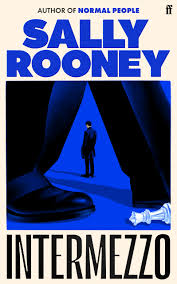
Intermezzo by Sally Rooney

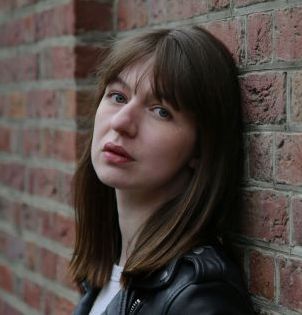
Irish writer Sally Rooney

A few hundred pages into the novel I was struck by the narrative format; actually Rooney employs two narrative formats.

This is the story of two brothers and their bumpy relationship following the death of their father.

Peter, 32 is a lawyer and Ivan, 22 is, well, nothing much but a wiz at chess but scraping a living from his checkered passion is not easy.

Peter has two girlfriends; Ivan has one. Peter seems happy but Ivan is happy. I feel sorry for Peter but I love Ivan. 


Sally Rooney is quite a literary phenomenon. Most of the action goes on in her character’s heads. She is a digger of truth about what goes on in the human mind which is often at odds with the way people behave. Especially men. So eager is she to explore our mental shenanigans, she sometimes overdoes it a bit. That’s a minor criticism.  

But back to the double narrative styles: for the chapters about Peter the narrative is almost stream-of-consciousness. Short sentences. Shorter phrases. Even just one word followed by a full stop. They all tumble over each other. It pretty much reflects Peter’s state of mind: full. His two girlfriends, his high pressured job, what to do about his under-achieving brother, and did he love his father. Enough? Ivan’s chapters are more conservative, the third person narrator is more conventional: long sentences, precise grammar, at a slower pace. This is Ivan. He’s a simple soul not much concerned with material matters but he knows love when he feels it. Although I’m not a fan of stream-of-consciousness narration it works here; it works for Peter. Another grammatical technique binds the narratives together. The dialogue, there’s a lot, isn’t punctuated. A modern trend. But it is easy to follow. When you listen to an audio book – another modern trend – the punctuation is not read yet it is always clear who says what to whom. 

I am almost to the end so I cannot tell you what happens. It’s a great read. I’m loving it. If you haven’t already give it a go.    

Prophet Song by Paul Lynch

Irish writer, Paul Lynch, winner of the 2023 Booker Prize.

In July 2023 I was house sitting for a family member and the first thing I noticed was there were no books in the house. Then one afternoon while searching for an iron I found, on the bottom shelf of the linen closet, a pile of five books, four Agatha Christie novels, and one novel by an unknown writer. What caught my attention was one of the endorsements on the front cover of this unknown title was by my all-time favourite novelist, the Irishman Colm Tóibín. Being a fan of, and I thought knowledgeable about, Irish literature I was embarrassed not to know the novel, Red Sky at Morning (2013) nor the author, Paul Lynch. I read several pages, at first wary of the poetic language but awed by the ease of understanding, the tension of, and immediate involvement in, the story. I planned to steal it, but didn’t, wished now I had, and will next time I’m in that house.

The plot is simple: a dystopian society on the edge of collapse and a deeply moving story of a mother’s fight to hold her family together. That’s on the back cover so I’m not spoiling it for you.

The language is sometimes poetic:

How the dark gathers without sound the cherry trees. It gathers the last of the leaves and the leaves do not resist the dark but accept the dark in whisper. Tired now, the day almost behind her, all that still that

And the size and design of the font is surprising clear and easy on the eye: it is very neat and black. Recently some publishers have been printing in grey, to save money I assume, which I find annoying.

But what most readers will be talking about is the punctuation, or lack of it. In this book, Lynch does not punctuate dialogue. This renders each page a justified, on left and right, slab of text. It can, on first glance, look daunting.

She lifts two mugs and peers inside them, squeaks her finger around the rim. Dad, look at these mugs, why don’t you use the dishwasher, you really need to wear your glasses when washing up. Simon does not lift his eyes from the newspaper. I’m wearing my glasses right now, he says. But you need to wear them while washing up, these mugs are ringed with tea. You can blame the useless cleaning lady

If you realise that you do not understand what you have just read, read the line again, read the paragraph again. Listen to your own reading voice. I had to do this initially. Just like turning to Dickens or Woolf, you need to get used to the different tone, the different syntax, and in this case, the different sentence structure. There’s a reason for this difference: Lynch’s fictional world is different; it’s falling apart. But, go with it. When you listen to an audio book the reader doesn’t ‘read’ the punctuation yet the listener understands perfectly who says what. Read like a listener and you will be rewarded.

Lynch burst onto the literary scene in triumph (more personal embarrassment – why didn’t I know?) when his first novel, that one I found next to the iron among the pile of Agatha Christies, was the prize of a six-publisher auction in London, and it won him acclaim abroad, especially in France where it was a finalist for France’s Best Foreign Book Award: Prix du Meilleur Livre Étranger. He’s written three novels since. Prophet Song is his fifth.

It’s a unique book and a remarkable feat of imagination worth getting stuck into.

Here is a succinct Q&A video by Paul Lynch, on the Booker short list, before the announcement of the prize winner.

You can buy the book here, in various formats.

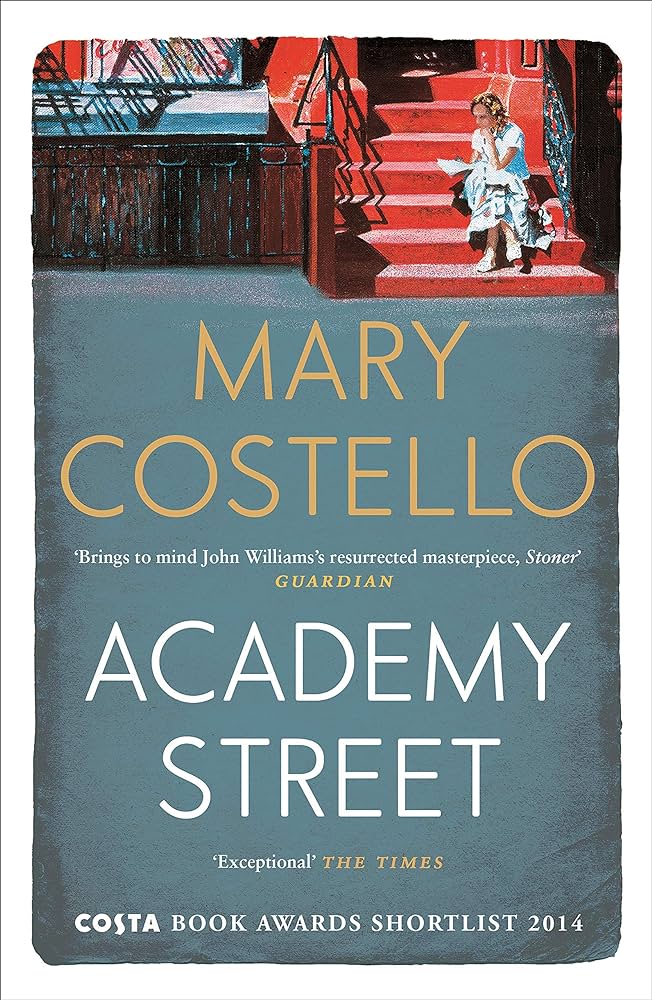
Academy Street by Mary Costello

Christmas Read 2

Irish writer Mary Costello

This writer, ‘one of literature’s finest new voices’ it says on the back cover, was new to me. I took it on my recent Christmas break. Previously a short story writer, this is her first novel.

This is a story of the life of Tess Lohan, from her mother’s funeral in Ireland through years of growing up, motherhood, work, and tragedy through to her old age in New York. It sounds like an epic but the book is slim, only 179 pages, but it is packed full of, not just events, but emotion. Costello’s experience of the short story has given her an economy of language.

It contains the usual tropes one expects from Irish fiction: hard religious fathers, stoic women, and the children who have to put up with surviving within their orbits. Tess moves to New York to start a new life – just like Colm Tóbín’s protagonist in Brooklyn (2009) – and eventually lives in an apartment on Academy Street. It is written in the usual third person but oscillates between the present and past tense to suit the writer’s intent.

The opening scene, her mother’s funeral, is imbued with little child expectations and ignorances. Her sisters corral her to join the family but she sees things from between people’s legs, from behind furniture, through windows and finds it easy to imagine that what is happening isn’t happening at all. Any moment her mother will come down the stairs in her new blue dress and Tess will sigh and realise she had it all wrong. It is someone else’s funeral; someone else is in the big shiny box with the gold handles. And Tess’s life will continue like before. We all know how easy it is to know something but not know something at the same time. She runs upstairs to find her mother but when she can’t she rummages through her mother’s wardrobe. And the new blue dress is not there either. There is a black cloth over her mother’s dressing mirror. So, yes, she knows where the new blue dress really is.

I won’t explain the events of the story because they are the story. It’s a life that could happen to anyone. Fate, mistakes, ignorance, love, and neglect are all familiar to all. It’s so hard to control a life, especially when it’s happening.

Costello’s writing is reminiscent of that other Irish short story writer, experiencing great acclaim at the moment, Claire Keegan, whose short stories, especially her latest ones, have been published as novels. Academy Street (2014) is definitely a novel but the tone and that of Keegan’s is similar. Apt descriptions and the understanding of the very things, sometimes small things, that are pertinent and important to a life. These writers know what a reader needs.

Yes, this is literary fiction but with a heart. Highly recommended.

Here you can buy the book in various formats.

And here is an interview with Mary Costello, winner of The Eason Novel of the Year 2014.

Water by John Boyne

Irish writer, John Boyne whose work has been translated into 59
languages making him the most translated Irish writer of all time.

This is a single linear story. Yes, there are minor characters but their stories are sufficiently sketched to need no more elaboration. There is just the narrative of a woman whose life, her old life, until now, has been destroyed. Her new life is yet unknown both in location and content. So she runs away. The reason? She doesn’t know. There are several possibilities to choose from but none of them stand out as more or less important. She hides on a small island in the Atlantic Ocean off the coast of western Ireland. She changes her name. She cuts off her hair.

It’s a short novel. A quick read. But an emotional one.

This is the second book where Boyne has chosen to use a female first person narrator: the first, All the Broken Places (2022). This narrator, Willow, her new name, takes residence in a small cottage near the sea. The locals, including a cat, are surprised by her, especially so since she seems not to have a husband, children, or a job. She is content to take long walks, watch the grey days, revel in what sunshine there is, and tries not to worry too much that there isn’t any Internet. Sometimes she walks into the village to get a sandwich and a bowl of soup at the New Pub. Sometimes she goes to the Old Pub. Sometimes she talks to people, sometimes they talk to her.

Slowly she can feel a possible life, sort of, returning to her. The horror, the truth, of her past is released in bits and asides. They pile upon each other like daubs on a canvas creating, and compiling, a past tangle of events that have you wondering how worse can it get. It does. The real story here is what happened to her; this, her running away, is her immediate response to those dreadful deeds. And here in this small isolated community she is forced to look at herself and wonder if she could’ve done something, anything, to avert the destruction. Is there guilt? And if so, there is blame.

Many writers, often-read and famous, have described the art of fiction writing as a force from without that could be from god, infers Jon Fosse; Colm Tóibín says its like opening a window and letting your imagination fly; Alexander McCall Smith describes it as allowing the subconscious to escape; Jennifer Egan – this unconscious generation process; writing begins with an idea for an opening and then the rest is done in a kind of trance, Paul Auster; D. H. Lawrence was up to page 145 and I’ve no notion what’s it about; and here’s another one from a more modern writer – it’s like watching a TV show in your head and you just write down what you hear and see. All of these descriptions suggest an amorphous idea, a swirling of fate and luck, of wandering and wondering without knowing what’s coming. That’s true to some degree but Boyne, in this new novel, the first of a quartet, seems far more controlled, he’s in command, and the simplicity of the narrative line gives the impression of meticulous plotting made to feel natural and easy.

The first person narrator frees the writer from worrying about what the other characters are thinking and feeling. The concentration is on the first person, the story-teller, who can only record what they see and hear: a concentrated world view experienced only through the eyes and ears of one person to lead you on. That’s why this novel is so short: a mere 166 pages. Surely, his shortest work. But, it’s a quarter of a much longer piece, that will, one day, I’m sure, be published in one volume: The Elements Quartet, maybe. Water, Earth, Air, and Fire. The second instalment, Earth, is due out in May 2024. Looking forward to that.

Highly recommended.

You can buy the hardcover or Kindle editions here.

The Queen of Dirt Island by Donal Ryan

Irish writer Donal Ryan

Donal Ryan’s 6th novel, The Queen of Dirt Island (2022) is a novel of very short chapters. All of them are short-titled and just shy of 2 pages. I would describe myself as a tough reader: it takes a lot to stir my emotions. Yet, chapter one at just one and three-quarter pages, moved me greatly. I read it four times. Of course, the emotion faded with familiarity but Ryan’s skill and control was always evident.

It’s like flicking through a family album picking up tit-bits that put the snaps into a semblance of order and understanding that becomes a narrative.

It’s the story of Saoirse (SER sha) Alyward raised by her mother, Eileen, and Nana, Mary, Eileen’s mother-in-law. Everyone speaks, adults and children, in a basic Irish rural lexicon with a heavy sprinkling of foul language at ease with the many Catholic idioms and easy blasphemy, illuminating the rural mind, more fearful of the weather than of god. They call themselves a family

…all sort of humming along in that comfortable dysfunction that seems to be the best any family can hope for…

but one that is treated with suspicion and contempt: there’s no man in the house. Saoirse had never felt afraid until at the age of fourteen years and nine months when an officious social worker asked her gossip-based leading questions about her mother’s integrity.

Her situation is slowly revealed: poverty, her mother’s privileged but outraged and aloof family, as well as her hardening personality to match the life that treacherous circumstances have chosen for her. It’s a story of husband-less and father-less women surviving in a land of patriarchal power but manage to create their own womanised niche while, at the same time, having to deal with feckless men blind to their own weaknesses.

Ryan describes writing as “burgeoning visions”. One of my gripes is that a few plot points, few ‘visions’, feel as if they’ve emanated from the writer’s universe and squeezed to fit into the story’s universe. For example, the sudden desire of Josh, Saoirse’s ill-matched boyfriend, to be a novelist and write Saoirse’s story,

…to make a record, he said … all of these things that happened, all of these dramas, all of these shades of declension between love and its absence, between living and dying, between love and hate…to sublimate all of this life into art…

the product of which she rejects and writes her own. It is, of course, a success. It’s a petty complaint and thankfully doesn’t distract from the excellence of the writing and the engaging characters and their story. But it could be seen as a metaphor for the resilience of women which makes it less of a complaint and more of a novelistic device.

Donal Ryan is one of many Irish writers that are part of what Sebastian Barry, the current Irish Laureate for Fiction, calls the ‘golden age’ of Irish writing. Writers like, Anne Enright, Colm Tóibín, Paul Murray, Elaine Feeney, Claire Keegan, Barry himself, all much loved and awarded, and Paul Lynch who on November 26th was announced as the winner of the 2023 Booker Prize for his 5th novel Prophet Song.

If you like Irish writing please, if you haven’t already, add Donal Ryan to your list.

Here you can read my blog about Ryan’s 4th novel from a low and quiet sea (2018)

You can hear Donal Ryan talking about The Queen of Dirt Island here.

You can buy the book is various formats here.


The Wren, The Wren by Anne Enright

Irish writer, Anne Enright, won the 2007 Booker Prize and the 2008 Irish Book of the Year for her third novel The Gathering.

Conversation is very different to writing. Conversation, saying what you mean, incorporates a lot of facial expressions, body language, shared history, and – most importantly – tone. Writing has none of that unless the writer uses more words to incorporate all that conversational stuff. Hence writing takes more words to get across everything conversation can do with less.

The first chapter of Anne Enright’s The Wren, The Wren (2023) is written conversationally without all that wordy conversational stuff. She creates this conversational tone not with words but with a lack of words and with a creative attitude to punctuation and line length. For the reader, this takes a little getting used to; don’t give up if you think you might. You just need to exercise more readerly skills and your wish to know will show you what you need to do. It doesn’t take long.

Does he love me
Is that him
Waiting for this man is better than being with him, it was certainly more intense, the way longing kept eating itself and giving birth to more longing. And nothing, but nothing was better than that first flash of arrival.
He loves me
There he is

This format has a subtle purpose: it prepares you for what this story is about: a poem. Or, more specifically, the shadow of its poet.

The first person narrator of the first chapter, NELL, is a young woman in thrall to the love of a man. See above. She’s young. Carmel is her mother and is the focus of the second chapter, CARMEL. She is older, of course, and so is the chapter’s format, more conventional, like Carmel who is the daughter of the poet Philip McDaragh, the writer of the poem, The Wren, The Wren.

Enright has a knack with language and uses her prose to characterise her creations. In her novel, The Green Road, one of her characters is a gay man living in Greenwich Village in New York. Her prose when dealing with him tells you far more about the character than what he says or does. Similarly here, Nell’s chapters, in their language and layout, reflect the character of Nell, modern, texting, informal, and peripatetic. Carmel’s chapters are more conventional, familiar, grounded, and mature.

Anne Enright is a writer of family. Her Booker Prize winning novel The Gathering (2007) is about a gathering of a family after a death in it. Her better book, The Green Road (2015) is about the gathering of a family after their prickly mother has decided to sell the farm. The Forgotten Waltz (2011) is a slight departure in that it’s about lust told through the eyes of ‘the other woman’, while Actress (2020) is about a mother-daughter relationship that also includes, fractiously, the mother’s career vs the mother role.

This is a novel without a narrative arc. That doesn’t mean there isn’t a story; there are many stories, particularly Nell’s and Carmel’s. Philip McDaragh left is wife and two young daughters, the youngest Carmel, and became a famous poet. The women, including Carmel’s daughter Nell – who never met her grandfather – would see him on television in a bar or YouTube clips on their phones and see a man strangely known to them but who now they must share with thousands of others and think how unfair that is. The shadow of Philip McGaragh follows these women all their lives and certainly colours Nell’s relationships with men.

Men (most) leave their families, even if they stay at home. Or am I, the reader, bringing my own meaning to this work? Readers can and should bring something to other people’s fiction. If my own father had lived long and past my 5th birthday I would be a very different person to the man I am now.

I loved this book not just because it is so different but because, even if the action is soft, the sentences, most of them, spark your interest simply because of the words she uses. I’ve searched and found many examples but showing them to you out of context doesn’t do them justice.

You’ll have to read it yourself to know what I mean.

It’s entertaining on many levels, a true work of art, a literary novel that you can easily enjoy again and again because there isn’t a plot to forget.

You can buy the book in various formats here.

Here you can watch the Waterstones Interview with Anne Enright about this new novel.

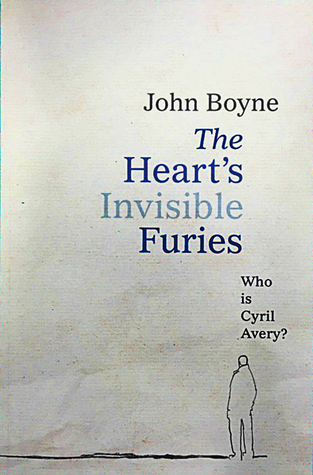
The Heart’s Invisible Furies by John Boyne

John Boyne pic
Irish writer, John Boyne.

Many years ago, on a small plane trip – the plane was small, not the trip –  as we were about to land in a provincial Queensland town, I continued to assiduously read my book. I was laughing so much, trying not to, but not succeeding, that my eyes were streaming, my nose running, and my face felt hot and red; the flight attendant broke the rules, unbuckled, and hurried to my seat to ask if I needed medical assistance. I just held up the book; I was unable to speak. She understood. Maybe she’d read it too. It was the hit of the season. The hysterical section was the Nativity Scene from A Prayer for Owen Meany by John Irving. The next time I laughed out loud, many decades later (yes, decades), was with this book, and the (highly illegal) Dinner Party Scene, from early on in The Heart’s Invisible Furies by John Boyne. Ironically Boyne has dedicated this book to Irving.

Making people laugh via the written word, and only the written word, is an extremely difficult and hazardous task. You can’t under play it or over sell it, and you certainly can’t ‘back-explain’ it; it’s all to do with tone, and tone is like a law of physics: it only happens when the universal conditions are absolutely right. It’s as if you need to foster a certain psychological state of mind, and write the episode with as much truthfulness and sincerity as you possibly can – don’t elaborate – just tell it, and if the tone is right, it will be hysterical. If it isn’t you can’t go back and make it right, edit it funny, you have to delete it all and start again. A plane will only fly if all the necessary preparations and current circumstances, weather, wind, mechanical health, operational skill, and power source, are perfect.

The dinner party – and it’s impossible to explain why it’s illegal, you’ll just have to read it to find out – is on page 92, but the preparation for it, and the other laugh-out-loud bits, preparation for the tone, I mean, in true Irving-esque fashion, begins right from the first killer sentence; and by the way, the opening sentence of Owen Meany has to be the killer-opening-sentence in all literature. There was a time when I knew it by heart and it became my dinner-party piece for some time after. I can’t sing, tell a joke, or play the piano, you see.

Boyne considers Irving a mentor, and Irving should be chest-thumpingly proud.

It’s impossible for Boyne to escape the moniker of “author of The Boy in the Striped Pyjamas” which he understands only too well, and he’s certain it will appear on his grave stone, so internationally popular was the book and film; but it changed his life making writing full time not only a possibility but a happy necessity.

Boyne was born in 1972. Ireland brought him up but the Church brought him down. He still suffers from its cruelty and hypocrisy. He’s not alone. His anger is present in this book but, much to his credit, he’s fashioned it into a cutting humour without lessening the truth of his understandable hatred.

The Heart’s Invisible Furies explains the life of Cyril Avery, although not a real Avery, from his pre-birth to two months before his death; from 1945 to 2015; and it is also the story of Ireland over that time; from a society dominated, straightjacketed, and suffocated by the Catholic Church, under the guise of strengthening morality, to one that legalises same-sex marriage. It’s a hell of a journey.

It’s full of surprising events, fashion, villains, extremely bad behaviour, political unrest, beauty, deception, selfishness, redemption, tears – yours as well as the character’s, death, forgiveness, love, birth in the midst of murder, politicians behaving badly, coincidences, literature, weddings, doctors behaving courageously, dreams – both fulfilled and dashed, sentiment, laughter, bigotry, violence, and even the ludicrous; in fact the entire palette that paints our lives that all conspires to prove that age-old adage, nobody’s perfect. And all these elements are wound around a cast of characters you won’t easily forget, and nor would you want to.

Boyne skillfuly uses many literary devices to tantalise and seduce his readers: he drops in an outcome before explaining how it happened; he triggers the reader’s memory before the character’s; and, best of the lot, dramatic irony: when the reader knows more that the characters do.

I love this book and I’ve recommended it to others, who too have loved it. I’m preparing a space on my bookshelf, between Jane Bowles and Peter Carey. You can get the book, in various formats, here.

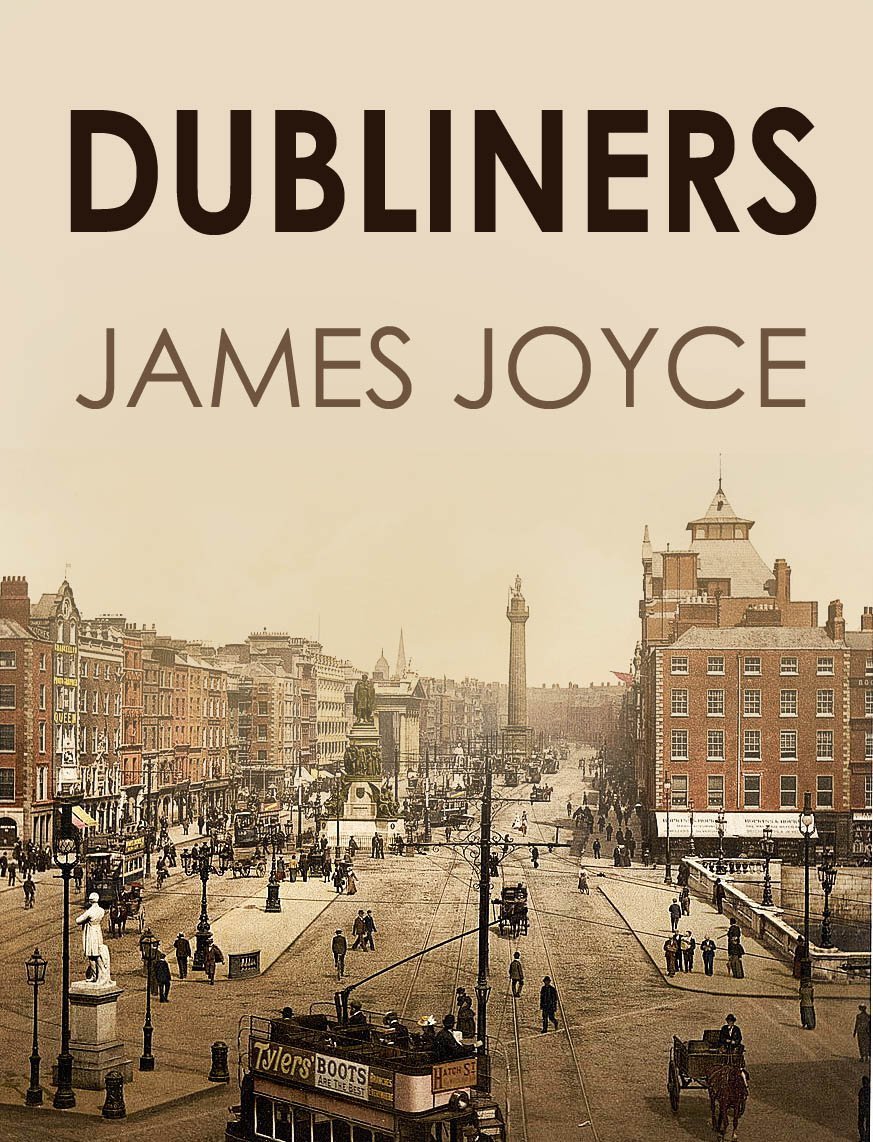
Dubliners by James Joyce

james-joyce pic Intelligent

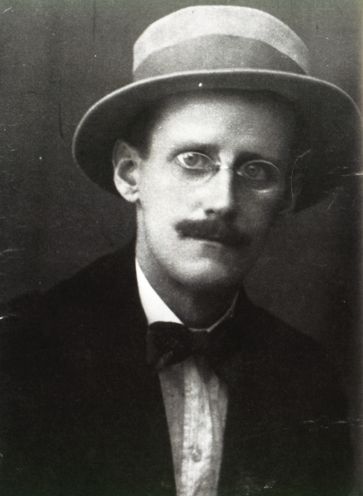
 Irish writer, James Joyce (1882-1941)

The first-person narrator, a boy, walks past the house of his dying priest night after night, wondering whether he is dead yet, but this night knows it to be true.

“Every night as I gazed up at the window I said softly to myself the word paralysis. It had always sounded strangely in my ears, like the word gnomon in the Euclid and the word simony in the Catechism.”

So begins the first story, The Sisters, in James Joyce’s collection Dubliners (1914) but in it is a clue to the theme of the book itself. Joyce wanted to write about the people of Dublin because to him it was the “city of paralysis” and the shadow of this word permeates the whole collection. For Joyce “paralysis” meant the inability to life meaningfully. Joyce spent most of his life on the continent, far away from Dublin, so strong was his belief that the city was tainted.

Here the “paralysis” is both literal, in the case of a dying priest after his third stroke, and moral: “simony” takes aim at the Catholic church’s corrupting stranglehold on Irish society; “gnomon” is somewhat different, being more about form than content (a gnomon is a parallelogram with a section removed, as well as the shadow-casting part of a sundial). The word is a cryptic warning to the reader that these stories contain many absences, not least traditional plot, character and scene-setting. These absences are part of what Joyce referred to as the style of “scrupulous meanness” with which he wrote Dubliners, meaning the frugality he applies to language, image and emotion.

Freytag’s pyramid, or dramatic arc or structure, suggests that a clear beginning consisting of a proper introduction of the setting and the characters, a middle discussing the conflict that would lead to a climax, and an end that ties the story together with a denouement are indispensable to any written work of fiction.

So was the literary thinking in 1914 – and in some circles it still is today. Joyce ignored it all, which may be why it took him 6 years to get this collection published.

In the story A Little Cloud, a shy and fragile clerk, known as Little Chandler, since “he gave one the idea of being a small man” meets in a bar, after 8 years, his friend Ignatius Gallaher, who once “known under a shabby and necessitous guise had become a brilliant figure on the London Press.” Little Chandler yearns of becoming a famous writer and dreams about the rave notices he would get for his work. He is delighted to see his old friend and Gallaher shouts him several whiskeys and regales the little man with innuendo and suggestions of his racy experiences in London and Paris: no married life for him. Of course, Little Chandler is late getting home to his young wife and child and had not brought the tea and sugar she had urged him not to forget. “She was in a bad humour and gave him short answers” and decides to go out and get the tea and sugar herself. “She put the sleeping child deftly in his arms and said: ‘Here. Don’t waken him’.” Little Gallaher cradles the child and stares at a photograph of his wife wearing an expensive blouse he had bought her. The image of his wife weaves no comparison to the “rich Jewesses” with “dark Oriental eyes” of Gallaher’s salacious plans and stories. Little Chandler feels nothing but entrapment, paralysis, in his mean little cottage with debt-laden furniture and no way of writing the book that “might open the way for him.” He reads some melancholy verse by Byron while nursing the child and wonders where he can find the time to write like that; he has so much to say. The baby wakes and cries and will not stop no matter how hard he tries to sooth him. Everything is useless. He is “a prisoner of life!” He loses his temper with the child and shouts at him which scares the infant and causes him to scream and “sob piteously”. His wife arrives and rescues the babe and glares at her useless husband and he listens to the child’s sobbing grow less and less in the arms of his loving mother. The story ends with Little Chandler just standing there as “tears of remorse started to his eyes.”

The reader is left with a feeling of pity and yearning for this little man who did the right thing, that every man should do, marry, start a family, and work to keep and protect them; while his friend did the other thing: travelled, wrote and became famous and whored around in London and Paris. This is the ending that Freytag’s pyramid espouses but it is a thought, not on the page but in the mind of the reader.

This was radical for 1914, when this collection first appeared. However, is it true today that more and more writers of fiction are leaving aspects of descriptive, consequential, and circumstantial narrative out of the text and up to the reader.  This is so true that it is not the writer’s place any more to answer the question, “And what did you mean by writing that?” After a story is in print – or, for that matter any creative work that is finally in the public domain – the meaning of what the reader reads is all to do with the reader – it means what the reader thinks it means – and has nothing to do any more with the writer and what was meant by the writer in the first place.

Although Dubliners is considered one of the greatest short story collections ever written, it is Anton Chekhov, the Russian playwright, who is generally considered the father of the modern short story. “The revolution that Chekhov set in train – and which reverberates still today – was not to abandon plot” – or Freyberg’s Pyramid – “but to make the plot of his stories like the plot of our lives: random, mysterious, run-of-the-mill, abrupt, chaotic, fiercely cruel, meaningless”. Chekhov’s short stories had been available in English since 1903, but Joyce didn’t get Dubliners published until 1914. He claims not to have read them. Many critics think this a little implausible since Dubliners seems to owe a lot to the work of the Russian. However, Joyce finished the collection by 1907, and with Chekhov’s work having been available in English only for a few years when Joyce was working as a teacher in Europe, it is entirely possible that he did not read it. Although William Boyd, American novelist and short story writer asserts that Chekhov liberated Joyce’s imagination as much as Joyce liberated writers that followed and “that the Chekhovian point of view is to look at life in all its banality and all its tragic comedy and refuse to make a judgment”. The Joycean view seems to look at life from the inside of his characters: to chart his country’s “moral history” in Dublin; and he does this by turning the plot inwards. It’s the landscape of dreams, desires, hopes and disappointments that bind the 15 stories together into a whole, which in itself is unique, creating a form of a novel in fifteen disparate but morally interconnected chapters: the early stories are from childhood, the centre charts the middle years, and the final devastating story, The Dead, his masterpiece, culminates in a mature realisation of man’s insignificance in the universe. In fact, the first image of the first story: a boy looking up at a window behind which lies a dead man, is reflected in the last image of the last story where a man looks out of a window contemplating all the dead that have gone before him and which one day he will join. Images like bookends.

Joyce’s narrator varies from story to story: first person in the first, but usually in the third-person but not of the omniscient kind:

“…as he set himself to fan the fire again, his crouching shadow ascended the opposite wall and his face slowly reemerged into the light. It was an old man’s face, very bony and hairy.” (Ivy Day in the Committee Room). The narrator doesn’t know the face until it is seen as everyone else sees it, including the reader. It’s like the narrator and the reader see and know everything at the same time; as if you and he are watching the scene together.

It is the final story, The Dead, that marks Joyce a masterful writer and it is easy to argue that it is the best short story ever written. It is the quintessential modern story although it’s structure is almost classic. It opens with a scene featuring minor players in the story; a device used by Shakespeare in the opening scenes of many of his plays: it’s a way to introduce the scene and action before the principle players emerge, creating setting, background, and expectation. The bulk of the story is the colouring of the situation: the interconnecting relationships, the characters, the party as life’s metaphor, building tension and expectation, preparing the reader for what will happen.

Lily the house maid is “run off her feet” tending to guests as they arrive for the annual dance party given by the aging Misses Morkan, Kate and Julia, and their niece Mary-Jane, a music teacher to some of the “better-class families on the Kingstown and Dalkey line.” All eyes and ears are attuned to the arrival of Gabriel Conroy, the old ladies’ nephew, and his wife, Gretta, but they are also worried that the local drunk, the course-featured Freddie Mullins, might make a too-soon appearance and spoil the party. All arrive as expected and the party is in full swing; shoes shuffle and skirts swish and sway to the dance music on the polished floor of the upstairs parlor under the chandelier and a piano recital is given by Mary-Jane and songs are sung by the talented tenor, Mr Bartell D’Arcy. The strata of Dublin society are represented: the proud and successful Gabriel and his unhappy wife, Gretta; the Morkans drenched in their good-natured, middle-class hospitality cocooned in their well-established morality; and the likes of Freddie Mullins who prizes a drink over employment, filial duty, and nationalistic pride.

And then there are the galoshes. Gabriel wears them and urges his wife to, but she refuses. They are a symbol of modernity, recently arrived from London and “Gabriel says everyone wears them on the continent”. They are a sign of progress but, of course, the locals don’t wear them, much to Gabriel’s disappointment, thinking that he may have been able to bring the modern world into the lives of his community and family; Aunt Julia isn’t even sure what they are; Gretta thinks they’re funny and “says the word reminds her of the Christy Minstrels”. The social boundaries are clearly drawn.

On the dance floor, Gabriel, preoccupied with his forthcoming speech and worrying that his planed quotes from Browning “would be above the heads of his listeners”, is half-jokingly harassed by his dance partner, Miss Ivors, who “has a crow to pluck” with him. She chastises him for writing book-reviews for an English newspaper; refusing to holiday in his “own land” among his “own people” and to speak his “own language” and therefore labels him a ‘West Briton”.

Gabriel is a dignified man. He is angered by Miss Ivor’s assertions regardless of her light-hearted tone; considers Dublin, like Joyce, a back-water of pseudo-happy and ignorant people; looks to England and Europe for artistic, fruitful, and intellectual sustenance; but, despite all this,  tonight he is excited by the idea of Gretta and he spending the night, without the children, in a local hotel. Their marriage has soured over the past few years into something that he sees as all too common in this society. He is hoping for, maybe even lustful, but at least an intimate night alone with his wife.

After all the singing, dancing, and a minor ruffle between the Catholics and “the other persuasion”, the goose is carved at the head of a fine, happy, and plentiful supper table. Gabriel’s speech is a great success.  The champagne flows freely. The annual party is drawing to a close and Gabriel while putting on his coat asks after his wife. He finds her standing high on the landing in the semi-darkness gazing at nothing in particular but seemingly listening to something. There is a plaintive singing voice “in the old Irish tonality” and distant chords on a piano that seemed to render his wife transfixed. This is the peak of the drama. What is happening to Gretta, what is going on in her mind, will bring down the story’s protagonist. But Joyce stretches the tension. There is the walk with others into the city, then to the hotel, then to their room, and their preparation for the night. Here, he, all expectant and eager, is willed finally to ask why she is so melancholy. Her reply, his reaction, and the devastating realisation because of it, ends the story.

What begins as a classically structured tale of Dublin life, full of Chekhovian realism bolstered by detail, humour, character, emotional connections, and social hierarchy, the epitome of life itself, ends as a modern fable, not based on action, but internal thought. And like all good writers, Joyce ends with an image: a disappointed and humbled man gazing through a window on to a darkened city as snow gently begins to fall all over Ireland.

“His soul swooned slowly as he heard the snow falling faintly through the universe and faintly falling, like the descent of their last end, upon all the living and the dead.”

-oOo-

The works of James Joyce, Dubliners, Portrait of the Artist as a Young Man, Ulysses, and Finnegan’s Wake, are out of copyright and can be downloaded, via various formats, for free here.

hOme by Frank Ronan

Irish writer, Frank Ronan

When a novel makes you laugh out loud it’s a great and wondrous thing.

Home, Ronan’s 6th novel from 2002, is a first-person narrative of a young boy, Coorg, born to an unwed teenager into the hippiest of hippy communes in 1963. These hippies throw the I Ching to decide if they should leave a rock concert early or not; they carefully remove a cabbage, roots, soil, and all, and carry it to a quiet place before chopping its head off so the other cabbages won’t get upset at the carnage; and their form of free love, wantonly and frequently exercised, is more about longevity than climax.

He spends his first six years with these people who care, stimulate and provide for him in a rural English paradise. They believe him to be the ‘messiah’ – also courtesy of the I Ching – or, as they call him, the ‘mage’. He is special and treated so. A boyish question about why a tree, next to a big rock, is dying will get an answer something like “The spirit of the rock and the spirit of the tree aren’t getting along at the moment.”

Then his grandparents suddenly show up and kidnap him (‘save him’) back to Ireland and plunge him headfirst into Catholicism, village politics, fish and chips, sausages, chocolate, and school with a new name: Joseph. The commune disbanded soon after this not because of the kidnapping of their ‘mage’ but because its self-styled mystic leader was caught eating a Snickers Bar in the High Street. Now for Joseph growing up in Ireland a boyish question would elicit an answer like “Stop asking such silly questions or the boogie man will cut your legs off and put you in his sack.”

He swaps one unreality for another.

“Is Baby Jesus Black?”
“Don’t ever talk about Our Lord like that.”
She raised her hand at me and I looked at it and realised what had caused the sting on the back of my legs when I vomited down the side of the car door.
“Baby Jesus couldn’t be black. He’s God.”
“Where is he now?”
“He’s on the altar. Behind the little curtain at the back there’s a gold door and he’s in there.”
“How do you know?”
“Because the lamp is lit.”
“Will he come out?”
“You have to wait for the priest to do everything, and the bell will ring and he’ll elevate the host, and if you’re good you can see God except if you’re good you’d be saying your prayers and not looking, and you have to make your Holy Communion first.”
“Is he a kind of wizard?”
“No. He’s God. He’s very, very holy.”
“Is that why you can’t see him?”
“Yes. And stop chewing that penny. A dirty black man might have touched it.”

Home is about belonging and it’s the first of a quartet although Ronan, on his website, warns us: “and the more you annoy me about it, the longer it will take to get on with the second”. He is obviously still being annoyed about it because nothing, novel wise, has appeared since 2002. However he is a keen gardener and talking about gardens and gardening will turn his usual laidback manner into one of wide-eyed enthusiasm. He also writes a monthly column in Gardening Illustrated and was a guest speaker at that magazine’s recent festival held in the Cotswold market town of Malmsbury last month; so gardening and writing about gardens, and not annoying readers, may be the reason the quartet is still only one book. His website (frankronan.com) seems equally unattended.

“I’m obsessed,” he says, “I can’t remember people’s names, but I can always remember plant names.”

For Ronan (born 1963) Ireland is ‘home’ but he lives in Worcestershire (“It’s the last bit of England worth living in”) where his partner commutes to London (“I hate London.”) but they spend weekends together.

His home town New Ross, not far from Colm Toibin’s home town of Enniscorthy, County Wexford, is where the young Coorg is taken and ‘rehabilitated’ and although the novelist swears he’s never stayed in a hippy commune there is enough evidence to suggest that the Irish growing-up of the young Joseph could be very much like the Irish growing-up of the young Frank; but then again there’s autobiography to some degree in every piece of writing.

Ronan’s humour, and there’s lots of it, doesn’t come from a child narrator’s misunderstandings and lopsided conclusions but from an adult narrator and so an adult’s sense of humour: “The pub turned out to be the manyplies of the village, where all the life missing from the street was being fermented into a state of contented excretability.”

Let’s hope that somewhere betwenn weeding, picking cabbages and writing about them he can find time for  books 2, 3, and 4. I’ll read them.

My Dream of You by Nuala O’Faolain (noola o fway lorn)

Nuala O'Faolain
Nuala O’Faolain

I loved this book!

After the international success of O’Faolain’s memoir Are You Somebody? this novel, her first, was published in 2001 and in a brief Afterward she acknowledges “splendid energetic advice” from fellow Irish writer Colm Toibin who recently opined that

“… in autobiographical writing your [the writer’s] job is to create illusion, to work with rhythm and image and detail to make the reader feel that whatever is on the page matters and must have happened.”

I would venture to say that this also applies to writing in the first person, memoir or fiction, since the first person point of view is meant to make the reader believe the protagonist is also the writer. I recently complained that in The Cast Iron Shore, Linda Grant’s debut novel, that I reviewed on this blog recently (posted January 27), Grant failed her first person POV responsibilities by inadvertantly creating a disconnect between the protagonist and the writer: they seemed like two different people.

O’Faolain does not make the same mistake. Although a novel (fiction), My Dream of You reads like a memoir, feels like a memoir; so skilfully does O’Faolain make you believe, using “rhythm and image and detail” that her story actually happened to her. Having read her first memoir there is a lot of O’Faolain’s past in Kathleen’s but autobiography and fiction are interwoven seemlessly. How do I know this? I cared about her.

Kathleen de Burca is an Irish travel writer fast approaching fifty, and with a waist to match, who travels the world, usually with her best friend, an gay American man called Jimmy, writing travel copy for her boss, and also close friend, Alex. These two men, and staff in the office in London, serve as her family, since she has all but abandoned hers, and her country, many years before. Then there is her boyfriend, Hugo, a law student, who interests her in a divorce case from the annals of Irish history: the young wife of an English aristocrat, on a forlorn Irish estate in the middle of nowhere, is accused of infidelity with her husband’s Irish groom, a very common man. In those days, the 1850’s, a divorce needed an act of parliament so the event is well documented although from a very English point of view. The wife is chastised, forsaken, deprived of her young daughter, and locked up in an asylum where she inevitably goes mad.

Kathleen is intrigued and fascinated by this tragedy and when Jimmy, her moral compass, suddenly dies she takes leave of her job (Hugo, the boyfriend, she betrayed and lost) and travels to Ireland to, maybe, write a book about this young wife and her passion for a comman man.

The book has three narrative arcs: Kathleen’s journey to Ireland, her adventures, and the brief reunion with her siblings and their families; her memories of her arrogant, distant, and emotionally violent father, her deeply unhappy and useless mother, and her friends and lovers; and the story from the 1850s of Marianne and her affair with the lowly William Mullen. Yes, there is a book within the book.

She thinks she is going to Ireland to research a story about someone else’s passion but what she actually does is confront passion in her own life and what she discovers is not what she expected.

The writing of the Marianne’s story (in the third person) begins confidently and the affair with Mullen is handled expertly: O’Faolain makes the reader understand how intense physical attraction can operate outside the realms of reason; but Kathleen discovers another document that proports to prove that … well, I don’t want to spoil it for you. There is here the flavour of a mystery to be solved.

O’Faolain’s literary skills are put to good use as she weaves the first and third narratives into a shared ending which also ends the book itself. Very satisfying.

My Dream of You is about love, sex, family, and aging, and it contains one of the best descriptions I have ever read of female friendship – how it works – and how emotional love with a woman can be far more rewarding and long-lasting than sexual love with a man. Mind you, Kathleen has a lot of experience with sexual love with men and she understands, and shows, that passion is far more complex and evolutionary than romantic books make out; and she comes to realize that her relationship with her body is also a part of the ‘passion’ equation and far from what she would like it to be, or thought it was. She is, or was, a beautiful woman and there are magic passages where a beautiful woman talks about being beautiful, without pride or sentiment, and when she believed it and when she didn’t. This is unusual stuff.

Nuala O’Faolain was engaged once but never married, had a fifteen year relationship with the Irish journalist, Nell McCarthy, but spent her latter years with a New York lawyer, John Low-Beer. She was diagnosed with metastatic cancer in 2008. Hugo Hamilton, whose memoir The Speckled People I recently reviewed on this blog (posted February 10), was a friend of O’Faolain’s and his 2014 novel Every Single Minute is a fictionalised retelling of a trip he took with the very ill O’Faolain to Berlin just before she died (May 9 2008).

She wrote two volumes of memoir Are You Somebody: The Accidental Memoir of a Dublin Woman (1996), and Almost There: The Onward Journey of a Dublin Woman (2003); another novel published posthumously in 2009 Best Love, Rosie; and a ‘history with commentary’ The Story of Chicago May (2005). Chicago May was the nickname of Mary Ann Duignan, an Irish criminal, who became famous in America, France and Britain in the beginning of the twentieth century.