I'm an Australian writer living in Bali. I recently took the plunge to self-publish, and to blog which was liberating, to say the least. Writing has never been so immediate and so rewarding.
The stories have been written over the last 25 years; the latest, A Marriage of Convenience, was written last month. Inspiration comes from some unlikely sources: a bus ride from Balmain, a conversation in a foyer, something a friend said, and among others, an opening paragraph from a magazine article which I read again and again, after returning from my laptop where I recorded the thought, but darned if I could find what it was among those few printed words that sparked the thought in the first place. Apparently the history of my sparking synapses leaves no footprint; or is that just another sign of my age?
I have not included every story from my collection; a few now seemed trite, uneven, and dull so I left them where they are.
And friends, if you think that I have used you for literary purposes you’re right and if you object, then let’s talk about it.
More often than not, the stories are of the What If? kind. Nothing more needs to be said because I will always steer away from expaining to an inquisative reader what I meant by a story, a line, or an idea for two reasons: usually I don’t remember what I meant in the first place, my synapses being what they are, but more importantly I believe that what the reader thinks it means is what it means.
Sometimes stories tumble out like washing from a dryer; at other times they are few and very far between. I’m in the middle of one now which augers well for volume 2.
I hope you enjoy volume 1 and if you do, and even if you don’t, tell me about it.
In 1993 Joanne Woodward was the narrator in Sorcese’s film of Edit Wharton’s The Age of Innocence. Her voice was measured and melifuous, full of American cadences of the time; a formal English suggesting refinement, wisdom, and good behaviour.
I was just over two pages into Go Set a Watchman, Harper Lee’s new/old novel (and if you’re a reader and haven’t heard of it you’ve probably been living on Mars), when I realised the voice in my head I was reading with was that of Woodward’s with the same measurement and melifuousness perfect for phrases like “a family example not Iikely to be discountenanced” and “Love whom you will but marry your own kind was a dictum amounting to instinct within her.”
The mood of life in Maycomb is set by annacdotes of the people in it. Tales of loyalty, family pride, and self reliance pepper the opening pages so by the time I met the aged Atticus Finch I was already steeped in small-town life and flavour. I expected, hoped for, a slow reveal of Atticus Finch but Go Set a Watchman was written before To Kill a Mockingbird and how could the author know what an indelable image her creation would leave on the minds of her readers; not to forget the looks and fatherly masculinity of Gregory Peck, from the 1962 film, that couloured it. Over a million copies have been sold in July: the month of it’s release, on the 14th. It’s been ringing tills all over the world and some critics have sharpened their knives and honed their sarcasm to firmly put it back in the bottom drawer.
It certainly isn’t as good as To Kill a Mockingbird but then no-one really thought it would be as part of the marketing campaign was to explain that the original publisher remarked to a young Harper Lee that the most interesting parts of the book were the flashbacks to Scout’s early years and being a novice, Lee took his advice and went back to her desk and, as we know, wrote Mockingbird, which has become a modern classic loved the world over. What is interesting in this book is its role as the precursor to that iconic text. You feel a sense of privilege to discover the germs of scenes that grew into those we know so well: the courtroom scene, for instance, that forms the climax of Mockingbird is a simple reminiscence Jean Louise (Scout) has when she visits the same courthouse.
However what is a surprise is that her father, Atticus Finch, is not the same man as the Mockingbird hero. In Go Set a Watchman ( from Isaiah: 21, 6) Atticus is a respected member of the Maycomb community but his attitude to race relations is totally different to those of the younger Atticus who Lee portrayed as a hero of tolerance and rational thinking; here he tries to justify racist attitudes as necessary to deal with, and live peacefully within, his chosen home. These ideas confound and horrify Scout, and us. However the climax, the confrontation between father and daughter, is very shallow and under-written with an outcome that has more to do with blood than sincere argument; the threat is weak and the ending is therefore disappointing.
It is remarkable to realise that not only was race still a devisive issue 20 years after the story of Mockingbird but today, in 2015, it is still an open wound on the face of American society: still as raw as a fresh cigarette burn.
As the mature woman Scout realises that her upbringing rendered her colour blind; but how can that be now that the model of her raising has turned against her? or was he always like he is now? If she is to stay in this world she needs a guide, a Watchman, to lead her through this place where she doubts she belongs or understands.
The writing is not as sharp and reliable as in Mockingbird but there are flashes of brilliance that set up images that stay with you; and most of them to do with the flashes back to Scout’s teenage years and before. The third person narrative is of the ‘close writing’ kind that sometimes gets so close to Scout that it often slips into the first person, a device that effectively creates the feeling of personal truth. Go Set a Watchman as a companion piece to To Kill a Mockingbird is its strongest attribute; it may be thin and embryonic but to those who value artistic endeavour and its evolution it’s a valuable text.
Canadian writer, Alice Munro, Nobel Laureate for Literature, 2013.
How’s this for a scenario; an artistic projectory: shy student marries as soon as she graduates, scared that she is old-maid material; wants to write novels but has children instead; still wants to write novels but time is limited so writes short stories while the babies are napping; when they reach school age has more time to write but has to stop writing mid-afternoon to do housewife and mother duties before family gets home; keeps writing short stories until she’s 82; wins Nobel Prize for Literature.
When told of her win, “It just seems impossible,” she said.
She is the 13th woman to win the Literature Prize and the second Canadian (after Saul Bellow), and therefore the first Canadian woman.
She writes about the internal drama of relationships usually from the female point of view; about simple country people, but also academics. She is often called ‘the modern Chekhov’ which is not entirely true: Chekhov is more interested in behaviour, Munro in the thoughts behind behaviour.
This collection, The Moons of Jupiter, came out in 1982. It contains eleven stories. One of them, Barton Bus, written in the first person describes a brief love affair in Australia but all the other scenes, like scenes from a bus window that pass you by, describe what it might be like if she, the narrator, bumps into the once brief lover. What will she say? What will she do? She doesn’t use his name only a letter;
“I call him X, as if he were a character in an old fashioned novel, that pretends to be true. X is a letter in his name, but I chose it also because it seems to suit him. The letter X seems to me expansive and secretive.”
In the brief final scene a female friend, Kay, describes to the narrator a man who is a friend of her husband’s and after dinner he sighed and laid his head in Kay’s lap. She thought it was a ‘nice simple’ thing to do. She mentions his name. I gasped! It was him! and the narrator does not say a word.
I’ve probably spoiled this story for you but when you read it, it will undoubtedly mean something different to you as meaning is always in the mind of the reader.
In Visitors a couple welcome the husband’s brother, his wife, and her sister to stay in their house which is so small that no room can accommodate them all at once. If the fifth person enters someone has to stand in the doorway. Sleeping arrangements are a bit like camping. They go for a drive – they can all fit in the car … just. They talk, they drive, they look for the site of the birth-house of one of them. It’s no longer there, but they imagine it. The talk is simple, personal, clichéd like small-talk. The three visitors finally go back home, a very long way away. The couple are back in their own small bed and Mildred realises Wilfred is crying: he will never see his brother again. They could visit. Will they? Probably not but she says ‘maybe’ and he says ‘not next week’.
I was left with a feeling of regret, mixed with helplessness wound around with sorrow leaving these two people in their cramped space forced to cling to each other as some sort of protection from the miseries of the world.
“When I write about something happening in this setting, I don’t think that I’m choosing to be confined. Quite the opposite. I don’t think I’m writing just about this life. I hope to be writing about and through it.”
All her stories are set in the country to the east of Lake Huron, Canada because she loves it; she understands the people, she likes its climate, its falling down barns, its “occasional farms that have swimming pools and airplanes.” She speaks the language.
Alice Munro, who doesn’t write any more (there are many published collections), reads and sometimes she doesn’t start to read a story from the beginning. She starts anywhere and reads forward a bit and sometimes goes back a bit. To her a story
“is not like a road to follow, it’s more like a house. You go inside and stay there for a while, wandering back and forth and settling where you like and discovering how the rooms and corridors relate to each other, how the world outside is altered by being viewed from these windows … and you can go back again and again, and the house, the story, always contains more than you saw last time.”
Having a volume of Alice Munro short stories by your bed is comforting as well as enlightening and entertaining no matter how many times you read one.
The Scottich writer Andrew O’Hagan“There’s an art to telling the truth.”
My first instinct was to say that The Illuminations, O’Hagan’s latest novel, is about the past; but then every novel is about the past, even one written in the present since the actual present is only on the page you’re on. It is more accurate to say that The Illuminations is about the little lies of the past that make the present bearable.
The two main characters are Anne, a grandmother sinking slowly into dementia, but once a well known pioneeing documentary photographer with an inner artistic life that her family only vaguely acknowledges, and her grandson Luke, a Captain with the Royal Western Fusiliers fighting the dirty war in Afghanistan. He witnesses a horror that he could’ve prevented if it were not for his weak, and tormented commander. On his return to Britain he takes Anne on a trip to Blackpool to see the famous light show at the end of summer, the Illuminations, hoping she will remember more about the romance she had there with Luke’s grandfather, the photographs she took, and the reason that his family is like it is. He craves enlightenment to make sense of the past which he can only vaguely see: the facts that don’t add up; the questions unanswered.
I first discovered O’Hagan via his 2006 novel Be Near Me which turns on a moral mistake of the protagonist, a Catholic priest, Father Anderton. When he is finally brought to account for his ‘sin’ by his religious superiors, the answer to the question he is asked only explains half the sin; and he is faced with a truely moral dilemma: should he simply answer the question knowing that the answer will satisfy his superiors and that will be the end of it, or should he, given the vows to his God, confess to ‘all’ the sin, and therefore end his vocation? The ‘action’ of the book is in the mind of Father Anderton, small compared to most novelistic plots, but I remember the feeling of the monumental challenge the man is asked to face; this is a ‘big’ story, or O’Hagan made it seem so.
The Illuminations isn’t quite as successful although the awkward scenes of a family get-together where the past and the present, old ideas and new, clash and bump are handled with insight and cringing recognition. O’Hagan is a master of the minutiae of the undercurrents and whirlpools that swirl beneath a family’s, and any personal, exterior. He also successfully describes that ellusive but sometimes debilitating feeling parents have of loving the family to visit but joyous when they leave.
O’Hagan is a well respected writer and his early novel, Our Fathers (1999) won the Winifred Holtby Memorial Prize and it was shortlisted for the International IMPAC Dublin Literary Award (2001) as well as the Man-Booker Prize for Fiction (1999).
However his most intriguing work is a lengthy article in the London Review of Books, Ghosting Julian Assange in March 2014 which tells the fascinating story of the time he spent shadowing the Wikileaks founder with the contracted intention of ghosting an ‘autobiography’ of the man. I should explain that the book, not yet written, had already been bought by Canongate for £600,000 and sold-on to a range of big publishing houses including Knopf of New York. The book never happened but a lot of legal battles did; the article explains why, and at the same time gives a detailed picture of Assange, his behaviour: paranoid and, to some degree, his motivation: selfish. You can find the article at http://www.lrb.co.uk/v36/n05/andrew-ohagan/ghosting which also includes an audio file of O’Hagan speaking about Assange.
He is also a playwright and his latest work for the stage is a doco/drama, Enquirer, staged by the National Theatre of Scotland in 2012 that deals with the machinations of the British press.
O’Hagan is a wonderful writer and there is a lot to enjoy in The Illuminations. I recommend it and Be Near Me as well.
Veronica, again, combines business with sex. She finds lovers but she also finds enemies, but in the most unlikely places. She embarks on a new career in hospitality although her previous career as a sex consultant proves hard to close down. However her biggest challenge erupts over her choices as a lover and as a friend. These combine to be life threatening but Veronica is a remarkable woman.
You can find this new Veronica story, Veronica Spreads it Around, on smashwords.com. Make sure to un-block ‘Adult Content’ otherwise you won’t find it. Simply type in the title into the ‘search’ box. I hope you enjoy it, and I’d love you to write me a review on the smashords site. Cheers!
I found this book compelling. I altered my daily routine to make more reading time, to find out what would happen; and I appreciated the small editing trick that put the climactic event on the top of a new page: I turned the page and gasped. I knew something was coming, but not that!
I discovered the South African writer, Damon Galgut, via his latest novel, Arctic Summer, which was a fictional re-creation of the latter writing life of E. M. Forster in his attempt to come to terms with the writing of his most famous and last novel, A Passage to India, and his own sexuality (See my review posted on the 4th March 2015).
The Good Doctor won Best Book in the African section of the Commonwealth Writer’s Prize in 2003 and was shortlisted for the Man-Booker prize, as was his 2010 work, In a Strange Room, a copy of which I am searching for. There is now a space on my bookshelf for the works of Damon Galgut, when I find them.
The setting of The Good Doctor is post-apartheid South Africa, in a dusty, remote, native ‘homeland’ which was created, had money thrown at it, but then abandoned, and integrated back into South Africa itself; the ‘capital’ neglected, and the hospital seemingly forgotten by the authorities in Pretoria. It is to this underfunded, under-utilised, but over-staffed hospital that the good doctor, Laurence Waters, comes.
Interestingly the story is told in the first person by the implied, ‘bad’ doctor, Frank Eloff with whom the new arrival has to share a cramped room. Laurence is ambitious, eager, committed and full of big ideas; Frank is not, he is none of these things. He is a plodder; content to muddle through although over-reaches himself in his care of the few patients the hospital treats. It seems Laurence is focused on the process, the work, while Frank is focused on the outcome.
The tension is the product of these two diverse personalities forced to share a small bedroom within a just-functioning institution in a just-functioning society. A friendship develops despite Frank’s constant denial that one exists. Everywhere is the threat of violence. Soldiers appear apparently because the failed, and enigmatic previous military leader of the ‘homeland’ is still lurking out there in the bush somewhere. Off duty military men drinking in the only bar in town lean their rifles between their legs; road blocks, forced car-searches, and abrupt interrogations create a feeling of unease, and the threat of potential calamities. Also within the hospital all is on edge. Frank’s illicit affair with a local woman who doesn’t want conversation; the possibility of the surly male nurse, the only nurse, Tehogo and his ‘pretty’ friend, Raymond, being part of the ex-leader’s band; and his tense relationship with the only two females on the team, his boss Dr Ruth Ngema, and his ex-lover Catherine, a Cuban exile, who continually fights with her husband – their loud arguments in Spanish permeating the thin wall separating them from the two men trying to sleep in close narrow beds next door.
One day the thought of Laurence getting his own room creates an unwelcome and surprising feeling in Frank: he would prefer that not to happen. I kept trying to ignore the sexual tension here, passing it off as wishful thinking, but, no, it is there but I won’t spoil it for you by telling you what does or does not happen.
I’m a slow reader but I read this one in record time; I didn’t want it to end, but I couldn’t help turning the next page, and the next, and the next. Highly recommended.
When a novel makes you laugh out loud it’s a great and wondrous thing.
Home, Ronan’s 6th novel from 2002, is a first-person narrative of a young boy, Coorg, born to an unwed teenager into the hippiest of hippy communes in 1963. These hippies throw the I Ching to decide if they should leave a rock concert early or not; they carefully remove a cabbage, roots, soil, and all, and carry it to a quiet place before chopping its head off so the other cabbages won’t get upset at the carnage; and their form of free love, wantonly and frequently exercised, is more about longevity than climax.
He spends his first six years with these people who care, stimulate and provide for him in a rural English paradise. They believe him to be the ‘messiah’ – also courtesy of the I Ching – or, as they call him, the ‘mage’. He is special and treated so. A boyish question about why a tree, next to a big rock, is dying will get an answer something like “The spirit of the rock and the spirit of the tree aren’t getting along at the moment.”
Then his grandparents suddenly show up and kidnap him (‘save him’) back to Ireland and plunge him headfirst into Catholicism, village politics, fish and chips, sausages, chocolate, and school with a new name: Joseph. The commune disbanded soon after this not because of the kidnapping of their ‘mage’ but because its self-styled mystic leader was caught eating a Snickers Bar in the High Street. Now for Joseph growing up in Ireland a boyish question would elicit an answer like “Stop asking such silly questions or the boogie man will cut your legs off and put you in his sack.”
He swaps one unreality for another.
“Is Baby Jesus Black?”
“Don’t ever talk about Our Lord like that.”
She raised her hand at me and I looked at it and realised what had caused the sting on the back of my legs when I vomited down the side of the car door.
“Baby Jesus couldn’t be black. He’s God.”
“Where is he now?”
“He’s on the altar. Behind the little curtain at the back there’s a gold door and he’s in there.”
“How do you know?”
“Because the lamp is lit.”
“Will he come out?”
“You have to wait for the priest to do everything, and the bell will ring and he’ll elevate the host, and if you’re good you can see God except if you’re good you’d be saying your prayers and not looking, and you have to make your Holy Communion first.”
“Is he a kind of wizard?”
“No. He’s God. He’s very, very holy.”
“Is that why you can’t see him?”
“Yes. And stop chewing that penny. A dirty black man might have touched it.”
Home is about belonging and it’s the first of a quartet although Ronan, on his website, warns us: “and the more you annoy me about it, the longer it will take to get on with the second”. He is obviously still being annoyed about it because nothing, novel wise, has appeared since 2002. However he is a keen gardener and talking about gardens and gardening will turn his usual laidback manner into one of wide-eyed enthusiasm. He also writes a monthly column in Gardening Illustrated and was a guest speaker at that magazine’s recent festival held in the Cotswold market town of Malmsbury last month; so gardening and writing about gardens, and not annoying readers, may be the reason the quartet is still only one book. His website (frankronan.com) seems equally unattended.
“I’m obsessed,” he says, “I can’t remember people’s names, but I can always remember plant names.”
For Ronan (born 1963) Ireland is ‘home’ but he lives in Worcestershire (“It’s the last bit of England worth living in”) where his partner commutes to London (“I hate London.”) but they spend weekends together.
His home town New Ross, not far from Colm Toibin’s home town of Enniscorthy, County Wexford, is where the young Coorg is taken and ‘rehabilitated’ and although the novelist swears he’s never stayed in a hippy commune there is enough evidence to suggest that the Irish growing-up of the young Joseph could be very much like the Irish growing-up of the young Frank; but then again there’s autobiography to some degree in every piece of writing.
Ronan’s humour, and there’s lots of it, doesn’t come from a child narrator’s misunderstandings and lopsided conclusions but from an adult narrator and so an adult’s sense of humour: “The pub turned out to be the manyplies of the village, where all the life missing from the street was being fermented into a state of contented excretability.”
Let’s hope that somewhere betwenn weeding, picking cabbages and writing about them he can find time for books 2, 3, and 4. I’ll read them.
For all you faithful readers of Veronica Comes Undone, the sequel, Veronica Spreads it Around will be available online at 12 midday on Wednesday 26 May 2015.
There are new men in her life, and a temptation she tries hard to resist; but also a new career that could be the death of her. She’s not quite, but almost, 40, and she still has lessons to learn.
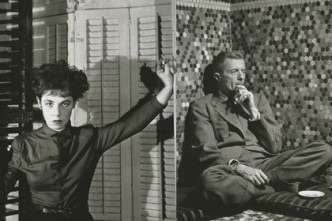
Paul (born 1910) and Jane (born 1917) Bowles led an eventful life including creativity in music and writing, the theatre (he as a composer, she as a playwright) literary frustration, depression, same-sex affairs, travel – Europe, Ceylon, and North Africa, drugs, and famous friends which included Jean Cocteau, Ezra Pound, Gertrude Stein & Alice B. Toklas, Jean Rhys, Stephen Spender, Christopher Isherwood – who would give Paul’s surname to his famous character, Sally, in Goodbye to Berlin, Aaron Copland – who gave Paul music composition lessons, Max Ernst, Tennessee Williams, Truman Capote, Gore Vidal, Alan Ginsberg, and Peggy Guggenheim and they shared a house for a time in Brooklyn with W. H. Auden, Benjamin Britten, Virgil Thomson, and Gypsy Rose Lee. I would’ve loved to be at that breakfast table!
Although Paul wrote crime stories and painted in his youth he received his initial fame as a Broadway composer for, mainly, the works of Tennessee Williams: The Glass Menagerie, Sweet Bird of Youth, The Milk Train Doesn’t Stop Here Anymore, and Summer and Smoke. He also wrote incidental music for his wife’s play In the Summer House for its Washington season before a short stint on Broadway in 1954.
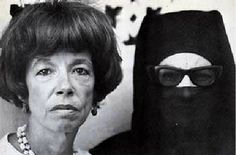
Jane with her Moroccan partner, Cherifa
Jane’s only novel Two Serious Ladies was published in 1943 to mediocre reviews although Tennessee Williams loved it and called Jane “the most important writer of prose fiction in modern American letters.” When I read that line in his memoir I was shocked that I had never heard of her. I soon remedied that and have been collecting her work ever since; that isn’t difficult, her output is small.
Two Serious Ladies began as Three Serious Ladies, she dropped one of them but from her early drafts featuring the third lady Paul edited various short pieces and submitted them whenever an editor or publisher wanted something from Jane. She was completely indifferent to it all: she considered herself a failure as a writer.
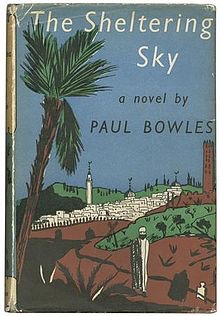
Paul turned to serious writing and his first, and most famous novel, The Sheltering Sky came out in 1948 and by 1950 was in the New York Times best-seller list. There is a taste here of a potential Joe Orton/Kenneth Halliwell literary rivalry but there were no murderous consequences. Jane was more interested in her female lovers and pre-occupied with her declining health. The Bowles’ latter years were spent in North Africa.
Jane died, after several strokes and breakdowns in 1973; Paul died from a heart attack in 1999.
The Sheltering Sky.
Port and Kit are a married American couple, financially independent, and crave to visit the centre of the Sahara Desert. What they really mean is to go as far as they can as long as the degree of ‘desert-ness’ increases. The moment the desert-ness begins to weaken they turn back. They want to be lost. They encouraged another American, Tunner, to be their traveling companion, although by the opening of the story they want to be rid of him; and finally succeed. They also meet the mother and son team Mrs Lyle and her lay-about off-spring, Eric. The mother has got to be one of the more odious characters in 20th century literature and together with Eric, and Tunner, who has his heart set on seducing Kit, form a trio embodying everything the couple hate in the civilized world; giving them the reason they need for running away.
Getting lost in the desert is akin to going to bed, and waiting in an airport for a flight to begin: they abrogate life’s responsibilities especially if you believe those responsibilities are crushing you or causing you grief. At an airport life stops until you get where you’re supposed to be; going to bed forces everything to leave you alone so you can sleep; and getting lost in a desert leaves your life on hold while you find your way back to it.
Kit Moresby is obviously modeled on Jane. “Ambivalence was her natural element: a decision filled her with anguish. The possibilities for an ‘about face’ had to be kept open” writes Paul Bowles in a biographical piece for the collection of Jane’s work, Everything is Nice published by Sort Of Books in 2012. Kit’s psychological problem relates to her obsession with omens and the ever-possibility of doom: all decisions about unfolding days depend on events that may or may not happen. For Kit
“… the feel of doom was so strong that it became a hostile consciousness just behind or beside her, foreseeing her attempts to avoid flying in the face of the evil omens, and thus all too able to set traps her her.”
Doom does catch up with her and when it does Kit is almost relieved that she was right and takes to her appalling circumstances with an energy and satisfaction at not having to be Kit Moresby any more. The more abhorrent her circumstances the more she gives in to them. Her plight includes, thirst, near starvation, kidnapping, daily rape, imprisonment dressed as a boy, and a beating by three angry wives; but what terrifies her more is what she will have to do and say when she is rescued by the civilisation she is running away from.
Being born out of the mid 20th century’s romance with expressionism it’s not surprising that there are adsurdist and Kafkaeque elements in the writing. The pleasure is not just the exotic locations but also the waiting for what torment will fall on her next but Kit’s acceptence of all that keeps you applauding her resilience while at the same time wondering where will it all end. It is Bowles’ plotting skills, only seemingly haphazard, that keep the revelation of the point of it all to the very last paragraph.
Bernardo Bertolucci filmed it in 1990 with John Malkovitch, Debra Winger, and Campbell Scott. That I’ve got to see. The excellent short stories of both Paul and Jane are readily available. Give them a go first.
On the online portal about Sexual Respect, for students, faculty, and staff at Columbia University, New York City, Colm Toibin, has recently provided an arts opinion commentary to accompany an art exhibition on Sexual Respect held at the Faculty House this month. In so doing he has defined what art is; where it comes from; and what it achieves. Here is what he said.
The art we make arises from the most private and intimate concerns and struggles, but also from pressing matters which arise when our dream life merges or intersects with what is sharply public or even openly political. Art begins in whispers and tentative rhythms but it can branch out into many realms, including ones in which the voice becomes loud and the rhythm angry and the tone combative. Art begins in ambiguity but as it proceeds it can shed that ambiguity and aim towards the forceful, the clear, the disturbing. Just as art can insist on its own need for subtlety and quietness, it can also inhabit a space where artists can have an argument with themselves and with the world.
Art seeks out an autonomous space. Now, more than ever, we are in need of autonomous space. Thus the image made, the dance movements worked out, the film shot, the words written on the page, the photograph taken, the painting created, are metaphors for our right in the wider world to imagine and make, metaphors for our own will, for our own freedom, for our own vulnerability; they are signs too of our own autonomy, our own power. These rights, these signs, stand for not only what we want from the world and how we wish to be in the world, but also how we want to re-imagine the world and how we want the world to re-imagine itself.
Many years ago, two poets living in America – Denise Levertov and Robert Duncan – in the white heat of the Vietnam War began an argument about what artists should do about evil. Levertov took the view that we should in our work oppose evil; Duncan believed that we had a duty instead to imagine evil. In the work on show here, it is clear that this argument remains as powerful as ever and as unresolved. The questions of sexual respect, sexual responsibility, the removal of power and violence from the sexual equation, are not questions that any one of us can be easy or complacent about. What is notable in this work on display here is its commitment, its passion, its stark and unsparing exploration of these most difficult and important and urgent subjects.
Some of the work here is deeply and openly opposed to evil. Other work seeks to explore what evil looks like, throw dramatic light on what is dark and cruel so that we can see it all the more clearly, so that we cannot avert our eyes from it, so that we will recognize it in the future.
Art comes from our loneliness. Images and phrases come most sonorously to us from the shadow world, a world in which the thing that should have happened did not happen, the world in which the right action was avoided and something else occurred, the world in which many people failed and some did their worst. Art arises from suffering, from regret, from harm, from experience more than innocence.
But art comes too from our sheer need for utterance, our urge to cry out, our knowledge that the silence all around us hungers for our noise. Art comes from our knowledge that silence moves like a thief, or someone who wishes to exert power, do harm, cause grief. Silence moves in fear; it darts and flits. Silence knows that its enemies are words and images and songs. The most forceful enemy of silence is someone speaking the truth, someone alone in a room, someone writing cries and messages from the depths of the self, words or images that strive to matter and make a difference, concentrate our minds, re-create the world.
Colm Toίbίn
Irene and Sidney B. Silverman Professor of the Humanities
Columbia University Department of English and Comparative Literature







 Michael K Freundt