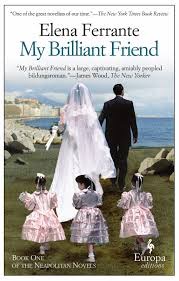
My Brilliant Friend by Elena Ferrante

image

My Brilliant Friend by Elena Ferrante
When we watch a film we have to assume that everything we see is what the film-maker wants us to see: that dreadful yellow coat the woman on the left is wearing in the airport scene is delibate; the bad hair on the star in the night-club scene is also deliberate. This book reminded me that the same assumption applies to books.

My Brilliant Friend begins with a series of events, reminisesces by the narrator, Elena, about her friend, Lila, the ‘brilliant friend’ of the title. They are scenes like, ‘I remember one day when she …’ and ‘and then one evening when we were six she ….’ Ferrante is colouring a picture which isn’t going anywhere. There is no clear narrative, no feeling of time passing. I was getting impatient and a little frustrated; and then the teacher in me was getting annoyed at the sloppy grammar, the confusing pronouns, and the profuse scattering of seemingly random commas, as if from a sloppy pen: comma splices proliferate like ants.

And then on page 74 I came across this line …

“Trained by our school books to speak with great skill about what we had never seen, we were excited by the invisable.”

I found this line profound. I read it again. Thought about it and read it again. That’s when I was reminded about the veracity of the above assumption. I was forced to find a reason for the grammatical sloppiness and such a reason wasn’t hard to find. The voice is extremely informal, like a mate sitting with you over a coffee latte telling you a story. It’s very conversational and, I eventually conceeded, intentionally so. In fact about half way through the book Elena eventually receives a longed for letter from Lila and describes it thus,

“The voice set in the writing overwhelmed me, enthralled me even more than when we talked face to face; it was completely cleansed of the dross of speech, of the confusion of the oral; it had the vivid orderliness that I imagined would belong to conversation if one were so fortunate to be born with the head of Zeus.”

This description of Lila’s writing as ‘vivid orderliness’ as if from the gods put Ferrante’s writing into focus as ‘the dross of speech’ and ‘the confusion of the oral’ and I understood that the sloppy grammar and punctuation had a purpose; it was a writerly technique designed to create the conversational tone and the confusion of the oral just as Lila’s letter wasn’t.

My Brilliant Friend is about self awareness and female friendship told by an elderly Elena Greco looking back at her lifelong friend, Lila Cerullo, from 3 years old to 16 years old, childhood and adolescence. Elena is the third-person narrator but very much part of the action; it feels like an autobiography.

Lilia’s family, like all the families in this book, is scarred with fillial violence. “What do you mean by love?” Lilia murmured to her brother, “what does love mean for our family?” Love seems to be at the heart of everything but it’s rarely visable. The Neapolitan characters, especially the men, wear their arrogance and ego so confidently and so visably but when it is challenged even ever so slightly they react as if such confidence and ego were tissue-thin: a side-ways glance is responded to as if a stab in the back; a smirk, a snide remark, as if a throat is cut, a eye gouged out and revenge is metered out ruthlessly.

This threat of violence is ever present, and terrifying since when it erupts it is life-threatening; not just between husband and wife but between father a daughter, brother and sister and usually over the purpetrator being made to feel foolish by circumstances that no-one has control over. It is the women who suffer the most. The blame, when its origins are unclear or undefinable, is always planted on a woman: a truely mysoginistic culture. Ferrante describes it as common-place, like doing the washing up and putting out the garbage. It is part of the fabric of their lives.

Despite what I said at the opening of this review the seemingly anacdotal descriptions give way to a narrative and a time-line slowly evolves and towards the end of this book, the first of a trilogy, tension and narrative builds slowly but firmly to Lila’s wedding day, at the age of sixteen, as a final act threatens to explode everyone’s lives. You don’t get the explosion, just the gasp, as someone who shouldn’t be there walks into the room, sits, crosses his legs, shows off his gleaming new shoes; the explosion, we assume, must open book two in the series. What a cliff-hanger!

We know that Elena Ferrante was born in Naples, and that’s about it. If you google images of her you get several pictures of Italian looking women which, if you pursue them, lead nowhere or to women who have written about Ferrante. However on ‘her’ website I found this …
” … guesswork around Ferrante’s identity proliferated, with reviewers speculating that “she” might be a mother, a man, or a sentient cabal of fire-ants,” says a reviewer Katy Waldman in her article for Slate (an online journal) heralding the Paris Review’s coup at gettng the first in-person interview with Elena Ferrante; in their Spring 2015 issue. So, soon, we may find out more about this intriguing writer that no-one has up until now seen and no-one up until The Paris Review has seemingly spoken to.

My Dream of You by Nuala O’Faolain (noola o fway lorn)

Nuala O'Faolain
Nuala O’Faolain

I loved this book!

After the international success of O’Faolain’s memoir Are You Somebody? this novel, her first, was published in 2001 and in a brief Afterward she acknowledges “splendid energetic advice” from fellow Irish writer Colm Toibin who recently opined that

“… in autobiographical writing your [the writer’s] job is to create illusion, to work with rhythm and image and detail to make the reader feel that whatever is on the page matters and must have happened.”

I would venture to say that this also applies to writing in the first person, memoir or fiction, since the first person point of view is meant to make the reader believe the protagonist is also the writer. I recently complained that in The Cast Iron Shore, Linda Grant’s debut novel, that I reviewed on this blog recently (posted January 27), Grant failed her first person POV responsibilities by inadvertantly creating a disconnect between the protagonist and the writer: they seemed like two different people.

O’Faolain does not make the same mistake. Although a novel (fiction), My Dream of You reads like a memoir, feels like a memoir; so skilfully does O’Faolain make you believe, using “rhythm and image and detail” that her story actually happened to her. Having read her first memoir there is a lot of O’Faolain’s past in Kathleen’s but autobiography and fiction are interwoven seemlessly. How do I know this? I cared about her.

Kathleen de Burca is an Irish travel writer fast approaching fifty, and with a waist to match, who travels the world, usually with her best friend, an gay American man called Jimmy, writing travel copy for her boss, and also close friend, Alex. These two men, and staff in the office in London, serve as her family, since she has all but abandoned hers, and her country, many years before. Then there is her boyfriend, Hugo, a law student, who interests her in a divorce case from the annals of Irish history: the young wife of an English aristocrat, on a forlorn Irish estate in the middle of nowhere, is accused of infidelity with her husband’s Irish groom, a very common man. In those days, the 1850’s, a divorce needed an act of parliament so the event is well documented although from a very English point of view. The wife is chastised, forsaken, deprived of her young daughter, and locked up in an asylum where she inevitably goes mad.

Kathleen is intrigued and fascinated by this tragedy and when Jimmy, her moral compass, suddenly dies she takes leave of her job (Hugo, the boyfriend, she betrayed and lost) and travels to Ireland to, maybe, write a book about this young wife and her passion for a comman man.

The book has three narrative arcs: Kathleen’s journey to Ireland, her adventures, and the brief reunion with her siblings and their families; her memories of her arrogant, distant, and emotionally violent father, her deeply unhappy and useless mother, and her friends and lovers; and the story from the 1850s of Marianne and her affair with the lowly William Mullen. Yes, there is a book within the book.

She thinks she is going to Ireland to research a story about someone else’s passion but what she actually does is confront passion in her own life and what she discovers is not what she expected.

The writing of the Marianne’s story (in the third person) begins confidently and the affair with Mullen is handled expertly: O’Faolain makes the reader understand how intense physical attraction can operate outside the realms of reason; but Kathleen discovers another document that proports to prove that … well, I don’t want to spoil it for you. There is here the flavour of a mystery to be solved.

O’Faolain’s literary skills are put to good use as she weaves the first and third narratives into a shared ending which also ends the book itself. Very satisfying.

My Dream of You is about love, sex, family, and aging, and it contains one of the best descriptions I have ever read of female friendship – how it works – and how emotional love with a woman can be far more rewarding and long-lasting than sexual love with a man. Mind you, Kathleen has a lot of experience with sexual love with men and she understands, and shows, that passion is far more complex and evolutionary than romantic books make out; and she comes to realize that her relationship with her body is also a part of the ‘passion’ equation and far from what she would like it to be, or thought it was. She is, or was, a beautiful woman and there are magic passages where a beautiful woman talks about being beautiful, without pride or sentiment, and when she believed it and when she didn’t. This is unusual stuff.

Nuala O’Faolain was engaged once but never married, had a fifteen year relationship with the Irish journalist, Nell McCarthy, but spent her latter years with a New York lawyer, John Low-Beer. She was diagnosed with metastatic cancer in 2008. Hugo Hamilton, whose memoir The Speckled People I recently reviewed on this blog (posted February 10), was a friend of O’Faolain’s and his 2014 novel Every Single Minute is a fictionalised retelling of a trip he took with the very ill O’Faolain to Berlin just before she died (May 9 2008).

She wrote two volumes of memoir Are You Somebody: The Accidental Memoir of a Dublin Woman (1996), and Almost There: The Onward Journey of a Dublin Woman (2003); another novel published posthumously in 2009 Best Love, Rosie; and a ‘history with commentary’ The Story of Chicago May (2005). Chicago May was the nickname of Mary Ann Duignan, an Irish criminal, who became famous in America, France and Britain in the beginning of the twentieth century.

Impression vs Experience

On April 25 1884 Walter Besant, English novelist and historian, gave a lecture at the Royal Institution, the London organisation devoted to scientific research founded in 1799. It was called Fiction as One of the Fine Arts. Besant’s novel All Sorts and Conditions of Men was published two years earlier and sold over 250,000 copies. It anticipated the rise of the slum novel and with the publication of The Revolt of Man (1882), The Inner House (1888) and The Children of Gibeon (1896), he consolidated his fame as a master of dystopian fiction.

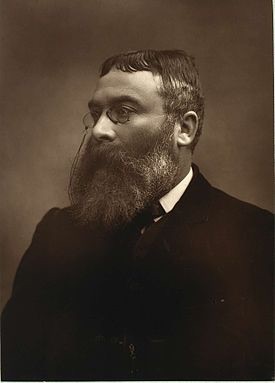
British novelist, historian and humanitarian, Walter Besant (1836 - 1901)
British novelist, historian and humanitarian, Walter Besant (1836 – 1901)

However he is best known today for the little pamphlet of his speech given at the Royal Institution that April day, which was published as The Art of Fiction. Most importantly it surprised everyone that people seemed to be interested in such a subject.

Besant’s little speech started an excited debate on the purpose of literary fiction and since that time many writers have weighed in to the argument with their own thoughts, beliefs, and theories on the subject.

Besant believed that writing fiction should be considered as a ‘fine art’ and like other fine arts – painting, sculpture, music and poetry – it “is governed and directed by general laws; and that these laws may be laid down and taught with as much precision and exactness as the laws of harmony, perspective, and proportion.” But fiction, like the other fine arts, is “so far removed from the mere mechanical arts that no laws or rules whatever can teach it to those who have not already been endowed with the natural and necessary gifts.”

Prior to this time “the general – The Philistine – view of the Profession is, first of all, that it is not one which a scholar and a man of serious views should take up: the telling of stories is inconsistent with a well-balanced mind.”

Everyone, it seems, agreed with what Mr Besant had to say, especially the belief that Fiction is an Art; but what started the debate was his assertion that “a young lady brought up in a quiet country village should avoid descriptions of garrison life; a writer whose friends and personal experiences belong to what we call the lower middle class should carefully avoid introducing his characters into Society … never go beyond your own experience.”

As an exponent of the ‘slum’ novel Mr Besant seems to be saying that when writing fiction one can write ‘down’ from your own experience but not ‘up’.

You can find most of Walter Besant’s work, fiction and non-fiction, including his essay, The Art of Fiction, at http://ebooks.adelaide.edu.au where you can download them for free.

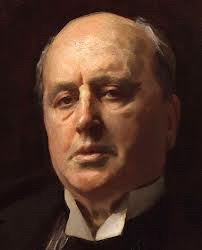
Henry James: The Art of Fiction.

James’s famous ‘reply’ using the same title as Basent’s pamphlet has become the cornerstone of fiction writing as an art, far outshining Besant’s in the fame stakes. His rebuttal is extremely polite to Besant and he certainly agrees with his elder that fiction writing is an art. However James took a more light-hearted tone and what the general pubic at the time thought of the novel, James famously wrote, “there was a comfortable, good humoured feeling abroad that a novel is a novel, as a pudding is a pudding and that our only business with it could be to swallow it.” This attitude, in some quarters, persists today.

James explains his ideas thus …

Experience “is the very atmosphere of the mind; and when the mind is imaginative … it takes to itself the faintest hints of life, it converts the very pulses of the air into revelations… I remember an English novelist, a woman of genius, telling me that she was much commended for the impression she had managed to give in one of her tales of the nature and way of life of the French Protestant youth. She had been asked where she learned so much about this recondite being, she had been congratulated on her peculiar opportunities. These opportunities consisted in her having once, in Paris, as she ascended a staircase, passed an open door where, in the household of a pasteur, some of the young Protestants were seated at table round a finished meal. The glimpse made a picture; it lasted only a moment, but that moment was experience. She had got her impression, and she evolved her type. She knew what youth was, and what Protestantism; she also had the advantage of having seen what it was to be French; so that she converted these ideas into a concrete image and produced a reality.”

James sums up his advice to novice novelists as,

“Above all, however, [the novelist must be] blessed with the faculty which when you give it an inch takes an ell, and which for the artist is a much greater source of strength than any accident of residence or of place in the social scale. The power to guess the unseen from the seen, to trace the implication of things, to judge the whole piece by the pattern, the condition of feeling life, in general, so completely that you are well on your way to knowing any particular corner of it.”

In other words, impressions are experience; and the novelist’s task is to convert those impressions into reality: “the power to guess the unseen from the seen…”

You can read James’s The Art of Fiction at
http://public.wsu.edu/~campbelld/amlit/artfiction.html

Other writers who have written on this subject.

Robert Louis Stevenson (1885): Essays in the Art of Writing
Free ebook at http://ebooks.adelaide.edu.au

Arthur Schopenhauer (1891): the Art of Literature
Free ebook at http://ebooks.adelaide.edu.au

Anonymous (1901): How to Write a Novel
Free ebook at http://manybooks.net

Clayton Hamilton (1918): A Manual of the Art of Fiction
Free ebook at http://manybooks.net

E. M. Forster (1927): Aspects of the Novel
Available through Amazon.com, BukuKita.com and Gramedia

John Gardner (1983): The Art of Fiction
Available on Kindle (ebook) through Amazom.com

Ray Bradbury (1990): Zen in the Art of Writing
New and used editions available on Amazon.com

David Lodge (1992): The Art of Fiction
Available through Amazon.com, BukuKita.com and Gramedia

Ayn Rand (2000): The Art of Fiction
Available through Amazon.com, BukuKita.com and Gramedia

Stephen King (2000): On Writing
Available through Amazon.com, BukuKita.com and Gramedia

John Mullen (2006): How Novels Work
Available through Amazon.com, BukuKita.com and Gramedia

James Wood (2009): How Fiction Works
Available on Kindle (ebook) through Amazom.com

Colm Toibin (2010): All a Novelist Needs: Colm Toibin on Henry James
Available from Amazon.com

The Paris Review: The Art of Fiction Interviews
(from 1953 to 2015 and continuing)

http://theparisreview.org/interviews

Arctic Summer by Damon Galgut

The South African writer, Damon Galgut

Damon Galgut, when he is not travelling, lives in Cape Town, South Africa, is 52, and an openly gay man – which begs the question, why mention it? I mention it in relation to his latest book, Arctic Summer, which is a fictionalised account of the middle years – the early 20th century – of E.M. Forster’s life, his early career, his success with Howard’s End, his long roaming interlude that finally brought him to A Passage to India, but most importantly, his grappling with his homosexuality.

“At the time I grew up in South Africa,” said Galgut in a recent interview, “it was illegal to be gay. The whole system of apartheid was extremely patriarchal; all its values were skewed in that direction. To be gay growing up in Pretoria in the 1960s – it would be hard to overstate what a terribly suffocating oppressive place it was. I learned, like quite a lot of gay men do, to hide and to assume fake personas. That sense of concealment has stayed with me, even now. I suppose I’ve internalised a lot of self-dislike – self-doubt, maybe, is a better way to put it.”

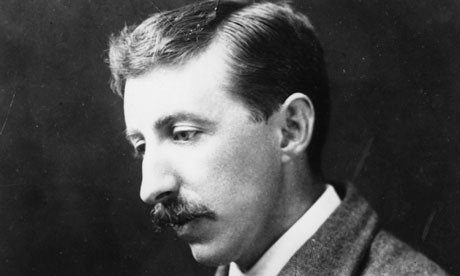
Edward Morgan Forster

Forster also hid and assumed a fake persona, all the more tragic that the persona he chose to hide behind was an imitation of the same persona all the men around him hid behind as well: English, literary, controlled, stiff-upper-lip, and straight, if only in that English way of not seeming to be interested in marriage. He also suffered immense self-doubt especially about his novelistic portrayal of relationships between men and women of which he had no experience at all. Yet he craved intimacy, especially sexual intimacy but had no idea of the actions or words needed to satisfy such a craving. When ‘it’ finally happened he stumbled into it, and before he knew it, there it was and his seducer did all the work; and although it was fleeting he was amazed and pleased, but he was thirty seven years old.

Arctic Summer was the name of another Forster novel but one that he abandoned in early 1913 having succumbed to a weariness at only writing, or being allowed to write, about the love between men and women.

Galgut’s writing is masterful especially in creating and colouring indecision, sexual expectation, and longing. Forster, who everyone calls Morgan, visits a country friend of a friend whom he hasn’t met yet although he has read some of the man’s writings on “Homogenic Love” which excited him. This country friend, Edward Carpenter, lives with his younger ‘companion’, George, a working class man from the Sheffield slums, and the three men have lunch, after which Morgan helps George clear the table. The following is the description of putting down the plates in the kitchen. A simple domestic act, but oh, there is so much more.

‘Looking for a clear surface on which to set down the plates, he was aware of George’s closeness behind him and of the sound of his breathing.
“Is this right?” he said. “Here?”
“Let me see. Yes, that ‘s all right. Just put them down.”
He put them down and stood, not moving. He could hear the sound of breathing, close enough to be intrusive. Then he realised it was his own.
“Oh,” he said, surprised.
And then a little frightened.
Because George was touching him.
It was merely a hand, in the lower curve of his back. The contact was suggestive though the fingers didn’t move. Perhaps it was the talk they’d been having, or the thoughts he’d entertained, but there was something subversive about that hand. Something flowed out of it, transmitted through the palm: a presumption of equality, or worse – ownership. Yes, this must be how it felt, to be touched by a lover. He could feel the heat of it, the possessive certainty of its contact. Then the hand dropped down to his bottom, wavered there for a moment, and came to rest a little above his buttocks, at the base of the spine.
It was astonishing. Something had happened to him. He wasn’t quite in the kitchen any more, not quite in his own body. His mind had flashed away from itself, to some inner place where the events of the day were still being arranged. Now they were arranged differently.
“Yes,” George said again. “That’s all right, there.”
Carpenter’s voice called outside, and the hand fell away.’

Forster did write a gay novel, Maurice, a happy-ever-after romance between men from different social backgrounds but it was only published after his death and inspired, Galgut suggests, by the scene of domestic ordinariness of that luncheon with Edward Carpenter and his companion, George.

This is a story concerning real people, real events but it is also full of conjuring, and flights of imagination, like the above quote – and Galgut’s depiction of Forster’s first sexual encounter – which sets this work as fiction, not biography. The above event may not have happened but it’s possible, and believable, that something like it did.

Galgut describes several of Forster’s relationships. The first, sexually unrequited, with an educated Indian, Masood, and the second, more successfully, although far from passionate, with an Egyptian tram conductor, Mohammed. Galgut also gives Forster the opportunity to tell the former about the latter: a ‘romance’ he called it, and it is due to Galgut’s skill that when Foster finally says it: vocalises his love for another man I was overjoyed for him, not so much that, finally, he had known sexual love, meagre though it was, but that he was able to express it.

Arctic Summer is not unlike Colm Toibin’s The Master, about another writer, Henry James, who also grappled with his sexuality, but in the American it was buried so deep that not even Toibin’s masterly conjuring could’ve produced a scene like that above, and nor would it have been appropriate: for James, thoughts such as those reliably never existed, whereas for Forster they plagued his every waking hour and sometimes his sleeping ones as well.

This work is an example of historical biographical fiction and if you are concerned about what is true – and you shouldn’t be – all that can be said is that this is Galgut’s version of what ‘maybe’ true; and there are many others. What IS important is what the reader understands, enjoys, is enlivened and enlightened by.

Damon Galgut was unknown to me until the arrival of my ‘book fairy’, a European friend who comes twice a year to the tropical island where I live bearing news about books and his reading adventures but also books themselves. He had forgotten the name of this book and its author but knew the work was about E.M. Forster. Google did the rest. Fancy finding it here in a local bookstore! It has only been out a year.

Galgut’s first book, A Sinless Season, was published when he was 17, and following a serious cancer scare, a collection of short stories appeared, Small Circle of Beings, in 1988. He has been short-listed for the Man-Booker prize twice: for The Good Doctor in 2003 and In a Strange Room in 2010. He has also written plays and taught drama at his alma mater, The University of Cape Town.

“… we’re constructing the story of our lives all the time, and memory, in the end, is no different than the telling of another kind of story.” Damon Galgut.

I’m going to make a space for Damon Galgut on my bookshelf between Anna Funder and Helen Garner.

Zeitoun by Dave Eggers

The American writer Dave Eggers

The relationship between truth and fiction is, and always will be, complicated and never more so than in the reading of this book: Zeitoun by Dave Eggers. It was published in 2009 to great acclaim, won many prizes and is a non-fiction account of Abdulrahman Zeitoun’s battle with the aftermath of Hurricane Katrina in 2005. I had heard of Dave Eggers but had never read any of his work. He is a remarkable achiever who sprang onto the literary landscape in 2000 with a memoir with the hubritic title, A Heartbreaking Work of Staggering Genius.

First of all it is a handsome and well-made book and heavy for its size; expensive paper perhaps. I was immediately impressed by the simple but effective language that painted a loving and respectful relationship between Zeitoun and his American, but Islamic, wife Kathy and their four children, while building the suspense of Katrina bearing down on them. The couple ran a busy and successful painting and maintenance business in New Orleans, but also had several rental properties that they managed. Everyone worked very hard. Zeitoun, originaly from coastal Syria, was a hard-worker, a loving husband, doting father, a devout Muslim, with a strong sense of community and duty to his neighbours. Here was the epitomic hero.

As the hurricane approached Kathy and the kids left for relatives further inland in Baton Rouge leaving Zeitoun to look after the house and their other properties. The storm comes and goes and Zeitoun wonders, is that all there is? No, the mighty storm was not the problem, but the rising water was. He moves everything he can to the second floor and when the water stops rising he jumps in his second-hand canoe and paddles around the city rescuing trapped people and neglected dogs. I knew from the back cover that he would be arrested for suspected looting and imprisoned in a cage but I hadn’t got that far yet.

Then on Thursday evening I went to meet some friends for dinner in a local restaurant. I was the first to arrive and so while I was waiting I Googled Zeitoun and Eggers; I was curious about what had happened to our real-life hero, Zeitoun, and his family. I wish I hadn’t.

Much has been written and reported about Abdulrahman Zeitoun and his wife Kathy since this book was published in 2009. The pressures of fame that the successful book generated, harrassment by the media, and not to forget the trauma of Hurricane Katrina herself all took their toll. Kathy Zeitoun accused her husband of repeated physical abuse, the first time, reportably, but witnessed, with a tyre-lever, and they were divorsed in February 2012. Abdulrahmin was then arrested on charges of attempting to murder his ex-wife and for paying a hit-man to do the deed. Both charges were dismissed in July 2013 by the judge who sided with the defense team who maintained that the prosecution pursued the case because of Zeitoun’s growing fame. In response to his aquittal Kathy Zeitoun said “I was shocked. I am now in fear of my life. I do believe he is going to attack me again, with all my heart.”

Knowing this informaiton before finishing reading the book changed the way I felt about it. This worried me. The publishers and Eggers himself have gone to great lengths to establish the story as not just non-fiction but as fact even though Eggers writes the book as a novel: he describes the thoughts in his character’s heads and conversation, in direct speech, between Zeitoun and Kathy in the privacy of their bed. These are the traits of fiction. Did Zeitoun leave out all the ‘bad’ stuff during his extensive interviews with Eggers? Kathy Zeitoun thinks so; or did Eggers only choose what he wanted to use for his narrative purposes? This is also a skill needed to write fiction.

I had to change my attitude about the book and treat it, think about it, as a novel; that was easy because it’s written like a novel, but changing the idea of the book from non-fiction to fiction wasn’t so easy. When talking about the frelationship between truth and fiction I’ve always used the line that

‘fiction is always about truth but, to make it clear, we have to lie about it a little’.

Dave Eggers has run away, literally, from reporters who want to ask him questions about the veracity of his book and if you google “Zeitoun + Eggers”, or similar, information runs out in late 2013 after Zeitoun was aquitted of the charges brought against him.

The hurricane itself certainly had a devastating effect on the people of New Orleans but for the Zeitoun family, did being the subject of Egger’s book bring its own misery and add to the family’s woes? Or were there already chinks in the relationship before Eggers came along? Chinks that he chose to ignore.

Non-fiction is about facts, truth is about emotion. The fiction may be set on a fictional planet or place but the interplay between the emotions and feelings of the fictional characters are about truth. I believe that the physical action of the story is true: the actual effect of Katrina on the people and the city of New Orleans, but I had to accept that the relationship between the characters, although they themselves existed, was not true, but manufactured, compiled, and organised by Eggers for his own novelistic purposes. This is what novelists do.

I went back to the book, I was only 50 pages in, but I was surprised to realise that I was no longer interested. I didn’t care anymore. The book was trying to be something it wasn’t. For years I’ve been telling people that if you’re not enjoying a book, stop and read something else, even though the urge to finish something you’ve started is very strong. I usually give in to this urge, but with this book, I didn’t. I stopped. Besides I had just found in my local bookshop a book that I’ve been longing for. This bookshop has a swap policy so I swapped my copy of The Luminaries by Eleanor Catton, the 2013 Man-Booker winner, ironically a book I also didn’t enjoy, but finished, for  Arctic Summer by Damon Galgut: a fictional biography of E.M. Forster. Ha! Yet another permutation of fiction and truth.

All writing is fiction. The only thing true about it is its physicality: little black marks on a white background.

A Conversation With Writer Colm Tóibín on the ‘Close Imagining’ of Fiction

The Irish writer, Colm Toibin

Colm Toibin has always been the most subtle writer. When I finished reading The Heather Blazing I went straight to page one and read it again. I doubted my reading skills; I thought I had missed something. I had; I was waiting for bits novelistic drama, a murder perhaps, a fight, but Toibin is not like tha. Thi story is the most gentle story of familial love where men find it so difficult to tell each other how they feel. Tobin makes drama from the everyday. Here is an interesting convesation with Toibin where he talks about his writing, how he writes, what a novelist needs, and how he is always thinking of the reader. Just click on the link below. I hope you enjoy it.

A Conversation With Writer Colm Tóibín on the ‘Close Imagining’ of Fiction.thenbeginning

The Dinner by Herman Koch

Dutch writer Herman Koch

Like most people I read all the words on the outside of a book before I read the words on the inside. My expectations, therefore, for The Dinner were high, as such marketing blurbs are meant to do, and my idea of the plot fairly set: two couples, the husbands are brothers, meet at a restaurant to decide what to do about a horrific crime committed by their sons, cousins, and now on YouTube for all the world to see. And, yes, that is the plot but this book is about much, much more.

Almost a third of the way into the book I wrote this in my notebook:

“Koch curiously plays with time. He begins a scene well into it and then ‘flashes back’ to explain how we got to the point where the scene began. There must be a point to this.”

Yes, there certainly is a point to this. There are three time-threads: the present, the past and the near-past. Koch weaves these threads like plaits, focusing on the first over the second which gives way to the third which in turn fades to give focus back to the first. This allows Koch to mete out information and back-story one little tantilising bit at a time ramping up the tension, and the mystery, and making you yearn for the next bit, and when it comes it isn’t what you expect.

At about the same place as I wrote that above note to myself all I had to go on, plot wise, was one of the fathers, Paul, the first person narrator, had seen something disturbing, we don’t know what, on his son’s computer just before they left for the restaurant, and when he kisses hello his sister-in-law, just after she arrives, he glances under her darkened glasses and notices that she has been crying.

Readers also tend to take sides with the first person narrator because usually, and in this case too, he is so honest, straight-forward, and ‘natural’ in the way he speaks to us, “I don’t know how to put it any more clearly.” It seems it is Paul who is writing this and not Herman Koch. You feel empathy for this man and it is only almost at the end when you realise that there is a reason for this too. Enough said.

The short chapters run numerically through four sections, Appetizer, Main Course, Dessert, and Digestif but this simple structure is nowhere near as limiting as you may expect. The action ranges far and wide but always comes back to the restaurant, the pretentious manager, the fawning staff, and the two couples trying to be the ‘happy family’ in a public place all the more threatening because, Paul’s brother, Serge, is a famous polititian. Everyone in the restaurant knows that they are dining in the presence of, maybe, the next Prime Minister. The stakes are high.

But this book is also about family, and about being a man, but most importantly about being a father. However it is not your feelings and thoughts about Paul that remain with you after you get to the ‘End’ it is … again enough said. I don’t want to spoil things for those who haven’t read it yet.

It’s easy to see how film-makers have been drawn to this book. There is already a Dutch version, an Italian version which takes some liberties with the plot and structure, and there is to be an English language version directed by, and making her directorial debut, Cate Blanchett. Read it before the film comes out.

This is a ripper of a yarn and as Christos Tsiolkas says on the cover, it’s “a punch in the guts but also a tonic.”

On Experience: writing about writing


Mark Twain’s memorable quote ‘Write what you know’ is probably one of the most misunderstood in all literature and according to Nathan Englander, the author of the short story collection What We Talk About When We Talk About Anne Frank, it isn’t about events, it’s about emotion; “Have you known love? jealousy? longing? loss? Did you want that Atari 2600 so bad you might have killed for it? If so, it doesn’t matter whether your story takes place in Long Island or on Mars – if you’re writing what you know, readers will feel it.”

Our literary landscape is full of proof of the veracity of such a statement: how many vampires did Stephanie Myers interview before writing Twilight? How many witches did J K Rowling interview before creating Harry Potter? None, of course. What is important is imagination and ‘don’t sell your imagination short’ said the American author Richard Ford (author of the Frank Bascombe novels that began with The Sportswriter in 1986). By that he meant, as he explained to his audience at a Southbank interview in October 2012, not to over-rely on what you know because, for him, writing is really about the imagination.

And so it is for the Irish writer, Colm Toibin,

“The imagination is a set of haunted, half-lit rooms. Sometimes we have no idea ourselves why a novel begins, why a style takes root, or a plot grows.” More about this later.

In his essay about Henry James and his final abode, Lamb House, (The Haunting of Lamb House in the collection All a Novelist Needs) Toibin describes his wandering through the master’s house, the ground floor of which is a Henry James museum, and then being invited upstairs to the private apartment of the owner. He was embarking on auguably his masterpiece, The Master, about the five years in the life of James following his disasterous tilt at being a playwright.

“I had what I was searching for – the two objects over the mantelpieces, the view, the height of the upstairs rooms. All I needed now was to get back to work.”

And then in the title essay he explains what he means,

“This is all a novelist needs, nothing exact or precise, no character to be based on an actual person, but a configuration, something distant that can be mulled over, guessed at, dreamed about, imagined, a set of shadowy relations that the writer can begin to put substance on. Changing details, adding shape, but using always something, often from years back, that had captured the imagination, or mattered somehow to the hidden self, however fleetingly or mystreiously.”

The publishers of the notable Australian writer David Malouf have recently released two volumes of his collected miscellaneous writings, the second of which is entitled The Writing Life and collects in one inspiring volume speeches, articles, and essays on what it means to be a writer.

He explains that sometimes our mind ‘plays a peculiar trick on us’ and we remember an event ‘so real, so alive’ that we can only believe it to be an actual event from our past; but when we think again we realise that this is not so but something we read in a book! ‘But’, he asks, ‘didn’t that also happen … to our ‘reading-self’? We read, go to the theatre, to the movies, to have just this kind of experiece.

Who among you is a murderer? No-one I hope, but you have an infinite number of experiences of murder and, who knows, all you may need is an ingenious trick or twist in a plot to be the writer of one.

Malouf quotes two literary ‘glimpses’ that help to illustrate Malouf’s, and Toibin’s point. One is an anacdote from the diary writings of Henry James where he tells of an English novelist, a ‘woman of genius’ who was much admired for her fictionalised portrayal of ‘the nature and the way of life of the French Protestant youth’; and what opportunities came her way to enable her to write with such assurance and believability? Only one, a glimpse, ‘in Paris, as she ascended a staircase, passed an open door where, in the household of a pasteur, some of the young Protestants were seated at a table round a finished meal. The glimpse made a picture; it lasted only a moment, but the moment was experience.’

The other is from Dickens’ David Copperfield who when visiting the Micawbers in prison the young man is asked to fetch a knife and fork from Captain Hopkins, another prisoner on an upper floor. He encounters in the Captain’s room ‘a very dirty lady’ and ‘two wan girls, his daughters with shock heads of hair.’ The young Copperfield knows ‘God knows how’ that the two wan girls are the Captain’s daughters, but the dirty lady is not his wife. He had only a glimpse of the room but he returned to his host knowing that what he held in his head was just as true as the knife and fork he held in his hand.

Malouf infers that it only takes a glimpse for a writer to expand that glimpse into knowledge and he uses a quote from James to explain what he means; that a writer needs the ability ‘to guess the unseen from the seen, to trace the implication of things, to judge the whole by the pattern, the condition of feeling life in general so completely that you are well on the way to knowledge of every corner of it … If experience consists of impressions, it may well be said that impressions are experience.’

On Saturday afternoon, 23 March, 2013 I experienced a mental ‘flip’ while I was sitting on my daybed reading a book review in The International Herald Tribune, as it was then called. I was only a few column centimeters into the review when suddenly a voice popped into my head: an angry, domineering, female voice chastising a wayward daughter for making bad decisions and giving her mother nothing but grief and disappointment.

It happened somewhere in the first two paragraphs but where exactly eluded me. I searched for it many times. It may have had something to do with ‘growing up evangelical in a secular age’ or ‘a buttoned down morality – a more adventurous approach to religious faith’ or maybe not.

What was important was that I had to write it down. It: the tone, the voice; hit me heavily. It is absolutely true that from the daybed, where I was reading, to collecting my iPad, to sitting down at the table, the ‘flip’ evolved into something else and then into something else again as I began to tap it out, and something else again as I wrote the last word and consolidated a reason. It was like what happens inside a chrysalis: no-one can possibly know. This is the imagination as Toibin’s ‘half-lit room’.

I recorded the above at the time and what I wrote down became not a very good one-act play called Truth which eventually turned into a much better short story called Truth, Justice, and the American Way.

I mention it here as an example of something happening, I still don’t know what, while reading a newspaper, which sparked my imagination which in turn morphed into a situation, two characters, and a comment on American culture. The point of what I wrote down only developed by the time I had finished; it certainly wasn’t there when I began.

In my soon-to-be-posted novel, Veronica Spreads it Around, the sequel to Veronica Comes Undone, there is a fire, a devastating, tragic fire, that my protagonist, Veronica, is trapped in. I have never been in this situation, and hope never to be, and, I confidently surmise, neither have you, but because of my many glimpses and impressions of terrible fires I launched into the writing of it relying on those glimpses and impressions and not on any direct experience. I knew it had to be hot, very, very, hot but I tried not to use those trite words; I had to find other words; I had to make writerly decisions about metaphor and simile. I also needed to ask myself important and pertinant questions: how do I describe the heat and the noise? without it sounding obvious and silly. How does she escape? I am using close writing (subjective free indirect discourse), eveything is seen from Veronica’s point of view, so she has to be conscious, trapped but conscious. Serendipitously there was another story-line that needed a conclusion that I realised at this moment, and not before, could be included in the introduction to this scene that would also provide a ‘red-herring’: the reader would think the scene would develop in one direction so when I dramatically took it in another there would be an ‘Oh my god!, moment. I definitely wanted an ‘Oh my god’ moment – what writer doesn’t? – and my confidence in my solutions to the problems of this scene is great enough for me to think that by telling you all this here you will still, when you read it, have the ‘Oh my god!’ moment. I hope.

Anyway, my decisions were more to do with what words and expressions to use rather than getting the experience right. Remember that the fire is seen from Veronica’s point of view so if she fainted she had to quickly recover in order to experience it and therefore for me to write about it and if she is then conscious she has to be protected in some way so as to be thinking, planning to get herself out of this very dangerous situation while the threat rages around her.

I knew that when I began work on this scene that the fire would happen at some stage but I did not know about the red herring idea or how she was going to survive. In fact the red herring idea provided the means for her survival. I repeat, I did not know this when I sat down at my desk to write the scene.

What happened to me that morning was an example of what I have written above: what Ford, Toibin, Malouf, and James were explaining in their various ways about experience and the incredible role imagination plays in the creation of something that can take the place of experience when direct experience is lacking, or, indeed, not needed, and that, I hope, will lead my readers to go along with the story, ‘believe’ the story, and be interested in Veronica’s many affairs, joyed by her success, moved by her plight and satisfied… if she makes it out alive.

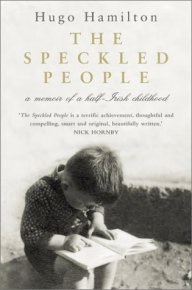
The Speckled People by Hugo Hamilton

Hugo Hamilton

“When I was small I woke up in Germany… Then I got up and looked out the window and saw Ireland.” And Ireland was a place where people spoke English, a language his father ferociously banned in his house. Hamilton said later, “The prohibition against English made me see that language as a challenge. Even as a child I spoke to the walls in English and secretly rehearsed dialogue I heard outside.”

Primarily, Hugo Hamilton’s intriguing memoir, The Speckled People, is about this: a language war.

“We lived in an imaginary place that my [German] mother had created in her stories,” Hugo Hamilton told an audience in the South Lounge on the Lincoln Center campus in February 2011. “As a child, I knew exactly how to get from my mother’s house where she grew up to the bakery, though I’d never been to Kempen, where she came from. And then there was also this imaginary place that my father had, which was a vision of Ireland as an Irish-speaking country.”

“We are the new Irish. Partly from Ireland and partly from somewhere else, half Irish and half German. We’re the speckled people…homemade Irish bread with German raisins.”

The Speckled People is like no other book I’ve ever read. Firstly it is told, in the first person, not surprising as this is a memoir, but by the author of about 8 years old, and to a person of such a young age whose world is that created by his parents there are things he perceives and understands but there are things he perceives and does not understand. His thoughts are usually long, bumpy, and windy but sometimes short and pithy.

“My mother makes everything better with cakes and stories and hugs that crack your bones. When everybody is good, my father buys pencil cases with six coloured pencils inside, all sharpened to a point …My father also likes to slam the front door from time to time. He sends a message to the world depending who knocked. If it’s the old woman who says, ‘God bless you Mister’, and promises to pray for him and all his family, if it’s the man who sharpens the garden shears on a big wheel or if it’s someone collecting for the missions, then he gives them money and closes the door gently. If it’s people selling carpets he shakes his head and closes the door firmly. If it’s the two men in suits with Bibles then he slams it shut to make sure that not even one of their words enters into the hall. And if it’s one of the people selling poppies, then he slams it shut so fast the whole street shakes.”

And like a child’s idea of what and when things happened different tenses are mixed, matched, and juxtaposed carefully constructed to give the impression of a child’s mind making sense of the world, juggling memory and present action to create an unusual but gratifying picture of a childhood marred by confusion, paternal foolery but maternal strength and self-acceptance.

Secondly, there is very little dialogue; the text is dense but accessible, and the narrative is reduced to chapters like vignettes; riffs on a common theme: a young boy’s memory of how and why he is what he is.

This may give the impression of monotone, both linguistically and metaphorically, but the patches of storytelling are fascinating as children seem to see things, and collate things, that adults either miss, discount, or deny; but given this format, like snap-shots, there is still an over-riding arc of passing-time which sees his father lose the language-wars and die before seeing his Ireland completely Anglicised and lost to his romantic and nationalistic idea of it; and yet his mother, as with everything, anchors the final image of widow and children lost on a family outing, watching the day disappear, vainly searching “to find things”, memories of her past in a new land…

“My mother took out a cigarette because she was free to smoke after my father died. We stood on the road and watched her face lighting up with a match. We smelled the new smoke in the clean air and waited. She said she didn‘t know where to go from here. We were lost, but she laughed and it didn’t matter.”

Hugo Hamilton, born in 1953, lives in Dublin and is well regarded in Germany where his contemporaries tell him he speaks German, softly, like it used to be spoken. So successful was The Speckled People that he continued the memoir in The Sailor in the Wardrobe which was published in 2006, as well as turning the former volume into a stage play that premiered at The Gate Theatre, Dublin, in 2011.

In 2008 Hugo Hamilton took fellow writer and friend, Nuala O’Faolain – also represented on my 2015 ‘to read’ list – to Berlin for a few days. O’Faolain was sixty eight, wheel-chair bound, doped up on Xanax, and in the last stages of metastatic cancer for which she refused treatment. She died 10 days after the journey. Hamilton fictionalised the experience in his 2014 novel, Every Single Minute, another must-read.

The Specked People is certainly not the Irish memoir of poverty and victimhood so universally popularised by Frank McCourt’s Angela’s Ashes and its ilk. This is unusual, bold and stimulating, profound and entertaining. Everything a memoir should be but satisfying in ways I didn’t expect.

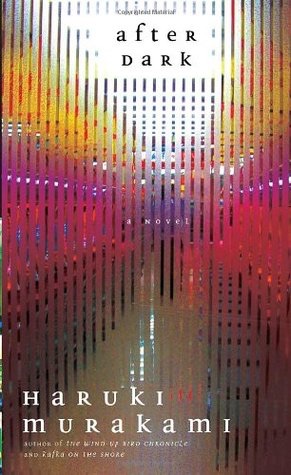
After Dark by Haruki Murikami

The Japanese writer, Haruki Murakami.

After Dark by Haruki Murakami

Haruki Murakami begins After Dark in much the same way that Charles Dickens hints at in the opening of Bleak House; that George Miller uses in the opening sequence of the film version of The Witches of Eastwick based on John Updike’s novel; and like Stephen King (with Peter Straub) opens Black House: a vast view over the land, the city, and then gradually focusing closer and closer until alighting on just one story in a land, city, of countless other stories; but as with King and Straub, but not as menacingly, Murakami personifies the god-like, eagle-eyed narrator who can fly through the air, see through roofs, and into people’s hearts. Here Murakami takes you, the reader along for the ride.

You know this in the opening two sentences.

“Eyes mark the shape of the city.
Through the eyes of a high-flying night bird, we take in the scene from mid-air.”

That all inclusive, “we” puts the reader in tandem with the narrator, described as nothing but a ‘point of view’.

However Murakami’s third person narrator has limited powers: there is limited knowledge of what is in people’s minds and these rare internal monologues are italicized, as if unusual. What is mainly recorded is what people do and say. This allows for surprises, and you, like a first person narrator, are as surprised as the next character.

It’s Tokyo after dark, beginning at 11.56 to be exact: each chapter is a time, 12.25, 2.43, 4.33 … 6.52 that marks its passing. The cast of characters is small. Takahashi, a lanky law student who plays the trombone and jams with his friends all night; the plain sister of Eri the sleeping beauty, Mari Asai who reads novels in family restaurants all night; Kaoru, the hefty manager of a love hotel, Alphaville; her two homeless assistants, Komugi and Korogi; a nameless Chinese prostitute who is beaten, robbed, and left naked in a love room; her pimp; and her abuser, the mysterious, immaculately dressed businessman, Shirakawa who seems to never sleep much to his wife’s annoyance. There are reasons why these people inhabit the small hours of Tokyo, some we discover, some we do not; but it is the story of the beautiful sleeping sister, Eri Asai, that is the most mysterious and fulfilled my expectations of Murakami. She is sometimes profoundly asleep in her bed in her room, sometimes alarmingly awake in a television set looking out trying to attract someone’s attention. There is a mildly satisfying ending but it is the relationship between Takahashi, the trombone player, and Mari Asai, the plain sister that is the most touching. Their developing attachment is handled deftly mainly through realistic dialogue – oh how effective dialogue can be to advance action and build relationships.

There is indeed mystery, a romance of sorts, and suspense but one thing marred my enjoyment of this work: the translation… I think. All the characters talk like the disaffected youth from New Jersey as they hang out over a McDonalds counter.

“I’m not gonna let the bastard get away with beating up an innocent girl. And it pisses me off that he skipped out on his hotel bill. Plus, look at this pasty-faced salaryman son-of-a-bitch: I can’t stand him.”

Do stray Japanese youth talk in Japanese like stray American youth talk in English? Possibly. Does Murakami use an Americanised Japanese to write his fictions? Possibly. Is the translator being true to Murakami or true to the target audience? I’m not sure. Do we assume that an American translator should translate Japanese into American English? Probably. Should my dissatisfaction be aimed at Murakami or the translator, Jay Rubin? I don’t know.

I have always believed that everything we read in a published book, and everything we see in a released movie is intentional: a decision has been made by someone about every detail. What we read and discern we are meant to read and discern, so I had to try to get over my dissatisfaction with the translation. Besides Jay Rubin is one of the main translators of Murikami’s work, and famous for it.

One of the joys of reading a book born from a different culture is that difference. I’ve delved into Irish, Dutch, South American, and Scandinavian literature over the past decade or so and yes, I could discern, and argue, that an Irish-ness, Dutch-ness, etc is present in each of those works. However, I felt that there is nothing Japanese about After Dark except the names of people and places. It didn’t feel Japanese. Mind you, I haven’t read much Japanese literature, in English of course; I haven’t been to Japan; I have only taught English to a handful of Japanese adults.

Murikami’s voice, in his English translations, is obviously something that I will have to come to terms with if and when I again pick up another book my Haruki Murakami.