‘somethink’


Somerthink pic
Professional consultancy for your Asia Pacific / China / Hong Kong events

TOP DEFINITION (Urban Dictionary)

Mis-pronunciation of the word something.

Also an indicator of low-IQ.

Imbecile A: Have you heard that song somethink in the way she moves by The Beatles?

Imbecile B: I have never heard of anythink by The Beatles. Are they a new band?

**********************************************
I know a living language like English changes but sometimes those changes are ‘wrong’.
The word ‘thing’ is a noun; the word ‘think’ is a verb. Saying ‘somethink’ but meaning ‘something’ is lazy enunciation.
But there’s a reason it’s so common …

The “ing” end of “something” is made in the same place of articulation as a “k”

The back of the tongue lifts at the soft palate for both the sounds. In “ing” the soft palate is lowered so sound can resonate through the nose and your vocal cords happily continue buzzing along. If you stop the vocal cords vibrating and you raise the palate you get a “k” sound. Maybe that happens just as you finish talking and then maybe it becomes more pronounced over time. Maybe it’s an influence of German for speakers who do it since final consonant devoicing is pretty common there.

John McCarthy, Speech Language Pathologist; Ph.D. Communication Sciences & Disorders & Augmentative and Alternative Communication, Pennsylvania State University.

… which strengthens my point: it’s lazy.

It’s use used to indicate a low IQ or poor education; but I’ve heard BBC journalists use it, academics, and teachers.

When the Scots say ‘summat’ it’s called an accent.

Those who use it, probably don’t know they use it, their brain is just mimicking what they hear.

Those who say they haven’t heard it aren’t listening very well.

There’s a Facebook page


Somethink  is an award-winning multi-disciplinary creative studio, founded in 2001. Their purpose is to transform ideas into meaningful design through a holistic approach. They develop brands for the long-term while changing perceptions through creativity.

Somethink is a song by Zoe Taylor Cassals

Somethink is a piece of @electronica by Thin King

Somethink Completely Different by Mwah is a book (new $4.18; used $3.89) about playing (around) with words differently, about being poetic differently, about making you smile differently, about inspiration and wit—but differently. You can buy it here.                     “We recommend this book to all who think with words and like to inspire theirselves with type and funny one-liners.”
-Typostrate.com

Somethink for Everyone by John Walter Cherwonogrodzky (Kindle edition £3.81)is a book with 545 ideas that range from astronomy to the atom to biology to religion and more. You can buy it here

Somethink (NZL) is a mare born in 2014 on September 4 by Rip Van Winkle out of Storm At Sea. The current race record for Somethink (NZL) is 0 wins from 3 starts.

So, what do you thing?


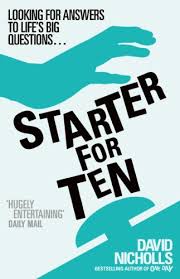
Starter for Ten by David Nicholls

David Nicholls pic
British novelist and screenwriter, David Nicholls.

I first encountered the work of David Nicholls with Us (2014) late last year. You can read my blog about it here. Starter for Ten (2003) is his first novel and there are many similarities with Us: the first person narrator, here Brian Jackson, like Douglas Peterson in Us, talks to the reader like you’re old friends, but – and here is where Nicholls shines – the hero is really a dork; yes, people call him names, especially his best friends, but you agree with them, Nicholls shows you, more than tells you, what he is really like: loveable but … for an intelligent university undergraduate he is clueless, particularly when it comes to women and himself, and that’s where most of the humour lies.

Brian Jackson has finally got to university and he heads off to engage with knowledge.

I want to know about Plato and Newton, Tolstoy and Bob Dylan; what the words ‘dialectic’ and ‘peripatetic’ mean; I want to know why people actually like jazz …

He is so enthralled with knowledge having been brought up on a diet of TV quiz shows whose list of questions has usually been introduced with the phrase ‘And your starter for ten is…’ i.e, your first question for ten points is … and his father has instilled in him at a very young age that getting it right is the ultimate point to everything.

He wants to join every student club there is but decides on the University Challenge team, well, he doesn’t quite get on the team, he’s given the standby spot. University Challenge is a nation-wide TV quiz show and he’s desperate to find an outlet, a successful outlet, for all that knowledge.

He also wants to be loved and fixes his sights on Alice Harbinson, the prettiest girl he has ever seen. Of course everything gets in his way, study, alcohol, friends, Alice’s parents, Alice, his Mum, and most importantly, his own view of himself – as well as his arms: what do you do with them when you’re sharing a single bed with someone?

It’s a laugh-out loud coming-of-age story, it’s become a Nicholls’ specialty, and framed by his ambition to be in the team for the coming-up new TV series of University Challenge. Yes, he gets places with Alice and yes, he gets on the team but that’s only a taste of the story. No spoilers here.

It’s highly predictable – but some unexpected twists – but entertaining and very funny.

On YouTube you can find an excellentHBO/BBC movie version (in English, you’ll soon get used to the Spanish sub-titles) made in 2006, penned by Nicholls, co-produced by Tom Hanks, with Sam Mendes as an executive producer, directed by Tom Vaughan, and  staring James McAvoy, Rebecca Hall, James Condon, and Benedict Cumberbatch.

You can buy the book, and other David Nicholls titles, in various formats here.


Ordinary Thunderstorms by William Boyd

William Boyd pic
Scottish writer, William Boyd

I place a lot of importance on the first page of a novel, and William Boyd’s first page of Ordinary Thunderstorms (2009) is a doozy.

It almost made me forget the book I was reading and move quickly on to the second page and the third… and …

Page one is perfectly in tune with the marketing cover design:

…swept along with the thundering narrative tide – Observer.

A thriller of hide and seek among London’s low life. – Tatler

A storm of a story – Daily Mirror

A compelling fugitive chase … – Evening Standard Books of the Year

I can’t remember when I’ve had a more exciting read. – Antonia Fraser

Thrilling, hilarious, intricately plotted and terrifically readable – Craig Raine, TLS Books of the Year;

and the best one saved for the front cover:

A deft combination of suspense and literature. – Stephen King

I was hooked and looked forward eagerly to starting it.

And the opening of the story doesn’t disappoint. A successful and upwardly mobile climatologist, Adam Kindred, goes into a cafe after a very important job interview, a job that could define his career, to wind down. He makes casual conversation with a man at the next table, a man who leaves behind a file. Adam surveys the technically challenging documents and finds a phone number which he rings and arranges to return the file to the man’s hotel room. When he arrives he finds the man on his bed with a knife in his chest. The man demands Adam pulls it out. “Pull it out!” Adam obeys and promptly the man dies leaving Adam with the bloody murder weapon in his own hand – and the murderer out on the balcony. He runs.

He runs and disappears; and it’s the disappearing and the people he discovers on the way that take up the bulk of the novel. This is fascinating but not particularly thrilling, in the sense that a thriller is thrilling. His particular method of disappearing is simple and surprisingly effective. He completely avoids the modern world that is defined by electronics. He doesn’t use his smartphone and he doesn’t use his credit card; the devices that make any human being knowable and traceable.

He is forced to sleep under a bush under a bridge; he is forced to count every penny he has in his pocket and use it wisely, he is forced to eat a seagull; he is forced to beg, and develops an intriguing, if dishonest, but effective method; he is forced to change his appearance – from a clean-shaven man with a head of hair to a bearded baldy; he is forced into a saintly refuge where he garners a new name, new friends, and is taken in by a prostitute called Mhouse – a wonderful literary creation – and her two-year old son, Ly-on whom she drugs as she can’t always afford a baby sitter. Through luck and circumstances of his own making he obtains yet another identity and consolidates that identity with a credit card and a smartphone. He turns into someone else.

Of course the police are after him as well as the murderer and the murderer’s superiors and these characters are equally interesting;  but of course, they are after Adam Kindred, a man who no longer exists. There are close-shaves and the stakes are high, but there is also romance and an ending that I won’t go into. No spoilers here.

I have been hearing about William Boyd for some time. He is a playwright, short story writer, screenwriter, and director and the author of highly praised and award winning books; he has been on the Booker Prize list twice and won the Costa Book of the Year in 2006 with his novel Restless; and I also understand why he was chosen by the Ian Fleming estate to write a James Bond novel called Solo which came out in 2013. I get the feeling that Ordinary Thunderstorms is one of his minor works and while I enjoyed it, it’s interesting and entertaining but not accurately reflected by the hype on the cover.

What did someone say once about how not to judge a book?

There are many enjoyable videos of William Boyd on Youtube such as this one: An evening with the Sunday Times bestselling author, recorded at the Duchess Theatre 24 September 2018.

You can find many books by William Boyd, including Ordinary Thunderstorms, in various formats here.

The Controversy over American Dirt

American Dirt pics
American writer, Jeanine Cummins and her recent book American Dirt.

American Dirt (2020) is a novel about a Mexican mother and her son who are forced to join the hordes of immigrants to try to enter the USA. The controversy around it rests on not just a white woman writing about a brown woman, and a writer who doesn’t understand the plight of ‘the other’, but critics are also  questioning her writing skills.

The two sides are simply described by NBC journalist Gwen Aviles:

The novel’s defenders maintain that Jeanine Cummins’ book, released on Jan. 21, is an important narrative confronting a topical issue, U.S. migration from Mexico and Central America. The book has been championed by high-profile celebrities, like Oprah who named it her bookclub pick.

The novel’s critics, however, primarily consisting of Latinos and other people of color, have deemed the book opportunistic and racist and are questioning why Latino authors often don’t receive a similar level of support for their projects, which touch upon similar themes and are written from an insider’s perspective.

This white-privileged use of people of colour and from other cultures as ciphers in novels has been around for hundreds of years: Charles Dickens’s Great Expectations (1861) and Charlotte Bronte’s Jane Eyre (1847) are the most famous examples and both spurned novels that ‘wrote back’ to the colonial centre with Peter Carey’s Jack Maggs and Jean Rhys’s Wide Sargasso Sea respectively. The characters: Dickens’ Abel Magwitch, a convict escaped from Botany Bay, and Bronte’s creole and unnamed mad-woman in the attic were used as plot points and not as rounded characters and it took Carey and Rhys to give these characters a voice and their own power and agency. These latter books are part of a literary genre known as Post-Colonial literature.

It’s not that a white writer cannot write about a brown character, it’s that when a white writer does they must do it with an understanding that that brown character has agency, honour, a past, and future. In other words the brown character must be respected.

The publishers of the American Dirt, Flatiron Books, a division of Macmillan have cancelled their planned national book tour because of the controversy.

An open letter signed by 138 writers has been sent to Oprah Winfrey asking her to rescind her support for the book. The letter succinctly explains the criticism and you can read it here.

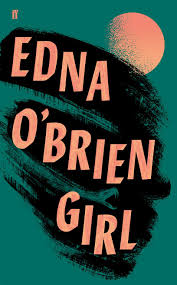
Girl by Edna O’Brien

Edna Obrien pic
Irish writer, (Josephine) Edna O’Brien

Girl is a first person account of Maryam, a very young girl, who with many others are kidnapped by members of Boko Haram, an ultra extremist sect of Islam in West Africa, although in the text it is only known as The Sect. She escapes, wonders aimlessly in the forest with her baby daughter, is discovered, returned to her mother who doesn’t recognise her. Does she also need to escape her family?

There’s an issue with this book that goes to the heart of what fiction is. O’Brien travelled to Nigeria twice to research this novel. She’s just turned 89. She said …

So one day I was in a waiting room (Doctor’s ) and I read a small item in a newspaper while I was waiting which said: A girl called Amina Something Something was found in Sambisa Forest wondering with her baby with nothing to eat, didn’t know her name and didn’t know where she was. And for some reason that’s inexplicable to me, I thought: I have to write that story. I didn’t think it when I first read about the girls, or when I heard about the hashtag #BringBackOurGirls. There was something about the girl alone in a forest that resonated with maybe lived and maybe imagined experience inside me.

The book is difficult to read. Her kidnapping, multiple rapes, witnessing a woman stoned to death, treated like a slave, mistreated and ignored by other women (perhaps the saddest blow), rendered invisible, are described vividly, if not in detail, although the detail she does share is certainly enough. It is confronting to think that human beings can treat other human beings like this. Yet, she was treated like this because she was a girl. Her forced marriage comes almost as a relief. Even her escape with her baby daughter was treacherous, misunderstood, and almost unbelievable, as well as unbelieved. Her reunion with her mother is distressing: they don’t know each other any more.

It is written as fiction – the word fiction implies untruth – yet we are lead to believe that these things actually happened to the girls who were kidnapped by Boko Haram in Nigeria in 2014. O’Brien met them, talked to them, heard their stories, wrote them down. And yes, I believe these things did actually happen to those girls, so I suppose, my question is why did she choose the novel form to tell her story? She is a writer of novels so perhaps she thought of no other way.

If you are in any way squeamish about violence, extreme sexual violence, on the page don’t read this book, or if you are, but do, its fiction label may give you some reprieve.

In order to explain the abundance and importance of truth in fiction I have often used the line, Fiction is about truth but to make it clear one has to lie about it a little. This still holds true.

And, yes, as O’Brien admits in her Acknowledgments, Maryam, her creation is an amalgamation of ‘the imaginative voicings of many through one particular visionary girl.’

So yes, this is fiction, Maryam in untrue, but her story is not.

Edna O’Brien’s first, and most (in)famous book, The Country Girls, came out in 1960. She has been a writer all her adult life, but as she says, the first was easy, it had been welling up inside her all her young life, she wrote it in 3 weeks, but each book is harder than the previous one. This one took three years and it may be her last.

If you search for her on YouTube you will find many fascinating interviews. Here’s one from the early 1990s to get you started.

You can find various editions of Girl and her other works here.

Girl, Woman, Other by Bernardine Evaristo

Bernardine Evaristo pic
British writer, Bernardine Evaristo MBE won the 2019 Booker Prize for Girl, Woman, Other.

Even before I started reading, I saw – there were no capital letters, no fullstops and the lines were of different lengths – and my prejudices jumped up and I thought, ‘Oh, poetry.’

But then I started reading – each new sentence, no capital letter, begins on a new line and there is no full stop, just a new line; and the unconventional format didn’t hamper the understanding.  It was clear. There is punctuation within each sentence, just not to begin or end them.

Evaristo calls it ‘an experimental novel’ which could refer to its unconventional format on the page or its structure as a book: there is no through-narrative although the lives of some of the characters intersect. In a sense the narrative is Britain itself but not a novelistic narrative that starts on the first page and finishes on the last.

Girl, Woman, Other, as the title implies is about women: Amma, Yazz, Dominique, Bummi, LaTisha, Winsome, along with Carole, Shirley, Penelope, Megan, Hattie and Grace: all British women, mainly black and so all are a consequence of Britain’s colonial past and the book is therefore an example of post-colonial literature which, in a nutshell, is writing that reacts to, usually against, the discourse of colonialism that was seen to perpetuate cultural imperialism.

Primary works in this field were writing against, or back to, colonial texts: Jean Rys’s Wide Sargasso Sea (1966) is a post-colonial take on Bronte’s Jane Eyre; J. M. Coetzee’s Foe (1986) to Danial DeFoe’s  Robinson Crusoe; Patrick White’s Fringe of Leaves (1976) to the popular myth of Eliza Fraser; Peter Carey’s Jack Maggs (1997) to Charles Dickens’ Great Expectations; Chinua Achebe’s Things Fall Apart (1958) to the colonial notion of the black man notoriously portrayed in Joyce Carey’s Mr. Johnson. In all of these post-colonial rewrites, the native character – the other – is given power denied them in the original colonial text. For example, the protagonist in Jean Rys’s Wide Sargasso Sea is Antoinette, a creole, and deals with her early life in Jamaica where she is forced into an arranged marriage to an Englishman; Antoinette is the heroine, she has the voice and the power (although not enough, she is a woman), unlike her literary dopplegänger, the un-named mad women in the attic in Bronte’s Jane Eyre – the first wife of Mr. Rochester of Thornfield Hall. Rys gives the mad-woman – a creole – a past, a name, and therefore authority.

Post-colonial writers today are not usually writing back to an existing colonial text*, but Evaristo, and her British contemporaries, Zadie Smith, Andre Levy, et al, are writing back (against) to a cliché-ed perception of what a British person is. They are also writing back to a perception of what a British woman is.

The writing is uncluttered, contemporary, conversational, and unintellectual. However, it has the flavour of journalism. Each woman’s story (and most are interconnected) feels like it was written for an article in a weekend magazine. Prose, and the characters that inhabit it, come to life when they react with each other. There is dialogue here within the prose, unannounced by punctuation but clear, but not much. Fiction works when all three elements, description, narrative and dialogue, are given their full force. This is really my only criticism. Dialogue is the most powerful descriptor of character, but here it is used sparingly, and so I felt some characters are not fully realised. There are some portraits that include intimate detailed scenes and these are the most powerful.

What impressed me was the authorial authority and bravery of writing without the usual writerly conventions: capital letters, full stops. The third person narrative slips easily into the first; the past tense seamlessly into the present without any loss of understandability. The prose has a playful freedom that is refreshing and new. I just would’ve liked to hear the characters talk more.

Evaristo is a self-confessed feminist and has been an anti-racist activist for all of her adult life.

Being the Booker-winning black woman writer in 2019 means that my black British feminist perspective is amplified around the world, and for the first time I am starting to feel heard beyond my community.

However, despite her win and her positive attitude to her win her feminist and anti-racist struggles continue. In early December 2019 over 190,000 people watched a lazy BBC announcer say ” … the Booker Prize was shared between Margaret Atwood and another author…”; he didn’t even bother to use her name and Evaristo tweeted ‘…How quickly & casually they have removed my name from history – the first black woman to win it. This is what we’ve always been up against, folks’ and started a twitter storm causing the BBC to publicly apologise to Evaristo. The Guardian newspaper also caused a furore over a headline referring to Girl, Woman, Other, Evaristo’s eighth, as ‘obscure.’ The headline was quickly re-written. It might seem trivial to some but it is the day-to-day small moments that perpetuate black people as the ‘other’; like the waitress who assumed Evaristo’s white dining companion would be the one to pick up the bill.

Girl, Woman, Other is a deserving winner of the Booker; it’s co-winner Margaret Atwood’s The Testaments, less so. You can read what I thought of that book, here.

You can browse and/or buy Girl, Woman, Other and Evaristo’s other novels here.

*However, in 2015 Algerian author, Kamel Daoud, had published The Meursault Investigation, a post-colonial take on Camus’s iconic The Stranger (1942) where the real stranger was refocused as the unnamed Arab that Camus’s protagonist shoots five times on a beach.


Saint Maybe by Anne Tyler

Anne Tyler pic
American writer, Anne Tyler.

Read Anne Tyler.

Have you read any Tyler yet?

You should read Anne Tyler.

These, and other inferences, came from a fellow book worm and one whose opinions as a reader I trust. So, finally, I read Anne Tyler.

Saint Maybe (1991) is typical of her work: family relationships. There seems two kinds of families in the American novel: the apple pie variety and the gun variety. Tyler’s are the former but, of course, coping with a threat, a dilemma.

Ian Bedloe, the son in an apple pie family in Baltimore did something he believes was very bad and caused two deaths. Only he knows what he did, what he said; the only other person, his older brother, who was there when he said it, and to whom he said it, is dead. He is desperate to be allowed to atone for his ‘sin’ and is drawn into a local Christian denomination called The Church of the Second Chance. After what he’s done, he so wants to be good. And forgiven.

What interested me in Saint Maybe is the subject of religion. I was brought up in a religious family but the Christianity taught by my Christian denomination (Lutheranism) always seemed to be more like an insurance policy than a belief system. My mother read the bible like a novel. I have come to understand that religion is a very important element in human existence: each group, tribe, and civilisation since the year dot has had a belief system; mainly to answer the big questions (How did we get here? What are we doing here? What’s that big ball of fire in the sky? and There’s got to be something better, doesn’t there?) so we can get on with the everyday necessities: digging for yams, inventing machines, filling in a tax return. What I object to, and what I see as a blight on humanity, is the administration, and interpretation, of these belief systems: the temple, the synagogue, the mosque, the church.

I believe in the Holy Spirit; the holy Christian Church, the communion of saints …”. So begins the last line of the Apostle’s Creed I learnt as a child, yet all three, the holy spirit, church, and saints are inventions of the (all male) administrators of Christianity over millennia.

The Church of the Second Chance is exactly one of these ‘administrations’; it teachers not so much what Jesus Christ said but what its leader, Reverend Emmett, says and Ian, so looking for a path to redemption and his second chance for what he has done, joins Emmett and his small flock, waiting, as the Reverend Emmett says, for a sign that he has been forgiven.

The Bedloes aren’t religious but Ian’s commitment to The Church of the Second Chance slowly pulls them in; ritual and routine can do that to people’s lives. The family conforms to the Church more out of respect for Ian than for a commitment to its beliefs.

Stream-of-consciousness is a novelistic technique (thank you James Joyce) that recently has had a revival: Anna Burn’s The Milkman won the 2018 Booker Prize and Lucy Ellman’s Ducks, Newburyport was shortlisted for the 2019 Booker. It usually is associated with internal thoughts,  the ordinary, the minutiae of people’s lives. Here, Tyler uses the more common third-person narrator to tell the very plain story of Ian Bedloe.

Above her work-desk is the following quote.

As a queen sits down, knowing that a chair will be there,

Or a general raises his hand and is given the field glasses,

Step off assuredly into the blank of your mind.

Something will come to you.

…from Walking to Sleep by Richard Wilbur.

“I see those words as about getting an idea and making a  book,” says Tyler. “I don’t get anxious. It will come to you, let it come in.”

She works in long hand, rewrites in long hand, and only when she is satisfied will she then type it onto a computer; print it out and work on another draft in long hand. And so it goes. Her style, if she has one – she says she has no style at all – is “unmistakably hers: transparent and alert to all the nuances of the seemingly ordinary,” wrote Charles McGrath in a 2018 profile in The New York Times.

It’s true that the appearance of truth in fiction is achieved through detail which is why her writing is so believable: her work is full of detail, to the brim with detail: the weather, the light on window glass, a tone of voice, a look, the type of cut and grain of wood, what people know and don’t know; but she also deliberately omits detail, for the reader to work out. This also, ironically, adds veracity to the work; creates an investment for the reader in the story and its meaning. She is a joy to read.

Saint Maybe was filmed for television in 1998 starring Blythe Danner and Tom McCarthy, directed by Michael Pressman from a teleplay by Robert W. Lenski.

You can buy the book in various formats here.


Monday in Piss Street

a short story

I live in a shit-hole. Lying here ain’t good. My bed stinks. I fart loudly and crawl through the thug of it and go to the kitchen. I can hear me mum snoring from here. It’s a small place. Yeah, course it is. Cockroaches nyere-nyere me as they scatter away. They feel safe, I reckon. At home. I open the fridge. There’s lots of space in our fridge. Green muck too. Fuck! The milk’s off. I drink from the sink tap. Tastes like Draino. What day is it? Shit! I’ve got to go to the dole office. There’s this fat fag creep there who looks at me like I’m a Macca’s burger with fries on the side, like that chick in that ad on TV. Hope I get the swami girl. She’s got Milo skin and eyes like mud cake. I shower, feel like a dump, take one. The Dettol soap is a nail clipping but it still strips every bit if moisture out of my skin. Me mum believes in squeaky clean. That and smack. Yeah, I know.

I can hear Scotty scratchin’ at the back door. I let him in and find a rusty can of four-bean mix in the cupboard, behind the tea bags she steals from the motel down on Cowper Road. A job she’s got, three days a week. It used to be two days but she gave the manager a blowjob and got three. That’s what I reckon. I open the can with a bread knife and Scotty and I share it. I go into me mum’s room and scratch around in her side drawer and – bingo! – find a twenty-dollar bill. Fuckin’ awesome. She’s dead to the world. I cover her up properly after starin’ a bit.

On the floor I find a belt to use as a lead for Scotty. We go to the shitty local con store; mum keeps telling me I need to think about the future. I’ve got to get some dog food. The chink sits behind mesh wire the thickness of pencils. I slide two cans of Chow, a Snickers bar, and a half litre of milk at him. He doesn’t look at me. I was 5 cents short on a packet of bbq chips once and he wouldn’t let me have them. I broke his nose, the slanty-eyed prick! Now there’s this fuckin’ pencil mesh everywhere. He gives me $1.50 change and I feel like punching him again. He knows it too. Fuckin’ reffos. Robbing us blind! Scotty craps on the footpath. I don’t have a placky bag with me, never do, so I shove it into the gutter and get dogshit on my stubs. Bloody hell! I find a patch of grass inside a car tyre, push it aside, and try to wipe me toes clean with it; fuckin’ jeez, I must look like a spazo dancing or somethin’. Scotty barks. Shut up ya dick! I see a couple of white haired geros up ahead. They stop talking and cross the street. “What are ya lookin’ at, ya coupla cunts! You’ll be dead before me. I’m just walkin’ me dog! Sa free country!” They scurry on a bit, as fast as their skinny little bandy legs can carry them. Ha! Makes me want to vommi. The pricks!

Charlie finishes serving a chick with her skirt up her crack. “Morning, Bo. What can I do for you”. He looks at me. I look at him. He knows what I’m goin’ to say. “Me mum’s still sleepin’ it off and there’s no food in the joint. I gotta go to the dole office. Can I have a burger?” “What about your mum?” he says. “Yeah,” I say. “Can ya make it two?” He looks at me like his shit don’t stink but he bailed me out once so mum says I can’t give him no lip. I gotta swallow it. Feels like nails. He goes to make the burgers. I stand and wait. I look out through the big window onto the street and see that pansy from the pub on the corner; the pub where they do prissy shows watched by chicks in merks and blokes with haircuts. I looked through the window one night at a couple of guys in frocks telling jokes about god and the prime minister. The crowd was lapin’ it up. Some sort of code, I reckon, like commi shit or somethin’.  The sissy-boy’s with his dicky little benji-dog. He bends down and picks the stupid mut up as good ol’ Scotty yaps fit to split and goes for his ankles. Rip him to sheds, Scotty! Little Scotty won’t leave him alone and his fluffy mut yaps in his arms. I’d laugh if I had the energy. Charlie gives me the burgers and I say “Thanks” like me mum said I had to. Scotty keeps barkin’ and jumpin and the sissy-boy…”Hey!” The cunt’s tryin to kick my dog. “Hey! Shit face! What the fuck do ya think ya doin’?” I run right up to him and stand right up to the prick with my chest in his face. He looks like he’s goin’ to shit himself. “You tryin to kick my dog? Hey!? Hey!? Ya fuckin’ cunt! Kick my dog and I’ll smash ya fuckin’ face in!” The fag tries to speak, “Well I’m not going to push a dog away with my hands, am I?” “What’s that supposed to mean,” I scream at him. “You tryin to be some kind of smart arse? Hey!? Hey!? Are ya!? Hey!?” and the cunt turns and walks away. “I’m askin’ ya a question, dum-fuck. What’s a poofta like you tryin’ to kick me dog? Hey!? Fuckin’ nancy-boy, take-it-up-the-arse, shit-pusher! Go on, answer me fuck-face. Poofta!” I yell and it feels real good. He’s shakin’ and can hardly walk straight. And then he stops and turns his lilly-white pansy-boy-face, white as froth, and says to me somethin’ like if I wanna insult im or somethin’ I’ll have to find somethin’ diff’rent than what’s true. What?! “What did you say!?” I scream. I don’t know what he’s tryin’ to say. “What the fuck!” I yell spit on his nose. “Ha!” I scream but the feel-good stuff’s oozin’ away and I hate it, but he’s still shakin’ huggin’ his stupid dog. I can taste his fear and it tastes good, salty-sweet. I’m runnin’ out of words. He walks away. “Ya fuckin’ cunt!!” I scream. My face is burnin’ and the heat in my body and lumps in my throat choke me, and I so fuckin’ hate it – “I fuckin’ hate it!” I scream at the sky; when smartarse pricks throw words at ya that don’t make sense. “Aaah!!” And I hear a few doors open and close. “What the fuck are you lookin’ at” I bellow at whoever can hear. But, I scared him shitless didn’t I? Yeah, the prick. Scotty is pullin’ on my belt, with his tail down and pullin’ away from me. “Come here! Ya my fuckin’ dog! Mine! Come here, ya prick.” And I can’t yell anymore and I walk away draggin’ Scotty like a pyjama bag I saw a kid with once on TV.

I sit under the concrete steps that go up to the freeway and try to stop the drummin’ in my ears. I eat my burger. It helps. Scotty looks at me like he doesn’t know nothin’. I give him a piece of bun. He eats it. I still feel hot but it’s goin’ away. I walk up the stairs to the freeway, and along the footpath to the park and let Scotty off the lead. He doesn’t know what to do. “Run, ya prick,” I say. I walk over to a tree and lean against it listenin’ to that drummin’ again. It’s getting fainter I think. A poxy bloke in a suit comes up to me and says, “Hey, pretty boy! Want to make a bit of money?” “Fuck off,” I say but it sounds weak. It comes out like I’ve got a cold, or somethin’. “What do you say to twenty bucks for a blowjob?” he says with just a slit on his shiny face, like we’ve done this before. “Fuck off,” I say again. More like a whisper this time. But I think about the money and how I can get the bus to the dole office, and maybe, some food for tonight. I gotta think of the future, like me mum says. “Fifty,” I say. “No blow, just a hand.” “OK, twenty though,” he says. “Fifty or nothin’” I say and make it like I don’t care.

His little dick is hot is my hand but it doesn’t take long, thank kryst, and no way did I let the faggot touch me. No way. He messed his expensive shirt which made me smile which gave him the wrong idea. I wiped my hands on the grass and took off with my bus money. Needle-dick loser. I took Scotty home. Me mum was still dead to the world. I put her burger in the fridge. I took the bus to the dole office.

I sat on the bus next to a chick with really big knockers, a green t-shirt and cut-off jeans. I said, “G’day.” She looked up from her phone. Nothin’. What is it with chicks who won’t even say g’day. Stuck-up bitch. I gotta get myself a phone. Yeah. The fat creep isn’t on duty today. Yeah, but the swami girl is. I wait and let some nuf-nufs go before me so I can get swami-girl. I sit at her desk. She’s really pretty and has a purple scarf-thing over her black hair.

“Hi, Bo. How you been going?”

“OK.”

“Just, OK?”

“Yeah.” I hand her my form.

“You’ve been to see all this people; all these jobs?”

“Yeah, course.”

“If I rang some of these people, they’d remember you?”

“S’pose not.” I ain’t stupid.  “They see heaps of fuckers.”

“How’s your mum?”

“OK.”

“Still working her two days a week?”

“She’s not working. Hasn’t worked in months”

“I thought she was at the motel two days a week.”

“Nah, when it came to pay day the prick wouldn’t pay her. Sack’d her.” Can’t tell swami-girl the truth, mum said.

“I see.” She goes down the list of interviews I’ve done, well, done some of ‘em. She looks at me like she likes me. I like her too. She’s wearin’ lots of flowing clothes so I can’t get the jist of her body, but I bet it’s alright. I start imaginin’ her black swami bush between her legs and I get a hard-on. I wanna touch her. I look at her hands and she’s wearin’ a few rings. She’s not supposed to wear stuff like that at work. Ya can get smashed fingers from some prick who’d cut your hand off as soon as look at ya. They’d fetch a bit, I reckon. She looks at me. I look at her. The kind of too-long look you see sometimes in movies. I reckon she likes me for a fact. “Nice rings,” I say. She looks at her rings and takes them off. Fuck! Why she do that for? “I was just lookin’.” “Sure,” she says but you can see she’s scared a bit. Stupid bitch! She looks at me again and there’s somethin’ she wants to say.

“It’s fuckin’ OK, alright?” I say.

“Is it Bo?”

“Ye-ah!?” What’s she getting’ at?

“You’ve got to think about the future, Bo.”

“Yeah well I am! Me mum says that shit all the time. I wanna get a phone.” I think about that loser in the park. I gotta get a phone. She’s lookin’ at me. Now, I don’t know if she likes me or not. This is what I don’t get. Chicks look at ya and ya know what they want, and then they look at ya again and it’s different. Or they look at ya and ya know what they want, so you do it, and then they scream at ya, call you names, and piss you right off.

But she signs my form and I say, “Thanks.”

“Say Hi to your mum,” she says. “Next!” she yells.

I go into the city to make me feel normal. When you’re in the city ya can be anyone walkin’ around. I look at them and they look at me and see what I see, just pricks walkin’ around being normal. I breath normal. I break the fifty at Maccas but know I have to get some food for tonight. I like this feeing, this doing stuff for me mum. I walk past a posh supermarket and think, I can go in here, and so I walk in. I look at security and he looks at me. Shit! There’s so much light, so much stuff. I look at all the packets on the shelves and don’t know half of them. There’s a whole room full vegetables. It’s like a farm or somethin’. Don’t know half of them either. What are ya supposed to do with ‘em? I look for the can section and pick up two cans of spaghetti. Me mum loves spaghetti on toast. I see all the bread on a huge table. What is all this shit? Bread’s bread. I take one that looks like real bread, a square one, and the skinny guy at the check-out looks at me as if I’ve forgotten somethin. “What are ya lookin’ at?” I say. He looks away and then back at me and says, “Nothing at all, mate. Nothing at all.” And it’s like I hear the words he’s sayin’ but it’s not what he’s sayin’ and I can feel my ears burnin’ and that thumpin’ again. “How ya goin’?” It’s the security guy with a weak little smile on his puss. And more words but it’s not what he’s sayin’. What the fuck is he sayin’? And I want to scream so fuckin’ loud and punch his fuckin’ prissy face, cut his cock off, and shove it up his arse, but there’s so much fuckin’ light in here. I can feel it like sunshine and I say “Fine, thanks,” and it comes out like it isn’t me and I suddenly don’t know where I am. This skinny guy is handin’ me some money. “Here’s your change.” I look at it. I take it. “Don’t forget your stuff.” What? I take the bag and head for the street. I can feel security followin’ me. What did I do? What did I say? The world’s a mess and I have to side-step a man with a broom. “Fuck off!” I yell at him.

I get home and walk inside. Nothin’ but stink. And mess. No sound. I put the grocery bag on the table. It takes me five goes to find the toaster. I want to do this for me mum. I plug it in. I’m gonna make me mum some spaghetti on toast.  I can’t find a pot so I use a fryin’ pan. It’s got stuff stuck to it but there’s no washing stuff so, fuck it. I ring-pull the spaghetti and tip the sloppy stuff in the pan. I turn on the gas. I put two slices of bread in the toaster and push the level. Bang! There’s a flash, sparks, and I nearly shit myself. Fuck! Is that supposed to happen? I push the lever again. Nothin’. Again. Nothin’. Again. Nothin’. My jaw aches. Again. Nothin’! I yank the toaster from its socket and throw it into the lounge room. It hits the floor and a shower of crumbs flies up like a bomb’s gone off. I have to keep doin’ somethin’ or I’ll explode. A cup of tea. I’ll make me mum a cup of tea. Yeah. I search through the cupboards. Nothing but shit and stuff. Stuff and shit. Where’s the fuckin’ tea bags? I smell smoke or somethin’ and I turn to see the spaghetti burning in the pan. I grab it and throw the whole fuckin’ lot in the sink with all the other shit. I stand there with my mouth shut tight, tryin’ to steady my breathing. The thump-thump-thumping is deafening. I want to scream but me mum’s still asleep.

And then I remember. And the thought is like sunshine, like a birthday present. It could be happiness, even. The thumping stops and I suddenly want to laugh. The burger! I’ve got a burger in the fridge. Me mum’s burger. It’s there. Just there in the fridge. Me mum was right. I thought about the future, I’ve got this burger and now everything’s OK. This new feeling is strange, but kryst, it feels good. I’ll take her a nice burger. I get it out, un-wrap it, and find a clean plate, well sort of. I put the burger on the plate and take it into me mum. She’s still asleep. I get a little closer and I reach down to wake her like I always do. There’s vomit on her check and I can smell a different stink. What is that? I touch her shoulder and it’s like touching the toaster. Is this dead? I stand there. Me mum’s dead. I hear myself saying it. Me mum’s dead. I don’t know what to do. It’s like she’s been turned off, or something. What am I supposed to do? Dunno. I eat her burger.

The Silent Patient by Alex Michaelides

Alex Michaelides pic
Screenwriter and novelist, Alex Michaelides

So, thrillers go like this.

The first plot points give intensely conflicting actions, like a wife expressing deep love for her husband, then a day later she is discovered with a gun in her hand and her husband tied to a chair with five shots into his face, his blood mixed with hers as it drips from her slashed wrists, but she stands comatosed, but alive, and refuses to speak.

Then the first person narrator, an authoritative figure like a lawyer, doctor, or detective tries to get the woman to speak and is determined to solve the seemingly unsolvable mystery. There are no witnesses and the case seems cut and dried. He, and increasingly she these days, talks to people involved with the woman, and/or her journal, or long lost sister / lover / colleague, is discovered and details emerge about her history, her marriage, her family, her work colleagues which intermingle simultaneously with details of the narrator’s history, marriage, family, and work colleagues until a complicated web of possible motives, secrets, jealousies, and, of course, red herrings swim around your brain leading you to think, at various moments, ‘Oh, I know who did it!’ and then you are encouraged more in your beliefs and then suddenly they are dashed, or seemingly dashed, onto the rocks of evidence, only to emerge later as indeed a possibility, but maybe not.

Sometimes you are right and you’re left with a scraggy feeling of disappointment causing you to discard the book after ‘the end’, if you get that far, and to search for a different thriller writer.

Sometimes you are wrong and rarely, very rarely, you are hit over the head with the truth at the very moment of reading it, and you gasp.

The Silent Patient is one of those.

Alex Michaelides is a screenwriter of Greek-Cypriot/English extraction and lives in London. This is his first novel.

Adding to this mix of intrigue, and as a source of clues, are photo-realistic paintings – the woman, Alicia Berenson, is an artist; a Greek tragedy of love and resurrection by Euripides, Alcestis – the name of a Berenson self-portrait; and a secure psychiatric facility, The Grove, where our first-person narrator, Theo Faber, works and where Alicia is incarcerated.

At times the writing feels formulaic but it is, after all, a ‘No.1 New York Times Bestseller’ so you are warned. The film rights have been snapped up by Plan B, Brad Pitt’s production company, as part of its next three year plan and is currently listed as ‘in development’.

I rarely read thrillers – generally, I don’t care who did it – but this one kept me reading and what I love about this book is that the very way it’s written is a clue to, not who did it, but what caused it to be done, and that it is not a simple first-person narrative: when you’ve read it you realise that what you’ve read is only possible because you’ve read it. Enough said. No spoilers here.

The language is simple and direct and the pages are very easily turned. I read this in two afternoons. It’s the perfect airport novel, great escapism, entertaining, and Mr. Michaelides is grinning all the way to the good life. Smart Alex!

You can buy this book in various formats here.

The Testaments by Margaret Atwood

Margaret Atwood pic
Canadian Writer, Margaret Atwood

Yes, this is a sequel to The HandMaid’s Tale (1985) but it is not a continuation of the story. The Testaments starts fifteen years after the story of Offred, the handmaid, and is a trio of narratives, the three (written) testaments: a young girl raised in Canada, a young girl raised in Gilead, and Aunt Lydia, the villainous trainer ‘Aunt’ in the original story; she is the only continuing character.

There was a 1990 movie of Atwood’s The Handmaid’s Tale starring Natasha Richardson, Faye Dunaway, Robert Duvall and Elizabeth McGovern, directed by Volker Schlöndorff and penned by Harold Pinter which was not a success (it only made 5 million back on its 13 million budget) but the television (streaming) version of the book which first aired in 2017 was a runaway success. Timing is everything, coming as it did in the wake of the #metoo movement.

I suspect it was the success of the television version that sparked Atwood, and/or her publishers, to embark on a ‘sequel’.

In a 2018 ad for Masterclass – an online teaching platform that Atwood signed up to teach creative writing – she says that all the bad things in The Handmaid’s Tale happened “in real life somewhere at some time … I didn’t make them up.” She also says that “as a writer, your goal is to keep your reader believing in your story even though both of you know it’s fiction.” I always knew The Testaments was fiction; I didn’t believe a word  of it.

There are three reasons why I think this is not a good book and the Booker Prize judges made a very big mistake.

  1. Fiction is made up of three components: narrative, description, and dialogue. The Testaments is all narrative. This happened, then that happened, then this happened, with dialogue peppered through the narrative like herbs sprinkled on a salad. You don’t learn much from the dialogue. There is very little description. I suspect Atwood believed the images, the ‘look’ of the story and characters from The Handmaid’s Tale, the TV version, would satisfy the reader’s need to ‘see’ it.
  2. So much of the detail of the times and life in Gilead are justified in the same sentence in which the detail is introduced. This is often necessary but it is a necessity that should only be used sparingly. Too much of it and it sounds lazy and clunky. We are told too much, when we should be shown. As a reader I had to ‘do’ virtually nothing. I fell asleep a lot.
  3. And what I believe to be the greatest sin: when the story is one of survival and escape from an evil or severe danger, which it is, we do not see the villains, the bad-guys – Commander Judd et al – get their comeuppance. It is a very unsatisfying read.

The Booker judges decided on a winner for 2019, Bernardine Evaristo’s Girl, Woman, Other and why, of why, did they also announce Atwood’s book as a co-winner – it’s against the Booker rules, btw – when it is such an obviously commercial enterprise capitalising, not on the success of the 24-year-old original book but, on the 2017 TV version of that book? Maybe they thought the Booker needed the publicity. Atwood didn’t need a Booker; she already had one (for her 10th novel, The Blind Assassin, in 2000) where as Evaristo did, but then had it diminished by having to share it.  Both author’s were kind and sanguine about their joint prize as one would expect.

If you enjoyed all or either of the versions of The Handmaid’s Tale, book, film, or TV series, leave this one alone: it adds nothing.

However, you can buy various editions of The Testaments here.