The Beautiful Screaming of Pigs by Damon Galgut

image
The South African writer, Damon Galgut

Don’t worry if you are woefully unread in South African literature, so is the South African writer Damon Galgut.

“Local writers are trying to escape a rigid set of moral gestures, if I can put it like that, which have imposed repetition upon us. Perhaps cliché is nothing more than the weight of the past pinning down your mind. In this sense, imaginative freedom is a way of finding the future, though it isn’t so easy to do.”

In other words, Galgut is looking out from South Africa not looking at it. However, there is a tone to his work that can easily be linked to his country, his continent: a tone that is built on the black and the white, the long distances, the heat, the poverty, the seemingly political ineptitude and the sense of people struggling to live a life they want but never seem to get. Most, but not all, of his male protagonists are slight in stature, indecisive, confused, loners with an ambiguous sexuality. Patrick Winter, the first-person narrator in Galgut’s 1991 novel, The Beautiful Screaming of Pigs is one such protagonist. He is also mentally fragile since his compulsory two-year stint in the military where he became not only horrified by death and boredom but he attained a sense of hatred and terror at things like the insistent regularity of bathroom tiles and the rigid diagonals of sunlight. He takes Valium twice a day.

He travels to Namibia by car with his mother to see her black boyfriend who is politically activated in the first free elections in Namibia, formally South West Africa, where Patrick did his mandatory South African national service one year earlier and, now on this trip, he constantly wonders if the locals he meets may have been the same people that he shot at; that shot at him. It’s a story about a child and his mother; she, extroverted, thrives to belong “but her glamorous strivings were hollow’’; he, introverted, convoluted, his “patterns ran inward, spiralling endlessly towards a centre that didn’t exist.” They, tragically for both of them, belong together.

This book fell out of print but it was Galgut’s shortlisting for the 2008 Man-Booker prize with his novel The Good Doctor (2003), and subsequent fame, that gave him the opportunity to refine the text for the inevitable re-print. He was never quite satisfied with the original text: ‘discordant’ he called it.

“I woke to the sound of a pig being killed. I sat up rigidly in bed, not moving till the noise suddenly stopped. Then I got up and dressed and went outside. I had forgotten this about the farm. Its calendar runs on slaughter.”

This is typical of Galgut’s prose: stark statement of fact, short clear sentences without any mention of what the narrator feels; but the arrangement of such words, sentences, creates its own feeling, supplied significantly by the reader. Galgut draws the scene, we colour it in.

I once heard an ordinary female tourist talk about the end of her wonderful and surprising holiday on a foreign isle and her inevitable return: “Home I go,” she said, “to crawl back under my rock.” For all Patrick and his mother’s yearnings and plans this is what will happen.

“I sat down on a swing and rocked myself to and fro. In a little while, I knew, I would walk back up the road to the hotel, and we would pack our bags and go, and our usual lives would resume.”

The promise of travel and the lure of a foreign place is rarely fulfilled, it takes courage to stay out from under that rock; and Galgut by writing about this makes us aware just how rare and courageous it is.

You can find this book here.

The Good People by Hannah Kent

Hannah Kent lic
The Australian Writer Hannah Kent

It is not all that long ago, 1994, that Frank Moorhouse’s Grand Days was disqualified from the Miles Franklin Award (Australia’s most prestigious literary prize because it was not Australian enough (he won the prize for its sequel Dark Palace (2000), which contains one scene set in Australia); apparently Australian literary sentiment has grown up since then, thank god – although the real problem lies from the rules of eligibility for the Prize . Here now is an Australian author, Hannah Kent, whose debut novel, Burial Rites (2013) was set in Iceland and now her second, The Good People, is set in Ireland: and still not a gum tree in sight. The only thing Australian about this book is its author; but that’s all that is needed, and rightly so, to herald Kent as a new, rising, and shining voice in Australian literature.

Kent paints time, place, and character through dialogue. The time is 1825 in rural, south-west Ireland where the Catholic Church is as powerful as ever but also where old Irish superstition and language is still rife and useful. All of this is established through how the characters talk: here a man comes to seek council from Nance Roche about his troubling dreams. Nance Roche is a wise woman who lives alone in a windowless, mud hut near the wood and who is said to have ‘the knowledge’.


‘Faith, what does it matter? I’d best be on my way.’

‘Sure, Peter, Go on home.’

He helped Nance to her feet and waited as she used the tongs to pluck a coal from the fire, dipping it, hissing, in her water bucket to cool. She dried the dead ember on her skirt, spat on the ground and passed it to him. ‘You’ll see no púca tonight. God save you on the road.’

Peter put it into his pocket with a curt nod. ‘Bless you, Nance Roche. You’re a good living woman, no matter what the new priest says.’

Here archaic English (“Faith, what does it matter?”), old Irish (púca means ghost) and Catholic salutation (”God save you on the road.”) all create the world of this novel: illustrative, complex, colourful, informative, and believable. The last because of Kent’s success at creating verisimilitude: the appearance of truth. You do not need to look up the meaning of púca; nor do you need to research the veracity of the use of the word ‘faith’ as an exultation in nineteenth century south-west rural Ireland; nor that the possession of a cool coal from the hearth of a bean feasa living in a mud-hut will soothe one’s dreams. As quickly as you read the lines the reader accepts this created truth because of the trust we readers place in the creator of such truth; when the real truth is that we are sitting in our reading chair scanning and finding shared meaning from little dark marks on a pale background. All hail our imagination and those that tickle it!

Kent has done her publisher proud: produced a novel with all the qualities of her first that prompted her global success and her publisher’s trust in her in the first place (it’s rumoured her earnings from rights, foreign publishers and the like, was $1 million); mid-nineteenth century far-western Europe in a valley of poverty, crime, women, faith, and fear, but with such differences that make it fresh and new, in tone, theme, crime, spine, and ending.

This is a story of three women: a new and bitter widow, Nora; a servant girl, Mary; and a feared and revered loner, Nance Roach; unwedded, unbedded, and therefore considered unworldly, but ironically, powerful despite the “fear of any woman who was not tethered to man or hearth.” In a society of family and neighbourily trust, tension and anger can boil quickly if livelihood is threatened: if cow’s milk is without butter, if a hen’s egg is yolk-less, or if a man falls suddenly dead, the inhabitants clutch at reasons, causes – be it four crows seen huddled together at a crossroads; lights seen bobbing on a fairy mound; or a cretinous child thrust on a widow who has no means to support it.

This is what happens to Nora whose motherless and afflicted grandchild is suddenly handed to her but who firmly believes it is the mischievous fairies, The Good People, who have taken her Micheál and left her one of their own. Her attempts to return the fairy to its own kind and see the safe return of her grandson is what propels the narrative to its tragic finale.

The belief systems, be it Christian or fairydom, give meaning to these ignorant people; the world is mysterious and explanations are needed for everything that ties them down, keeps them safe, or lifts them up. They need these causes of things to be certainties to allow them to get on with their poor and mundane lives; to keep planting their potatoes, milking their skinny cows, and harvesting turf to heat their hovels because their only other choice is to take to the road: the worst of outcomes.

Some readers have found the book depressing; yes, the story is sad, but the writing is evocative and succeeds is creating a vanished world, surreal almost, for the reader to get lost in so when the world of this valley is pushed into a civilized courtroom the reader too is confronted by the complexities and necessities of belief, survival, and what is true, good, and right.

I urge you to read this book. You can find it here.

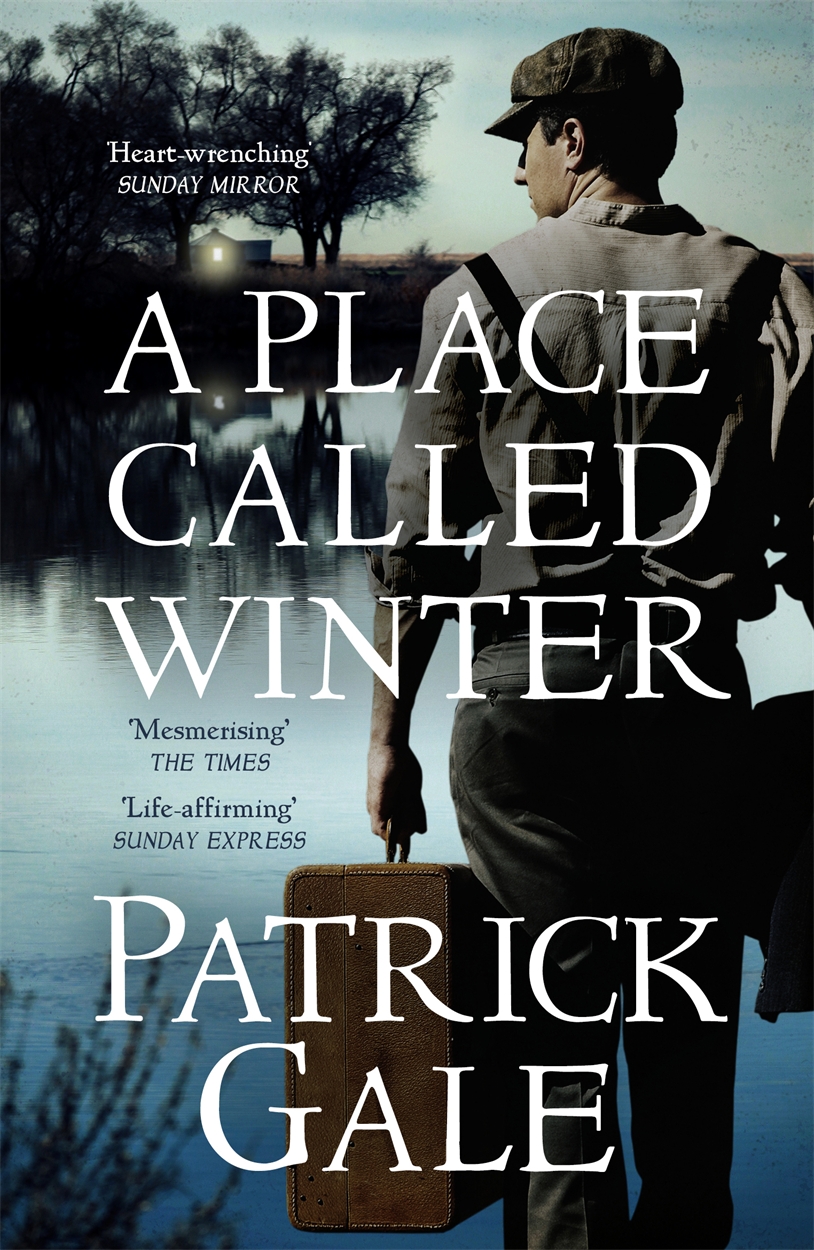
A Place Called Winter by Patrick Gale

patrick_gale_pic2
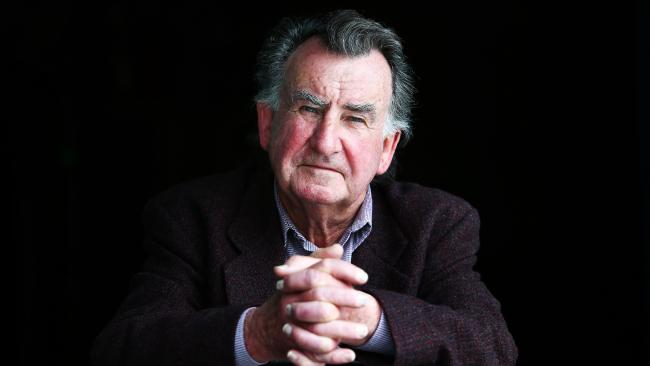
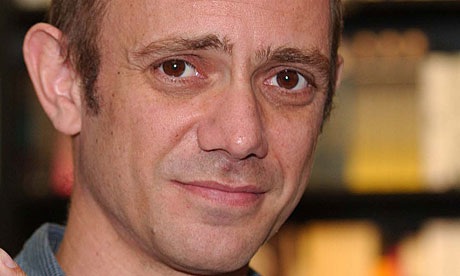
British writer, Patrick Gale

This is a very different book, Gale’s latest, from his other work which have usually been an insular look at a group of people in a localised area, usually a small Cornish community. A Place Called Winter is epic in its geography, historic in its time and language, and romantic in its tone. If you had to write a précis of this book it would read something like a historical romance, complete with abandonment of wife and family, a journey across the ocean to a strange and inhospitable land, the finding of love in the most unlikely place, a world war, murder, insanity, tragedy, and a villain of truly despicable proportions, but Gale avoids all the possible clichés that would otherwise render such a story fit only for the sensational shelves of suburban bookshops patronised by retired ladies.

“I didn’t decide, ‘Now for an historical novel!’ Rather I found myself more and more possessed by the material suggested by the fragments of my great-grandfather’s story,” and Gale has been reported many times as saying that for the purposes of fiction, and to account for surprising decisions from his ancestor’s known but sketchy life, he ‘turned’ his great-grandfather gay. This is not surprising for Gale readers, as Gale, an out gay man, writes often and well about sexuality. However “The great challenge in this novel was to write about sexuality while inhabiting the head of a man who realistically would not have had anything like the psycho-sexual vocabulary we take for granted now.” Indeed, in his first homosexual experience, which he, Harry Cane, subconsciously seeks out under the guise of a remedy for his stuttering from a handsome, but opportunistic actor and speech therapist, says, when it is obvious what is going to happen and without any stutter at all, “I have absolutely no idea what to do.”

Once his affair is discovered by a kind but firm brother he is forced to avoid a family scandal and possible imprisonment, and flees to the wild cold west of Canada where he is befriended, then abused, but finally set up by a land agent next to a shy and reclusive brother and sister pair, there for their own reasons of displacement. It is here, near a place called Winter, that he discovers what life, love, sacrifice and family really mean. Plot points of self-realization, murder and reunion are described in unsentimental terms and even the climatic act of …. No; no spoilers here.

For all of Gale’s extolling his attention “on the psychology and emotional life” of his characters I found A Place Called Winter, although enjoyable and sustaining, not as rewarding as his other works that focused on a domestic band of rural characters dealing with each other, and more importantly, themselves. The Cornish landscape, both emotional and geographic, he knows well and writes about it with, insight, force and understanding, while such considerations in A Place Called Winter are a little overshadowed by the grandeur of the plot. However, there is a lot to gain from this book; it’s probably the most commercial of his works and one that will gain him a new and, hopefully, loyal readership. He’s prolific: this is his 17th work and I eagerly look forward to what next he has to offer.

Days of Abandonment by Elena Ferrante

Female-silhouette
Elena Ferrante is the pseudonymous name of an Italian writer. Publicity shy, she only accepts interviews by email.
        The abandoned woman has a long tradition in classic poetry and literature with Dido, Queen of Carthage during the Trojan war as the most famous example; a time when virtuous heroes where meant to choose duty over love. Abandonment, and the courage to put up with it, became a romantic womanly duty.
        Not so for Elena Ferrante in her most famous novel, Days of Abandonment, 2002, (courageously translated by Ann Goldstein): her protagonist, Olga, who is told by her husband, Mario, a man of “quiet feelings” that he is leaving her because he was having “terrible moments of weariness, of dissatisfaction, perhaps of cowardice” and “he assumed the blame for everything that was happening and closed the front door carefully behind him” leaving Olga “turned to stone beside the sink.”  At first she thinks it is just a phase, he will be back,  but when she finds out the real reason for his departure she is enraged, she becomes violent, obsessed, deranged but determined.
        Told in the first person, the prose is robust, strong; I can understand why some readers think Ferrante is really a man: it feels masculine and has a rowdy momentum that could sweep away any male equivalent like bulls before a train. But this is its strength. It certainly makes you turn the page. I’ve never read rage like this from a writer of either gender. It’s mesmerizing. And her attempt to redeem herself by adopting a man-ish attempt at seduction is funny, sad, distressing, messy, and humiliating all at once.
        The action culminates in a single hot August day: the kids are on summer holidays; there’s no money to entertain them, besides the lock on the front door is faulty and they are trapped. There is sickness, outrage, potential violence and indifference, an annoying brat, and ants. It is exhausting and exhilarating. Great stuff. But if you hate reading strong language stay away!
        It is a war, an internal war between the woman she was and the woman she’s become. Her senses become distorted: time stretches, her spacial understanding convulses and she no longer knows the usual spaces of her own home; they’ve become “transformed into separate platforms, far away from each other.” She loses her balance and can no longer trust her eyes to tell her what is there, her ears what is said, and her past what is true.
        Convoluted but fascinating discourses on love, her past, the world, and relationships – “what a complex foamy mixture a couple is” – sways her brain away from her responsibilities which she fears will unseat her; she employs her daughter to jab her with a paper-cutter. She is losing it but she knows she is losing it.
        She is also an outsider, from Naples, in Italy’s south but living in the northern city of Turin where a common saying peppers local conversation: North Africa starts at Rome. This would put her origins, in the minds of her neighbours, as somewhere in the southern Sahara, as remote as their imaginations could muster. They already think she is a little mad; maybe she is.
        What you think could happen in a locked apartment during a hot summer’s day doesn’t prepare you for what does. The ending will be for you to discover but Ferrante’s point is unexpected, politically incorrect, but perspicacious, and once you read it, digest it and realise what she means, that last line will stay with you for a very   long    time.
the-days-of-abandonment film pic
Margarita Buy as Olga in the 2005 film directed by Roberto Faenza who co-write the script with six other writers.
        You can buy the ebook at Amazon, Kobo, and Europa Editions and if you haven’t read it you should.

Ease by Patrick Gale

Patrick Gale Pic
British writer, Patrick Gale

I’m not a recipe-bound cook. I like recipe books for ideas not instructions. Generally due to this approach I produce eatable, sometimes interesting, but usually unmemorable dishes. However, sometimes I even amaze myself: my first soufflé was a triumph and I basked in my own pride, and praise from others. Usually, though, when I attempt a former triumph a second time, it is a disaster: my second soufflé was more like a biscuit.

I have seen evidence of this second-time-failure phenomenon in other human endeavours, and not just mine, but Patrick Gale’s second novel of 17, Ease (1985), is not one of them.

His first The Aerodynamics of Pork (1985) was a joy to read but Ease surpasses it: its simpler, clearer, better structured, and philosophically more interesting.

Domina (Dom, Min, Mina) Tey is a successful playwright, who lives with her long-time partner – too long to be a boyfriend, but not legal enough to be a husband – Randolf Herskewitz, (Ran, Rand, Randy – Gale loves to play with names). He’s a writer too, although an academic one, more truth-as-wonder than Domina’s truth-as-reality.

Min writes plays about “menopausal lecturers and novelists” for “the discerning Guardian-reading, professional-oblique-arty masses”, which Des (Desiree), her agent, loves and can sell, but Min is worried she’s getting bored, and therefore boring.

Min leaves Randy and leaves behind the loveliest ‘I’m leaving you/not leaving you’ note you have ever read: “I won’t be in for dinner for a few weeks but the freezer is well stocked,’ it begins. She goes to “visit herself” and “secrecy of whereabouts vital to success of spiritual growth” and she signs “Apologetic affec. Mxxxxxxx.”

She moves to “a top-floor bedsit by Queensway, with no view, in a house full of odd little men and an old-bag downstairs who used to be a mortician.” One of these little men is Thierry, a young, French, gorgeous, promiscuous, and very successful, homosexual who takes her on one of his sauna-searching escapades; another is Quintus, a young, sweet, naïve history student who is trying also to find himself but has just found God, well, not God really, more a church; and not just any church, the Greek Orthodox Church. He captures Min’s curiosity and she captures a few other little things of his as well. I won’t go on; no spoilers here, and there’s quite a lot I could spoil, but no.

No-one knows how this thing we call human life started, if only by a bolt of lightning in a pool of primordial ooze, but start it did, with or without a creative hand. It sounds unlikely but it only had to happen once in a multi-squillion or so years. Anyway, stuff happens and us humans have many diverting, equally unlikely, annoying, and definite views on how we cause or are affected by such stuff and what we then need to feel or do; but if you are of the philosophical bent of our protagonist, Min, (and Mr. Gale, I suspect) you may come away from reading this book with a more peaceful, uncluttered, and sanguine view of us, allowing you to get on with life, like washing the dishes, walking the dog, loving, reading and /or writing books.

Patrick Gale is a British novelist whose ebook editions of his many novels are published in the US by Early Bird Books, and marketed by Open Road Media.

Know Them While You Can

elizabeth_harrower_pic
Australian writer, Elizabeth Harrower

Recently I was alarmed by an article in The New Yorker (October 20 2014) entitled No Time for Lies: rediscovering Elizabeth Harrower by my favourite literary critic, James Woods. It was not the title that alarmed me, it was the opening line of Wood’s article:

“The Australian novelist Elizabeth Harrower, who is eighty-six and lives in Sydney … “

What!? Who!? I had never heard of Elizabeth Harrower, much to my shame, and the fact that she was still alive added, curiously, to the urgency to find out more.

Several of her novels were published in the 1950’s but she withdrew her last novel, In Certain Circles, in 1971 on the death of her mother. She was “frozen” by her loss, besides, as she says, I was “very good at closing doors and ending things. . . . What was going on in my head or my life at the time? Fortunately, whatever it was I’ve forgotten.” How quickly readers forget: by the 1990’s all of her work was out of print.

Then in 2012 Michael Heyward and Penny Hueston of Text Publishing ‘re-discovered’ her and began re-publishing her work, The Watch Tower (1966), considered by some to be her greatest novel; “Down in the City” (1958), her first work; then The Long Prospect (1958), her second; followed by The Catherine Wheel (1960); and then Heyward managed to persuade her to let him have In Certain Circles (1960), completing the re-issue of her entire work. To this collection Text added, in 2015, a small collection of short fiction, A Few Days in the Country and other Stories, which includes the story, Alice, published in The New Yorker in 2015.

“Harrower’s writing is witty, desolate, truth-seeking, and complexly polished,” writes Wood and although he admits her themes are somewhat repetitive (a young girl bends to coercion and cruelty in a stifling and misogynist era) “her sentences, which have an unsettling candor, launch a curling assault on the reader, often twisting in unexpected ways. And … her prose is full of variety.”

“I want to argue that Elizabeth Harrower is on a par with Patrick White and Christina Stead, who would be on anybody’s list of postwar literature giants in Australia.” Michael Heyward, Text Publishing.

The Watch Tower “reminded me of Zola in its unflinching depiction of two sisters entangled with a moody, violent man … It is a brilliant achievement.” Michael Dirda, Washington Post.

“I seized on Elizabeth Harrower’s The Watch Tower, originally published in 1966. What a discovery! Harrower’s voice in this book is disconcerting at first: almost fatigued, as though she knows that everything to come is fated to be so and there’s little to do but tell the story.” Nicole Rudnick, managing editor, The Paris Review.

“The writing is just fantastic. I couldn’t believe I had never heard of her before,” Irish writer Eimear McBride told The Guardian. “Australians have their F Scott Fitzgerald in Elizabeth Harrower.”

Elizabeth Harrower was born in 1928: know her while you can.

Elizabeth Harrower is published by Text Publishing

***

gerald_murnane_pic
Australian writer, Gerald Murnane

I recently set aside prejudices and inaction and knuckled-down and worked out how to use twitter; but, someone said, you’re a bit late, as usual, twitter’s on the way out. Is it? Anyway, I find it very useful. I follow all the literary magazines I can’t afford to subscribe to and whenever I get a tweet that interests me I click on the link and there is the article in full. Magic! This happened recently when I got a tweet from The Paris Review (despite its name it comes out of New York) about Gerald Murnane. I know that name, I thought. Why do I know that name?

He too is a mostly unknown Australian writer (although that is quickly changing) who lives in Goroke, a small Wimmera town in the west of the Australian state of Victoria.

Paul Genoni, Associate Professor, Faculty of Media, Society and Culture at Curtin University, Melbourne said in his 2014 review of Murnane’s The Plains (1982) that the opening could very well be the best in Australian literature:

“Twenty years ago, when I first arrived on the plains, I kept my eyes open. I looked for anything in the landscape that seemed to hint at some elaborate meaning behind appearances.

“My journey to the plains was much less arduous than I afterwards described it. And I cannot even say that at a certain hour I knew I had left Australia. But I recall clearly a succession of days when the flat land around me seemed more and more a place that only I could interpret.”

And here is Gurnane’s opening line from his latest work, Border Districts (2016),

“Two months ago, when I first arrived in this township just short of the border, I resolved to guard my eyes and I could not think of going on with this piece of writing unless I were to explain how I came by that odd expression.”

The first, “I kept my eyes open”; the second, “I resolved to guard my eyes…” Seeing or not-seeing is a recurring theme in Murnane’s work.

“Murnane’s work has always been a world in which what we see never exists in isolation, so that its reality is only fully understood in relation to what the writing tells us we cannot see.” Will Heyward, writer and editor, New York.

 Gerald Murnane won the Patrick White Award in 1999; the Melbourne Prize for Literature, 2009; and the Adelaide Festival 2010 Award for Innovation in Writing. His work has been translated into Swedish and Italian.

“The Australian Gerald Murnane, a genius on the level of Beckett, is known in Australia and Sweden but almost nowhere else.” – Teju Cole, an American writer of Nigerian parentage. He is currently the Distinguished Writer in Residence at Bard College.

“Murnane is a careful stylist and a slyly comic writer with large ideas. I know it’s the antipodes, but it’s hard to fathom why he isn’t a little better known here [the USA].” American critic and scholar, Robyn Creswell who joined the Comparative Literature Department at Yale in 2014.

“If you want the supreme triumph of Murnane’s method read Inland (1988), which he has admitted is the God-given book, a work that dazzles the mind with its grandeur and touches the heart with a great wave of feeling and brings to the point of maximum reality the grave and soulful preoccupations that run through every bit of fiction Murnane has ever written.” Peter Craven, Sydney Morning Herald, June 2014.

There are rumours that Murnane has never been in an airplane; he hasn’t watched a movie in decades; keeps meticulous files on his everyday life; and that Border Districts will be his last work of fiction.

Gerald Murnane was born in 1939: know him while you can.

Gerald Murnane is published by Giramondo Press and Text Publishing .

The Story of the Night by Colm Tóibín

Colm Toibin image
Irish writer Colm Tóibín

Page one can tell you a lot about a book. Here, in  Colm Tóibín’s 1996 novel, The Story of the Night, the first paragraph is in the simple past tense with a first person narrator, Richard Garay, a young Argentinian with an English mother:

“During her last year my mother grew obsessive about the emblems of empire: the Union Jack, the Tower of London, the Queen and Mrs. Thatcher.”

The second paragraph is in the present continuous: now, the time of writing.

“I am living once more in her apartment. I am sleeping in her bed, and I am using, with particular relish, the heavy cotton sheets that she was saving for some special occasion. ”

The third paragraph returns to the past, to the story Tóibín wants to tell; set in the time before, and after, his mother’s death,

“She died a year before the war [The Falkland’s war, 1982] and thus I was spared her mad patriotism and foolishness … The war would have been her shrill revenge on everybody, on my father and his family, and on the life she had been forced to live down here [Buenos Aires] so far away from home.”

What you also get from page one is the tone, generated by a sparse prose peppered with well-chosen adjectives (“her shrill revenge”); simple and often short sentences; a formal style – few contractions; and of course the situation, melancholic and fearful, which has a lot to do with meaning: his mother a widow in a foreign country with an only child who is anxious about his future and his desires.

By the end of page one it is clear that the world of The Story of the Night is dark, devious, and dangerous.

“She was elated by the election of Mrs Thatcher. Here is a woman, she said, who knows what is right and what is wrong. And that is what we need here, she said. She showed me Thatcher’s face in a magazine, pointed to her and said how sorry she was not to be in England now.”

This direct speech without punctuation; more like indirect speech is curious since there are passages of traditionally punctuated direct speech. It may be that this direct/non-direct speech, which is reported by Garay, is his version of what was said which raises the question of his trustworthiness; yet he is our key to the story. He is honest with us about his desires, inexperience, political naïveté, and inaction; or is he?

The creation of verisimilitude is essential to the novelist’s goal: to make the reader believe that what they are reading is true, even if that truth only exists in the universe that the writer has created and in which the story lives. As in the theatre, the audience, the readers, are expected to suspend disbelief and believe what they are experiencing. With a first person narrative a strong and common way to do this is, ironically, for the narrator to admit what he or she does not know:

“I don’t remember how or why I began to talk about this.”

Curiously, such a line makes the narrator more believable; we all forget things, why we said things, how we met someone, how we know something. (This doesn’t work, of course, for a third person narrative who is usually all-seeing, all-knowing, god-like) But this not remembering makes him more like us. Tóibín uses this little technique to also heighten the tension surrounding the narrative which is steeped in the political uncertainty following the war with Britain over the Falklands, the Malvinas as the Argentinians call them. Garay is fearful of his professional future; he has a lowly paid English-teaching job which he hates; he is watchful of others who may be spying on him; he is anxious about others knowing his desires; and doesn’t know who to trust. However he is brave (or foolish) enough to take a gamble and becomes politically involved with the father of one of his regular students who introduces him to an American couple, Donald and Susan Ford, with whom he embarks on a friendship but with hidden motives and where the real story, what he assumes, is possibly false. These layers of acquaintances help to deepen the fear; slipping him deeper into a labyrinth. This mixture of political and sexual intrigue creates a sense of danger that always threatens to manifest itself: it is as if danger is around every corner, under every bed, over every page. Garay is constantly on edge and so are we.

Tóibín has been criticized for getting the history wrong and although the setting is a country we all know exists, Argentina, it doesn’t have to be that Argentina; it is the Argentina of the writer’s imagination and this a reader accepts or doesn’t. This is creative writing and one has to accept that it is all created; just because he writer uses the name of an exiting place the reader should not confuse the associational reference with the place itself; anyway, how many of us know the political climate, atmospheric geography, and bar etiquette of 1983 Buenos Aires? And would you take time out to research such things at such times? I think not. The writer wants us to use our knowledge, albeit skimpy and tabloid-ish, to his advantage: he is creating a world in which it is possible for us to believe that what we are reading is true (even if it isn’t). That is the point of fiction.

The Story of the Night is a love story, a tragedy, but also an affirmation: Tóibín is too much an optimist about love to let it be down-trodden by plot.

Tóibín has written previously about men, The Heather Blazing (1992) and The Master (2004), but not for over a decade; his last three novels have been about women; but of all his long-form work The Story of the Night is the most unusual. It has been reported that he has said that his next novel will be again about a man. We can all look forward to that!

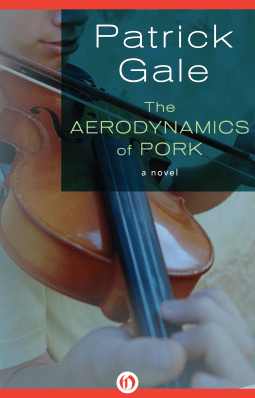
The Aerodynamics of Pork by Patrick Gale

Patrick Gale Pic
British writer, Patrick Gale

To begin a book review in a recent edition of The New Yorker (April 25, 2016), James Woods asserts that if there is such a thing as ‘late style’ in classical music then there must be such a thing in contemporary fiction; and then he describes what it might look like in the late works of Muriel Spark, Philip Roth, Saul Bellow, and Edna O’Brien. He’s right, of course, but then there must be such a thing as ‘early style’; and having read, and blogged about, two later works of Patrick Gale, Notes from an Exhibition (2007) and A Perfectly Good Man (2012) this one, The Aerodynamics of Pork his debut novel from 1985, is a perfect example of such an ‘early style.

There are no exquisite sentences nor the confident rearrangement of narrative time that characterise Gale’s later work. You can sense that Gale is testing the waters with this one; not just testing his own talent but flexing his literary muscles really, paving the way for more complex, more personal, and more adventurous writing.

Gale starts chapters and you find yourself in a maze. This isn’t as disturbing as it may seem; it just ups your trust in the writer a notch or two. (So you think, “This better be worth it”) But, as in a maze, you gradually find youself making sense of where you are, and who people are, their friends and situations and before you know it you find youself out of the maze – it’s only page three and you meet a before-mentioned character, say, from page one – and suddenly you’re into a plot. Gale allows the reader to do some of the work, to test assumptions and make predictions based on the information he gives you without spelling everything out which always halts the flow causing the narrative to plod rather than skip. Gale’s plots always skip.

It remains popular with the reading public even though Gale has somewhat dismissed it as over-written and under edited; I see it more as one of the work’s two narratives working better than the other.

Seth Peake, 15 going on 35, a musical prodigy and an extremely well-adjusted gay school-boy, blossoms artistically and romantically during a summer music festival; and a police inspector, Maude Faithe, a lesbian who’s let her sexuality slip in importance in recent years, discovers it again during her investigation into a bizarre series of burglaries of the homes of astrologists and popular fortune tellers and their soon to be announced prophecy of global importance. Seth is certainly ‘out’ while Mo is definitely ‘in’; as she is about her profession: she’s secretive of her sexuality among her work-collegues, but even more so about her job to potential friends and especially to potential lovers.

Seth’s narrative is more satisfying if only for the characters of his mother and sister; the former a progressive thinker but still a worrier, and the latter, an underachiever who finally understands that her lack of interest in sex is her own affair and her anxiety is solely due to her younger brother’s success at it even if he is underage.

The title is intriguing and there are cute little references to ‘pig’ and ‘piglets’ as euphemisms for members of the constabulary, although more benign than one might expect; and subtle inferences to the adynaton, ‘if pigs could fly.’ It would be a mistake to read too much into this; a memorable title need not be anything but a memorable title; but, of course, it means whatever you think it means.

If you are new to Patrick Gale why not start with this one, just like he did.

This and other Patrick Gale titles are being released in the US as e-editions through Open Road Media and you can find this title here.

http://www.openroadmedia.com/ebook/the-aerodynamics-of-pork

You can also find the book on Open Road Media’s affiliated sites:

Amazon:
https://www.amazon.com/Aerodynamics-Pork-Novel-Patrick-Gale-ebook/dp/B01FRQEVBK?ie=UTF8&SubscriptionId=AKIAIWK3GU7N4Y5GTA6Q&camp=2025&creative=165953&creativeASIN=B01FRQEVBK&linkCode=xm2&tag=httpwwwopen01-20

Barnes & Noble:
http://www.barnesandnoble.com/w/the-aerodynamics-of-pork-patrick-gale/1000208127?ean=9781504037624

Goodreads:
https://www.goodreads.com/book/show/30227509-the-aerodynamics-of-pork

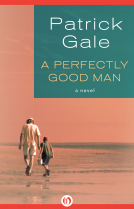
A Perfectly Good Man by Patrick Gale

A Perfectly Good Man Cover Pic

In 1937 J. B. Priestley was – if not the first then one of the first – writers to use time as a plot point. His play Time and the Conways tells of the decline of a monied Yorkshire family between the wars. Act one is set in 1919 at the birthday party of one of the daughters; act two is set on the same night but in 1937 and we see how far the family and all its members have fallen; and act three continues from act one and we see all the misjudged decisions, wrong turnings, and false expectations that caused it all. It is a tragedy, not just of a family but of Britain as she unwittingly is drawn into war, a war that Priestly predicted; but because the audience knows what happens they are spared any melodramatic sentimentality at the Conway’s future and, instead, are left with the truly tragic knowledge that it is all their own fault, therefore teaching us that our future is all our own fault. Damn it!

By the end of the first chapter of Patrick Gale’s A Perfectly Good Man I was gasping at what I had just witnessed, as our hero, the perfectly good man, an Anglican vicar, Father Barnaby Johnson, had just witnessed and could do nothing to stop: a suicide in broad daylight at a kitchen table. Time jumps back twenty years for chapter two and by its end I was misty-eyed at a lonely farm girl who almost became a matinee spinster, and at her sudden and unexpected happiness that she grabbed with her heart and both hands, despite her mother’s selfish interference and her own self-acceptance of a lonely life; so that when she saw Barnaby, finally, and they kissed and kissed again I’m sure I heard an orchestra belting out a soppy Korngold score like anything starring Joan Fontain and Lawrence Olivier: emotional, yes, but not sentimental; there’s no time for that as the next chapter jumps forty years into the future with Barnaby at 60. We know the consequences of everything they see and do. As with Priestley’s time plays Gale reveals outcomes before their gestation which not only spares us sentimentality and underlines the folly of mankind but also provides the reader with a few delicious “Oh yes, of course!” moments. I love those little moments.

Gale’s clever narrative, not only doesn’t follow the linear life of Barnaby Johnson, but rather his life is painted not by what he does but by what effect he has on the people around him: Dorothy, his wife; Lenny, his young, lapsed parishioner; Carrie, his daughter; Phuc (Careful! It’s rhymes with look), his adopted Vietnamese son; Modest, an interfering, totally unpleasant and obese man, to whom Barnaby shows nothing but kindness; James, his gay uncle; and Nuala, his onetime Australian lover. We get to know Barnaby Johnson through his reflection in the lives of these Cornish people. Be assured that I have left out some important information in my descriptions of these characters: I don’t believe in spoilers.

It’s set in Cornwall and in the little parishes north of Penzance, the same location of the previous Gale novel I read and blogged about; and incidentally two characters from that book, Notes from an Exhibition (see my previous post) make an appearance in this one. A neat synchronicity but only because I read these two back to back.

He has a way with the nuanced phrase …”the sisterly happiness she felt for him was borne up on little upwells or erotic regret …  she could smell the disappointment of her, a passing sourness, as of stale sweat trapped in a dress sleeve … In a priestly way – all cheekbones and fine feeling – he was handsome, she considered … And there she was in his maths class like a princess sent to a rural comprehensive to learn humility… Even now they weren’t exactly alone because her parents were standing in the porch, like an advertisement for mortgages…she simply preferred to keep her feelings private and as reassuringly compartmentalized as the meticulously size-sorted screws in the trays of her tool box …”

These gems give you little jolts of joy, like finding a $20 note in a pair of jeans you haven’t worn for a while.

Notes from an Exhibition, along with A Perfectly Good Man are now available as ebooks and you can find them here.

Since my literary heroes (at the moment), Colm Tóibín, Tim Winton, and Damon Galgut are not very prolific I’m happy to add Patrick Gale to the list so now I have his whole body of work to explore. I hope you will too.

Notes from an Exhibition by Patrick Gale

Notes from an Exhibition Cover pic

I read, years ago, Patrick Gale’s Rough Music (2000) which is anchored in my mind solely because of the protagonist’s long-time lover who also happened to be his brother-in-law; familial relationships of the unusual kind are his specialty, and those of Pictures from an Exhibition (2007) add to that reputation. The Middletons, husband Antony, and children Garfield, Morwenna, Hedley and Petroc, are Quakers who live in Penzance on the warmish tip of England’s most southerly bit and who revolve imperfectly around the mother and wife, Rachel Kelly, whose mental instability is only ever mollified, cooled, and placated by her painting: her world is only true and real to her once she can represent it in paint, form, and, sometimes only, colour – on something, anything, flat and at hand.

Each un-numbered chapter is headed by a note; that which you see, read, and is placed usually on the wall at the bottom right of a painting in an art museum. They begin with the painting’s name and then its medium – pencil and crayon on particle board, for example, and a paragraph or two adding colour and depth to its creation, subject, and then its current owner. These notes, you should know, not only illustrate Kelly’s art works, there are also objects, clothing even, which like art works, can sign-post our lives. Gale adds novelistic detail to this museum icon giving him a wry and clever means to add momentum, depth, and suspense to the following chapter. It is in one of the early notes that we discover in passing that there has been an untimely death in the family; the text features the deceased and one is a little tense for expecting the death to occur at any moment. When it doesn’t the tension remains and the expectation of tragedy is all the more true the longer one is forced to wait for it. The result of this little suspense I’ll leave for you to discover.

Each chapter doesn’t necessarily extrapolate on the opening note (but sometimes it does, of course); Gale is never always that obvious, and the portrait of the Middletons is not linear – Rachel Kelly’s death is in an early chapter – so their life, loves and dreams, both dashed and fulfilled, are built up with flash backs and forwards like the accumulated image of a jigsaw puzzle and all the more truthful for this intriguing form, layer-upon-layer, like walking through a retrospective exhibition of your favourite, but recently late, artist.

Early in the book I read this,

She was superstitious of describing the process but if forced to put it into words by a trusted friend she would have likened it to taking dictation – if one could take dictation of an image – from a quixotic teacher who could never be relied upon to repeat anything one failed to catch.

This dense, neat sentence which shines some light on the artistic process – no mean feat in itself – made me jolt in my seat and forced me to read it again, and again, until its cleverness revealed itself: in the short final clause the subject jumps from the speaker to the listener, like a filmic panning shot from one person to another. I read it again, aloud, just for the simple pleasure of it in my mouth.

Then, in hospital, after a suicide attempt Rachel Kelly is visited by a recent stranger and saviour, Antony, whom she later marries.

“You brought me flowers.’

“Yes, sorry. They’re not very…”

“They’re hideous. You’re so sweet. Sweet Antony.”

There’s nothing that impresses me more than character building through dialogue: three little spoken sentences says more than a page of exposition; and a little later,

She didn’t sob or wail. Her grief was horribly discreet but as persistent and almost as silent as bleeding from an unstitched wound.

I was hooked, a fan, and wondered why I hadn’t garnered Gale’s output from my first exposure to him all those years ago.

Remembering Tolstoy’s famous opening line about unhappy families, all families, really, are unique in their own way; and the book although ostensibly about such a family is full of … well … interest. It hardly seems necessary for Gale to add an astonishing twist to the true identity of Rachel Kelly: she is literally someone else. However he handles this revelation with intimate historic detail, tone and a shift in the narrator’s allegiances that legitimises this remarkable plot swing and puts Gale firmly within the reader’s trust … but enough of that: no plot spoilers here.

Gale’s omnipotent narrator is of the free-wheeling kind: jumping from character to character with ease and intent to tell the story, to paint a family life; unlike some other, more popular writers – Dan Simmons, for example (see my blog post dated April 17), whose narrators are restricted: bound to one character.

I found myself scheduling reading time; always a sign of a good book.

Patrick Gale, was born on the Isle of Wright in 1962 where his father was the prison warden. He now lives near Land’s End with his partner, raising beef, barley and obsessively readable novels. Check out his website at galewarning.org.

Notes from an Exhibition, along with A Perfectly Good Man (2012), -my review will follow shortly – will become available on 31 May, 2016 and you can find them here.

A further release of titles, by Open Road Media, is scheduled for later in the year.