“None of the Irish writers I know are afraid of the pleasure of the sentence.”
If you read the blurb on the back cover you’d get the idea that this is a book about a family gathering for a funeral; and, like me, you’d think you know what it’s about – it seems such a cliched reason for a book – but the actual ‘gathering’ doesn’t happen until Chap 30 (out of 39) and a lot of fabulous stuff happens before chap 30. This book has been unread on my shelf for four years because I thought I knew what it would be like. I was wrong.
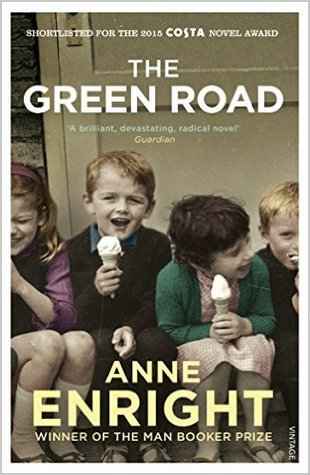
Enright has employed this same idea recently in The Green Road, although in that book the event is a house-sale; but still a family gathers. Anne Enright is big on families.
And this is Anne Enright on big Irish families:
There is always a drunk. There is always someone who has been interfered with, as a child. There is always a colossal success, with several houses in various countries to which no one is over invited. There is a mysterious sister. These are just trends of course, and, like trends, they shift . Because our families contain everything and, late at night, everything makes sense. We pity our mothers, what they had to put up with in bed or in the kitchen, and we hate them or we worship them, but we always cry for them – at least I do. The imponderable pain of my mother, against which I have hardened my heart. Just one glass over the odds and I will thump the table, like the rest of them, and howl for her too.
Both these books, The Green Road and The Gathering are similar in structure. She places an event at the nut of her tale and weaves around it threads of people, their plights and joys, pasts and presents until you have something like a doily of a story. A weave of narratives around a perfect whole. In one masterful chapter two of her characters, Ada Merriman, the narrator’s grandmother, and the man, Lambert Nugent, who has always loved her, and who she should’ve loved, but didn’t, touch. She a hand on his shoulder, he a hand on her hip; and the narrator, a writer, the granddaughter, Veronica, who admits to writing all this down, describes what might have happened had both their hands moved a little further, a little more truthfully until they were on the floor with him inside her. The reader certainly wants this to happen and Enright, having us in mind, gives it to us. It’s satisfying. It didn’t happen in the story, only on the page, but satisfying nonetheless.
Hovering above for most of the book, like a drone, is the little mystery Enright, (Veronica?) tells us in the very first line: something happened in Ada’s house when Veronica was eight and her brother, Liam, the corpse at the centre of this doily, was nine. Something happened that little Veronica shockingly saw.
The Hegertys are a big clan: the nine surviving children, there were more births than survivors, gather for the funeral of one of their own and Veronica needs to bare witness to an uncertain event. She remembers it but as something so improbable – she was very young -way outside her, then, experience that now, as an adult, it’s entirely possible, she thinks, that it might not have happened at all.
Pleased as punch; and rightly so.
The Hegertys were “dragged-up”. They were entirely “free range”. But this is all pre-80s, pre-parenting, pre-how-to books, pre-child murders, pre-4-wheel-drives to school; pre-dry cleaning plastic as death-bags: pre-fear, when us baby-boomers were all “free-range”, and all “dragged up.” If you are over 50 you probably know what this is like.
Anne Enright writes sentences chock-full of meaning, or insight, or revelation; and even her linking sentences between chock-full sentences are chock-full. But then she throws in a little doosey: It is like Christmas in Hades, and I laugh and think she is going to suck the universe dry of all the good lines leaving us in her wake scrabbling for left-overs.
She uses dialogue to re-assure us that these people are complicated, but real:
‘Thanks,’ he says.
‘What?’
‘Thanks for staying with me.’
‘Oh, for God’s sake.’
‘No. Really.’
‘I’ll be back in a minute.’
and prose for more meaningful and ‘under-the-surface’ revelations:
I thought about this, as I sat in the Shelbourne bar – that I was living my life in inverted commas. I could pick up my keys and go ‘home’ where I could ‘have sex’ with my ‘husband’ just like lots of other people did. This is what I had been doing for years. And I didn’t seem to mind the inverted commas, or even notice that I was living in them, until my brother died.
The doily book, The Green Road, was written in 2014, and it’s a book Enright calls “more of a proper book” insinuating that the other doily book, this one, The Gathering, written in 2006, is not. I know what she means. The Green Road is tighter, neater, more confident, and adventurous, the pattern more stable; this one is loose, equally compelling and recognisable, but free-range and at the same time narrow in its world; but for lovers of contemporary literary fiction, so rewarding.
So, yes, a lot happens to Veronica, the narrator, before the point of it all; and near the end the mystery is revealed; then the gathering itself; but Enright keeps a little ‘gasp’ to send you off into the last little chapters when, by the end, you realise it was all, not about a family, but about a woman, coming to turns with hers:
God, I hate my family, these people I never chose to love but love all the some.
I’ve never read another author’s work back to back before. I have another Anne Enright book on my shelf: The Forgotten Waltz (2011); that might be next. It’s turning into a little Anne Enright Reading Frenzy. Read her yourself and see why.
You can find The Gathering in various formats, including audible and audio CD, here.
Irish writer, Anne Enright, won the Man-Boooker Prize for The Gathering (2007)
After the last page is turned, after you’re full to overflowing with this book you’ve just read, Anne Enright writes an Acknowledgements page, and she starts it like this: Thanks for the information used and cheerfully misused in this book are due to: and she lists a whole swag of people. That is the branding mark of a writer: once she knows something, then and only then, can she choose to change it.
With the very first sentence she grounds the story in the domestic:
Later, after Hanna made some cheese on toast, her mother came into the kitchen and filled a hot water bottle from the kettle on the range;
but it’s the very first word ‘later’ that made me jump: what?, this uncertainty, tension; something happened before the cheese on toast and the filling of the hot water bottle. But what was it? What?
And then on the 2nd page, this
He took them for rides in fast cars, up over the bridge, bang, down on the other side.
It’s the word, ‘bang’ that hit me this time. With that one out-of-place word, not a word, a sound; no quotation or exclamation marks, nothing but surety about the picture it conjured: a too-fast car, over a bump, where you hit your head on the roof and the sound of the car bouncing back to earth with the woop and cheer of kids, out where they shouldn’t be. Such a big picture from such a small sentence.
I smile to myself and think: I’m in the hands of a master, and I breathe a little sigh of relief: a very good feeling at the start of a read..
But then Chapter 2 opens 11 years later in the East Village, New York, with a gay male narrator among gay men torn between their right to be promiscuous and a stalking, discriminating death.
What Billy wanted was big, shouty unafraid sex with someone who did not cry, or get complicated, or hang around after the orange juice and the croissant. Billy was across the threshold and cheerfully out and he wanted men who were basically like him; sweet guys, who lifted weights and fucked large, and slapped you on the shoulder when it was time to swap around.
Where did an Irish 50-something mother of 2, who looks like a little housewife from Central Casting, find authentic language like that? I was now severely impressed with this writer; and she can do that relaxed but spiky gay table-talk; sassy, arch, and funny.
I don’t want to give too much away because there is too much to enjoy about this novel; but it is neatly constructed. Divided in two, the first half assigns a chapter, each with a different narrator, at a different time for each of the four beautiful children of the difficult woman Rosaleen; and at the end of which is the reason that all of them are lured home to Ireland, County Clare, for Christmas in the family home that their prickly mother has decided to sell.
Bring on Part 2.
In a London Review Bookshop interview she describes the first half of the book, a ‘proper’ book, as getting to know the four siblings in a way that none of them could ever know about each other; in a sense this is dramatic irony on a large scale. We readers know more about each of them than any other family member knows about each other. They have gone off elsewhere (New York, Asia, Africa, Dublin) to care for, or sleep with, the lost, the undernourished and come back home full of themselves, their adult selves; but to the childhood home where their mother, Rosaleen, is waiting to be empathised with. That’s all she’s ever wanted. They go off to look after big-bellied African babies, or dribbling disease-ridden men but here she is not being looked after at home … alone. She has a point. The trouble it she doesn’t know how to accept it, or express it.
I foolishly avoided Anne Enright’s books, even though there they were on my bookshelf, and even though I’ve met the woman (twice!), I thought her books were all about families collected together at a funeral, a wedding, a last Christmas, and I thought, yes, I know what they’re like. I’ll get to them … one day. And this book is like that. Exactly like that; but at the same it is so unexpected, unpredictable and therefore rewarding, satisfying, and oh-so wise.
She got her hair done in a place so posh it didn’t look done at all,
and this is one of those rare books where you can believe what’s written on the cover: ‘brilliant’, ‘radical’ – don’t let that put you off, ‘beautiful’, ‘virtuosic’, and ‘hugely readable.’
“It’s all among Workhouses, and Coffin Makers and Pickpockets,” said Lord Melbourne, the young Queen Victoria’s prime minister. “I don’t like those things; I wish to avoid them; I don’t like them in reality, and therefore I don’t wish them represented.”
I think it’s “excessively interesting,” said the young Queen.
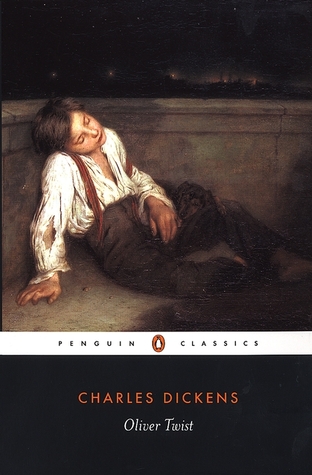
Oliver Twist (1837) was a bit of a shock for Dickens’ fans who were introduced to the writer through that plump, accident-prone, well-off, and comic character, Mr Pickwick. And then along comes the serialised Oliver Twist, even before the serialised The Pickwick Papers, which garnered a circulation of 20,000, had finished; and in a new magazine, Bentley’s Miscellany, edited by Dickens. The underworld of London low life had, in the past, been treated lightheartedly, even comically, but Oliver Twist was something very different. Thieves, house-breakers, pickpockets all living squashed together in dingy slums and mud, taking pride in their work, but seemingly surviving in little groups that resembled something close to ‘a family’; and dealing not only with petty crime, but also, kidnapping, murder, treachery, and domestic violence.
If you think you know the story, you probably do.
A young orphan, innocent and alone, is put to work in a workhouse, fed on watery gruel, and where he has the audacity to ask for ‘more’; is mistreated, runs away, meets Jack Dawkins, the Artful Dodger, and Fagin and his gang of thieving street boys; is saved from the same occupation by the kindly Mr Brownlow; is kidnapped by Nancy, harassed by the villainous Bill Sikes and forced into a stint of house-breaking, only to be shot and taken in by the also kindly Mrs Maylie and her ward Rose – really his aunt; threatened by the mysterious and dangerous, Mr Monks – who is actually Oliver’s half-brother; but saved by the pitiable but kind Nancy, who is murdered by her lover, Sikes for her efforts; and ultimately reunited with the kindly Mr Brownlow, who adopts him for a predictable happy ending: the oft used, and abused, first rule of novel writing. Oscar Wild said it best and said it better by giving it to Miss Prism to say in his most famous play, The Importance of being Earnest (1895):
The good end happily; the bad end unhappily. That’s what fiction means.
“I want some more.”
However, what is equally as interesting is what Dickens can teach writers.
Expression.
Oliver took the hint at once, for the fist had been so often impressed upon his body not to be deeply impressed upon his recollection.
Dickens sentences, usually long, are full of information and in a way that makes them seem packed with it; and sarcasm.
Oliver was frightened at the sight of so many gentlemen, which made him tremble; and the beadle gave him another tap behind, which made him cry; and these two causes made him answer in a very low and hesitating voice; whereupon a man in a white waistcoat said he was a fool, which was a capital way of raising his spirits, and putting him quite at his ease.
These two lines are early in the book, carrying some of the lightheartedness his readership would’ve expected having read The Pickwick Papers, but then surprising them later by his darker themes.
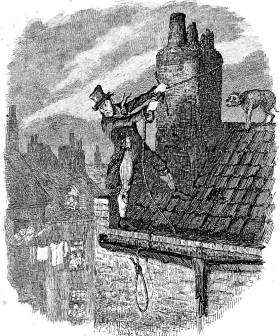
He also uses expression to mirror action. After Sike’s failed house-breaking attempt, during which Oliver is shot, the friends and neighbours of the assailed inhabitants, Mrs Maylie and her ward, Rose, decide to investigate the crime-scene.
Lights were then procured, and Messrs Blathers and Duff, attended by the native constable, Brittles, Giles, and everybody else in short, went into the little room at the end of the passage, and looked out at the window, and afterwards went round by way of the lawn, and looked in at the window, and after that had a candle handed out to inspect the shutter with, and after that a lantern to trace the footsteps with, and after that a pitchfork to poke the bushes with.
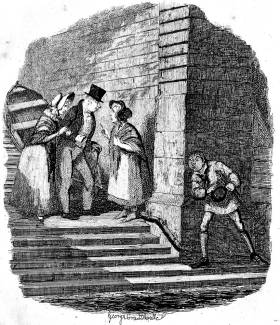
Oliver discovers what his street-mates are up to
A lot of repetitive energy, and phrases, to produce not a scrap of evidence.
Character.
Dickens is a great character-builder with the use of dialogue.
Mr Bumble, the beadle, drops the first syllable of ‘apprentice’ (‘prentis), the ‘n’ off the article ‘an’ (‘a old lady’), any syllable that gets in his way (‘unfort’nate’), uses ‘porochial’ (instead of ‘parochial’), and ‘w’ instead of ‘v’. Mr Grimwig, a friend of Mr Brownlow’s, uses a unique expression not ‘… I’ll eat my hat” but ” … I’ll eat my head.” Barnaby, a street urchin, has an adenoidal problem over the letters ‘n’ and ‘m’: “Dobody but Biss Dadsy” (Nobody but Miss Nancy.) Bill Sikes regularly uses the word ‘damn’ but too risqué for British readers of 1838 so it was replaced simply by ‘D-‘; they understood what it meant but were not forced to actually ‘read’ such a shocking word. In a hierarchical society such as Dickensian London where one’s status is ruled by birth, income, education, and gender, such distinctive character differentiation may not be appropriate in a modern context but giving characters vocal habits is a useful device for character differentiation. Dickens has Fagin call everyone, regardless of gender, age, or status, ‘my dear’. Ascribing a character with a particular grammatical habit of, say, never using contractions helps to paint a rather serious and stern person. If characters are not first speakers of the readers’ first language grammatical mistakes ( no plural ‘s’, wrong prepositions, gerund misuse, etc) are really essential. I once heard a writer, a young male American, read, at a literary event, a section of his new novel that was set in Rome but had a Mexican character who sounded, when he spoke, nothing like a Mexican English-speaker living in Rome; he and each of the characters sounded like a young male American. A missed opportunity.
Nancy is betrayed.
Narrator.
In contemporary fiction the narrator is, usually in the third person, a nameless, genderless, all-knowing, god-like voice with access not only to characters’ thoughts, desires, and plans, but also to their past and future lives. Not so with Dickens. He writes directly to the ‘reader’, calling them such, and refers to himself as the ‘biographer’, and ‘faithful historian … who knows his place’. He even chastises himself for keeping an esteemed character waiting while dealing with other plot necessities. The use of the narrator for plot-based effects is rare but was used effectively by Ian McEwan in his 2012 novel Sweet Tooth, where the first person narrator turns out not to be the writer; and, most intriguingly, the satisfying ending is only evident because you, the reader, have read the book: it’s because the book is available to read that you then know the ending. Curious? Check the link above. Dickens used his narrators in a far freer and more colourful way with direct input into not only the plot but the tone. Here, in a recent short story, Serendipity, is an example of the narrator not only intruding into the writing of the story, but also is a secondary narrator with his own story: a double narrative, if you like, one feeds on the other.
Dickens’ reference to himself, the narrator, as ‘historian’ leads now to another novelistic ‘trick’: creating
Yes, we know that we are reading fiction, that most of the whole thing – sometimes not all – is made-up but the writer wants us to believe that the story is true. Writer’s rely on our imagination to create for ourselves our own reality, and so allowing our emotions to do their work. However, writer’s don’t want to ‘lose’ their readers by letting the text slip too far from possibility. A text in the first person has a better chance of doing that, more so than a text in the third.
However, Dickens ‘tricks’ us several times implying that what he is saying is true: 1) he (the narrator) admits to omitting a word in the dialogue of a character because it is too impolite for your, the reader’s, ears. By refusing to tell us what the word is he is implying that he actually heard it, but decided it was not suitable; 2) a character observes a conversation between two people in the same room but can’t hear the exact words and so infers what is said. This is a plot point but it also implies that the conversation actually happened – no, the narrator is not making this up because if he was he would’ve placed the character closer to the talkers; and 3) forgetting a name. We, real people, do this all the time, so by the narrator confessing he has forgotten someone’s name, or the name of some place, reinforces the truth of the scene because actually the person or the place is made-up – this is fiction, remember – and being made-up the writer (narrator) could’ve provided a name. But he didn’t, so the implication is that the action must’ve happened.
It is true to say that contemporary fiction is the mainstay of a modern reader’s literary diet. However, a dip into the classics now and again, is a palatable way to hone critical thinking, get a grip on literary history, and understand where our literary tastes may be heading, and where our cultural references came from.
Most of the classic literary texts from Australia, Britain, Europe, and America are out of copyright and are, therefore, available online for free. The University of Adelaide has established a website where you can find a myriad of classic texts. It contains all of Dickens’ novels as well as a large collection of his short fiction and you can download ebook versions in various formats and for various devices. Happy exploring.
Dickensian sentence p 10
“He took the hint at once, for the fist had been so often impressed upon his body not to be deeply impressed upon his recollection”
Sarcasm –
P12 “… made him answer in a very low and hesitating voice… at his ease.”
p13
“… the poor people liked it …”
Sinecure
Narrator as biographer p46
D is a great teacher of dialogue for character building:
Mr Bumble, the beadle, drops the first syllable of ‘apprentice’ (‘prentis), the ‘n’ off the article ‘an’ (‘a old lady’), and any syllable that gets in his way (‘unfort’nate’ p 296).
Ie Dodger,
Mr Grimwig ‘… I’ll eat my head” p110
And Barnaby p119 with his adenoid problem
P155 Bill Sikes who regularly uses the word ‘damn’ but too risqué for British readers of 1838 so it is replaced by ‘D-‘. Mr Bumble, the beadle, uses ‘porochial’ (instead of ‘parochial’) and ‘w’ instead of ‘v’.
The relationship between narrator and reader: strong in OT but rare in modern lit. P135
The narrator calling himself “author” and “faithful historian …. who knows his place” p216 and insinuating what kind of an author would he be to keep a beadle waiting …
Unpleasant description of Fagin: “loathsome reptile” p153. P154, by telling the reader that he, the narrator, will not mention something adds veracity to the tale.
Also, like forgetting a name, not hearing a conversation because the whispers were too quiet. P213;
Describing 1 or 2 minutes when nothing is said p 218
Possible theme: what Dickens can teach us about writing. Use of narrator. A N can be a biographer, a person, not just a dissociated god-like voice. But take it further, if s biographer, then why not a person; and one with opinions, attitudes, even a history, even a present history! Narrators nowadays are usually ‘apart’ from the narrative; what if the narrator was a part if the narrative, or framed a parallel story, see Serendipity. Link to Tablo.
Character: Nancy’s ‘acting’ p165 OT nor the reader is ever quite sure what Nancy is playing at.
Dickens on description p234-5 “0f the two ladies …” He describes not so much what they wear but the impression the whole picture gives.
Action
“Lights were then procured, and …with” p246
The bad are bad but show a little bit of good, ie Fagin. The good are good but not bad (Rose).
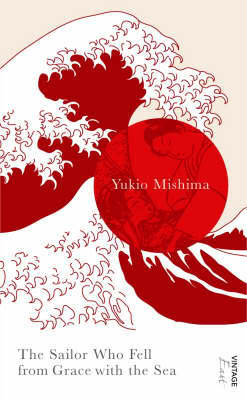
Kimitake Hiraoka, aka Yukio Mishima, was an author, poet, playwright, actor, model, and film director. He was considered for the Nobel Prize three times. He disembowelled himself on November 25, 1970. Two of his followers beheaded him, as Harikiri tradition demands.
Translated by John Nathan.
In the port of Yokohama, one hot summer, Noboru, a 13-year-old fatherless boy, a member of a pack of boys held in the thrall of its leader, the ‘chief’, who believes in the insignificance of sex and life and the overwhelming emptiness of the world where only acts like murder can fill such hollows, spies on his mother through a peephole in his dresser and witnesses her nakedness in the arms of a sailor.
The gang of boys ritually kill and skin a stray kitten:
…the glossy layer of fat beneath was like a peeled spring onion. The skinned neck, draped gracefully on the floor, seemed to be wearing a cat mask. The cat was only an exterior, life had posed as a cat.
Noboru thinks:
I killed it all by myself – a distant hand reached into Noboru’s dream and awarded him a snow-white certificate of merit – I can do anything, no matter how awful.
It’s in modernistic prose in shades of Woolf and Joyce, descriptions of the imagination, terrors, and death. Images of, and references to death and the sea, abound.
The sailor, Ryuji, and mother, Fusako, develop their little affair his two-day shore leave. The sailor is a phantom to the boy; not hero-like at all. The boy, Noboru, knowing so much about the world is careful to act the boyish part as he joins his mother on the dock to see Ryuji off; departure is just another step towards death. Fusako is stoic; Ryuji keen to get back on board. The mother and boy watch the sailor’s huge ship drift off into the setting summer sun.
He returns in winter. The mother is there to meet him.
Ryuji slipped his hands under Fusako’s coat and clutched wildly at her body as though searching for life in a corpse he had saved from drowning.
Fusako surprised herself to realise that she had been waiting for him. Ryuji gives Noboru a carved crocodile from Brazil. The boy is careful not to let his boyishness show. “Thanks” but he is angry at the sailor for coming back at all. Not at all heroic.
The mother is persuaded, by the sailor, not to lock the son’s door at night, he’s almost grown; the sailor is helping the son with his maths homework; his mother is kinder and more devoted to him. A trap!
Noboru calls an extraordinary meeting of the gang and much to the horror of the ‘chief’ and the boys the sailor is attempting to create a family, a just, fair, and loving family – all lies – headed by the worst of the worst, according to the chief: a father.
A father is a realty-concealing machine …
The boys must act. The sailor has betrayed the world, lost his love of the sea, the only permissible thing, and intends to enslave the boy to his brand of nothingness.
Noboru could feel a lunatic courage welling with in him.
They have done it before – remember the cat? -they can do it again. However, they must hurry because boys under 14 are not subject to punishment by law; and Noboru, and several of the other boys will be 14 come the spring.
With the help of a friendly invitation to talk to the gang about his seafaring adventures; a secluded location overlooking the sea, and a tea laced with poison, the gang begin their quest to revenge the betrayal of this man they see as a traitor to their cause. Do they succeed?
The book was originally published in 1963 in Japan as 午後の曳航, The Afternoon Towing. The title, as we know it, is a western concoction; its vague but poetic eastern syntax is reminiscent of the supposed colonial authority over the East by the West. This was very much abhorred by Mishima. He was a paradox: he basically lived a Western lifestyle and followed Western culture but raged against Japan’s imitation of the West. Culturally, he sought to promote traditional Japanese values as a post-colonial reaction to the West’s post-war reconstruction of his country.
His life exhibited a mass of contradictions: weak versus strong, masculine versus feminine, physical versus intellectual, eroticism versus aestheticism, elegance versus brutality, beauty versus ugliness, purity versus pollution, East versus West, ‘brave harakiri’ versus ‘defeatist suicide.’
In 1976 the story, with the same name but transposed to a small English port town, was filmed; written and directed by Lewis John Carlino and starring Sara Miles and Kris Kristofferson.
Here is a short biography of Mishima on YouTube including an interview with him in English.
“When a boy…discovers that he is more given into introspection and consciousness of self than other boys his age, he easily falls into the error of believing it is because he is more mature than they. This was certainly a mistake in my case. Rather, it was because the other boys had no such need of understanding themselves as I had: they could be their natural selves, whereas I was to play a part, a fact that would require considerable understanding and study. So it was not my maturity but my sense of uneasiness, my uncertainty that was forcing me to gain control over my consciousness. Because such consciousness was simply a steppingstone to aberration and my present thinking was nothing but uncertain and haphazard guesswork.”
― Yukio Mishima, Confessions of a Mask
British novelist, Anita Brookner (1928 – 2016) won the Booker Prize in 1984 for Hotel du Lac.
When Brookner’s editor Liz Calder rang her up to report the news of her Booker Prize nomination Anita replied, “I think I shall go out and get a pair of shoes resoled. That will help me keep my feet on the ground.”
Everyone thought J. G. Ballard would win for Empire of the Sun – the odds were 6 to 1 that he would. He didn’t. She did.
Before becoming a novelist – she was always a writer – she was a celebrated art historian and the first female Slade Professor of Fine Art at the University of Cambridge. She wrote 24 novels, almost one a year, from 1981, she was 53, to 2011. She was an only child of “unhappy” parents who lived with her grandmother. “They were transplanted and fragile people, an unhappy brood, and I felt that I had to protect them. Indeed that is what they expected. As a result I became an adult too soon and paradoxically never grew up.” She never married or had children.
Fellow British writer and friend, Julias Barnes remembers, “She was witty, glitteringly intelligent, reserved, and unknowable beyond the point she herself had already decided upon. I can’t think of a novelist less likely to write an autobiography. She was fiercely moral without being moralistic, and fiercely truthful.”
With the opening to Latecomers you know you are in the safe hands of an authoritative wordsmith:
Hartmann, a voluptuary, lowered a spoonful of brown sugar crystals into his coffee cup, then placed a square of bitter chocolate on his tongue, and, while it was dissolving, lit his first cigarette. The ensuing mélange of tastes and aromas pleased him profoundly, as did the blue tracery of smoke above the white linen tablecloth, the spray of yellow carnations in the silver vase, and his manicured hand on which the wedding ring fitted loosely, without those deep indentations that afflict the man who has gained weight or age, a man to whom in any case his wedding might be presumed to be an affair of the irrelevant past.
She then describes Hartmann’s gaze falling on a group of middle-management men and Brookner drops into the second person as Hartmann chastises them for gorging themselves on lobster cocktail and steak and kidney pie:
My dears, you do not look well … your complexions are not clear, your haircuts unbecoming.
It’s the story of two German Jewish immigrants, Hartmann the voluptuary, Fibich the worrier, who, although from the same background and bind their lives together in the same work, are two very different men, marry two very different women, and have, one each, two very different children. The narrator tells us about them. There is very little dialogue, hardly any; only carefully considered sentences almost bursting with detailed information. As you can see from the quote above hardly a noun is allowed to exist without at least one apt adjective. Brookner places a lot of trust and love into her adjectives and adverbs. When my book-fairy brought me this one from Europe late last year I looked at it and said, “Oh, I didn’t know about this one.” He said, “What? Oh, I don’t recall their titles, I just read her, over and over,” and he made a face as if to say, “Well, why wouldn’t you? They’re delicious.” Another apt adjective. Hers is the type of writing that brings you pleasure no matter what the writing is about. Of course, she honed her writing skills as an art historian writing about art, until hers became an art in itself.
Her style won’t please everybody; her focus is on what these people are like, not what they do but on the way you find out what they did, and how they did it, why, and what they felt about it. I often write about the image of a novel’s narrator as an imp sitting on the shoulders of the protagonists having access to what the protagonist not only sees and hears but also what they think; but in Brookner the imp is sitting just behind their eyes surrounded by the cluttered furniture of their hopes and fantasies, feelings and thoughts, and so by telling us all this the characters emerge and she shows us what being human is like.
Although the action is minimal, time passes – actually over 50 years pass, from when the boys first meet at boarding school to their latter years when grandchildren are on the way, mixed with the feelings of love, pride, and even disappointment in what their children have, or have not, achieved. Many critics of Brookner chastise her for her moody, timid, and undemanding characters due, they say, to her never marrying and not having children. However, for a husbandless and childless woman she deftly handles the changing feelings, the stings and shadows, joys and love-bursts of two very different couples for their offspring: one becomes a self-centred and ebullient actor, one a passive and disappointed housewife.
Fibich, the desperately thin and always fearful one, takes a courageous journey back to Berlin in an effort to try to recapture something of himself as a child; some inkling of what home might feel like. His journey is revelatory because of a chance scene he witnesses; something that has nothing to do with Germany, but all to do with memory. It’s Brookner at her best.
It’s a handsome volume and part of the Vintage Contemporaries Series, but don’t take much notice of the blurb on the back: it makes it sound something it isn’t, but then if you take the ebook, which you can find here – and where you can read the first few pages for free – you won’t be tempted.
Anita Brookner died on March 10th, 2016 and an obituary appeared in the Guardian, on Tuesday, March 15 You can read it here.
In April 2008 in the Lower Austrian town of Amstetten a woman called Elizabeth Fritzl told police that she had for the past 24 years been held prisoner in an underground room under her father’s house. He had systematically raped her, she bore him seven children, and kept her from the world; even his wife didn’t know she was there.
This was the inspiration for Donoghue’s 2011 Man-Booker long-listed novel, Room, which went on to be filmed, with a script by Donoghue, in 2015, starring Brie Larson, who won an Oscar for Best Actress.
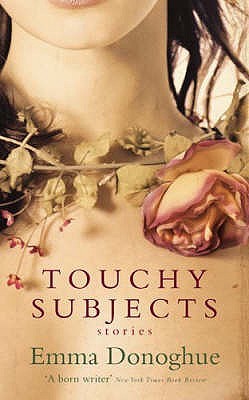
This book is a collection of short stories, her third, and came out in 2006. She tackles the foibles of modern people in stories told by various voices, genders, and sexualities: the desperate, but hilarious, lengths a forty-something woman will go to, to beat her biological clock; a cool romance set against the rough and back-slap masculinity of football where two rookies find more than the ball during their training sessions; and a touching and romantic story about the meeting of two minds and two bodies told in two narratives that weave and tangle with each other just like their hands do in the back of a van in the middle of a dark night, lost in the back lanes of Connemara. And that’s just three of them.
There’s a thread here running through these stories: of inner thoughts shared only with the reader that gives Donoghue’s writing the personal warmth and favouritism of dramatic irony; an intimacy with the reader that draws you in and makes you part of her intent.
Donoghue not always, but mostly, instills in the reader a confidence that you are in good literary hands. This is a book that could sit comfortably in your bedside book pile so you can dip into it again and again. Some stories will become favourites.
Elena Ferrante is/might-be the pseudonymous name of an Italian writer. Publicity shy, she only accepts interviews by email. There are no photos of her online. James Wood, The New Yorker critic has deduced … a number of her letters have been collected and published. From them, we learn that she grew up in Naples, and has lived for periods outside Italy. She has a classics degree; she has referred to being a mother. One could also infer from her fiction and from her interviews that she is not now married…In addition to writing, “I study, I translate, I teach.”
… the story of the facts has to reckon with filters, deferments, partial truths, half lies: from it comes as arduous measurement of time passed that is based completely on the unreliable measuring device of words.
That … what are writers stuck with? … the unreliable measuring device of words.
Every tone of voice, every possible meaning of words spoken, every possible meaning of words unspoken, the way they dress, walk, cry, smile, serve the pasta, look, and stand; all are analysed by Elena, the first-person narrator, in her attempt to understand what’s going on. It’s a Brugel-esque landscape of feelings colouring the lives of the Neapolitan working class in the 1960s and all seen through the eyes of Elena Greco -“always fearful, always subordinate, always pleasingly willing”, the unmarried, bookish one with glasses.
Elena Greco: I said to myself every day: I am what I am and I have to accept myself; I was born like this, in this city, with this dialect, without money, I will give what I can give, I will take what I can take, I will endure what has to be endured. This could easily be Lina’s creed too.
The title refers to Elena’s brilliant friend, Lina Cerullo and her new name now that she’s married, her married name, Lina Carracci, and, of course, Elena can’t be everywhere, especially in Lina and Stephano’s hotel room on their disastrous wedding night, but we get the scene, in the third person. Ferrante doesn’t need to justify how the narrator, Elena, knows what happened, she does (Lina told me) and clumsily so. However, there are other instances when the narration slips from the first to the third person unannounced. It’s OK. It’s a legitimate literary device, unnoticeable if attention is not drawn to it. It allows a flow of action or insight. This inconsistency is something the editor should’ve picked up. Ferrante is usually masterful at using these literary tools. Quotation marks, and ‘he said’, ‘she said’ are abandoned at times in the frenzy of verbal, sexual, or social violence giving the scene a filmic quality, making the action jump out of the flat page. This is good stuff, but doesn’t need justification.
The story is about Lina’s marriage that fell apart at the wedding at the end of Book One and how it continues on its downhill slide while Elena continues to bump against her upbringing and pursue an academic life, free – she thinks – from her stifling Neapolitan history; but Elena by this book’s end still believes Lina, despite her choices, is the more beautiful, the more intelligent.
Thank god there’s a glossary of families and family members at the front of the book. Ten families and their intra and extra familial relationships make up the fodder of the story and the glossary is well needed; and don’t be afraid to use it (no-one will know). Things get complicated especially with diminutives, family nicknames, and similarities; Alfonso, Antonio, Lina, Linu, which is a diminutive of Elena, not Lina whose real name is Raffaella. See? And don’t skip over the Italian family names, Cerullo, Cappuccio, Scanno, Solara. Say them out loud! You need to be familiar with them all and if you say them, you’ll be saying them a lot, right from the beginning so it won’t take long before you’re at one with the family, families. You’ll be in among them all. That’s the best bit.
The worst bit is the fate of the women. Not only are they treated like shit by all of the men – except when they want something, usually sex – their worst enemies are the other women: mothers, sisters, aunts, cousins, and friends. Shame, gossip, inference, innuendo, treachery, lies, superstition, and pride are all weapons these Neapolitan women use against their own. And Elena sails bumpily, battered and bruised, but defiant, through it all, but ultimately aware that she is a woman and people see her more clearly, listen to her more intently, talk to her more respectfully, when she is on the arm, even metaphorically, of a man. Have things changed?
And then the story splits: Elena goes to study in Pisa, and Lina’s messy life of deception, abandoned commercial success, and personal war-mongering continues to engulf everyone in her circle of destructive intent and selfishness. Here I wanted to hear more about Elena, but I had to wait.
And then this:
One morning I bought a graph-paper notebook and began to write, in the third person, about what happened to me that night on the beach near Barano. Then, still in the third person, I wrote what happened to me on Ischia. Then I wrote a little about Naples and the neighborhood. Then I changed names and places and situations. Then I imagined a dark force crouching in the life of the protagonist, an entity that had the capacity to weld the world around her, with the colors of the flame of a blowtorch: a blue violet dome where everything went well for her, shooting sparks, but that soon came apart, breaking up into meaningless gray fragments. I spent twenty days writing this story, a period in which I saw no one, I went out only to eat. Finally, I reread some pages, I didn’t like them, and I forgot about it.
This is Elena Greco explaining herself, describing what changed her life, but it is more; it is a confession from Ferrante: how to write a novel. It’s finding the ‘dark force’ that’s the tricky bit. However, it’s this notebook, hand-written, unedited, that she gives as a gift – despite “I reread some pages, I didn’t like them” – and it’s this notebook that finds it’s way into literary circles, someone types it and shows it to a publisher and …
When Elena and Lina finally re-unite it’s in the most unlikely of places; two women, one about to be hoisted aloft, the other about as low as she can go but united by a shared intellect, history, and belief in the other, no mater how sorely that belief is tested. One ignored the upbringing they both had no control over; the other gave in to it. And like the end of Book One, My Brilliant Friend, this, Book Two, has a sting on the last page that compels you, no matter what you might think, to move on as quickly as possible to Book Three, Those Who Leave and Those Who Stay. Ferrante is a reading experience like no other.
You can purchase the book, in various formats including the ebook, here.
This is not a story, and readers may find it difficult and not worth continuing with, but it takes a little gear change to alter your expectations. However, for readers interested in the life of the novel To the Lighthouse is an interesting read; but before sitting down with it a little research into the times and the literary landscape into which it was written is a good idea. It is considered a pioneering work of literary modernism.
Modernism is hard to define since it’s such a broad term and encompasses other ‘isms’ like expressionism and surrealism to name just two; and modernists did not actively adhere to any philosophy or movement like the visual impressionists did. However, it is generally considered to show a strong feeling for experimentation, and anything that was new, as well as a strong anti-Victorian bent. It is also difficult to pin down a starting date but generally it is agreed that literary modernism began at or near the turn of the 20th Century. While Robert M Kirschen of the English Department at the University of Nevada, opts for the end of Modernism in 1939 (some say 1945) with the publication of Joyce’s Finnegan’s Wake: “the ultimate work of Modernism. It is truly the pinnacle of this experimentation and novelty. After the Wake, it is no longer possible for a writer to attempt to supersede his or her predecessors in the way Modernists often strove to do. As such, the Modernist movement had reached its natural teleological* conclusion, and anything which came after must be part of a different part of literary history” i.e. Postmodernism. However, these labels are arbitrary and are the result of literary theorists looking back into the immediate past and recognising similar themes, memes, and ideas across the broad spectrum of literary endeavour. James Joyce, T. S. Eliot, Ezra Proud and Virginia Woolf are all considered pioneers and pillars of modernism.
In To the Lighthouse the drama, like many modernist texts, is not in the action, there is very little. Action did not interest Woolf. The book begins with the announcement of a desire, for the boy’s sake, for James, to go to the lighthouse, and ends, 10 years later, with them actually setting out. The drama is internal, the weave and weft of emotional attachments, of familial love and hate, the gamut between, and even dissertations on life matters. There is also an argument, external to the book, but installed in it’s very creation, about doubt of the creative force; about two guests, two of many, at the house: Charles Tansley, a sycophant, who pronounces that women do not have a creative force, and Lilly Briscoe, a woman who desperately yearns, and attempts, to be an artist, a successful painter, but fails. She is a metaphor for Woolf herself and her own legendary self-doubt (thinks Margaret Atwood); but ironically Woolf not only completes this work, and publishes it, but knows its success.
The man, Mr Ramsey, stands over his wife, while she knits a pair of stockings for the underprivileged boy of the lighthouse keeper, which she hopes to take and give to him, if they ever get there, and he demands sympathy, since he declares himself a failure as a man. While knitting, as the boy, James – loving his mother, hating his father – stands between her knees clutching a book, she assures her husband, “beyond a shadow of a doubt, by her laugh, her poise, her competence” that he is wrong about himself. Look at the undying admiration of Charles Tansley, and his very own fecundity, his own house “full of life” – he has eight children – and in response to his wife’s success in turning his self-doubt into self-admiration- not via the sympathy he sought – but “as a nurse carrying a light across a dark room assures a fractious child” he goes for a walk to watch the children playing cricket. But once he is gone she is exhausted and can hardly lift her needles; can hardly read the fairy tale James so wants to hear, with the demands on her to mend her husband as well as wonder where the fifty pounds will come from to mend the greenhouse roof; and all this laden with the half knowledge that her husband is right about himself, adding lies to the accumulated burden she has to bear.
It is this internal drama, thoughts, treacheries, responsibilities, and admissions that interest Woolf. Then here, while knitting and thinking about why children must grow up; why can’t they stay happy forever, she thinks, “We are in the hands of the Lord?”
What brought her to say that: “We are in the hands of the Lord?” she wondered. The insincerity slipping in among the truths roused her, annoyed her. She returned to her knitting again. How could any Lord have made this world? she asked. With her mind she had always seized the fact that there is no reason, order, justice: but suffering, death, the poor. There was no treachery too base for the world to commit; she knew that. No happiness lasted; she knew that. She knitted with firm composure, slightly pursing her lips and, without being aware of it, so stiffened and composed the lines of her face in a habit of sternness that when her husband passed, though he was chuckling at the thought that Hume, the philosopher, grown enormously fat, had stuck in a bog, he could not help noting, as he passed, the sternness at the heart of her beauty. It saddened him, and her remoteness pained him, and he felt, as he passed, that he could not protect her, and, when he reached the hedge, he was sad. He could do nothing to help her. He must stand by and watch her. Indeed, the infernal truth was, he made things worse for her. He was irritable — he was touchy. He had lost his temper over the Lighthouse. He looked into the hedge, into its intricacy, its darkness.
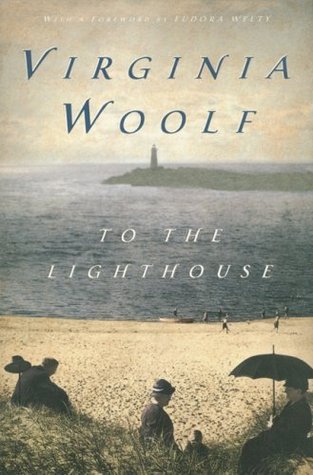
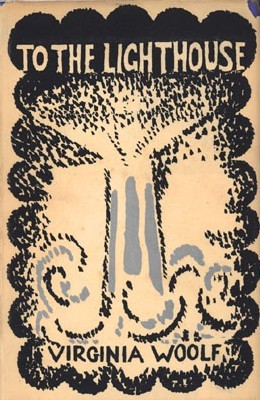
Original cover design by Virginia’s sister Vanessa Bell: 1927
It is this combination, this ‘conversation’ between the narrator, Mrs Ramsey, and Mr, but all in the narrator’s ‘words’, that, among others, mark this text as a work of ‘modernism’; and, indeed, one of the first.
If you think of the third person narrator as an omnipotent genie commenting and assessing each character, every moment, past, present and future, and sitting on the shoulder of the protagonist listening in to their thoughts and desires and explaining, prophesizing, and assessing them for the reader, here it is like that genie is not just rooted to the shoulder of the main character but, flitting to and fro onto the shoulders of many characters. And in the final short sentence of chapter 11 Woolf has all three voices ‘speaking’: the narrator, wife and husband,
For he wished, she knew, to protect her.
James Joyce’s Ulysses was published in English in 1922 and Woolf’s reaction to it was initially uncomplimentary, “puzzled, bored, irritated & disillusioned as by a queasy undergraduate scratching his pimples,” but she later came around to admitting his genius even if she may have not finished reading it. However, it is clear that she was influenced by him, and, no doubt, by the first English translation of Marcel Proust’s À la recherche du temps perdu, translated into English as In Search of Lost Time or Remembrance of Things Past, which also came out in English – it was originally published in France – in 1922. What a year!**.
However, it is important to keep in mind that just as fads flutter through most of our civilised efforts, food, fashion, and politics, so too do fads pepper our literary history; and ‘obscurity’ was a particular literary fad of the early 20th century. Writers thought that every story that could be written had been written so they sought ‘the new’ within the structure of the novel itself, the use of the language, and in the relationship between writer, narrator, and reader.
Woolf did not deliberately seek to be obscure, no writer does, but in order to describe, set down, what interested her she had to find new ways of convincing her readers that they would be interested in it too.
The pleasure of the works of Virginia Woolf is immediate; it is in the reading, not the remembering.
Although the story is set on the Isle of Skye, western Scotland, Godrevy Lighthouse, built in 1858–1859 on Godrevy Island in St Ives Bay, Cornwall, was the inspiration for Woolf’s novel.
You can find the ebook, in various formats, for free here, as well as other works by Virginia Woolf including all her novels and a large number of short stories. If you are interested in discovering Woolf try her first novel, The Voyage Out (1915); a good place to start.
-oOo-
* Teleology is the philosophical attempt to describe things in terms of their apparent purpose, directive principle, or goal
** THE WORLD BROKE IN TWO: Virginia Woolf, T.S. Eliot, D.H. Lawrence, E.M. Forster, and the Year That Changed Literature, by Bill Goldstein, comes out in November this year.
When trying to describe the writing of Colm Tóibín it is easier to point out, not what he does, but what he does not do. He does not use contractions which gives his writing formality, gravitas, and weight; he does not use many adjectives and rarely long and compound sentences making the writing plain, stark, and bold; he does not describe places, people, or the weather unless it is absolutely necessary; and he does not use many adverbs or sentimental phrases to steer the reader into an emotional reaction. It is like watching a movie without a soundtrack (and if you would like an example of such a movie try Maren Ade’s superb comedy/drama Toni Erdmann, 2016 – no soundtrack).
Tóibín asks a lot of his readers; he allows readers to supply the detail: he simply says
‘she walked slowly along the corridor of the palace to her room,’ and leaves it up to us to provide the detail: the decorations, the floor tiles, the guards and their uniforms, drapes, and statues. We all have an idea of the a corridor in a pre-christian palace. Our thoughts may not be accurate, but interior design has nothing to with Tóibín’s story. Our imaginative efforts are all he needs.
All of these elements are in his latest work, House of Names, Tóibín’s retelling of the pagan Greek tragedy of the turbulent family of the House of Atreus, headed by Agamemnon who prepares to besiege the city-state of Troy and return his kidnapped sister-in-law, the beautiful Helen, and return her to her husband, his brother, Menelaus. There is also no sense of good and evil, there is just what must be done to get what you want. Revenge, rape, human sacrifice, incest, matricide, kidnapping, imprisonment, and murder by any means are par for their daily lives as they are for the gods they worship and from whom they seek guidance.
She [Cassandra] had come to us in glory and now, in ignominy, she was running through the palace seeking Agamemnon, having divined that something had happened to him. Aegisthus followed her at a slow pace. When I saw her, I calmly ushered her into the bathroom, where she could see my husband bent over naked, his head in the bloody water. As she howled, I handed Aegisthus the knife I had used on Agamemnon and indicated to him that I would leave him to his task.
Tóibín has used the bones of the story garnered from the Greek playwrights, Sophocles, Euripides, and Aeschylus but has also relied heavily on his own imagination, especially in the Orestes section. The book is divided into parts each focusing on one of the three main characters, Clytemnestra, wife of Agamemnon, Orestes, their son, and Electra, their daughter. The sections labeled Clytemnestra are told in the first person, the others in the third. However, Tóibín uses free indirect discourse (also known as ‘close writing’) where the words used are similar to those the protagonist might use giving the third person narrative a taste of the first; so, whether told in the first or third person this tale is very personal to the murderous trio.
The story opens the day after Clytemnestra has slit the throat of her husband Agamemnon just after he slipped into a warm bath,
I gave orders that the bodies should remain in the open under the sun a day or two, until the sweetness gave way to stench
but quickly takes us back to the reason for this: the death of Iphigenia, Clytemnestra and Agamemnon’s eldest daughter; rather than marrying Achilles, her father’s famed warrior, which she thought was happening that day, she was sacrificed to the gods, with Agamemnon’s approval, to enable fair winds to take him and his fleet to Troy. Clytemnestra plots her revenge which never fades while Agamemnon is away fighting the decade long Trojan War.
This novel, his eleventh work of fiction, is a departure for Tóibín, which may have been his attraction to the idea. Usually his family stories are more about the emotional geography of everyday life of everyday people: the inability of a father to confess love to a lonely son; a recently widowed mother’s attempt to regain her life on her own terms; or how a writer, used to success, copes with failure; rather than the murderous shenanigans of the rich and powerful. However, in the first-person narrative of Clytemnestra, there are similarities with Tóibín 2012 novel, The Testament of Mary. Here too the tone is confessional: a woman, a character from our ancient past, confessing to the reader her inner thoughts, motivations, and decisions.
To facilitate her murderous plans, Clytemnestra has her son, Orestes, still a teenager, kidnapped and sent away along with other young men – to garner silence from their fathers – and guards who might get in her way. Orestes, with two others, the strong and decisive Leander, and the weak and sickly Mitros, escape and in this third-person narrated section there exists, eventually, a taste of domestic happiness, rural contentment, and even romance. But Tóibín only hints at such human pleasures with the same distanced control he uses to describe filial treachery, pride, and murder.
Electra, a sad and rather pathetic character does not have the beauty of her dead sister, Iphigenia, nor the cunning and charisma of her mother, or the courage of her brother, but she hovers over the story biding her time, making plans, until she is able to set up the matricide for her brother to commit.
I enjoyed this tale – it’s a quick read – but I hanker for Tóibín to get back to what he does best and to the promise he made post Brooklyn (2009), that after three novels about women he would tackle a story about men; his previous, The Heather Blazing (1992), The Story of the Night (1996), and The Master (2004), where a long time ago.
You can obtain this work in various editions here.
I don’t know who this person is – I found the image on the net – but to me now he is the reason for this work. The look, the attitude, the knowingness, and even the colouring all add up to my image of Robert. Robert, never Bobby or, heaven-forbid, Bob.
This is Robert Gulliver, and he’s in the process of being born.
Over the last few years, longer probably, I have sketched out a story about this curious character in script form. Because that’s how I originally saw him, it. I don’t remember where he, the idea, came from. He is sixteen but the rigours of puberty landed heavily and early on dear Robert; that, and given his unusual parenting, and intellect, he is very much a round peg in a square hole. In fact, he is a man still in high school.
I was inspired to re-visit Robert recently as circumstances are that I don’t have the luxury of blocks of hours at my disposal to give long-form writing the wealth of time it needs. I have a few long-form projects that need just that. I thought polishing and cut & pasting an existing work would be a much better use of the time I have. Unfortunately I had written 80% of Gulliver’s Travels on a script-writing program called Final Draft; my subscription had expired, the update was expensive, and I was locked out of the program. However, although Robert has been sitting there, locked in the ether, he has been a lot on my mind: the story is well formed and remembered, and re-remembering it, but in a different form, was an interesting and challenging idea to dive into.
Robert’s story is about family. And the moment I wrote that word ‘family’ Leo Tolstoy’s famous opening line from Anna Karenina sprang to mind:
Happy families are all alike; every unhappy family is unhappy in its own way. (Translation by Constance Garnett)
And a comment by Patrick Gale, a British and favoured author of mine, in which he said he likes page one to hold some sort of key to the whole work itself. It’s not that Robert’s family is unhappy or that I need a cryptic smack of the whole thing to begin, but what those two thoughts inspired was this,
Gulliver’s Travels
a novel
by Michael Freundt
Prelude
If you asked a family member – of any family – if they were happy, they would invariably pause, not wanting to simply say “yes”, and try to think of a word, or words, that would accurately describe their … but they would all so quickly realize that they have no idea how to describe how they feel so they say, “Yes,” usually adding, “of course.” You know that this is a lie, but politeness and fear forces you to acquiesce and you smile and say something limp in acknowledgment, like “Good.” This is an example of two lies being better than none. You can both now get on with whatever you were doing; conditioning your hair, mowing the lawn, doing your tax, without upsetting the balance of the universe, happy in the faceless knowledge that you have successfully bypassed the slippery dip to yelling, tears, and/or the breakdown of your world as you know it. This is the bedrock of why families survive; sometimes, even when they shouldn’t.
If you realise at any time that you have somehow been perplexingly born into the wrong family, or if circumstances render your family suddenly, or slowly, unacceptable to you, you need to – or may be forced to – do something about it. This is a story of a boy who did just that.















 Michael K Freundt