I'm an Australian writer living in Bali. I recently took the plunge to self-publish, and to blog which was liberating, to say the least. Writing has never been so immediate and so rewarding.
Australian journalist turned novelist, Trent Dalton
This is a rollicking good read. Entertaining, insightful, rich in characters, with a heavy dose of autobiography, and only marred a little by the ending; more about that later.
Eli Bell is 12 years old and the younger son of dysfunctional but estranged parents, Frances and Robert, and they all bump along day to day on the outer hazardous rings of petty criminality in Brisbane in the 1980s. Rugby, television, drugs, poverty, junk food, cigarettes, XXXX beer, and a surprising amount of love for each other get them through every day. Well, almost. Eli’s ‘family’ is extended to include his mum’s boyfriend, Lyle, the first man he ever loved – it takes him time to feel that for his dad; Slim Halliday, his babysitter, mentor, and possible murderer, but certainly notorious escapee from Boggo Road Goal; and his older brother, August, who has decided not to talk since he and Eli were possible victims of attempted filicide. He communicates only with Eli who has learnt to decipher his brother’s air writing. They are inseparable.
The story is told in the first person and Eli’s colourful language, obvious intelligence, unwavering loyalty, and passion for words make him an unforgettable character. There’s a love story, or love fantasy, woven into the second half that is centred on a Courier-Mail crime reporter, Caitlyn Spies, eight years his senior. Eli hankers after, not only her lips and other parts of her body, but also a job like hers: he aches to be a crime-busting journalist. But does he make it? No spoilers here.
There is a lot of back-story to get through before the narrative really starts, so the opening is a bit slow but once Dalton gets in his stride you are grateful for the time taken; he also weaves in a flavour of surrealism that doesn’t quite work, for this reader, but it’s easy to go along with it and to allow yourself to be ‘taken for the ride.’
And what a ride!
It has all the flavour and action of a television crime story right down to the satisfying climax and the just-desserts handed out to the bad-guys. But there is a climactic tag, a chase sequence that is contrived, too long, and unnecessary. It’s like this sequence has been lifted from another genre and medium; it sits uncomfortably, and ‘tacked-on’, at the end of such a well-written story. But this is a minor criticism.
Yes, it would be perfect for a television, and an adaptation is in the pipeline, produced by Joel Edgerton, but, surprisingly, it is the theatre that has snaffled the goods first. The stage version is scheduled for the 2020 season of the Queensland Theatre Company for the Brisbane Festival in September of that year. Sam Strong, QTC’s artistic director will direct the adaptation written by Tim McGarry.
You can watch a promotional video here, where Dalton gives away a few secrets of inspiration for this, his debut novel with the books that helped him write it.
After I finished my 4th novel, well, the 3rd draft of it, who knows what needs to be done to it and at what time it needs to be done, I sent it off to my ‘agent’. He’s not really my agent as we don’t have a writer/agent relationship, he doesn’t have a relationship with me but with a book of mine, my 3rd novel, Johnny William & the Cameraman. However, what’s a writer to do after finishing number 4 but send it on to someone and an agent who has a relationship with number 3 is as good as any. He said he was looking forward to reading it. He said he liked it. With number 4 out of my hair, I felt like my pet budgie had flown away, a little lost. I scanned two abandoned pieces of prose, both over 20,000 words, one set in a declining rural town that seeks its survival only to have that thwarted by the media; and a story of a group of people who witness a tragedy on Sydney Harbour. Neither re-tickled my novelistic fancy.
But then, I found an old note on my Notepad App called The Owls of Kensingtown. The idea was to chart the reactions and romances of a small group of queer-minded people after the sentencing of Oscar Wilde in 1895. I changed the name to Arcadia Lane, but the title is still up for grabs. Actually Up for Grabs isn’t such a bad title itself. The Owls are metaphorical (“Who is that? Who? Look at them, Who is that one? Who? The one in the hat. Who are you? Who? Who? Who? ….” a chorus like a parliament of Owls. Oh, and A Parliament of Owls isn’t a bad title, either).
As I read through my very brief sketch a scene occurred to me, a scene that has become the opening of this new work, a scene that also sets up a need, which in turn will become the narrative. I have no idea, yet, where the story is going; I only have a direction, not an outcome.
Because of the first scene one of my characters, I’ve called him Henry, leaves his employment. I have no idea where he’s going, but a quick look at Google maps of rural England leads me to a village of Cockley Cley in the east – very obscure, very small – so Cockley Cley becomes his destination, where his peasant parents live.
Along the way he helps a farmer fix a broken down dray and gets a lift from him (This scene isn’t written yet, just mentioned, but as I write this I’m beginning to understand that it needs to be fleshed out. Later). They spend the night at a hogsman’s barn. I don’t know if there was such an occupation as hogsman, but a quick ask of Ms Google tells me that it’s a family name, so an occupation it could’ve been; anyway, I like the sound of it, so hogsman it is.
I don’t believe that a potential reader will stop and Google ‘hogsman’ and then complain that it’s an occupation that doesn’t exist, and has never existed. The sound of it alone fits the times (late 1800s) and it’s also self-explanatory. It is within the realm of possibility and so I believe a reader will accept it.
With the intention of Henry continuing his journey in the morning, I open the next scene early in the morning
with him pissing behind the barn. As he is returning a small girl comes running around the corner and almost knocks him over. I did not plan this. It was as if I was watching this scene, like an audience, and then the little girl appeared. She is strange, precocious, and manic. She is followed by the hogsman, a character I had not intended to draw. The relationship between the hogsman and the girl is ambiguous, and even a little sinister. The hogsman attempts to get the child back into the house with the help of Henry but the child bites Henry on the arm and screams, “He’s a prince!”. This also wasn’t planned. But, serendipitously, (and serendipity plays a very great role in novel-making) a reason for her outburst occurs to me. Henry, a gentleman’s valet, has left his employment because he was having a sexual affair with his gentleman employer, a very satisfying and loving relationship, but the morning paper’s reporting of Oscar Wilde’s sentence of two years hard labor scares the young man and he leaves, leaving the gentleman bereft and without anyone to cook his breakfast. Henry is therefore dressed and groomed very well, courtesy of his employer/lover and his appearance, especially to the little manic girl, seems that of a wealthy man, maybe even a prince!
I continue to ‘watch’ the scene and write down what I ‘see’. The hogsman invites Henry into his house to tend to the wound, shoving the girl into a room where the voices of other young girls can be heard. As the hogsman tends to Henry’s wound the young man looks around the house and notices its two fires, one in the sitting room, one in the kitchen, its heavy wooden and polished furniture, and its decorations, rugs, and paintings. This is not the house of a lowly pig farmer, unless my unnamed hogsman has a very lucrative side business.
The hogsman tangentially suggests a deal: he is willing to pay the young gentleman a tidy sum for his silence about the presence of the little girl/girls in his house. He knows his guest doesn’t look like he needs it, but a deal is a deal and an exchange of money between men who can afford it is as good a deal as most. Henry remains silent, a little character trait I just happened to give him earlier when he saw the wisdom of remaining silent when the truth, which is his usual trope, might do more harm than good (serendipity again). Henry takes the £5 silently, money he, now unemployed, sorely needs.
Understand that this scene may not make it into the final cut.
What has occurred to me since beginning this novel, if that’s what it is, is the similarities between writing prose and playing football. Writers take courses and listen to experts and go on writers’ retreats – players listen to coaches and go on training camps; writers read other writers – players watch other games; writers hone their skills, trying out ideas, different voices – players go to training, honing their skills; writers are disciplined – players are disciplined; writers know and understand grammar – players know and understand the rules of the game; but when it comes to doing the work, writing the thing, playing the game, there is no time to think about rules, advice, examples, and should I write this, should I tackle that; you just write it, play it, and hope to kryst that all the rules, advice, examples, and shoulds have oozed into your intuition, become your default mechanism, and what comes out is eventually a readable novel, a win.
I’m not yet convinced about the veracity of this work but I keep ‘seeing’ scenes, and as long as the scenes keep coming I’ll keep writing. Wish me luck.
When you open a book to page one you usually do so with a blank mind, but an expectant one; waiting for the writer to paint you a picture which becomes – the quicker the better you hope – understanding: place, time, people, action. But right from the start of Max Porter’s Lanny this assumption is useless.
Don’t be put off, if by the end of page 9 you haven’t got a clue what’s going on. Let the snatches of village gossip and easy chatty phrases wash over you like breezes, like waves: exactly like they do on the page – yes exactly like waves, not in straight lines.
Watch and listen to Max Porter talk about the making and the essence of his book, Lanny.
In the first sentence you are introduced to Dead Papa Toothwort; at this moment, and for a few pages to come, a mystery. The more you read the more theories of his identity test themselves until you think that Dead Papa Toothwort is a presence, something like an invisible, all-knowing spirit that flits, swoops, and hovers in and over a village, through its stories, myths, and pliable imaginations, past and present. The strange beginning and pages of wavy lines are necessary: once you accept the existence of Dead Papa Toothwort, and you must, Porter prepares you to accept a whole lot more (no spoilers here).
But the village is real, as real as a novelistic village can be; a dormitory nameless village on the outskirts of London – and we finally meet characters in that village, and we are on safer ground. Understanding, place, time, characters, action emerge like a happy vista through a rising fog. Lanny’s Mum, Lanny’s Dad and Pete. They tell you their stories in the first person, and all of their stories revolve around Lanny. A boy. An exceptional boy. Everyone loves Lanny. He scares people sometimes, especially his parents. He sings when he walks. He collects stuff like a bower bird. He soothes anger with a well-chosen question or a song. And then Lanny disappears.
This book is not a conventional book. Porter has created something different, and what that something is I’m not sure, yet. What it has in common with a conventional book is that it is satisfying, a strange, but satisfying read. There are some conversations and dialogue but not in the familiar form – punctuation is minimal, but no quotation marks – yet it’s always clear what you’re reading, who is speaking, what is being said. You get to know these people very quickly. It’s a small book, I read it in two consecutive afternoons.
In the middle of the book when the town, the police, the media, turn on these three people the tension, the fear, and the unease is told through multiple voices; it isn’t important who says them; you can guess who says them.
Lanny is the centre of the story, but Lanny isn’t given his own voice. You learn to love Lanny via those around him. Porter gives you recognisable emotions, flawed parents, uncaring neighbours, who themselves sometimes are given a voice; familiar novelistic traits that are compensation for, it seems, for the unconventional beginning and format.
I have only one criticism: I would’ve liked to have witnessed more of Lanny’s exceptionalism; his soothing of anger with a song, for example, than just been told about it.
As Porter says, it is not a book that has much to do with today. There are no mobile phones, computers, or text-speak. It is a book about sound and our imagination and how we need to let a writer tickle that imagination into forms and acceptances that are a little out of our comfort zone.
I urge you to give him that chance.
Max Porter’s first novel, Grief is The Thing with Feathers (2015), won many awards and nominations and has been sold in twenty nine territories. A theatrical version was staged in Dublin in March 2018.
You can watch an interview with Porter about Lanny, it’s themes and genesis, here.
Australian writer, Patrick Victor Martindale White, 1912 – 1990. Offered but declined a knighthood in 1970. Won the 1973 Nobel Prize for Literature.
I have had a checkered reading of Patrick White: I started The Tree of Man (published in 1955) when I was too young to appreciate it, so stopped; I started The Twyborn Affair (1979) but, not long in, threw the thing against the wall – I don’t remember why; and in 2011 I read A Fringe of Leaves (1976) several times – for academic purposes – and loved it! It was his first novel after the Nobel Prize and the pressure must have been immense.
The title comes from A. E. Houseman’s A Shropshire Lad (31):
There, like the wind through woods in riot,
Through him the gale of life blew high;
The tree of man was never quiet:
Then ’twas the Roman, now ’tis I.
In 1957 Patrick White wrote in a letter, “I felt the life was, on the surface, so dreary, ugly, monotonous, there must be a poetry hidden in it to give it a purpose, and so I set out to discover that secret core, and The Tree of Man emerged.”
“I wanted to suggest in this book every possible aspect of life, through the lives of an ordinary man and woman. But at the same time, I wanted to discover the extraordinary behind the ordinary, the mystery and the poetry which alone could make bearable the lives of such people, and incidentally my own life since my return” … to Australia in 1948.
He uses the word ‘poetry’ in both these quotes. If you see this word on the cover, or more usually on the back-cover, of any book it usually means ‘literary’, ‘difficult’ and such a book won’t be found in an airport bookshop. It is, apart from anything else, informative.
The Tree of Man is about life. Stan Parker, a young ordinary man, (Life had not yet operated on his face) marries Amy, a young orphan (…had not yet felt affection for any human being) and takes her to live with him in a rough hut he has built on a plot of rough inherited land in the bush. What happens to them is the plot. What they feel, and usually don’t understand, and the discovery of meanings, insights, and poetry is the narrative and far more important; the description is the place and what it does to them, and the dialogue is how we get to know, and feel for, all the characters. These are the elements of a novel: narrative, description, and dialogue. And in the first two is where the poetry is.
Early in the book, after a devastating flood Amy Parker takes in a stranded boy, assumed an orphan. During the boy’s first night with the Parkers, she finds the lad late at night sitting by the fireplace looking at the dying fire through a piece of red glass:
‘What are you doing here?’ the child asked.
‘Why,’ she said, ‘I live here. This is my house.’
But her skin was cold. She was uncertain of her furniture.
That last line of two short sentences is an example of literariness. The link between her last spoken line, This is my house and the next line of prose, But her skin was cold is not linear. There is a knowledge gap. And there is another, bigger, gap between that line and the next, seemingly strange one, She was uncertain of her furniture. What has to happen here is for the reader to fill in those gaps. This reader filled in that the child was warm but she wasn’t, so at a disadvantage; the child had control here, and she, not much more than a child herself, was intimidated by him. The second larger gap I filled in with an even stronger feeling of inadequacy: she knew nothing about anything, not even her furniture, which suddenly seemed irrelevant to her, as if she had no say in it; again like a child.
The child was looking at her hand. It was lying with some lost purpose along his arm. She still had to learn the words that she might speak.
This is what literary fiction does: the thought processes are not linear so requiring the reader to use their intuition, experience, and self-trust. What the writer meant by all of this is irrelevant – they’ve either moved on to their next book, or are dead – it’s in the realm of the reader, always, and what the reader thinks is correct.
This is an Everyman story of how people behave based on their own wishes and desires and to each other, the poetic majesty of living, loving, and making a life for themselves out of the scrubby wilderness but without any of the words necessary to express such feelings and mysteries. They talk to each other as uneducated country people do while the narrator reveals everything else.
Like all readers, we make a pact with writers to accept their omnipotence and let them lead us blindly along the tracks, twists, and turns of the narrative, no matter how ordinary the action is. The ‘novel’ is in the narrative. If you pick up a Patrick White novel and open it this is what you have to do. This is where the pleasure is.
Along the way, in the narrative, not in the dialogue, there can be incredible wisdom.
But he respected and accepted her mysteries as she could never respect and accept his.
This is profound. In one short sentence White encapsulates the essence of male-female relations that lie at the heart of countless novels, films, musicals, and, indeed, relations between the sexes for centuries, as in the song, Marry the Man Today, from the 1950’s musical Guys and Dolls, with music and lyrics by Frank Loesser.
Marry the man today Rather than sigh in sorrow Marry the man today And change his ways tomorrow.
As a literary work about the essence of mankind such pronouncements are the result of his intention: to discover the ‘poetry’ of human existence. His sentence instantly paints that archetypical relationship in which the husband unquestionably, but usually because he just wants peace between them, follows the tenants of his married life as stipulated by his wife, but she is forever ‘nagging’ him to change his ways. During this scene where White uncovers such universal truths the pair are talking about selling a calf: he thinks they have too many, she thinks the heifer, she calls her Nancy, will fret; she worries about their daughter who has cried over the extraction of a splinter under her fingernail, he thinks she’s doing fine if that’s all she has to worry about. Character based dialogue, simple and personal, but the wisdom and truth is in the literary narrative with language that the uneducated characters of their own story would never use.
His simplicity had not yet received that final clarity and strength which can acknowledge the immensity of belief. So instead of praying he went into a café and ordered a plate of food.
What people mean when they say ‘I believe…’ is often ‘I believe in the believing’. Believing comes with ritual, mannerisms, uniforms, social contact, expectations, and the resulting satisfaction. People pray without a sense of who they are praying to. They believe in the action of praying. It’s comforting. It’s doing something. Something that many people would approve of, and is therefore satisfying; like ordering a plate of food, which, realistically, is far more comforting because it actually arrives.
The narrative follows the couple, their two children, Ray, who doesn’t turn out well, and Thelma, who marries a solicitor and has the opportunity to wear furs and crocodile skin shoes and so she has the excuse to look down on her parents. Stan and Amy Parker have two grandchildren and it’s possible they might like to make things right with the children and the children’s children; but it’s too late: it’s not their call any more. They missed it, and it’s inferred that the next generation, as parents, will do no better.
White explores the dichotomy of parental love and how we have no control over it: you love them as kids but maybe not as adults. They grow-up and grow-away. Even the people with we live with for decades we learn to take for granted. So when the grandson comes in wet from a storm …
And Stan
The old woman began to remember her husband whom she had forgotten. She forgot him now for whole days.
White started out to find the poetry in life, instead he found the truth.
To write novels you have to read novels, a LOT of novels.
The best way to write a novel is to start.
Don’t be waylaid by family, friends, and lunch invitations. You’re the writer. Write.
Know how the language works. If you hate grammar take up knitting.
Genre is something that agents, publishers, booksellers, and readers think about; write what interests you. Let them work it out.
Don’t try to be too clever with your narrator.
Spew the whole story onto the screen, or page. This is the first draft: 90,000 words +
Be disciplined. Give yourself a daily goal, i.e., 2000 words. If necessary write anything. Any writing (except the shopping list) counts.
You don’t necessarily need to write what you know. How many witches, snakes, and house-elves did J.K. Rowling interview before she wrote Harry Potter?
You don’t need to know the ending when you start; in fact, it’s best if you don’t.
The three elements of a novel are narration, description, and dialogue.
Narration is what your narrator says.
Description doesn’t need to be exhaustive. A few apt words can paint hundreds more. Let the reader fill in the gaps.
Dialogue is the best way to create believable and distinguishable characters.
Verisimilitude (creating truth) is the writer’s goal; you do that with detail.
Don’t think about your muse. They take the focus off you.
A cure for writer’s block: put two clear but different characters in an adversarial situation and make them talk to each other. You will be amazed what happens.
Somewhere towards the end of the 1st draft you need to know what it is about. What is the point of it? What does it all mean. This will lead you to the ending.
Not every idea you have while writing this novel is right for this novel; it may be better for the next novel.
After you’ve finished the 1st draft put it away for a few weeks and write some other stuff.
The best person to tell you the real truth about the 1st draft is (almost always) the person who shares your bed. This is true and a whole lot cheaper.
The second draft is cleaning up and consolidating the timeline, characters, relationships, lose ends, and getting rid of your (the writer’s) voice.
You should lose about 10% of the 1st draft. You can add or cut, but it’s mainly cut. Be brutal. If you don’t know about “Murder Your Darlings!” Sir Arthur Quiller-Couch said it first, find out.
The 3rd draft should be printed out. Read it on paper. You’ll be surprised what ‘other’ stuff you see and that may need to go too.
Once it’s ‘out there’ it’s no longer yours. It belongs to the reader and it means what the reader thinks it means. You’re irrelevant.
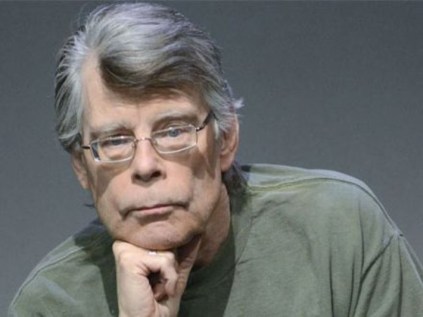
American writer Stephan King. “Nothing can live up to the memory of a good scare.”
Outside the Palazzo Vecchio in the Piazza della Signoria in the centre of old Florence is the statue of David by Michelangelo. Actually it’s a statue of David by someone else. It’s a copy. The original is in the Galleria dell’Accademia not far away. Michelangelo’s David is truely remarkable but what is more revealing are the accompanying statues of slaves; unfinished statues. The figures seem to be emerging out of the stone; or to put it another way, they were always in the stone; Michelangelo just had to remove the marble from around them to reveal them in all their glory. Music is like that. The Clarinet Concerto always existed; Mozart just wrote it down so now it’s called Mozart’s Clarinet Concerto. Stories are like that too.
I want you to understand that my basic belief about the making of stories is that they pretty much make themselves … Stories are relics, part of an undiscovered existing world. The writer’s job is to use the tools in his or her toolbox to get as much of each one out of the ground intact as possible.
or, in other words; stories have always existed, writers just have to write them down as accurately as they can.
If you hear a writer say “…Oh, it just wrote itself, really,” this is what they are talking about without really understanding anything about it.
Plotting is way down on King’s list of what’s important. For him it’s narration – to move the story along; description – to create a sensory reality; and dialogue – to bring characters to life.
I’ve never plotted any more than I ‘d try to convince you that I’ve never told a lie, but I do both as infrequently as possible …. plotting and the spontaneity of real creation aren’t compatible … It’s clumsy, mechanical, anticreative. Plot is, I think, the good writer’s last resort and the dullard’s first choice. The story which results from it is apt to feel artificial and labored.
I’ve heard, and read, many times that Stephan King is a writer’s writer. It’s a good line, although I’m not sure what it means. I took it to mean that I should read him. I’ve been planning to but as his work is not my preferred type (hate the word ‘genre’) other books kept preempting my plan. And then this one came along: a Christmas gift from my sister.
King calls it a memoir, and it certainly is. His chapter on his early struggles – menial jobs – many rejections, a family to support – is particularly honest and heart-warming. Yet, his chapter on being an alcoholic is electric. Talk about ‘being honest.’ It’s an insider’s view, the view of an alcoholic looking out with all the denials, justifications, and excuses that are virtually the ‘brand’ of all alcoholics but while he’s being one, seem particularly applicable to him and him alone.
But the life story doesn’t take long and soon he’s into the advice: the reason for reading it. I was heartened to read that his first piece of wisdom is, if you want to write, you must read. Phew! Good. I do that. His next piece of advice was to wage war on adverbs, especially attributive adverbs in dialogue: he said dismissively, she blithely said. His argument against adverbs like these was particularly convincing. I got up and opened my computer to the writing I had done that day and erased all my attributive adverbs, well, most of them. I had to make a few other adjustments to follow his advice: it should be perfectly clear how a line of dialogue should be said from the words themselves and, of course, the accumulated tension, tone, and information. Don’t be scared of oft repeating, he said, she said.
All I ask is that you do as well as you can, and remember that, while to write adverbs is human, to write he said or she said is divine.
And vocabulary? “As the whore said to the bashful sailor, ‘It ain’t how much you’ve got it’s how you use it.” And if you have to run to the thesaurus to find the right word, it’s probably not the right word. He quotes Earnest Hemingway to seal the point.
“He came to the river. The river was there.”
He’s equally honest and up-front about narrative, description, dialogue and a myriad of other implements from his literary toolbox. I am very happy to now know that I share his belief in dialogue as one of the best ways to built character. There are some writers who avoid dialogue. What a missed opportunity!
However, I was, at times, at a disadvantage reading this book because he often makes his point by referring, in detail, to his own work and decisions he had to make, and why. I have never read anything by King so I found these passages redundant. Not his fault, but mine.
For a new writer like me (I can’t use the adjective ‘young’ any more), who’s grappling with the second draft of a major work that at the moment is a broad, messy, and a wooly thing, reading King’s On Writing now is the most serendipitous and useful coincidence.
All writers, especially new ones, and most readers would get a lot out of his insights into the writing process, the hazards and joys of writing for a living, and the more profound elements of imagination, fiction making, and self-fulfilment. Highly recommended.
-oOo-
I have a gripe with Mr King. He’s down on adverbs, but he’s also down on pronouns. And so he should be; he uses them so clumsily (Yes, I now its an adverb but its necessary here.)
Move too fast and you risk leaving the reader behind. either by confusing or wearing him/her out.
The phrase ‘him or her’ is bad enough, but ‘him/her’? Unforgivable! He uses ‘he and she’ and even ‘he/she’ – but thank god, not ‘s/he’!
This is one of the English language’s greatest failings: there is no gender-neutral singular pronoun. For centuries it has been common practice to use the masculine ‘he, him, and his’ to refer to both genders. Today, this is not acceptable. But, there is a solution. What’s wrong with using the gender-neutral plural pronoun? Nothing. This has been around for a few hundred years, from the 16th century in fact* (It’s also been a solution for Jane Austin, Bernard Shaw, and Barak Obama). Yes, it’s breaking a fundamental rule of subject-pronoun agreement which maybe a small problem for some but it fixes a much bigger problem. Hence King could’ve and should’ve written,
Move too fast and you risk leaving the reader behind. either by confusing or wearing them out.
Much simpler, easier, cleaner, and no confusion, despite the broken rule.
* He neuer forsaketh any creature vnlesse they before haue forsaken them selues.
– J Fisher Wayes to Perfect Religion (before 1535)
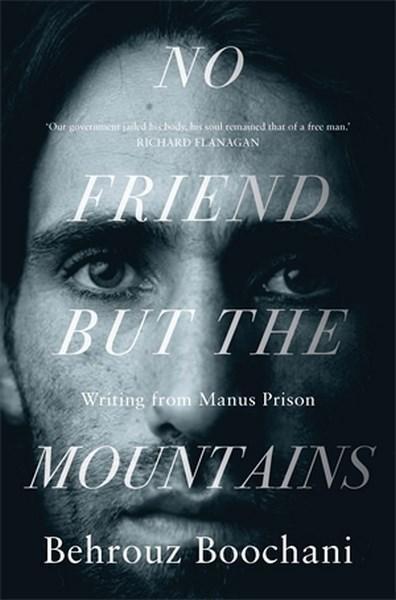
You can find the Kindle edition, as well as other formats, here.
Omid Tofighian is Lecturer in Rhetoric and Composition in the School of Literature, Art, and Media and Honorary Research Associate in the School of Philosophical and Historical Inquiry at the University of Sydney.
Although Tofighian is the translator, he acknowledges over a dozen people involved in getting Boochani’s original text smuggled from Manus via WhatsApp and Facebook into his hands.
One aspect I was always conscious of was that Behrouz was writing in Farsi, not Kurdish. He was writing in the language of his oppressors, even though he is a fervent advocate of Kurdish culture, language and politics. And the book was being translated into the language of his torturers.
I saw this translation opportunity as a chance to contribute to history by documenting and somehow supporting the persecution of forgotten people; translation for me, like writing for Behrouz, is a duty to history and a strategy for positioning the issue of indefinite detention of refugees deep within Australia’s collective memory.
The book is dedicated to Janet Galbraith who coordinates and facilitates the writing group Writing Through Fences, an organisation that collaborates with incarcerated refugees (or previously detained refugees) and amplifies and supports their writing and art.
____________________________________
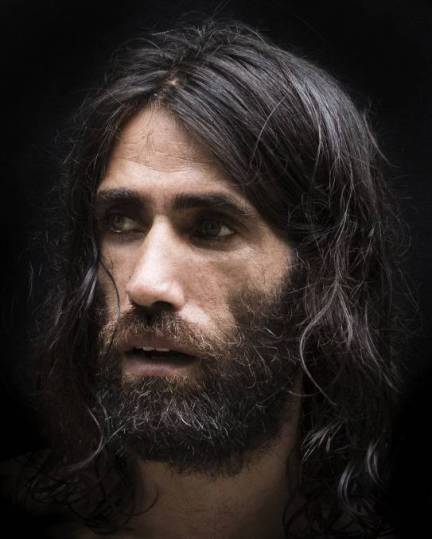
Kurdish-Australian writer and asylum seeker, Behrouz Boochani. Winner of the Non-Fiction Prize and the Victorian Prize for Literature at the Victorian Premier’s Literary Awards, 2019.
“In 2013, Kurdish journalist Behrouz Boochani was illegally detained on Manus Island.
He has been there ever since.”
Australian law would object strongly to the word ‘illegally’, international law may not.
On a truck bumping through the dense Javanese jungle on a dark and bumpy track heading to the beach, even asylum seekers aren’t immune to the hazards of public transport,
A loud, obnoxious and completely inconsiderate Kurdish guy forces everyone to breathe his cigarette smoke throughout the trip. He is accompanied by a gaunt wife, adult son, and another son, a little bastard. This kid has his mother’s physical features and his father’s character. He is so loud he torments the whole truck, treating everything as a joke, and annoying everyone with his impatient and disruptive manner. He even gets on the nerves of the smuggler, who yells at him.
Finally after much shouting, rudeness, and disrespect as the over-wrought passengers jostle for space, the rotting boat heads out to sea
like a heavily pregnant mare cantering carefully across a dark prairie of water,
where there isn’t enough room for everyone to sit or lie but those who can, sleep.
Even the normal physical boundaries between families has fallen apart. Men lie in the arms of another’s wife, children lie on the chests and bellies of strangers…the young Sri Lankan family, whose bond is maybe the strongest of all on board, has fallen apart. The husband is in the arms of the man next to him, the wife has her head on the bicep of another man, and their child has ended up across the thighs of a different woman.
Those who aren’t sleeping are vomiting as the waves get bigger and pound the leaking boat … then the bilge pump fails …
This whole mess / In the darkness of midnight / Looks like death / Smells like death / Embodies death / The cries / The screams / The swearing / The knocking about / The sounds of the small children / The heart-wrenching and painful sounds of the little children / These sounds transform the chaotic boat into hell.
Why don’t the people, who just hours earlier were in danger of death from the waves but now on the deck of the Australian ship listening to those same waves lick and lap harmlessly against the hull; why don’t they yell and laugh with happiness at their salvation? They sit quietly and still. Even Boochani doesn’t know why. To the Australians they must seem like, like, cargo, soundless cargo, salvaged from the sea.
Boochani has known death and fear; as a young man he wanted to fight for the liberation of his homeland, but he chose the pen over the gun. Was he a coward? Afraid of death? Then on the ocean he faced both fear and death. Saw fear in the faces of others and felt it in his guts, tasted it on his tongue; the ocean provided him with the most intimate relationship with fear and death. Now he is judged and locked up by people who know neither of these two things. Maybe he should’ve been a soldier, at least he would be shot at by people who, like him, knew about fear and death. It would be an equal fight. Just, even.
Boochani tried twice to get to Australia. He encountered fear and death on both attempts. As he scrambled onto another ill-prepared boat for his second attempt he had to admit that such an action wouldn’t be possible but for courage and foolishness. Returning to Iran, unthinkable! He was aware of his fellow travellers not really knowing any of these four demons: fear, foolishness, courage, and death. They soon would.
I’m stopping! I write this post as I read – as I usually do when reviewing a book, but it’s hard to know what not to cut and paste to show you, let you see what it sounds like because everything is worthy of quoting; every line is full of something, something worth passing on. I want to show you all of it. So, do it; just read it.
Writing allows us to “come to understand another’s point of view in the most profound way possible.” (Erica Wagner, writer, critic, and a Man-Booker Prize judge, twice)
I will continue to read this book, not out of a need for entertainment, but for enlightenment, understanding. I’ve only ever seen asylum seekers on the news, voiceless bodies behind wire. The Australian Government has not wanted us to hear what they have to say: journalists are banned on Manus and Nauru. This is the first time I have the opportunity to hear what the Australian Government does not want me to hear. That is why I will read it to the end; as I hope you will too.
You can buy the eBook ($14.99) from Pan-Macmillan here.
Arnold Zable, an Australian writer is also part of this story. You can read his SMH article and watch a short trailer for the video Chauka, please tell me the time, here.
Watch Behrouz’s videoed acceptance speech, here. He was not allowed to attend the Award’s Presentation.
Anne Summers: journalist, feminist, and writer. “If we constantly rewrite history to fit how we see things now, we forget how things used to be and, equally important to future scholars, how we used to see them.”
Anne Summers and her publishers have produced a handsome book, and it begins, unusually, with a letter to her thirty-year-old self: Dear Anne, and so, consequently, it’s written in the second person; and it sets the beginning as at that time, when she was thirty, and summarises what went before which was told in her first autobiographical work, Ducks on the Pond 1945-1976 (1999). So this, a re-cap, is a neat and imaginative way to catch you up, especially if you haven’t read the earlier work; which is, by the way, now only available on Amazon US at $115.64 for the second-hand hardcover, which is cheaper than the $191.89 for a second hand paperback! However, if you can’t find a copy anywhere else, here’s the link.
For someone who, from an early age, felt profoundly at odds with what the Adelaide world of her Catholic childhood promised her: an identity based on a man and the success, or otherwise, of their children and a future slowly fading into cranky old age and invisibility, she has stubbornly and courageously shunned all of that and forged her own path that has turned out to be something like an open-ended roller-coaster. It’s a crackling tale: ecstatic highs and scary lows; and all along the way the reader gets an insight into the characters she engaged with and the history we all lived through, all in a chatty and self-effacing tone that has you barracking for her as she strides around yet another corner into the unknown, including South Africa, the badlands of western Pakistan – without a hijab, and later as Chair of Greenpeace International which took her, well, everywhere.
Anne Summers at the National Press Club during the 1980 CHOGM meeting in Australia directing a question at British Prime Minister Margaret Thatcher. photo: Allan & Unwin
The personal is also covered. Her uneasy relationship with her parents, especially her father; the painful rediscovery of her paternal grandfather; there’s treachery and betrayal from colleagues and friends; a health scare; and finally meeting the love of her life, and that started in the photo-copy room! He’d been around all along!
The political years of this chronicle cover Fraser, Hawke, Keating, Howard, and Rudd/Gillard/Rudd: a turbulent, often frustrating – for us, I mean – but never a boring time in Australian politics. Of special note is her calling out the appalling misogyny Prime Minister Gillard received at the hands of the shock jocks, political opponents, and a particular, but faded, cartoonist. Her insights and insider status make fascinating reading as seen from her media perspective (her attitude to Keating changed; her attitude to Howard didn’t); and then in the middle of all that her successful empire building (and spectacular fall!) at the top of the media tree in New York “…if I can make it there, I’ll make it …..” you know how it goes! Well, she did and then, almost immediately, she didn’t!
But when down, or idle – something she hates – an opportunity passes her window or, more usually, she creates one, and so grabs it with both hands and she’s off again!
Running through all of this, is her strong advocacy for the rights of women; their professional fulfilment, all their wishes, needs, and ideas taken seriously, and the universal understanding that they make mistakes but deserve to, and be allowed to, try again. What a rich, informative, and fulfilling read this is.
2011 Australia Day postage stamp featuring Dr Anne Summers AO.
I’ve known Anne for a few decades usually meeting with mutual friends over a sumptuous meal and a bottle of good red wine or three but I wasn’t prepared for the breadth and depth of her worldly participation nor her personal honesty.
I find scheduling reading time a sign of a good book; but you’ll also need to schedule a breather now and then. Don’t read this in bed. You’ll never get to sleep.
You can find the book here, and the kindle version here. For Indonesian readers you can find the book here.
Be very careful when Googling Anne; you’ll undoubtedly get the English Ann Summers (Ann, no ‘e’) who is a designer and marketer of raunchy women’s underwear.
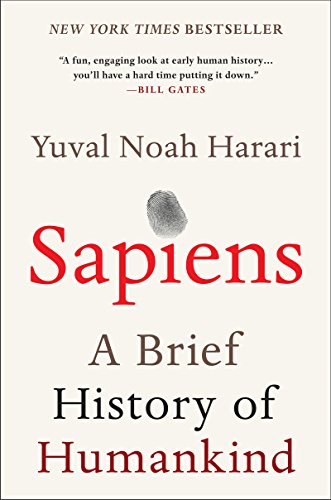
Yuval Noah Harari, Israeli Historian and Professor of History at the Hebrew University of Jerusalem
For a man who likes fiction, and who usually only reads fiction, I found myself, because of Christmas, with 4 new non-fiction books on my bedside table: Anne Summers’ memoir, Unfettered and Alive; Colm Tóibín’s Mad, Bad, & Dangerous to Know: the Fathers of Wilde, Yeats and Joyce; Stephen King’s On Writing, and this one, Yuval Noah Harari’s Sapiens: A Brief History of Humankind (2014).
The first I have because Anne Summers is a friend; the second because I am a fan of Colm Tóibín and I collect everything he writes; the third was a Christmas gift from my sister; and the fourth was a grab-bag gift from the festivities of Christmas Day. They all interest me, in fact many non-fiction books interest me, but volumes of fiction always got in the way. Even now, there are seven novels hovering ready to pounce and to grab my attention.
Let’s start with Harari’s definition of history: the development of elaborate human structures called cultures which the organism known as Homo Sapiens began to form about 70,000 years ago. Once I read this I knew I was in safe hands and that I was going to, not only find out stuff that would fascinate, but that it would all be in accessible language.
Sapien’s time on this planet is a very short period in the cosmic time frame: if you could squeeze the time from the beginning of the universe to the present day into a 12 hour period, Homo Sapiens would have first stood upright at about 11.59.
The book is full of fascinating detail and remarkable insights. Homo Sapiens was not the only Homo species to exist at the same time but the reason Sapiens prevailed and destroyed the others – as one theory goes – is not because of our strength or our brain size – the Neanderthals had bigger brains and bigger bodies – but because of one fundamental difference: our cognitive ability, via language, to imagine things that do not exist: fictions like religion, nationalism, honour, human rights, politics, literature, and (the only fiction that everyone in the world believes in) money.* These mental constructs were what enabled Homo Sapiens the where-with-all to organise themselves in large numbers. Large crowds of people, from 2,000 to 100,000 individuals can organise themselves to behave well and orderly for many hours to witness the outcome of a competition (football) or the staging of a story (Wagner’s Ring Cycle). If you put only 500 of our nearest relatives, the chimpanzees, in a theatre there would be chaos. Of course, large crowds of humans can degenerate into chaos but only when the acceptable boundaries, rules; i.e., agreed constructs, that all members of the gathering adhere to, or believed would be adhered to, are broken. For example, the premier of Stravinsky’s ballet Rite of Spring.
And fundamental to the success of our ability to co-operate in large numbers is our obsession with social information: gossip. This fascinating topic and its historical necessity I’ll leave for you to read about.
English suffers from the absence of the third-person singular and genderless personal pronoun. We have plural ones: them, they, and their, and they are allowed to be used in singular form (“Each writer needs to be merciless when re-writing their work” – his/her is no clumsy), but the long standing acceptable way around this problem has been to use the masculine singular personal pronouns: he, his, and him. Harari raises the finger to such ‘traditions’ and opts for the feminine: she, her, and hers. A nice touch, given our current social and linguistic shenanigans around gender. It puts it firmly in the 21st century.
The language is not simplistic but is easily digestible – you need to read it with the TV off – and is peppered with humour, irony, and hyperbole. It’s a wonderful read, entertaining, enlightening, and often astounding.
You can watch and listen to an excerpt from Harari’s TED talk (June 2015) on “Why Humans Run the World” here.
Everyone is reading this book and the two that follow it: Homo Deus: A Brief History of Tomorrow (2016) and 21 Lessons for the 21st Century (2018). They are everywhere. If you haven’t seen a copy you’re either blind or have just returned from Mars.
* Money was created many times in many places. It’s development required no technical breakthroughs – it was purely a mental revolution. It involved the creation of a new inter-subjective reality that exists solely in people’s shared imagination. Money is not coins and banknotes. Money is anything that people are willing to use in order to represent systematically the value of other things for the purpose of exchanging goods and services. Money enables people to compare quickly and easily the value of different commodities (such as apples, shoes and divorces), to easily exchange one thing for another, and to store wealth conveniently. Sapiens, Page 197.
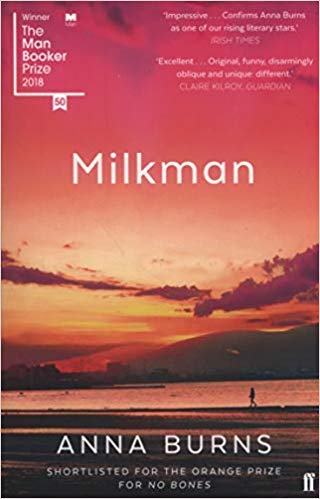
The day Somebody McSomebody put a gun to by breast …
and it made me feel I was in safe hands; a safe writer’s hands. She could’ve used the simple word, somebody, but the capital letters and the Mc told me where she was and also her attitude to this person, it could’ve been one of many people from the place she comes from. Guns are rife. Even if you hadn’t read the Booker Prize announcement or the publicity it generated, or the back of the book itself and discovered Anna Burns is from Northern Ireland and always writes about the Troubles you could work it out: the use of Mc tells you it’s either Scotland or Ireland but the prevalence of guns tells you it’s probably Northern Ireland given it’s history which any reader must remember.
When one uses an article in front of a noun it gives information about that noun; “a success” means something different from “the success”: the former means success in general, the success of anything; the latter means a particular success, the one we’re talking about. If there is no article the meaning is different again; it means the quality of success, success-ness. Anna Burns omits the article of the noun, brother-in-law; as in …
…there was a rumour started by them, or more likely by first brother-in-law, …
… which suggests there is such a thing as brother-in-law-ness. The insinuation is that she has a lot of experience with brother-in-law-ness since this one is just the first one. It’s like a job – all plumbers are the same type, just like all brother-in-laws. And she doesn’t like them.
No one is named, but they have names. She calls her mother ma, her name is ma; ma calls her middledaughter, she calls him maybe-boyfriend, and him, third brother-in-law, and her brothers, thingy, thingy, and thingy; she calls him, milkman. Not the milkman, just milkman; no article, so no name but with a name, milkman. Even though he has nothing to do with milk, not even its distribution, he has milkman-ness: he knows where everybody lives, especially daughters, and what they have for breakfast. Ah, but this is not to be confused with real milkman. This is a man of a rare kind.
The stream of consciousness can be daunting: each page is densely packed with words; direct speech, brief though it is, is imbedded in the paragraph, there is little page-space. It gives the impression of dense weight.
Yes, there is a narrative in the traditional sense. Let’s call this the plot. But the plot is sparse. The narrative is really inside her head; this young innocent girl trying to live a life in a war zone, but a war that isn’t an official war, but therefore it’s much more dangerous, because even the language is full of weapons, bullets, and grenades.
As regards this psycho-political atmosphere, with its rules of allegiance, of tribal identification, of what was allowed and not allowed, matters didn’t stop at ‘their names’ and at ‘our names’, at ‘us’ and ‘them’, at ‘our community’ and ‘their community’, at ‘over the road’, ‘over the water’ and ‘over the border’. Other issues had similar directives attaching as well. There were neutral television programmes which could hail from ‘over the water’ or from ‘over the border’ yet be watched by everyone ‘this side of the road’ as well as ‘that side of the road’ without causing disloyalty in either community. Then there were programmes that could be watched without treason by one side whilst hated and detested ‘across the road’ on the other side. There were television licence inspectors, census collectors, civilians working in non-civilian environments and public servants, all tolerated in one community whilst shot to death if putting a toe into the other community. There was food and drink. The right butter. The wrong butter. The tea of allegiance. The tea of betrayal. There were ‘our shops’ and ‘their shops’. Placenames. What school you went to. What prayers you said. What hymns you sang. How you pronounced your ‘haitch’ or ‘aitch’. Where you went to work. And of course there were bus-stops.
The narrative inside her head, which the above quote gives you a taste of, is relentless – as thoughts are – and in the midst of all this danger – 80% of the book is this danger – there is the simple plot: a much older man, milkman, is stalking her, and even if she doesn’t reply and just stands there letting him talk, even with her arms folded, not engaging with him, wishing he would go away, she doesn’t like him – she likes maybe-boyfriend – but he won’t go away – and when he does go away it’s as secretly and silently as he arrived – but he’s there long enough for them to be seen together. That is enough for chins to wag and tongues to spit. They were seen together so she, daughter, must be having an affair with milkman, and it must be true because Mrs Someone and Mrs Thingymabob said. Even ma doesn’t believe her. What’s a girl to do?
Did I enjoy this novel? To start with, yes; but as it progressed it felt repetitive and over-written. The Man-Booker judges have, in recent years, favoured the experimental voice to the detriment, I believe, of story-telling and therefore of their readership. Although a stream-of-consciousness novel, James Kelman’s How Late it Was, How Late won in 1994 the past four years have seen more experimental novels taking the prize. New writing doesn’t necessarily mean better writing.
Here is a very short video of Anna Burns after winning the Man-Booker and talking briefly about the writing of her novel. She seems overwhelmed by the media attention, which given its intensity is understandable. I apologise for the god-awful and too loud backing music.













 Michael K Freundt