The Novel Game.

The Novel Game - Aussie Rules pic
Australian Rules Football

After I finished my 4th novel, well, the 3rd draft of it, who knows what needs to be done to it and at what time it needs to be done, I sent it off to my ‘agent’. He’s not really my agent as we don’t have a writer/agent relationship, he doesn’t have a relationship with me but with a book of mine, my 3rd novel, Johnny William & the Cameraman. However, what’s a writer to do after finishing number 4 but send it on to someone and an agent who has a relationship with number 3 is as good as any. He said he was looking forward to reading it. He said he liked it. With number 4 out of my hair, I felt like my pet budgie had flown away, a little lost. I scanned two abandoned pieces of prose, both over 20,000 words, one set in a declining rural town that seeks its survival only to have that thwarted by the media; and a story of a group of people who witness a tragedy on Sydney Harbour. Neither re-tickled my novelistic fancy.

But then, I found an old note on my Notepad App called The Owls of Kensingtown. The idea was to chart the reactions and romances of a small group of queer-minded people after the sentencing of Oscar Wilde in 1895. I changed the name to Arcadia Lane, but the title is still up for grabs. Actually Up for Grabs isn’t such a bad title itself. The Owls are metaphorical (“Who is that?  Who? Look at them, Who is that one? Who? The one in the hat. Who are you? Who? Who? Who? ….” a chorus like a parliament of Owls. Oh, and A Parliament of Owls isn’t a bad title, either).
As I read through my very brief sketch a scene occurred to me, a scene that has become the opening of this new work, a scene that also sets up a need, which in turn will become the narrative. I have no idea, yet, where the story is going; I only have a direction, not an outcome.
Because of the first scene one of my characters, I’ve called him Henry, leaves his employment. I have no idea where he’s going, but a quick look at Google maps of rural England leads me to a village of Cockley Cley in the east – very obscure, very small – so Cockley Cley becomes his destination, where his peasant parents live.
Along the way he helps a farmer fix a broken down dray and gets a lift from him (This scene isn’t written yet, just mentioned, but as I write this I’m beginning to understand that it needs to be fleshed out. Later). They spend the night at a hogsman’s barn. I don’t know if there was such an occupation as hogsman, but a quick ask of Ms Google tells me that it’s a family name, so an occupation it could’ve been; anyway, I like the sound of it, so hogsman it is.
I don’t believe that a potential reader will stop and Google ‘hogsman’ and then complain that it’s an occupation that doesn’t exist, and has never existed. The sound of it alone fits the times (late 1800s)  and it’s also self-explanatory. It is within the realm of possibility and so I believe a reader will accept it.
With the intention of Henry continuing his journey in the morning, I open the next scene early in the morning
with him pissing behind the barn. As he is returning a small girl comes running around the corner and almost knocks him over. I did not plan this. It was as if I was watching this scene, like an audience, and then the little girl appeared. She is strange, precocious, and manic. She is followed by the hogsman, a character I had not intended to draw. The relationship between the hogsman and the girl is ambiguous, and even a little sinister. The hogsman attempts to get the child back into the house with the help of Henry but the child bites Henry on the arm and screams, “He’s a prince!”. This also wasn’t planned. But, serendipitously, (and serendipity plays a very great role in novel-making) a reason for her outburst occurs to me. Henry, a gentleman’s valet, has left his employment because he was having a sexual affair with his gentleman employer, a very satisfying and loving relationship, but the morning paper’s reporting of Oscar Wilde’s sentence of two years hard labor scares the young man and he leaves, leaving the gentleman bereft and without anyone to cook his breakfast. Henry is therefore dressed and groomed very well, courtesy of his employer/lover and his appearance, especially to the little manic girl, seems that of a wealthy man, maybe even a prince!
I continue to ‘watch’ the scene and write down what I ‘see’. The hogsman invites Henry into his house to tend to the wound, shoving the girl into a room where the voices of other young girls can be heard. As the hogsman tends to Henry’s wound the young man looks around the house and notices its two fires, one in the sitting room, one in the kitchen, its heavy wooden and polished furniture, and its decorations, rugs, and paintings. This is not the house of a lowly pig farmer, unless my unnamed hogsman has a very lucrative side business.
The hogsman tangentially suggests a deal: he is willing to pay the young gentleman a tidy sum for his silence about the presence of the little girl/girls in his house. He knows his guest doesn’t look like he needs it, but a deal is a deal and an exchange of money between men who can afford it is as good a deal as most. Henry remains silent, a little character trait I just happened to give him earlier when he saw the wisdom of remaining silent when the truth, which is his usual trope, might do more harm than good (serendipity again). Henry takes the £5 silently, money he, now unemployed, sorely needs.
Understand that this scene may not make it into the final cut.
What has occurred to me since beginning this novel, if that’s what it is, is the similarities between writing prose and playing football. Writers take courses and listen to experts and go on writers’ retreats – players listen to coaches and go on training camps; writers read other writers – players watch other games; writers hone their skills, trying out ideas, different voices – players go to training, honing their skills; writers are disciplined – players are disciplined; writers know and understand grammar – players know and understand the rules of the game; but when it comes to doing the work, writing the thing, playing the game, there is no time to think about rules, advice, examples, and should I write this, should I tackle that; you just write it, play it, and hope to kryst that all the rules, advice, examples, and shoulds have oozed into your intuition, become your default mechanism, and what comes out is eventually a readable novel, a win. 
 
I’m not yet convinced about the veracity of this work but I keep ‘seeing’ scenes, and as long as the scenes keep coming I’ll keep writing. Wish me luck. 

Lanny by Max Porter

Max Porter Pic
British writer, Max Porter.

When you open a book to page one you usually do so with a blank mind,  but an expectant one; waiting for the writer to paint you a picture which becomes – the quicker the better you hope – understanding: place, time, people, action. But right from the start of Max Porter’s Lanny this assumption is useless.

Don’t be put off, if by the end of page 9 you haven’t got a clue what’s going on. Let the snatches of village gossip and easy chatty phrases wash over you like breezes, like waves: exactly like they do on the page – yes exactly like waves, not in straight lines.

Watch and listen to Max Porter talk about the making and the essence of his book, Lanny.

In the first sentence you are introduced to Dead Papa Toothwort; at this moment, and for a few pages to come, a mystery. The more you read the more theories of his identity test themselves until you think that Dead Papa Toothwort is a presence, something like an invisible, all-knowing spirit that flits, swoops, and hovers in and over a village, through its stories, myths, and pliable imaginations, past and present. The strange beginning and pages of wavy lines are necessary: once you accept the existence of Dead Papa Toothwort, and you must, Porter prepares you to accept a whole lot more (no spoilers here).

But the village is real, as real as a novelistic village can be; a dormitory nameless village on the outskirts of London – and we finally meet characters in that village, and we are on safer ground. Understanding, place, time, characters, action emerge like a happy vista through a rising fog. Lanny’s Mum, Lanny’s Dad and Pete. They tell you their stories in the first person, and all of their stories revolve around Lanny. A boy. An exceptional boy. Everyone loves Lanny. He scares people sometimes, especially his parents. He sings when he walks. He collects stuff like a bower bird. He soothes anger with a well-chosen question or a song.  And then Lanny disappears.

This book is not a conventional book. Porter has created something different, and what that something is I’m not sure, yet. What it has in common with a conventional book is that it is satisfying, a strange, but satisfying read. There are some conversations and dialogue but not in the familiar form – punctuation is minimal, but no quotation marks – yet it’s always clear what you’re reading, who is speaking, what is being said. You get to know these people very quickly. It’s a small book, I read it in two consecutive afternoons.

In the middle of the book when the town, the police, the media, turn on these three people the tension, the fear, and the unease is told through multiple voices; it isn’t important who says them; you can guess who says them.

Lanny is the centre of the story, but Lanny isn’t given his own voice. You learn to love Lanny via those around him. Porter gives you recognisable emotions, flawed parents, uncaring neighbours, who themselves sometimes are given a voice; familiar novelistic traits that are compensation for, it seems, for the unconventional beginning and format.

I have only one criticism: I would’ve liked to have witnessed more of Lanny’s exceptionalism; his soothing of anger with a song, for example, than just been told about it.

As Porter says, it is not a book that has much to do with today. There are no mobile phones, computers, or text-speak. It is a book about sound and our imagination and how we need to let a writer tickle that imagination into forms and acceptances that are a little out of our comfort zone.

I urge you to give him that chance.

Max Porter’s first novel, Grief is The Thing with Feathers (2015), won many awards and nominations and has been sold in twenty nine territories. A theatrical version was staged in Dublin in March 2018.

You can watch an interview with Porter about Lanny, it’s themes and genesis, here.

The Tree of Man by Patrick White


Patrick White pic
Australian writer, Patrick Victor Martindale White, 1912 – 1990. Offered but declined a knighthood in 1970. Won the 1973 Nobel Prize for Literature.

I have had a checkered reading of Patrick White: I started The Tree of Man (published in 1955) when I was too young to appreciate it, so stopped; I started The Twyborn Affair (1979) but, not long in, threw the thing against the wall – I don’t remember why; and in 2011 I read A Fringe of Leaves (1976) several times – for academic purposes – and loved it! It was his first novel after the Nobel Prize and the pressure must have been immense.

The title comes from A. E. Houseman’s A Shropshire Lad (31):

There, like the wind through woods in riot, 
      Through him the gale of life blew high; 
The tree of man was never quiet: 
      Then ’twas the Roman, now ’tis I. 

In 1957 Patrick White wrote in a letter, “I felt the life was, on the surface, so dreary, ugly, monotonous, there must be a poetry hidden in it to give it a purpose, and so I set out to discover that secret core, and The Tree of Man emerged.”

“I wanted to suggest in this book every possible aspect of life, through the lives of an ordinary man and woman. But at the same time, I wanted to discover the extraordinary behind the ordinary, the mystery and the poetry which alone could make bearable the lives of such people, and incidentally my own life since my return” … to Australia in 1948. 

He uses the word ‘poetry’ in both these quotes. If you see this word on the cover, or more usually on the back-cover, of any book it usually means ‘literary’, ‘difficult’ and such a book won’t be found in an airport bookshop. It is, apart from anything else, informative.

The Tree of Man is about life. Stan Parker, a young ordinary man, (Life had not yet operated on his face) marries Amy, a young orphan (…had not yet felt affection for any human being) and takes her to live with him in a rough hut he has built on a plot of rough inherited land in the bush. What happens to them is the plot. What they feel, and usually don’t understand, and the discovery of meanings, insights, and poetry is the narrative and far more important; the description is the place and what it does to them, and the dialogue is how we get to know, and feel for, all the characters. These are the elements of a novel: narrative, description, and dialogue. And in the first two is where the poetry is.

Early in the book, after a devastating flood Amy Parker takes in a stranded boy, assumed an orphan. During the boy’s first night with the Parkers, she finds the lad late at night sitting by the fireplace looking at the dying fire through a piece of red glass:

‘What are you doing here?’ the child asked. 

‘Why,’ she said, ‘I live here. This is my house.’ 

But her skin was cold. She was uncertain of her furniture.

That last line of two short sentences is an example of literariness. The link between her last spoken line, This is my house and the next line of prose, But her skin was cold is not linear. There is a knowledge gap. And there is another, bigger, gap between that line and the next, seemingly strange one, She was uncertain of her furniture. What has to happen here is for the reader to fill in those gaps. This reader filled in that the child was warm but she wasn’t, so at a disadvantage; the child had control here, and she, not much more than a child herself, was intimidated by him. The second larger gap I filled in with an even stronger feeling of inadequacy: she knew nothing about anything, not even her furniture, which suddenly seemed irrelevant to her, as if she had no say in it; again like a child.

The child was looking at her hand. It was lying with some lost purpose along his arm. She still had to learn the words that she might speak.

This is what literary fiction does: the thought processes are not linear so requiring the reader to use their intuition, experience, and self-trust. What the writer meant by all of this is irrelevant – they’ve either moved on to their next book, or are dead – it’s in the realm of the reader, always, and what the reader thinks is correct.

This is an Everyman story of how people behave based on their own wishes and desires and to each other, the poetic majesty of living, loving, and making a life for themselves out of the scrubby wilderness but without any of the words necessary to express such feelings and mysteries. They talk to each other as uneducated country people do while the narrator reveals everything else.

Like all readers, we make a pact with writers to accept their omnipotence and let them lead us blindly along the tracks, twists, and turns of the narrative, no matter how ordinary the action is. The ‘novel’ is in the narrative. If you pick up a Patrick White novel and open it this is what you have to do. This is where the pleasure is.

Along the way, in the narrative, not in the dialogue, there can be incredible wisdom.

But he respected and accepted her mysteries as she could never respect and accept his.

This is profound. In one short sentence White encapsulates the essence of male-female relations that lie at the heart of countless novels, films, musicals, and, indeed, relations between the sexes for centuries, as in the song, Marry the Man Today, from the 1950’s musical Guys and Dolls, with music and lyrics by Frank Loesser.

Marry the man today
Rather than sigh in sorrow
Marry the man today
And change his ways tomorrow.

As a literary work about the essence of mankind such pronouncements are the result of his intention: to discover the ‘poetry’ of human existence. His sentence instantly paints that archetypical relationship in which the husband unquestionably, but usually because he just wants peace between them, follows the tenants of his married life as stipulated by his wife, but she is forever ‘nagging’ him to change his ways. During this scene where White uncovers such universal truths the pair are talking about selling a calf: he thinks they have too many, she thinks the heifer, she calls her Nancy, will fret; she worries about their daughter who has cried over the extraction of a splinter under her fingernail, he thinks she’s doing fine if that’s all she has to worry about. Character based dialogue, simple and personal, but the wisdom and truth is in the literary narrative with language that the uneducated characters of their own story would never use.

His simplicity had not yet received that final clarity and strength which can acknowledge the immensity of belief. So instead of praying he went into a café and ordered a plate of food.

What people mean when they say ‘I believe…’ is often ‘I believe in the believing’. Believing comes with ritual, mannerisms, uniforms, social contact, expectations, and the resulting satisfaction. People pray without a sense of who they are praying to. They believe in the action of praying. It’s comforting. It’s doing something. Something that many people would approve of, and is therefore satisfying; like ordering a plate of food, which, realistically, is far more comforting because it actually arrives.

The narrative follows the couple, their two children, Ray,  who doesn’t turn out well, and Thelma, who marries a solicitor and has the opportunity to wear furs and crocodile skin shoes and so she has the excuse to look down on her parents. Stan and Amy Parker have two grandchildren and it’s possible they might like to make things right with the children and the children’s children; but it’s too late: it’s not their call any more. They missed it, and it’s inferred that the next generation, as parents, will do no better.

White explores the dichotomy of parental love and how we have no control over it: you love them as kids but maybe not as adults. They grow-up and grow-away. Even the people with we live with for decades we learn to take for granted. So when the grandson  comes in wet from a storm …

And Stan 

The old woman began to remember her husband whom she had forgotten. She forgot him now for whole days.

White started out to find the poetry in life, instead he found the truth.


What I have Learnt about Writing a Novel by Writing a Novel.

  1. To write novels you have to read novels, a LOT of novels.
  2. The best way to write a novel is to start.
  3. Don’t be waylaid by family, friends, and lunch invitations. You’re the writer. Write.
  4. Know how the language works. If you hate grammar take up knitting. 
  5. Genre is something that agents, publishers, booksellers, and readers think about; write what interests you. Let them work it out.
  6. Don’t try to be too clever with your narrator.
  7. Spew the whole story onto the screen, or page. This is the first draft: 90,000 words +
  8. Be disciplined. Give yourself a daily goal, i.e., 2000 words. If necessary write anything. Any writing (except the shopping list) counts.
  9. You don’t necessarily need to write what you know. How many witches, snakes, and house-elves did J.K. Rowling interview before she wrote Harry Potter?
  10. You don’t need to know the ending when you start; in fact, it’s best if you don’t.
  11. The three elements of a novel are narration, description, and dialogue.
  12. Narration is what your narrator says.
  13. Description doesn’t need to be exhaustive. A few apt words can paint hundreds more. Let the reader fill in the gaps.
  14. Dialogue is the best way to create believable and distinguishable characters.
  15. Verisimilitude (creating truth) is the writer’s goal; you do that with detail.
  16. Don’t think about your muse. They take the focus off you.
  17. A cure for writer’s block: put two clear but different characters in an adversarial situation and make them talk to each other. You will be amazed what happens.
  18. Somewhere towards the end of the 1st draft you need to know what it is about. What is the point of it? What does it all mean. This will lead you to the ending.
  19. Not every idea you have while writing this novel is right for this novel; it may be better for the next novel.
  20. After you’ve finished the 1st draft put it away for a few weeks and write some other stuff.
  21. The best person to tell you the real truth about the 1st draft is (almost always) the person who shares your bed. This is true and a whole lot cheaper.
  22. The second draft is cleaning up and consolidating the timeline, characters, relationships, lose ends, and getting rid of your (the writer’s) voice. 
  23. You should lose about 10% of the 1st draft. You can add or cut, but it’s mainly cut. Be brutal. If you don’t know about “Murder Your Darlings!” Sir Arthur Quiller-Couch said it first, find out.
  24. The 3rd draft should be printed out. Read it on paper. You’ll be surprised what ‘other’ stuff you see and that may need to go too.
  25. Once it’s ‘out there’ it’s no longer yours. It belongs to the reader and it means what the reader thinks it means. You’re irrelevant.
  26. Start the next one.

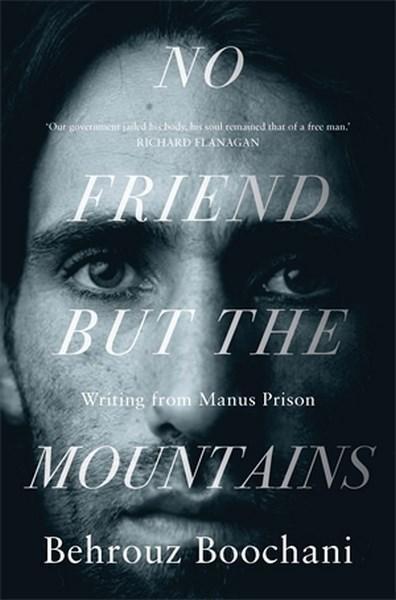
No Friend but the Mountains: Writing from Manus Prison by Behrouz Boochani

Translated by Omid Tofighian

Omid Tofighian pic

Omid Tofighian is Lecturer in Rhetoric and Composition in the School of Literature, Art, and Media and Honorary Research Associate in the School of Philosophical and Historical Inquiry at the University of Sydney.

Although Tofighian is the translator, he acknowledges over a dozen people involved in getting Boochani’s original text smuggled from Manus via WhatsApp and Facebook into his hands.

One aspect I was always conscious of was that Behrouz was writing in Farsi, not Kurdish. He was writing in the language of his oppressors, even though he is a fervent advocate of Kurdish culture, language and politics. And the book was being translated into the language of his torturers.

I saw this translation opportunity as a chance to contribute to history by documenting and somehow supporting the persecution of forgotten people; translation for me, like writing for Behrouz, is a duty to history and a strategy for positioning the issue of indefinite detention of refugees deep within Australia’s collective memory.

Janet Galbraith lic

The book is dedicated to Janet Galbraith who coordinates and facilitates the writing group Writing Through Fences, an organisation that collaborates with incarcerated refugees (or previously detained refugees) and amplifies and supports their writing and art.


____________________________________

Behrouz Boochani pic
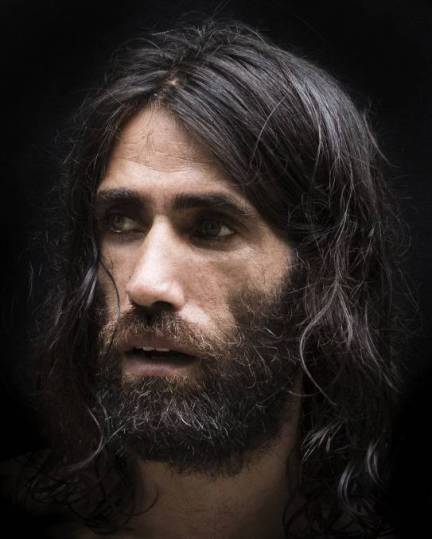
Kurdish-Australian writer and asylum seeker, Behrouz Boochani. Winner of the Non-Fiction Prize and the Victorian Prize for Literature at the Victorian Premier’s Literary Awards, 2019. 

“In 2013, Kurdish journalist Behrouz Boochani was illegally detained on Manus Island.

He has been there ever since.”

Australian law would object strongly to the word ‘illegally’, international law may not.

On a truck bumping through the dense Javanese jungle on a dark and bumpy track heading to the beach, even asylum seekers aren’t immune to the hazards of public transport,

A loud, obnoxious and completely inconsiderate Kurdish guy forces everyone to breathe his cigarette smoke throughout the trip. He is accompanied by a gaunt wife, adult son, and another son, a little bastard. This kid has his mother’s physical features and his father’s character. He is so loud he torments the whole truck, treating everything as a joke, and annoying everyone with his impatient and disruptive manner. He even gets on the nerves of the smuggler, who yells at him.

Finally after much shouting, rudeness, and disrespect as the over-wrought passengers jostle for space, the rotting boat heads out to sea

like a heavily pregnant mare cantering carefully across a dark prairie of water,

where there isn’t enough room for everyone to sit or lie but those who can, sleep.

Even the normal physical boundaries between families has fallen apart. Men lie in the arms of another’s wife, children lie on the chests and bellies of strangers…the young Sri Lankan family, whose bond is maybe the strongest of all on board, has fallen apart. The husband is in the arms of the man next to him, the wife has her head on the bicep of another man, and their child has ended up across the thighs of a different woman.

Those who aren’t sleeping are vomiting as the waves get bigger and pound the leaking boat … then the bilge pump fails …

This whole mess / In the darkness of midnight / Looks like death / Smells like death / Embodies death / The cries / The screams / The swearing / The knocking about / The sounds of the small children / The heart-wrenching and painful sounds of the little children / These sounds transform the chaotic boat into hell.

Why don’t the people, who just hours earlier were in danger of death from the waves but now on the deck of the Australian ship listening to those same waves lick and lap harmlessly against the hull; why don’t they yell and laugh with happiness at their salvation? They sit quietly and still. Even Boochani doesn’t know why. To the Australians they must seem like, like, cargo, soundless cargo, salvaged from the sea.

Boochani has known death and fear; as a young man he wanted to fight for the liberation of his homeland, but he chose the pen over the gun. Was he a coward? Afraid of death? Then on the ocean he faced both fear and death. Saw fear in the faces of others and felt it in his guts, tasted it on his tongue; the ocean provided him with the most intimate relationship with fear and death. Now he is judged and locked up by people who know neither of these two things. Maybe he should’ve been a soldier, at least he would be shot at by people who, like him, knew about fear and death. It would be an equal fight. Just, even.

Boochani tried twice to get to Australia. He encountered fear and death on both attempts. As he scrambled onto another ill-prepared boat for his second attempt he had to admit that such an action wouldn’t be possible but for courage and foolishness. Returning to Iran, unthinkable! He was aware of his fellow travellers not really knowing any of these four demons: fear, foolishness, courage, and death. They soon would.

I’m stopping! I write this post as I read – as I usually do when reviewing a book, but it’s hard to know what not to cut and paste to show you, let you see what it sounds like because everything is worthy of quoting; every line is full of something, something worth passing on. I want to show you all of it. So, do it; just read it.

Writing allows us to “come to understand another’s point of view in the most profound way possible.” (Erica Wagner, writer, critic, and a Man-Booker Prize judge, twice)

I will continue to read this book, not out of a need for entertainment, but for enlightenment, understanding. I’ve only ever seen asylum seekers on the news, voiceless bodies behind wire. The Australian Government has not wanted us to hear what they have to say: journalists are banned on Manus and Nauru. This is the first time I have the opportunity to hear what the Australian Government does not want me to hear. That is why I will read it to the end; as I hope you will too.

You can buy the eBook ($14.99) from Pan-Macmillan here.

You can buy the Kindle version ($US11.99) here.

Arnold Zable, an Australian writer is also part of this story. You can read his SMH article and watch a short trailer for the video Chauka, please tell me the time, here

Watch Behrouz’s videoed acceptance speech, here. He was not allowed to attend the Award’s Presentation.

Unfettered and Alive: a memoir by Anne Summers

anne summers pic
Anne Summers: journalist, feminist, and writer. “If we constantly rewrite history to fit how we see things now, we forget how things used to be and, equally important to future scholars, how we used to see them.”

Anne Summers and her publishers have produced a handsome book, and it begins, unusually, with a letter to her thirty-year-old self: Dear Anne, and so, consequently, it’s written in the second person; and it sets the beginning as at that time, when she was thirty, and summarises what went before which was told in her first autobiographical work, Ducks on the Pond 1945-1976 (1999).  So this, a re-cap, is a neat and imaginative way to catch you up, especially if you haven’t read the earlier work; which is, by the way, now only available on Amazon US at $115.64 for the second-hand hardcover, which is cheaper than the $191.89 for a second hand paperback! However, if you can’t find a copy anywhere else, here’s the link.

For someone who, from an early age, felt profoundly at odds with what the Adelaide world of her Catholic childhood promised her: an identity based on a man and the success, or otherwise, of their children and a future slowly fading into cranky old age and invisibility, she has stubbornly and courageously shunned all of that and forged her own path that has turned out to be something like an open-ended roller-coaster. It’s a crackling tale: ecstatic highs and scary lows; and all along the way the reader gets an insight into the characters she engaged with and the history we all lived through, all in a chatty and self-effacing tone that has you barracking for her as she strides around yet another corner into the unknown, including South Africa, the badlands of western Pakistan – without a hijab, and later as Chair of Greenpeace International which took her, well, everywhere.

anne summers 1980
Anne Summers at the National Press Club during the 1980 CHOGM meeting in Australia directing a question at British Prime Minister Margaret Thatcher. photo: Allan & Unwin

The personal is also covered. Her uneasy relationship with her parents, especially her father; the painful rediscovery of her paternal grandfather; there’s treachery and betrayal from colleagues and friends; a health scare; and finally meeting the love of her life, and that started in the photo-copy room! He’d been around all along!

The political years of this chronicle cover Fraser, Hawke, Keating, Howard, and Rudd/Gillard/Rudd: a turbulent, often frustrating – for us, I mean – but never a boring time in Australian politics. Of special note is her calling out the appalling misogyny Prime Minister Gillard received at the hands of the shock jocks, political opponents, and a particular, but faded, cartoonist. Her insights and insider status make fascinating reading as seen from her media perspective (her attitude to Keating changed; her attitude to Howard didn’t); and then in the middle of all that her successful empire building (and spectacular fall!) at the top of the media tree in New York “…if I can make it there, I’ll make it …..” you know how it goes! Well, she did and then, almost immediately, she didn’t!

But when down, or idle – something she hates – an opportunity passes her window or, more usually, she creates one, and so grabs it with both hands and she’s off again!

Running through all of this, is her strong advocacy for the rights of women; their professional fulfilment, all their wishes, needs, and ideas taken seriously, and the universal understanding that they make mistakes but deserve to, and be allowed to, try again. What a rich, informative, and fulfilling read this is.

anne summers stamp
2011 Australia Day postage stamp featuring Dr Anne Summers AO.

I’ve known Anne for a few decades usually meeting with mutual friends over a sumptuous meal and a bottle of good red wine or three but I wasn’t prepared for the breadth and depth of her worldly participation nor her personal honesty.

I find scheduling reading time a sign of a good book; but you’ll also need to schedule a breather now and then. Don’t read this in bed. You’ll never get to sleep.

You can find the book here, and the kindle version here. For Indonesian readers you can find the book here.

Be very careful when Googling Anne; you’ll undoubtedly get the English Ann Summers (Ann, no ‘e’) who is a designer and marketer of raunchy women’s underwear.


Gulliver’s Travels (working title) by Michael K Freundt. A work in progress.

Robert Gulliver Cover picAfter sex years I’ve finally finished the first draft. I’m letting it rest for a while. Here is the Prelude and the first three chapters … a teaser.

Prelude

If you ask a family member – of any family – if they are happy, they would invariably pause, not wanting to simply say “yes”, and try to think of a word, or words, that would accurately describe their … but they would all so quickly realise that they have no idea how to describe how they feel so they say, “Yes,” usually adding, “of course.” You know this is a lie, but politeness and fear forces you to acquiesce and you smile and say something limp in acknowledgment, like “Good.” This is an example of two lies being better than none. You can both now get on with whatever you were doing; conditioning your hair, mowing the lawn, doing your tax, without upsetting the balance of the universe, happy in the nameless knowledge that you have successfully bypassed the slippery dip to yelling, tears, and/or the breakdown of your world as you know it. This is the bedrock of why families survive; sometimes, even when they shouldn’t.

 If you realise at any time that you have somehow been perplexingly born into a situation, a family, where you don’t fit in, or if circumstances render your situation suddenly, or slowly, unacceptable to you, you need to – or may be forced to – do something about it.

This is a story of a boy who did just that.

1

Off to School with Daddy.

In the early Monday morning pre-light, a masculine hand hovers over a digital clock’s green numbers as they inescapably eat up time: 5:57, 5:58, 5.59 … It taps the ‘off’ button. Waking up is as close to birth as us humans can get; and we do it every day. If only we could remember to think this, maybe we would then try to make this day better than the last. 

Robert Gulliver, fifteen years old but who has suffered a heavy dose of puberty much earlier than most, desirously handsome and dark, raises his arms, hands clasped over his head, and stretches while he flexes and rotates his feet, clockwise then anti. He lies still for a moment listening to the sounds of the house. All is quiet except for the living hum he hears in his ears: the sound of himself. He flings back the covers of his three-quarter bed, swings his naked body over the side, scratches his hirsute chest and yawns. He stands on tip-toe, raises his arms above his body, and stretches, making sure he breathes normally. Hold. 1. 2. 3. 4. 5. He then walks out of his room to the bathroom down the hall confident no-one is around at this hour; his parents are still asleep. He is up early because there is so much to do: the day is his first at a new school, the third this year, and it’s only June.

He uses the toilet. Drinks a handful of water from the tap, washes his hands, rinses his face, and dons running shorts, with inbuilt support, then T-shirt, socks, Nikes, and Raybans. He heads out the back door of the suburban family home, down the drive and through the front garden where a neglected, immense, and loathsome stand of Strelitzia reginae, bird-of-paradise, dominates a sparse and neglected garden. He thinks about its place, the family’s face to the world, and wonders if he should get stuck into the garden as no-one else will, but he knows he won’t. He is scared of the garden. He’s never said this and never will, and certainly not tell anyone. Even now, he is only vaguely aware of an aversion to it. But it is fear, nonetheless. 

A Sunday morning only a few years ago when he was still a boy, a real boy, a hairless little boy, he was watering the garden and he let the curved force of the water from the hose in his hand linger in a spot of dirt. A muddy hole appeared and gurgled and mesmerised him, spoke to him. Yes, the sound became voices, the words were unintelligible but the conversation, was definitely hostile. He was caught by the sound, pulled by it, but repulsed by the tone. He strove to catch the words. Who belonged to these voices? He concentrated to understand but it was impossible to discern any meaning or purpose; they didn’t even sound like words, but there were two voices and they were full of hate, unmistakable hate. He yanked himself away despite the tug of perverse curiosity, but the fear was worse; a fear that at any moment he would be dragged into the hateful dialogue and have to explain himself. He never had anything more to do with the garden, any garden.  

Now that he has looked at his own garden, well, Ewan, his father’s, garden, with the eyes of a stranger, he glances up and takes in the whole neighbourhood. A straight street of single storey houses all built the same distance from the road, as if there was a plan, or at least, an intention or will. They all are of different designs, nothing matched, but the predominant feature of the vista was the low fences and walls, that separate each front yard; all different too, like personalities, but in this neighbourhood not very stylish personalities. Some in tact, some falling down or covered in weeds pretending to be ground-cover, or ground-cover that has escaped the ground. It was all built well before the brief social experiment of no fences, vast lawn-scapes that was supposed to be egalitarian but ended up being separatist. No one had a fence to talk over so nobody talked. But here no-body talks much anyway. Everyone’s life is pretty much like their neighbour’s. He knows the neighbours to the left, Joe and Betty Dodd, nice people but Betty looks at him too hard sometimes, like she’s weighing things up, and he used to have a yen to catch a glimpse of Joe Dodd in the shower, which was possible since their respective bathroom windows faced each other; and he did – he had to stand of the bath-rim to get the angle he needed – but once he did he didn’t want to anymore; so now he avoids any close association with them; the ones on the right are renters and are rarely seen. Both left and right gardens don’t seem to be tended much either, but they are infinitely neater than the Gulliver’s. If location defines you, he’s not too pleased about this location and what it might say about him. Cromer, northern beaches, but annoyingly inland from the beach and so a little suburban self-loathing has crept into the street, called an Avenue but looks nothing like one. He thinks about doing something about it – the garden? – the house? – the suburb? – but not sure what, just yet. 

He sets ear-phones to his smartphone, opens the National Broadcaster, and chooses News. He walks briskly at first, gearing up to a power walk, and then a more energetic lope; but never a jog. He concentrates on the news wanting to hear something to agree with but well aware that that won’t happen, but, news, somehow, is addictive. He’s a left-leaning moderate while the government of the day is conservative although led by a broad-spectrum party failing to come to terms with its outdated conservatism and led by a centrist ditherer desperately trying to maintain his leadership until attrition and bi-elections foster in new blood and through which he can bring the party to where he wants it to be. Wrong! Meanwhile he is hounded by the media and old far-right-old-boys on the back bench in equal measure. He plods two steps forward, two steps back, but smiles at the cameras confident that he is making headway; and sometimes he does, but less of a step and more of a shuffle. He frustrates Robert as does the opposition leader who is too much from the old-school believing politics not policy will be his way to the top-job. Those days are over. Ewan is a backbencher in the Labor opposition but the State scenario is pretty much the same as the national only smaller, narrower, and pettier. 

As happens when exercising, the brain can sometimes randomly rove. Robert, despite the battling political voices dishing up platitudes into his ear, remembers, or tries to remember, this morning’s dream that suddenly impinges itself on his mind. He is aware of a blurry Arcadian scene, of countryside, picturesque vistas, streams with verdant banks, but where farming has disrupted the living cycles. Machines have turned the sod, oblivious farmers have planted horizons of alien grasses, and tend ignorant creatures from other climes. Through this he walks becoming increasingly bereft at the damage he sees – you know what dreams can be like – but finally he discovers a field that looks at peace. The headed grasses have been cut, waiting he knows for another machine that will thunder over them making enormous round bungles of what now lies peacefully where they grew. But not now. Not yet. He feels a calmness and an incredible urge to lie down with the fallen stems and all the other naked men where he knows he will find serenity, and an odour akin to kindness wafts over him and … and … but the rest is gone, buried within the maze of neurones and synapses, hibernating, but ready to return unannounced at any inconvenient moment in the future. Or lost forever. But, he knows enough about the mysterious process of writing fiction, practiced by his mother, sometimes with his help, to know that such neurone memory can serendipitously splutter into his fingers as they dance over the keys in a red-hot spurt of creativity. He shares this glorious, but untetherable creative agility with Edith. It binds them. 

By 6.30 as the day brightens Robert is back home. He shaves slowly, his beard is thick and dark: his hormones belie his age. Personal attention takes time. He showers, with an olive oil based gel, ‘washes’ his hair with conditioner, and then pat-dries himself thoroughly. On his face he uses a liquid cleanser, exfoliant, and moisturiser; for his short thick hair – but longer in front, he likes the floppy look, especially late in the day – he uses Aesop Violet-Leaf Balm. It’s the best. He’s tried them all. He believes soap on the body is as evil as sugar in it.

Back in his room he dons a pair of white Giorgio Armani briefs; always Giorgio, never Emporio. He used to iron his shirt the night before but he now prefers to do it in the morning; for a fresher look. There is something meditative about ironing in the quiet. The ironing board always stands waiting in front of his curtained window, under which stands his broad dresser which holds several photographs of himself as a child, so long ago it feels historic, but really it’s only two years, not ten. There is also a photograph of a youngish Sean Connery. Robert’s clean but creased shirts lie in a deep top drawer. It takes him seven and a half minutes to iron a shirt. He cleaned and polished his shoes last night. He takes his new grey and blue school uniform and tie out of their dry-cleaner plastic and dresses. He always uses a full Windsor Knot and a shirt with a cutaway collar: he likes their proportions which he believes suits his facial geography. Robert Gulliver cares about these things.

So there, in his full length mirror on the back of his door, a model for Everyman; fifteen going on thirty two, in more ways than age; a man in a school uniform which, on any other man would look silly, but on Robert? It’s a head-turning magnet of a look.

By the time he enters the kitchen, his parents, Ewan, the back-bencher, is already at the breakfast table. His mother, Edith, an eBook novelist who produces a generally lucrative line of novellas about a woman called Veronica and her sex and work life – sometimes intermingling, – is, as usual, already at her desk, down the hall in, what was, the third bedroom but is now Edith’s writing room.

Ewan looks up from his newspaper, runs his eyes slowly over his son, and gives a frustrated sigh, or is it something else? “You’re going to school dressed like that?”

“Good morning, Ewan!” says Robert, sarcastically as Edith, pencil in her mouth, comes into the kitchen. “Morning, Mother Dear.”

Through teeth clenched on the pencil she says, “What? Don’t talk to me. I’m not here.” She goes to a cupboard, opens it and takes out a packet of Bushells tea. “Ah, two els.”

“You know, Mum, you could’ve googled that and saved a trip.”

“Ssh! I’m not here.”

“Ewan doesn’t like my uniform,” says Robert.

“Oh, come on, Ewan, you know Robert likes to look neat.”

“And does he like having his neat little head punched in as well?” But she’s gone.

“So how would you like me to dress, Ewan?” says Robert cheerfully as he carefully drapes his jacket over the back of his chair and sits, “flapping shirt-tales, a tie skew-wiff and loose, and a crotch dangling to my knees?”

“You could at least try to fit in this time.”

Edith’s head appears around the door frame, “Your toast is in the toaster. Ah! And Ewan, you know Robert needs a cloth napkin.” She disappears again.

“I’ll get it,” says Robert as he retrieves one from the dresser drawer. As he drapes his napkin, edged in lace and ironed stiffly, carefully on his lap, sits and contemplates his Swiss muesli, Greek yoghurt and red papaya, he says “Oh, and while we’re on the subject of fashion, your national leader dresses exactly like you seem to want me to. You’d think with such a glamorous wife she’d help him out; he could, at least, wear clothes that actually fit him.”

“I have no concern for the federal leader, it’s my state leader I’m focused on.”

“That’s the trouble with the Left in this country: all the branches looking out for themselves; and can’t agree on exactly the shade of left they want to be.” Edith appears and goes straight for the cupboard again. “So, what’s Veronica up to these days, Mum? Bonking a client again?”

“What? Oh, she’s bonking a builder,” she says as she takes the Bushells tea packet out again and takes it with her. At the door she turns and says, “Well, she had to, really. He caught her staring at him on the bus. And she was staring but not because of him, but because of who he reminded her of. She tried to explain that to him while he rubbed up against her in the crowd, but no man want’s a woman he fancies to talk to him of another man, does he? She’s having a little bit of a crisis over this one not because she should’ve known, which she should’ve, but because she quite liked being rubbed up against in a public place.”

“Ha!” guffaws Robert, “I love you Mum, for all your distance, you must have a never-ending treasure trove of unfulfilled fantasies, wouldn’t you say Ewan?” And he throws a look at his father who refuses to look up. “And what does this one look like?”

“A bit like you. Can’t chat. Must go,” and she disappears with the packet of Bushells tea but pops her head back and says, “I may need your help later today, Robert. I’ll text you,” and she is gone again.

“I suppose you know most of Veronica’s roots look like you,” says Ewan without looking up.

Robert ignores the comment. “And what has this Monday in store for you, Ewan?” says Robert making family morning chit-chat.

“I have a party meeting at 9.30 so I can take you to your new school if you like.”

“Isn’t it wonderful that all the world starts their work at 9 but politicians like to start at 9.30; makes them feel so, so, special.”

“No, so fathers like me can take children like you to school. I could also have a word with the principal which may, at least, postpone the inevitable.”

“Nothing’s happened yet.”

“It will. You’re a shit-magnet, Robert.”

“And you think dressing like shit will help?”

“At least you’ll fit in.”

“Oh, yes, that old blend-in philosophy; don’t stand out, be grey and everything will be alright.”

“At least it may save your pretty face being smashed in.”

“Nothing touches my face unless it’s out of a beautifully designed and expensive tube.”

“Be ready in 25 minutes,” says Ewan and he downs his coffee, folds the paper and leaves the kitchen.

“You know he loves you, Robert,” comes Edith’s voice sailing down the passage from her office, or was that a voice from a god somewhere?

Robert says quietly, “And so do you, precious.”


The car, a Volvo, faded Green and far from the the latest model, is always in the drive, never in the garage as the garage is full of rubbish, sorry, storage. Robert stands with his jacket over his arm waiting for Ewan who eventually emerges from the house.

“When are you going to tend to this Strelitzia?” asks Robert.

“I planted it for the very reason that it doesn’t need tending to.”

“Have you ever read John Wyndham’s Day of the Triffids?”

“No.”

“You should. It’s very prophetic.”

“Come on. Get in. We’re late.”

“Get real! We’re only late because you’re late.”

As Ewan backs out of the weedy driveway and joins the morning traffic Robert tends to his seat belt. It takes him five blocks to make sure there are no shirt creases under his seat belt straps.

Robert has for some years been aware of his dislocation within his family and the precarious position, both emotionally and financially, it holds in the weave of the society in which they live: his mother writes salacious novels, self-publishes them online, and receives payment, eventually, via her online publishing platform straight into her bank account which a debit card gives her access to, therefore rendering her daily working life free from any human contact outside her husband and son; his father sits on the back-bench for a major political party, now in opposition, who does nothing but sit in the seat he is elected to – and continues to be elected to – but should he attract any attention from the media, and therefore the world, which in the realm of political life is more likely than not – the state of his front garden alone – and let’s leave out, for the moment, his proclivities, history, and immediate future – would be enough to send worrying waves to his party, the media, and constituents. Robert seems to be the only one, of the three of them, who understands this.

“Later this morning, Eastern Standard Time, the state opposition will gather for a party meeting behind closed doors to try to wheedle three backbenchers, Thomas Undershaft, Marion Heath, and Ewan Gulliver, into supporting the contentious vote on euthanasia,” the car radio says.

“Ewan! You’ve made the news! Wow. Now you will have to do something about the front garden.”

“Whatever for?”

“It’s the first thing the paparazzi will photograph and the first story the journos will write about. Next thing you know the producers of “Celebrity Makeover” will be banging on our door to bring our front garden into the 21st century. And once the journos dig, Ewan … well, you know.”

The radio continues its morning roundup of news, weather, and not-so-current affairs. Father and son sit in silence in the heavy traffic. Ewan’s knuckles begin to turn white, he indicates, pulls over, and stops the car.

“Ewan! You can’t park here. It’s a bus lane.”

Ewan replies by covering his son’s hand with his own.

Robert quickly pulls his hand away. “If you get picked up by the traffic police they’ll start asking questions and next thing you know your face will be on the front page of some gutter tabloid, and you know what they…

“Robert,” interrupts Ewan, “we have to talk.”

“No, we don’t and there’s a bus coming.”

“Baby.”

“Don’t call me that and that bus is not a figment of my imagination. Ewan!”

Ewan checks his rear-view mirrors and pulls out into the traffic again. It is slow.

The Volvo eventually pulls into the curb outside the high school with a yard empty of children. The men sit: Robert waiting for, but not wanting, Ewan to say something and worried about why he himself is so confused about this.

“Sorry about the traffic,” says Ewan.

“Not your fault.”

“You remember the principal’s name? Mr Steen?”

“I know. It’s tragic.”

Ewan has more important things to say. “… Robert,” begins Ewan in a different, soft, but alarming voice that causes Robert to angrily interrupt.

“Ewan! Stop! We are going to be like a normal, well, normal-ish, family and tonight I’ll tell you about my day and Mum will tell us about Veronica’s day, and you’ll tell us about your day; and while we’re on the subject of your day, do what you have to, to stay out of the media’s sites. And you know perfectly well why.”

As he gets out of the car Ewan says irritably, “Oh, so you want me to blend in, do you? Don’t stand out, is that it?”

“Exactly!” Robert prepares to slam the door.

But in a swift move Ewan, held by his seatbelt, leans low on the passenger seat where he can feel the still, but fading, warmth of Robert’s body and holds the door open, looks up at his son and says pleadingly, “But I don’t understand, Baby, why you are so afraid of what you did. I didn’t mind; don’t mind.”

“I was underage,” says Robert harshly but in a whisper, foolishly, as there was no-one around, “I wasn’t responsible!”

“And you’re still not,” says Ewan with a calm inevitability that renders his son shocked and speechless. Robert abruptly turns, leaving the door open and walks rapidly away and into the deserted playground. He hears the door close and the Volvo pull away but doesn’t turn around. He stands in a sea of black asphalt. He knows he’s late, but since late is late, later is still just late. He might only be fifteen but he’s also a man; he thinks of himself as one, and one that feels responsibility even if the law won’t let him. But here he is; a man in a playground. Its implications belie its flatness. Another school. Let’s hope this one is a little more … accommodating.

2

Pretty Straight Back

Familiar noises and the habiliments of school architecture, direct him into a building and a short corridor turns him down a longer one. He can see up ahead a teacher’s aid in a lab coat mopping the floor next to a free-standing, yellow, warning sign, and heads for him to ask directions. But as he approaches he becomes gradually aware that this man has the potential to be incredibly attractive; not in a conventional sense he thinks, but craggy, well built, and to Robert’s well developed sexual senses, luscious. Dearie me! Look at that! Robert can’t help a sensuous smile begin to teeter on his lips as he excitingly anticipates gazing into this man’s eyes; but just as the smile is involuntary so is the rest of his face and as the man hears Robert’s approaching steps, he looks up and locks eyes on the lad. Robert chucks him a lascivious wink. The man’s shocked reaction has its altering affect and Robert lets his momentum propel him past without being able to utter a word, much to his annoyance, but he can’t help looking back. Be still my beating heart! What is it about those deep creases, like parentheses around a sensual mouth? The man is staring after him, standing next to the yellow sign: caution.

It’s as if another Robert, the man, vies for space in his body and mind of Robert, the boy. He looks like a man, thinks like a man, his penis certainly behaves like a man, but although the chemical cocktail that unleashed the man in him was spilt way too soon there are still boyish elements lurking beneath his adult exterior that bubble up at times sending his mind racing around a traffic clover trying to find the nearest exit to rationality and a calm breathing pattern. Robert has adapted to these moments of libidinal confusion by taking, as he likes to call it, my rational pill: the sensical, almost female, attribute of  attending to the stimuli of reality around him at this present moment: the smell of a school corridor, finding the Principal, being a school boy.

He finds the Principal’s office where he notes the man’s name on the door as C. E Steen: Principal. He knocks and enters and sees the man rise from his desk. He is grossly fat and, when he speaks, flummoxed by a seemingly random stammer and a casual link between tongue and intellect. His desk is messy. A good sign, thinks Robert. A laptop, stacks of papers, a small secretaire of ancient polished wood, and a small photo frame. He’d love to see what it holds. 

“Ah, yes. Am I expecting you?” the man says with a frown.

“Yes, I think so. I’m the new student transferred from Sanderson High. Robert Gulliver.”

“Oh! Is that so? You’re late! And I was expecting someone a little, well, you know, younger, and not so w-well d-dressed. Your file says you’re fifteen, but” Robert’s slightly annoyed look has its effect, “ well, you know what b-boys can be like these days. Yes. Well, now. You’ve got a little reputation stuck to your b-boots, my lad. But Elliot, that’s Will Elliot, the Councillor – old friend of mine from w-way back, says you’re a bold lad, or some such thing. Ah, yes, my lad. Yes. Yes. E-expecting you. Yes, G-gulliver. R-robert. Yes. Robert, I think. Come in. Sit down. Here’s a chair. I’m the boss around here,” and he laughs rather sillily.

“Pleased to meet you sir.”

“Now, no need, no need, you know, around here to be so, well, formal. You can call me Mr Steen or P-principal. Everyone d-does. Someone called me ‘Prince’ once and I quite liked it. Now, there’s a form somewhere around here. Somewhere. For you to fill-in, or is it fill-out? Silly language at t-times,” and he chuckles to himself.

“I filled in all the necessary forms online. I’m sure we don’t have to do them again,” says Robert, trying to help.

“Yes. Yes. Certainly. Of course. Of course. The office staff will deal with that, that you know, computer stuff. So. W-what can I do for you then?”

“What I don’t have is the weekly schedule and …..”

“Yes, of course! Of course. That’s here too, somewhere. Somewhere. Oh yes! Here it is! Glory be! Here’s the whole d-damn thing: a folder with your name on it. Robert Gulliver. This must be yours,” and he hands Robert a full manila folder. “W-what else do you need to know?”

“I was hoping you could show me to my first class. but Sir, Mr Steen, you need to keep this file, I think.” He hands it back.

“Ah, yes. Of course. But now, what? Oh, yes, come with me,” and the Principal rises with difficulty from his seat and leads Robert out into the corridor, talking all the time. “Your home teacher is Mr Luff. G-good bloke. Very knowledgeable about literature and all that. English, I think, is first up this morning,” and on and on about Mr Luff and his string of qualities until they get to a closed door. He knocks and enters. The entire class shuffles to its feet, but the Principle waves them down. “Thank you, people, thank you. Good morning, Good morning, Adrian.” Everyone sits. Robert follows but his view of the room is almost completely restricted by the bulk of Mr Steen. “This is the new chap I told you about, Adrian. Robert Gulliver,” and as Mr Steen steps aside a breathless “Oh shit” escapes Robert’s lips. Mr Luff is the craggy-handsome teacher’s aid minus his lab coat.

There is a pause, like a stop-frame, as Adrian Luff takes in Robert Gulliver, especially his clothes as does the whole class. “You? Mr Gulliver? We’ve been expected you,” says Adrian Luff with a touch of irony in his voice.

“Good morning, sir,” and he looks around the room. It is as expected: students in various states of hormone-induced dishevelment all around fifteen loll on their chairs, or against, or over, their single and double desks, as if to belie the furniture’s shape. Three rough-pretty boys up the back attract his attention as they lean into each other like conspirators, like the trio from Macbeth. One of them, a lanky lad stares at him and mouths a word with derision: an unmistakable ‘Poofta’. Ah, yes. Here we go again, thinks Robert but his attention is taken by a very pretty girl who, of all of them, is sitting up straight.

“Not so formal here, Mr Gulliver. Mr Luff is all that is needed.”

“Fine. Where would you like me to sit?”

“Why not over there, third row back.”

“Ah, a window seat. Thank you,” and Robert walks to his seat, takes off his jacket and hangs it neatly on the back of his chair. All eyes are locked on him as he sits.

“We’re talking this morning about A Passage to India. Have you read it?”

“It’s on the syllabus.”

“Yes, but have you read it,” says Adrian Luff in a tone that suggests that everybody should, but nobody has. There’s a few chuckles of acknowledgement.

“Yes, I have. Twice,” and a few groans punctuate the dying laughter.

“Ah, then you might like to enlighten us on your theories of what happened in the Malabar Caves.”

“I think I’d prefer to sit this one out, Mr Luff, if you don’t mind. It’s my first day. I’ll just gauge the lie of the land, if you know what I mean. But thanks for the offer.”

“Oh, come now, Mr Gulliver. You must know I’ve read your file.”

Oh, fucken hell. So much for starting with a new slate when the one he’s given is already scratched and bloodied. He can feel the look of mischief from Adrian Luff; a little pay back probably for Robert’s audacious wink in the corridor.

“So, come on, Mr Gulliver. Enlighten us with your opinion,” and his soft-looking lips form a little challenging smirk.

I know what I’d like to do to those lips of yours. Stick my tongue through them and press them hard against mine as I run my hand up and under your shirt and then down behind your belt. Robert smiles and says “Do you mind if I stand?”

“Not at all Mr Gulliver. Be our guest.” And it is something about that reply, a little too smug, a little too all-inclusive – us against you, too condescending and challenging with a hope of failure no doubt, that Robert doesn’t just stand but also grabs and dons his coat as he walks to the front of the class – into Adrian Luff’s territory – turns, and boldly and unflinchingly begins – but first he tugs on his cuffs and buttons his jacket.

“Miss Adela Quested, rather plain, has led a slow and very ordinary English life, but despite very little happening in it she has found herself rushing past, at an alarming rate, her marriageable age. No female then would ever contemplate being left on the shelf. However, she is now engaged, probably hurriedly so, to be married, but to a rather pompous and dull prick who has been all this time in India while she has been, all this time, on the other side of the world, being plain and un-noticed.” And then staring at Lanky Lad up the back says, “She’s a virgin, wouldn’t you say?”

The dumb lad falls for the trap and says rather cockily, “Yeah, but I reckon she’d like a bit of the old rumpy-pumpy,” and his two off-siders punch each other and giggle like twits. “Because, you know, she gets all moist and gagging-for-it just lookin’ at all those Karma Sutra statues humpin’ each other, like all over the place.” And the twits giggle some more.

“Ah, so you’ve seen the movie,” says Robert egging the boy on.

“Yeah, I have. Twice!” and the class laughs with him as his chest puffs up like a gobbler.

“But you haven’t read the book, laddy!” The laughter dies. “Because if you had you would have known that scene is not in the book. It’s a little invention from Mr Lean, the director, just to make it a little easier for people who aren’t comfortable just with words on a page, or even pictures on a screen, but need a little extra to help them understand what’s going on.” Lanky Lad sinks a little in his chair and fixes Robert with a hateful stare, although Robert can see that the lad isn ‘t quite sure why he feels put down. Robert’s eyes move from Lanky Lad’s to Pretty Straight Back. She’s smiling at him. “So,” Robert continues, “Miss Quested is a virgin, sexually repressed and about to marry a bore who is also sexually repressed. A disaster in the making. Missionary Position 101 with the lights off. But then she spots the good man, Dr Aziz, with his swarthy good looks,” Robert prances before his audience letting his own attractiveness work for him, “a handsome, exotic, and friendly man,” – he tosses a smiling “Hi!” to Pretty Straight Back – “and poor Adela is hooked. It’s Dr Aziz she wants, although wanting a man isn’t something she would ever contemplate; more like, wanting him to do something to her. So, in the cave, the dark and eerie cave, just the place for a randy man to take advantage of an inexperienced but willing virgin” – and Robert rubs his nipples – “Mmmmm. But Dr Aziz is not with her: he’s somewhere else in the labyrinth with the other tourists. She’s alone in the gloom, exotic, and sensual place with nothing but her imagination” and his hands wander again. “So, what does she do? She lets her imagination go wide to a point where she can’t help herself. She masturbates” – he demonstrates, “Breaks her hymen, gets blood on her hands, -Ah! – panics, runs from the cave, and stumbles into a convenient bramble bush. Now! The real question here – and much more interesting – is not what happened in the cave – I just told you what happened, end of mystery – but, did she accidentally stumble into the bramble bush or did she do that deliberately to cover up her vaginal blood; blood with more blood? Right! I want 500 words from each and every one of you on your opinion on the bramble bush equation, on my desk by 3.45 this afternoon. Thank you for your attention.” Pretty Straight Back leads the mediocre applause. He smiles back at her as he walks back to his seat and, removing his jacket, replaces it on the back of his chair and sits. Adrian Luff takes an unsatisfactory amount of time to get the class back and under his control so he can proceed with the lesson he has planned.

Eventually, a harsh sound of an electric bell, left over from when Brutus was a boy, pierces the air and as the class room erupts with eager but underdeveloped bodies scrambling to get out of here, Robert gathers his things and finds he is the last to leave.

“I’d like a word with you, Mr Gulliver,” says Adrian Luff.

“Certainly, Mr Luff,” says Robert as he alters his momentum and leans against the desk immediately in front of Mr Luff who sits watching Robert’s every move.

“Are you aware of what is in the report from your previous school?” asks the older man.

“No,” says Robert, “but I’d like to be.” And I think there’s a few other things I’d like to be aware of at this very moment, Luffy.

“I’m afraid that’s not possible.”

“You mean, I’m stuck forever with my crumpled past?”

“Aren’t we all?”

“Oh! So you have a crumpled past too, do you Mr Luff?”

Mr Luff chooses to ignore the question; so instead he says, “My job is to make sure you fit in well to this school and keep – incidents – from happening that we’d rather not happen.”

“And how do you suppose to do that?” asks Robert cheekily.

“By understanding a little bit of what’s going on in that head of yours.”

Robert can’t help a smirk distorting his lips, “Oh, Mr Luff, even if you did know what was going on in this head of mine, you may not understand it” which I would greatly regret as I run my hand up your naked body to a nipple and squeeze it ever-so gently while I grab your erect penis in my fist and guide it, expertly, inevitably, into my waiting mouth “Sorry, did you say something?” asks Robert snapping out of his little reverie.

“No.”

“Oh,” and then coquettishly “would you like to say something?”

“Mr Gulliver,” begins Mr Luff in a slightly exasperated voice but he is prevented from continuing by a knock on the door.

“Yes?” calls out Mr Luff.

Oh look! It’s Pretty Straight Back. “Excuse me, Mr Luff, but as Mr Gulliver has a free-period this session, as I do, I thought I’d take the opportunity to show him around.”

“A very good idea, Ms Lately, as it seems he needs a bit of looking after.”

“Oh, Mr Luff,” says Robert, “why don’t we forget about our crumbly pasts and start afresh?”

Again, Mr Luff ignores the question. “I’ll see you back here for the last session de-brief.”

“Oo! A de-brief,” says Robert as he collects his bag, “I look forward to that,” and he pushes himself off the desk and heads to the waiting Ms Pretty Straight Back, sorry, Ms Lately; but then he stops, turns back to Mr Luff, walks over to the man still sitting in his chair, stands a little too close signifying an intimacy that apparently the older man does not object to – Mmm – and says conspiratorially, “What where you doing dressed as a teacher’s aid mopping a corridor earlier this morning?”

“It was a lab coat. I also teach Junior Chemistry. I broke a beaker. I mopped rather than swept to make sure I got every shard of glass.”

The men stare at each other, one looking up, one smiling down and then “Very sensible,” says Robert who then turns and continues towards Ms Lately waiting at the door.

A few steps from the recently closed door Ms Lately says, “Are you always that arrogant on day one?”

Robert looks at her with some surprise as her question was, well, surprising, and then quizzically as if her question consolidates the basis of their relationship and so he consolidates it even more by saying, “Yes. And are you always so abrupt on first meetings?”

“Yes.”

“We are going to get along just fine.”

“Actually, I’m not usually that abrupt…”

“So, you lied?”

“No. There’s something about you that elicits – honesty.”

“Something, what exactly?”

“Something in your face.”

“What about my face?”

“Well, apart from it being incredibly handsome …”

“I know.”

“… really!” with a sigh, “it’s also incredibly open.”

“And it gets me into a lot of trouble.”

“Being open?”

“No, the other bit.”

Ms Lately ignores that. “A virgin doesn’t necessarily bleed when she masturbates.”

“She does if her hymen breaks.”

“Not necessarily. I didn’t.”

“Oh. It’s a good story though, don’t you think?”

“What other theories do you have about Ms Quested?”

“I don’t want to talk about Ms Quested.”

“What do you want to talk about?”

“Adrian Luff.”

“Do you fancy him?”

“Of, course!”

“He’s off limits, I’m afraid.”

“Well, we’ll see about that.”

“I may not know what’s in that report about you, but I can sure as hell guess. You really …..”

“Ah!” gasps Robert, “I haven’t yet asked your name.”

“I wonder why that would be?”

“And you haven’t told me.”

“It’s Penny.”

“Ah, Penelope.”

“No, Penny.”

“Why not Penelope?”

“It’s so old fashioned.”

“But with a noble pedigree.”

“And you’re now going to tell me all about it.”

“She was the wife of Odysseus, better known as Ulysses, who stayed loyal to him for more than twenty years while he was away fighting in the Trojan wars.”

“Was she dull?”

“No, she was very beautiful and had over 180 suitors, but she shunned them all, aching for the day when Ulysses would return to her. And he did. She is known for her connubial fidelity.”

“Why do you know so much stuff?”

“I have an uncanny ability to remember everything I see, touch, smell, hear, and taste.”

“And make-up.”

“You have a healthy skepticism. I like that. We’re going to be very close. Anyway, I’m calling you Penelope.”

“Must you?”

“It’s your name, just like my name is Robert. Robert.”

“Robert. Not Bobby?”

He looks at her as if she just farted. “Robert.”

“Robert.”

“Penelope. Penelope Lately. Nice. And where does the family Lately come from?”

“It’s the English version….”

Anglicised is the word you need, if it’s the adjective you want.” Robert can be incredibly annoying.

“It’s the Anglicised version of some Eastern European name with too many zeds and not enough vowels.”

“You mean like Latzkowzkizitzky?”

“Something like that.”

“So, Penelope Lately, I think you were about to tell me all you know about the delectable Adrian Luff.”

“OK. Ermm … he’s a teacher.” 

3

Rough Pretty Boys

Penelope Lately is tiny with a luscious crop of very bark brown hair, almost black but not quite. Her small stature belies her intellect and sense of humour. It’s as if, when aged seven, all her growing energy was transferred to her brain leaving her frame stationary. 

Robert said one morning, “You have gorgeous hair.”

“Would you like to touch it?”

“Er … No!” said Robert a little taken aback. “Why would I want to touch it?”

“Well, I just thought, since you liked it, you might want to, you know, touch it.”

“No. I just like looking at it.”

“Oh.” Penelope doesn’t quite know why but she’s a little disappointed.

“The Mona Lisa in the Lourve in Paris is covered by a sheet of glass so when you look at it all you can see is the reflection of the boards of people staring at it.”

“And why did you tell me that?”

“Nobody wants to touch it.”

“Well, you couldn’t touch it, even if you wanted to.”

“That’s right.”

” … you’re weird.”

During that first meeting of Penelope and Robert not a lot of ‘showing-around’ went on, which Robert didn’t mind as school-yard geography is very much the same the world over: building, asphalt, building, asphalt, boutique bushes, demountable, worn grass, asphalt, building. But it did set a precedent and all their subsequent free time between classes and other annoying educational commitments were spent together. Robert, basically self-educated, simply is marking time until he comes of age when his real life, he believes, will begin. Robert makes no other friends; he adopts a friendly but sarcastic, slightly belittling tone to all others which they can’t actually recognise as such but know it isn’t welcoming. His feelings for Penelope quickly grow close to love, brotherly love that is, and his feelings for Adrian Luff stay frustratingly close to lust-from-afar; not a feeling Robert is comfortable with. He usually gets what he wants.

“Look at them!” says Robert after a short pause that ended a satisfying but exhausted discussion about the modern uselessness of royalty. “Horsing around like children.” The rough-pretty boys are tagging each other; their shirttails blowin’ in the wind.

“They are children,” says Penelope chewing on her apple core.

Lanky Lad and his two accomplices are energetically teasing each other some metres away, chasing and grabbing each other for no apparent purpose or gain.

“Who are they again?”

“Don’t you know their names?”

“I only remember the names of people who interest me.”

“The tall skinny one is Lenny, Leonard Averset. His family owns a delivery business. Gio Chang is from Korean parents, they have two restaurants in the inner East. He was born here not long after his parents arrived from Korea and they chose what they thought was an English name for their new little boy, Giovanni. He’s the brightest of the three; and the other one is Tommy Masood, Lebanese I think. Don’t know about his family.”

“Look at him trying to get his hands under their shirts, flesh on flesh.”

“Play isn’t all about homo-eroticism, Robert.”

“Wanna bet?”

“You’ve got your hand on my knee.”

“I’ve always got my hand on your knee, your hand, your arm, your neck. That’s got nothing to do with eroticism.”

“What is actually erotic for you, Robert? Humour me.”

“Oh, a mustache, hairy chest, with a truck outside.”

“Does it ever worry you that your sexual fantasies are such a cliché?”

“Constantly.”

“Mr Luff is none of those things.”

“Ah, but Mr Luff has the flavour of all of those things? He’s in a category all of his own.

“So why don’t you want to move your hand further up my leg?”

“I told you. It’s got nothing to do with eroticism.”

“What does it have to do with?”

“Love and affection.”

“Aah, you’re sweet.”

“I know. But, look at them. He’s got his arms around his waist, under his shirt and his crotch smack up against his arse. And loving it.”

“Leave them alone. I’m more interested about why you don’t want to move your hand up my leg.”

“You know perfectly well why.”

“You could still try.”

“Why?”

“Because I want you to.”

“No, you don’t. What you want is a boyfriend.”

“I’ve got a boy, friend.”

“A fuck-buddy then.”

“I’ve tried that. It didn’t work out.”

“No no. What you need is a straight me.”

“And where am I going to find one of those?”

“Don’t worry. I’ll find you one.”

“So, if I have you and a straight-you, how would you feel about that?”

“Fine. You’d have me for 90% of the time and him when you feel horny.”

“And where did you get that statistic from?”

“The point is, he’s there when you need him.”

“And what if he falls in love with me and wants to marry me?”

“And what if you get hit with a plummeting piece of burning space junk on the way to Social Science? Come on!”

“Are you saying that the chance of me …..!?”

“Relax! You know what I mean.”

“No, I don’t exactly. Take your hand off my knee.”

He removes his hand. “My point is, seriously,” says Robert pulling her chin around to look at him to prove he is serious, “you are gorgeous, funny, caring, self-ware, and intelligent but finding a bloke, a straight bloke, to match you is not going to be easy; not if those three are anything to go by. But I promise you, Ms Penelope Lately, I will find him. Where ever he is.”

“…you can put your hand back on my knee, if you like.”
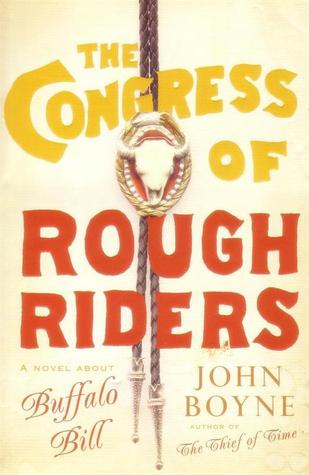
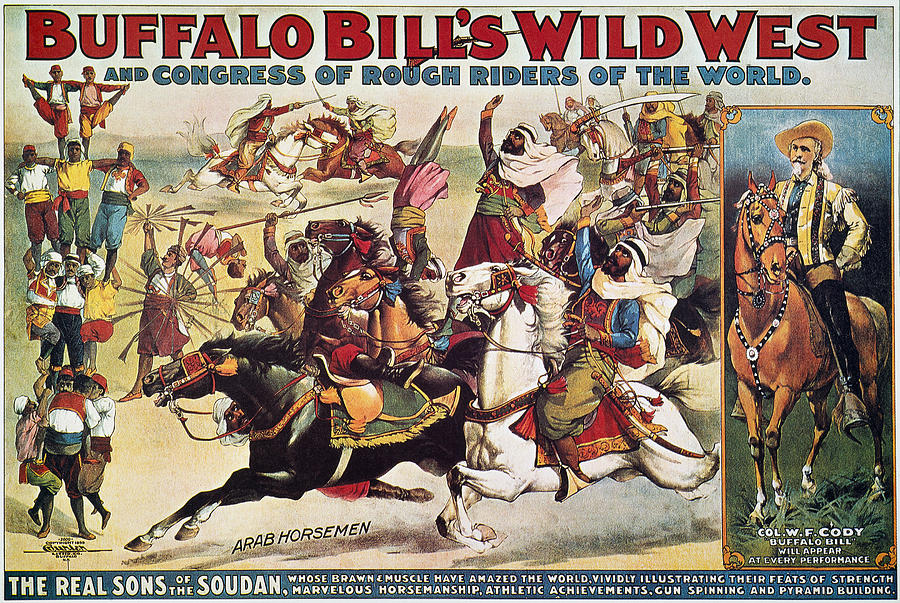
The Congress of Rough Riders by John Boyne

John Boyne pic
Irish writer, John Boyne, writer of the wildly successful, The Boy in the Striped Pyjamas (2006).

John Boyne, among many things, is an adventurous writer, and by that I don’t mean he writes adventure stories – despite the title of this one; he is adventurous in what he choses to write and how he writes. His books have included historical figures and events, stretching time, multi-narratives, contemporary issues, varying sexualities, hysterically funny scenes, teary climaxes, novels for adults as well as young readers. The Congress of Rough Riders (2001) is a double narrative; one concerns the latter life of William Cody, aka Buffalo Bill, the other concerns his great-grand son, also William Cody, but born in England and who forever is trying to separate his contemporary life from his famous ancestor’s.

However, it is his second published novel, and it feels like it. It is a sweeping saga that sweeps lightly over its subjects. I was engaged and entertained, but not deeply involved. I’ve read his last two works, The Heart’s Invisible Furies (2017), his best (so far), and A Ladder to the Sky (2018); I was deeply involved in both of them – in fact I sank so far into them, especially the former, that I didn’t want them to end. Riders, however, felt like a novel of a writer that was nurturing his talent, gaining confidence, and honing his skills, destined for greater things, which I can confidently tell you, he  has.

He also has the enviable skill of looking at a historical event or character from an unusual angle, and if the historical truth doesn’t allow such an angle, well, he alters things a bit so it can. This I feel is the way of a true novelist. His literary palette is boundless, as it should be. He is fearless.

With 17 books in 18 years he is no slouch and having just, this year, discovered him there’s a wealth of writing to uncover.

A poster for Buffalo Bill's Wild West, Congress of Rough Riders, 1899

Watch and listen to John Boyne talk at the Wimbledon Book Festival in 2013 where he is talking to mainly aspiring young novelists in the audience.

For all things John Boyne-ish check out his website.

You can buy the ebook of The Congress of Rough Riders here.

Life & Times of Michael K by J M Coetzee

Coetzee pic
South African born writer, John Maxwell Coetzee, relocated to Adelaide, South Australia in 2002 and became an Australian citizen in 2006. 

J. M. Coetzee won the Booker Prize twice: for Life & Times of Michael K in 1983, and for Disgrace in 1999. He won the Nobel Prize for Literature in 2003.

Life & Times of Michael K is a short novel in three untitled chapters: a long one, a short one, and an even shorter one. It is literary, not in the writing, which is simple, stark, and unadorned, but in its ideas.

The first long chapter begins with a very short description of Michael K’s undistinguished birth and the subsequent disappointment of his mother because her baby has a cleft lip. It is told in the third person by an unnamed and omnipotent narrator. Michael K’s early life is uneventful and he works in a mediocre job as a gardener. It is clear that the novel is set in a very violent and war-torn South Africa with curfews, gangs, and uncertainty. It seems to be always raining. His mother is desperate to leave Cape-town and return to her hometown of Prince Albert many hundreds of miles to the north. Without money, or the necessary papers – unattainable for Kafkaesque reasons – he attempts to push his mother in a homemade pram all the way north to Prince Albert. His mother dies on the way but Michael K finally manages to arrive at what he believes to be the farm, now deserted, where his mother was born. He tries to live off the land; for his own security he learns to sleep in a hole during the day and to work in his garden at night. He grows pumpkins. He is discovered and abused, escapes to the mountains where he tries to live without leaving a trace. He is hijacked to work for a road-gang, is interned in a work-camp, escapes and is taken to a hospital where he sparks the interest of a doctor.

The second chapter is told in the first person by this unnamed doctor and we see how Michael K, now identified as CM (coloured male ?) but referred to as Michaels, is seen by others. He is an enigma. He refuses to eat, talk, or co-operate. The doctor is tormented with the urge to help him but to no avail. The doctor comes to think that Michaels may have the real answer to living in this particular country at this particular time: living in order not to exist. The doctor is eventually thwarted in his kindly efforts as Michael K escapes.

The last, and shortest chapter, is a return to the third person narrator. Michael K eventually returns to the building in the city where he and his mother used to live. He is befriended by a group of nomads; one of the women has sex with him and he thinks he might even like her, but he continues to reflect on his time in the wilderness; all he would need in the wilderness was his garden, a shaft in the ground, and a teaspoon and string with which he could gather water. Then, “he would say, one can live.”

A happy and fulfilled life need only be concerned with what it is you need to survive, and nothing else. Life isn’t so bad if all you are doing is marking time.

This book is bleak, fascinating, frustrating, but ultimately rewarding – if you stay with it   – but a very different book to the mainstream literary works of today.

Coetzee,” says the writer Rian Malan, “is a man of almost monkish self-discipline and dedication. He does not drink, smoke or eat meat. He cycles vast distances to keep fit and spends at least an hour at his writing-desk each morning, seven days a week. A colleague who has worked with him for more than a decade claims to have seen him laugh just once. An acquaintance has attended several dinner parties where Coetzee has uttered not a single word.”

J.M. Coetzee’s latest novel, The Schooldays of Jesus and Late Essays: 2006-2016 are now available from Viking.

Oliver Twist by Charles Dickens

96h07/fion/3340/exp1576
Charles John Huffam Dickens      1812 – 1870


Original illustrations by George Cruikshank

“It’s all among Workhouses, and Coffin Makers and Pickpockets,” said Lord Melbourne, the young Queen Victoria’s prime minister. “I don’t like those things; I wish to avoid them; I don’t like them in reality, and therefore I don’t wish them represented.”

I think it’s “excessively interesting,” said the young Queen.

Oliver Twist (1837) was a bit of a shock for Dickens’ fans who were introduced to the writer through that plump, accident-prone, well-off, and comic character, Mr Pickwick. And then along comes the serialised Oliver Twist, even before the serialised The Pickwick Papers, which garnered a circulation  of 20,000,  had finished; and in a new magazine, Bentley’s Miscellany, edited by Dickens. The underworld of London low life had, in the past, been treated lightheartedly, even comically, but Oliver Twist was something very different. Thieves, house-breakers, pickpockets all living squashed together in dingy slums and mud, taking pride in their work, but seemingly surviving in little groups that resembled something close to ‘a family’; and dealing not only with petty crime, but also, kidnapping, murder, treachery, and domestic violence.

If you think you know the story, you probably do.

A young orphan, innocent and alone, is put to work in a workhouse, fed on watery gruel, and where he has the audacity to ask for ‘more’; is mistreated, runs away, meets Jack Dawkins, the Artful Dodger, and Fagin and his gang of thieving street boys; is saved from the same occupation by the kindly Mr Brownlow; is kidnapped by Nancy, harassed by the villainous Bill Sikes and forced into a stint of house-breaking, only to be shot and taken in by the also kindly Mrs Maylie and her ward Rose – really his aunt; threatened by the mysterious and dangerous, Mr Monks – who is actually Oliver’s half-brother; but saved by the pitiable but kind Nancy, who is murdered by her lover, Sikes for her efforts; and ultimately reunited with the kindly Mr Brownlow, who adopts him for a predictable happy ending: the oft used, and abused, first rule of novel writing. Oscar Wild said it best and said it better by giving it to Miss Prism to say in his most famous play, The Importance of being Earnest (1895):

The good end happily; the bad end unhappily. That’s what fiction means.

George_Cruikshank_Oliver_Twist 1
“I want some more.”

However, what is equally as interesting is what Dickens can teach writers.

Expression.

Oliver took the hint at once, for the fist had been so often impressed upon his body not to be deeply impressed upon his recollection.

Dickens sentences, usually long, are full of information and in a way that makes them seem packed with it; and sarcasm.

Oliver was frightened at the sight of so many gentlemen, which made him tremble; and the beadle gave him another tap behind, which made him cry; and these two causes made him answer in a very low and hesitating voice; whereupon a man in a white waistcoat said he was a fool, which was a capital way of raising his spirits, and putting him quite at his ease.

These two lines are early in the book, carrying some of the lightheartedness his readership would’ve expected having read The Pickwick Papers, but then surprising them later by his darker themes.

He also uses expression to mirror action. After Sike’s failed house-breaking attempt, during which Oliver is shot, the friends and neighbours of the assailed inhabitants, Mrs Maylie and her ward, Rose, decide to investigate the crime-scene.

Lights were then procured, and Messrs Blathers and Duff, attended by the native constable, Brittles, Giles, and everybody else in short, went into the little room at the end of the passage, and looked out at the window, and afterwards went round by way of the lawn, and looked in at the window, and after that had a candle handed out to inspect the shutter with, and after that a lantern to trace the footsteps with, and after that a pitchfork to poke the bushes with.

George Cruikshank OT 3
Oliver discovers what his street-mates are up to

A lot of repetitive energy, and phrases, to produce not a scrap of evidence.

Character.

Dickens is a great character-builder with the use of dialogue.

Mr Bumble, the beadle, drops the first syllable of ‘apprentice’ (‘prentis), the ‘n’ off the article ‘an’ (‘a old lady’), any syllable that gets in his way (‘unfort’nate’), uses ‘porochial’ (instead of ‘parochial’), and ‘w’ instead of ‘v’. Mr Grimwig, a friend of Mr Brownlow’s, uses a unique expression not ‘… I’ll eat my hat” but ” … I’ll eat my head.”  Barnaby, a street urchin, has an adenoidal problem over the letters ‘n’ and ‘m’: “Dobody but Biss Dadsy” (Nobody but Miss Nancy.) Bill Sikes regularly uses the word ‘damn’ but too risqué for British readers of 1838 so it was replaced simply by ‘D-‘; they understood what it meant but were not forced to actually ‘read’ such a shocking word. In a hierarchical society such as Dickensian London where one’s status is ruled by birth, income, education, and gender, such distinctive character differentiation may not be appropriate in a modern context but giving characters vocal habits is a useful device for character differentiation. Dickens has Fagin call everyone, regardless of gender, age, or status, ‘my dear’. Ascribing a character with a particular grammatical habit of, say, never using contractions helps to paint a rather serious and stern person. If characters are not first speakers of the readers’ first language grammatical mistakes ( no plural ‘s’, wrong prepositions, gerund misuse, etc) are really essential. I once heard a writer, a young male American, read, at a literary event, a section of his new novel that was set in Rome but had a Mexican character who sounded, when he spoke, nothing like a Mexican English-speaker living in Rome; he and each of the characters sounded like a young male American. A missed opportunity.

George Cruikshank OT 2
Nancy is betrayed.

Narrator.

In contemporary fiction the narrator is, usually in the third person, a nameless, genderless, all-knowing, god-like voice with access not only to characters’ thoughts, desires, and plans, but also to their past and future lives. Not so with Dickens. He writes directly to the ‘reader’, calling them such, and refers to himself as the ‘biographer’, and ‘faithful historian … who knows his place’. He even chastises himself for keeping an esteemed character waiting while dealing with other plot necessities. The use of the narrator for plot-based effects is rare but was used effectively by Ian McEwan in his 2012 novel Sweet Tooth, where the first person narrator turns out not to be the writer; and, most intriguingly, the satisfying ending is only evident because you, the reader, have read the book: it’s because the book is available to read that you then know the ending. Curious? Check the link above. Dickens used his narrators in a far freer and more colourful way with direct input into not only the plot but the tone. Here, in a recent short story, Serendipity, is an example of the narrator not only intruding into the writing of the story, but also is a secondary narrator with his own story: a double narrative, if you like, one feeds on the other.

Dickens’ reference to himself, the narrator, as ‘historian’ leads now to another novelistic ‘trick’: creating

George Cruikshank OT 5
The end of Bill Sikes

Verisimilitude.

Yes, we know that we are reading fiction, that most of the whole thing – sometimes not all – is made-up but the writer wants us to believe that the story is true. Writer’s rely on our imagination to create for ourselves our own reality, and so allowing our emotions to do their work. However, writer’s don’t want to ‘lose’ their readers by letting the text slip too far from possibility. A text in the first person has a better chance of doing that, more so than a text in the third.

However, Dickens ‘tricks’ us several times implying that what he is saying is true: 1) he (the narrator) admits to omitting a word in the dialogue of a character because it is too impolite for your, the reader’s, ears. By refusing to tell us what the word is he is implying that he actually heard it, but decided it was not suitable; 2) a character observes a conversation between two people in the same room but can’t hear the exact words and so infers what is said. This is a plot point but it also implies that the conversation actually happened – no, the narrator is not making this up because if he was he would’ve placed the character closer to the talkers; and 3) forgetting a name. We, real people, do this all the time, so by the narrator confessing he has forgotten someone’s name, or the name of some place, reinforces the truth of the scene because actually the person or the place is made-up – this is fiction, remember – and being made-up the writer (narrator) could’ve provided a name. But he didn’t, so the implication is that the action must’ve happened.

It is true to say that contemporary fiction is the mainstay of a modern reader’s literary diet. However, a dip into the classics now and again, is a palatable way to hone critical thinking, get a grip on literary history, and understand where our literary tastes may be heading, and where our cultural references came from.

Most of the classic literary texts from Australia, Britain, Europe, and America are out of copyright and are, therefore, available online for free. The University of Adelaide has established a website where you can find a myriad of classic texts. It contains all of Dickens’ novels as well as a large collection of his short fiction and you can download ebook versions in various formats and for various devices. Happy exploring.


Dickensian sentence p 10
“He took the hint at once, for the fist had been so often impressed upon his body not to be deeply impressed upon his recollection”
Sarcasm –
P12 “… made him answer in a very low and hesitating voice… at his ease.”
p13
“… the poor people liked it …”
Sinecure
Narrator as biographer p46
D is a great teacher of dialogue for character building:
Mr Bumble, the beadle, drops the first syllable of ‘apprentice’ (‘prentis), the ‘n’ off the article ‘an’ (‘a old lady’), and any syllable that gets in his way (‘unfort’nate’ p 296).
Ie Dodger,
Mr Grimwig ‘… I’ll eat my head” p110
And Barnaby p119 with his adenoid problem
P155 Bill Sikes who regularly uses the word ‘damn’ but too risqué for British readers of 1838 so it is replaced by ‘D-‘. Mr Bumble, the beadle, uses ‘porochial’ (instead of ‘parochial’) and ‘w’ instead of ‘v’.
The relationship between narrator and reader: strong in OT but rare in modern lit. P135
The narrator calling himself “author” and “faithful historian …. who knows his place” p216 and insinuating what kind of an author would he be to keep a beadle waiting …
Unpleasant description of Fagin: “loathsome reptile” p153. P154, by telling the reader that he, the narrator, will not mention something adds veracity to the tale.
Also, like forgetting a name, not hearing a conversation because the whispers were too quiet. P213;
Describing 1 or 2 minutes when nothing is said p 218
Possible theme: what Dickens can teach us about writing. Use of narrator. A N can be a biographer, a person, not just a dissociated god-like voice. But take it further, if s biographer, then why not a person; and one with opinions, attitudes, even a history, even a present history! Narrators nowadays are usually ‘apart’ from the narrative; what if the narrator was a part if the narrative, or framed a parallel story, see Serendipity. Link to Tablo.
Character: Nancy’s ‘acting’ p165 OT nor the reader is ever quite sure what Nancy is playing at.
Dickens on description p234-5 “0f the two ladies …” He describes not so much what they wear but the impression the whole picture gives.
Action
“Lights were then procured, and …with” p246
The bad are bad but show a little bit of good, ie Fagin. The good are good but not bad (Rose).