Get up, groan, write a bit, moan, eat breakfast, write some more, cycle my bike through the Sligo hills, make up country songs as I pedal along, sing them, have lunch, have a nap, groan, moan, write a small bit more, cook dinner, feed wifey, open a bottle, or several, slump, sleep.
I don’t quite operate within the realist mode. I kind of push the stories out towards the cusp of believability – that’s the area of interest for me.
♠♠♠
The style of Kevin Barry’s Night Train to Tangier (2019) feels like a play because it was originally conceived as one; but that was not what gave me pause when I read about him and this, his new book; it was the (many times) mention of Samuel Beckett and his play Waiting for Godot, and I thought, “Uh oh!” Vladimir and Estragon sit and wait under a dead tree for Godot who never comes. Maurice Hearn and Charles Redmond sit and wait in a ferry terminal for Dilly, Maurice’s missing daughter who never comes, maybe, maybe not.
These two guys are Irish drug dealers who made a shit load of money when they were younger, loved the same woman – since deceased, and now quite can’t get their old mojo back, although they try by intimidating and threatening strangers. You wouldn’t want to meet them in a back alley. It maybe that Dilly doesn’t want to be found. No spoilers here.
The conversation is sometimes repetitive, but the language is glorious, lyrical, and adventurous:
Charlie Redmond? The face somehow has an antique look, like a court player’s, medieval, a man who’d strum his lute for you. In some meadowsweet lair. Hot, adulterous eyes and again a shabby suit, but dapper shoes in a rusted-orange tone, a pair of suede-finish creepers that whisper of brothels, also a handsome green corduroy neck-tie. Also stomach trouble, bags like graves beneath the eyes, and soul trouble.
The pages are formatted with large gaps of white between sentences. One reviewer wrote, “The blank spaces that Barry inserts between paragraphs, the empty gaps in the text, seem to signify accumulated pain.” That’s kind. I’m of a more cynical bent; they seem to me to be the editor’s doing: if you’ve decided to print it between hard covers, you need more pages.
Almost all of the reviews for this book have been glowing, and it’s been long listed for the this year’s Booker Prize. However, I was disappointed. There are three elements of novel writing: description, dialogue, and narrative. Barry’s descriptions are poetic, imaginative, and surprising. He’s at his best with description (like the quote above). Dialogue? Well, firstly, his dialogue isn’t punctuated. That’s OK: dialogue usually sounds like dialogue, but sometimes it doesn’t and I don’t appreciate having to go back and check. Narrative? I found it shallow and, again, I had to go back a page or two and take another run at it to find out exactly where we were. Contemporary readers have to do more work, I know, but I don’t appreciate feeling left behind; it stops the reader being enthralled, and enthralled is where all readers want to be; and by enthralled I mean forgetting that your reading.
For this reader, Night Boat to Tangier is about parents and parenting, and how we usually get it wrong, or this from Dilly’s mother,
The fear of turning into our parents, she said, is what turns us into our fucking parents.
I have to admit that it did grow on me a little but not enough to send me racing for his previous works, City of Bohane (2011) and Beatlebone (2015), both lauded and prize-studded.
You can buy the ebook, and other formats, here, and you can ‘look inside’ before you buy, or hear what sounds like Kevin Barry reading from the text.
Swiss-German writer Benedict Wells; real name, Benedict von Schirach
Marcel Proust’s monumental – 7 volume – novel, certainly the longest, and arguably the best novel ever written, À la Recherche du temps perdu, sometimes translated as In Search of Lost Time or Remembrance of Things Past was the first to use memory as a novelistic tool. It appeared in English in 1922, the year of Proust’s death, and helped to change the way literary novels were written; its stream of consciousness technique was revolutionary at the time but still remains today as an author’s story-telling option: the Northern Ireland writer Anna Burn used it for novel Milkman, her 2018 Booker Prize winner.
Benedict Wells’ novel, The End of Loneliness (2016) is a contemporary product of how memory can ‘write’ a novel. Jules Moreau, the first person narrator, wakes up in hospital and tries to remember how he got there, but memory isn’t linear, it jumps around like a rabbit in a cage. He even draws it for us:
It is the story of three siblings who loose their parents when they are all very young and are sent to boarding school where they slowly drift apart, geographically, emotionally, and intellectually. Their lives seemed pre-ordained but the tragedy sets them adrift leaving them, and the reader, wondering what would their lives have been like if the accident had not happened. It is also a love story that runs parallel to Jules’s memory of the siblings’ separation and their slow and difficult return to each other.
Although an author’s dreams can sow the seeds of fiction, using dreams, real or fictional, as the basis for plot decisions, I believe is a lazy option for a writer. One reviewer warns that this ‘may irk the critical’. However, Wells keeps the writer’s interest with slight, but intriguing, references to some event in the future:
‘… all this had nothing to do with what happened later.’
But the real star of the show is memory. Only twice, before the end, does the narrative return to the present: Jules lying in a hospital bed, where his children are mentioned. Children? There’s been no mention of children. This is another reference to the ‘future’ which pricks the writer’s curiosity and adds to the page-turning momentum.
In contemporary literary fiction relationships and character are far more important than plot; but the set up – an injured man with plenty of hospital time remembering his past to understand who he is and why he is there – is credible and neat, and although the prose is straight-forward the emotional pull is strong which has a lot to do with Well’s talent. The word ‘tear-jerker’ has been used, too much I think, in many reviews of this book.
Although it is his fourth novel it’s a book that Wells had to write; it was stuck in his head for seven years but then, following its publication and success, his head was free to write the novels he wantsto write. I look forward to those.
Wells changed his name to remain free from his famous family and chose ‘Wells’ from his writing mentor, John Irving’s hero Homer Wells in his novel Cider House Rules (1985).
Here is an interview, in German with English sub-titles, with Wells when he won the European Prize for Literature in 2016 for The End of Loneliness; and you can watch another interview with Wells, in English, when the book was translated into French, here.
Javier Marías, Spanish writer, whose work has been translated into 42 languages. He is, like me, 67.
A woman sits at her regular table in a café and has noticed for many mornings a couple at their regular table. She has become fascinated by them; her day isn’t complete, or even ruined, if, because of work or some other reason, she has to miss her morning coffee and doesn’t get her daily dose of them. The husband is suddenly and brutally killed, murdered unnecessarily, possibly even mistakenly, and the woman goes up to the wife and offers her condolences and is invited into the life of the widow.
I’m not given anything away by telling you that: this all happens just before the novel begins.
This is the starting point, the seed, that allows Marías to write many conversations, some even imaginary; to explore the subject of death, or more specifically, the effects of death on those who remain.
Now, don’t get scared but I’m going to use a word that scares most readers: philosophical. It’s like a philosophical exploration of the effects of death on people, but the use of dialogue between characters, instead of long passages of prose, makes the ideas, the philosophy, so accessible. We’ve all thought about it (Haven’t you?). In conversations, as short sometimes as Marías’s, I’ve often used the sentence, ‘We cease to exist after we die in exactly the same way as we don’t exist before we are born’. This is the very subject of one of the conversations in the novel and one of the reasons I found the book so interesting, particularly because one of the characters refutes that statement. Another reason is that the writer is a man but the first person narrator is a woman. This is unusual. If the protagonist and author are of different genders the author usually chooses to use the third person.
(But there is also mystery. I started writing this blog when I was a third of the way through – I often start my blog well before I’ve finished the book, even finishing the blog-writing before I finish the novel-reading – when I had a sneaking suspicion that the circumstances surrounding the murder may not be true. I haven’t worked out how Marías triggered this thought, if it’s a red herring, or novelistic supposition. I shall see.)
Curiously, and comically, Marías gives the protagonist, the lonely woman in the cafe, Maria Dolz, a job at a publishing house. She has a very low opinion of writers; they continuously annoy, frustrate, and make unwanted demands on her. She is a passive woman, and knows it, but seems to enjoy subverting her writer’s wishes and gaining the upper hand if only to prove to herself that she isn’t as passive as she believes herself to be.
And now that she has been introduced into the life of the sudden widow, Luisa Desverne, and met her friends, she falls hopelessly in love with one of them, Javier Diaz-Varela, the one that she imagines would’ve been chosen by the murdered husband to console, care for, and eventually marry his wife had he had forewarning of his own demise; believing that Diaz-Varela is indeed biding his time with her, toying with her, waiting for Luisa to notice and accept him. Maria has a vivid and self-deprecating imagination.
‘If anything bad were to happen to me and I was no longer here,’ Desverne might have said one day, ‘I’m counting on you to take care of Luisa and the kids.’
‘What do you mean? What are you talking about? Why do you say that? You’re not ill are you?’ Diaz-Varela would have replied, anxious and taken aback.
(Ah, yes, a mystery!)
Marías is continually praised for his sentences, and his sentences are indeed dense, elegant, and rewarding; even very long, but don’t be fooled by a page long sentence; it’s usually a page of many sentences but only one full stop.
When someone is in love, or, more precisely, when a woman is in love and in the early stages of an affair, when it still has all the allure of the new and surprising, she is usually capable of taking an interest in anything that the object of her love is interested in or speaks about. She’s not just pretending as a way of pleasing him or winning him over or establishing a fragile stronghold, although there is an element of that, she really does pay attention and allow herself to be generally caught up in what he feels and transmits, be in enthusiasm, aversion, sympathy, fear, anxiety, or even obsession.
The book slowly takes on the form of a murder novel, but not one that could easily be turned into a movie as it all happens in the mind of Maria. She imagines a lot of things, conversations, desires, intentions, but does she imagine everything?
(I’m two thirds of the way through now … )
There is certainly a taste of fear for Maria’s well being, and a growing sense of excitement that borders on compulsive page-turning. I found myself reading the first paragraph of a new (short, un-numbered, un-titled) chapter to get the sense of the continuing story, but then find myself at the next chapter. There is also a recurring image of the dead returning which is always accompanied with a feeling of dread, even though the deceased has been greatly mourned.
… surely not!
You can buy the paperback, ebook, audio book, and/or read a free sample here.
Listen to Marías reading from one of his novels and talking about writing here.
Anglo-American non-fiction writer, Bill Bryson: born 1951.
Step one: Choose a common phrase like, There and Back to See How Far it is, Head you Off at the Pass, It’s a Long Way to ……, you get the idea, and make it your title.
Step two: Collect anecdotes of your coming of age (COA).
Step thee: rack your brain for your pubescent sexual fantasies (PSF).
Step four: make a list of your own foibles (SD = self-deprecation).
Step five: have handy anecdotes from other trips to the same places (SP).
Step six: if you’re an American living in Britain, collect phrase and stories that put down the Yanks or the Brits. (OPD = own put downs).
Step seven: collect puts downs of a nerd that gets put down a lot by your targeted audience, like the Irish, the Mormons, the Kiwis, etc. (NPD = nerd put downs)
Step eight: you’ll also need some RPD’s – racial put downs.
So, let’s begin.
Chapter One. Of course, you start with a journey. However, if the journey is a little boring you can always rely on a PSF:
I fanaticised about “…finding myself seated next to a panting young beauty being sent by her father against her wishes to the Lausanne Institute for Nymphomaniacal Disorders, who would turn to me somewhere over the mid-Atlantic and say, ‘Forgive me, but would it be alright if I sat on your face for a while?”
and you can then tack on an NPD which has OPD overtones:
“In the event my seatmate turned out to be an acned string-bean with Buddy Holly glasses and a line-up of ball-point pens clipped into a protective plastic case in his shirt pocket.”
But if you find yourself on an inspirational roll you can continue this novel scenario:
“I spied a coin under the seat in front of me, and with protracted difficulty leaned forward and snagged it. When I sat up, I saw my seatmate was at last looking at me with that ominous glow.
‘Have you found Jesus?’ he said suddenly.
‘Uh, no, it’s a quarter,’ I answered and quickly settled down and pretended for the next six hours to be asleep, ignoring his whispered entreaties to let Christ build a bunkhouse in my heart.”
It’s important to understand that such ‘stories’ don’t necessarily need to come from the trip you are now writing about, nor do they necessarily need to have happened at all. Let’s call it comedic license.
And of course, when in Germany, it’s likely that funny incidents are few and far between but there’s always a good PSF to come to your aid:
“I had only signed up for German [as a boy] because it was taught by a walking wet dream named Miss Webster, who had the most magnificent breasts and buttocks that adhered to her skirt like melons in shrink-wrap.”
Or, as in his few pages on Cologne, he begins with an RPD about the woman running the statin café who ignored him because he ignored her:
“This is the worst characteristic of the Germans. Well, actually a predilection for starting land wars in Europe is their worst characteristic, but this is up there with it.”
He then segues into an SP about a previous visit to Cologne when he stayed in a cheap hotel and read soft-porn magazines that other guests had left behind. He then contemplates the massive cathedral and comments on its size with a little OPD:
“You can understand why it took 700 years to build – and that was with German workers. In Britain they would still be digging the foundations.”
Without any nicer things to say about Cologne Bryson indulges in a reminiscence about flying on a 747, and regaling the reader with the lack of American know-how of audio electronics – a bit of ODP – and praising the Japanese “for filling my life with convenient items like a wristwatch that can store telephone numbers, calculate my overdraft and time my morning egg” – a sort of reverse RDP. He then cuts short his Cologne stay when he spies a non-stop porno cinema in the train station, which one would’ve thought would’ve given Mr Bryson an extra beat of his heart but it instead caused him to high-tail it out of Cologne and head for, ironically, Amsterdam.
His stay in Hamburg is similar: he complains about the ugliness of the prostitutes, the smallness and expense of his carpet-less hotel room, the sex-shops – “nothing compared to those in Amsterdam” – although he does praise their ingenuity when it comes to manufacturing and promoting sex dolls. He indulges in a little RDP, ODP, SP and then tops it off with a lengthy analysis of why beautiful and stylish German women don’t shave their armpits; like “a Brillo pad hanging there. I know some people think it’s earthy, but so are turnips …”
Oh, and he also hates dogs.
It seems that Mr Bryson understands well his potential readership: the kind of travellers that other travellers try to avoid.
However, after reading the dense prose of our human stains in the stories by Tsiolkas, a house-brick sized Moorhouse about mores, political and sexual, in Canberra in the 1950’s, and the ethereal beginnings of literary modernism in Joyce, I thought I needed something light.
Neither Here nor There (1992) is entertaining-ish, undemanding, diverting, and completely forgettable, but don’t let it inform you about Europe.
Access to all 46 formats and editions you can find here.
American short story writer and novelist (1912 – 1982), the ‘Chekov of the suburbs.’
John Cheever was not a very nice man; or, to be kinder, a very complicated man. His wife. Mary, hardly spoke to him – she had good season, he disliked homosexuals but was one himself – one lover, a student, lived with the family for a while; but he also had a short affair with Hope Lange, and he was an alcoholic until 1973; his daughter describing him as a father said, “he was a nightmare”. He was a snob and feared shame; and while terrified of his sexuality he wrote “if I could express myself erotically I would come alive.” He and his wife certainly hurt each other but they didn’t see that as a reason to break up a family. He craved the safety of domestic life but it made him ‘blissfully unhappy’.
In Colm Tóibín’s essay collection New Ways to Kill Your Mother: Writers and Their Families (2012) his chapter on Cheever is entitled, New Ways to Make Your Family’s Life a Misery. That chapter was well-thumbed while writing this post.
He loved fame. If you are a famous musician, you can play something; if you’re a movie star, you can give them an autograph; but if you’re a writer, as Cheever’s son Federico put it, “Well, you get to say pompous things. You get to talk about aesthetics and things like that. That’s the goodies you get.”
“I would like to live in a world,” Cheever wrote, “where there are no homosexuals but I suppose Paradise is thronged with them.”
Before he died he wrote to his son “What I wanted to tell you is that your father has had his cock sucked by quite a few disreputable characters. I thought I’d tell you that, because sooner or later somebody’s going to tell you and I’d just as soon it came from me.” “I don’t mind Daddy, if you don’t mind.” In 1991 the New Yorker and Knopf paid 1.2 million dollars for the rights to publish the journals. Mary Cheever did not read them.
Cheever’s most famous story is The Swimmer (1964): a man ‘swims’ home via all the swimming pools from where he had been lounging beside one, to his. He is well regarded by his neighbours along the way but as he ‘swims’ closer to home the mood gets darker and the context more surreal. Is this really happening? When he gets there his house is empty. It was made into a film in 1968 starring Burt Lancaster. It was unsuccessful, but since has garnered a cult status. It was also the acting debut of comedienne Joan Rivers and the compositional debut of composer Marvin Hamlisch.
*
Many years ago my partner (now husband) and I had a boat: an old wooden cruiser. We took two friends motoring on Broken Bay one weekend and had a meal at Cottage Point Inn. We moored the boat rather grandly right in front of the restaurant; had a wonderful long lunch; too many bottles of wine; and returned to the boat only to find that it wouldn’t start. One of our guests, Julian, a vet, pulled up the floor hatch, climbed into the engine cavity and with a small implement borrowed from a neighbouring boat (far more grand, far more impressive) and a teaspoon from our cutlery drawer, got the engine going. What impressed me most, and has stayed with me all this time, was the feeling of Julian’s self-confidence, ease, and complete understanding of what he was doing. That same feeling returned while reading this book.
Falconer got Cheever on the cover of Newsweek with the title, A Great American Novel in 1977. It was on the New York Times best-seller list for three weeks. Cheever won the Pulitzer Prize in 1979 for his next published work, his collected Stories.
Falconer, on the surface is a crime/punishment/redemption story: Ezekiel Farragut, an academic and drug addict kills his brother, although he admits hitting him with a fire iron, he says his brother was drunk and he fell and hit his head on the hearth; he has a “profound” love affair with a fellow inmate and then escapes, posing as a corpse, and understands he’s a better man.
The third-person narrator self-references once …
… but at the time at which I’m writing, leg irons were still used …
This is rare, as if the narrator is a character, Cheever we suspect, but it need not be. If a third-person narrator self-references too much, he becomes a first-person narrator.
His wife, Marcia, visits him in prison
Farragut stepped into this no man’s land and came on hard, as if he had been catapulted into the visit by mere circumstance. ‘Hello darling’ he exclaimed as he had exclaimed ‘Hello darling’ at trains, boats, airports, the foot of the highway, journey’s end; but in the past he would have worked out a timetable, aimed at the soonest possible sexual consummation.
and as they talk,
Out the window he could see some underwear and fatigues hung out to dry. They moved in the breeze as if this movement – like the movements of ants, bees, and geese – had some polar ordination.
The narrator relates Farragut’s anecdotes about his relationship with his wife: their back story …
… he thought that perhaps a bag of fox grapes may do the trick. He was scrupulous about the sexual magic of tools.
He means ‘tools’ in the sense of ‘gifts’, but uses the word ‘tools’; it darkly colours the image with cynicism and says more about Cheever than about Farragut.
Contradictions are scattered through the text like peppercorns in a stew; light and shade, good and bad, right and wrong, innocence and guilt, ‘superficial and fortuitous’, masculine and feminine …
He had been called a bitch by a woman he deeply loved and he had always kept this possibility in mind.
Most of the text is a stream of consciousness, a re-emerging writing style, as noted in the Booker Prize 2018 winner, Milkman by Anna Burns; but I’ll leave the last word to Tóibín.
“If you ignore the upbeat, cheesy ending, Falconer is the best Russian novel in the English language.” Colm Tóibín.
You can read Joan Didion’s review of Falconer in the New York Times, March 6, 1977, here.
British writer Patrick Gale lives in Cornwall and plays the cello, modern and baroque.
Having read a few of the 19 volumes written by Gale, A Sweet Obscurity, A Place Called Winter, The Aerodynamics of Pork, Ease, Notes from an Exhibition, A Perfectly Good Man, one thing stands out: he’s very good at self-discovery; by that I mean, his protagonists cope with discovering who they are. In this latest, Take Nothing With You he does it again. This is a coming-of-age story.
Actually it is two stories about the same person: Eustace as a pre-teen discovering his love of the cello and boys, and coping with his parents; and Eustace as a fifty-something coping with thyroid cancer, mortality, and an on-line, but serious, love affair with a British soldier in the Middle East who he’s about to meet face-to-face i.e., kiss, for the first time.
Although told in the third person but from the point of view of Eustace, the narrator is so close to our hero, think of him as an imp sitting on Eustace’s shoulder, knowing, seeing, but not understanding everything – just like a 10 year old. James Wood, literary critic for The New Yorker since 2007, calls this ‘close writing’, or if you prefer a more literary moniker, ‘free indirect discourse’. I prefer Wood’s term as it creates the idea that the third-person narrator could very easily slip into the first-person narrator, so close are they. Fellow British novelist Edward St-Aubyn in his quintet, which has become known as The Patrick Melrose Novels (1992-2012), uses such a technique for all of his major characters; it’s like the narrator-imp jumps from shoulder to shoulder using the language and tropes of each individual, depending on which shoulder he sits. In Take Nothing With You (2018, Gale’s 16th novel) this close writing enables Gale to create a narrative of the boy’s parents and their disintegrating marriage, including his mother’s secret, that Eustace is unaware of. This dramatic irony is what makes Eustace’s small-town family life, in Weston-super-Mare, a seaside holiday town in North Somerset, so interesting. We readers know more than he does.
By the way, his mother’s secret (no spoilers here) is never mentioned, but you know it because Gale lets you know it.
As an adult Eustace is more at ease with himself and the world, and although his thyroid cancer and its treatment are troubling, his new, as yet, unconsummated romance gives him hope and joy. The world is no longer a mystery to him, as it was when he was young, and he is sanguine about his future; but he hasn’t told Theo, the soldier, about his cancer as he doesn’t want to sour his only communication with him: their daily Skype calls. In this older Eustace narrative the action takes place mostly in the lead-lined hospital room where he goes for radio-therapy treatment and is advised, because of the radiation, that anything he takes with him has to be disposed of, hence he is told to ‘take nothing with you.’
The narrative never follows Theo which makes him less of a character and more of a metaphor for hope. But its Eustace’s hope and Eustace is who we care about.
For a lonely, quiet, and sensitive boy discovering a passion for the cello is heart-warming. Gale plays and performs on the cello himself and if you are interested in music, or a player of any instrument yourself, these passages are a delight. His passion is palpable and these scenes often blurred my vision.
Gale is allergic to clichés; in fact, I get the impression that he tries to invent clichés and then vows never to use them again. He is also a word-smith and sometimes his word choice takes you by surprise: ‘…heedlessly in love’ is almost a story in itself with a beginning, middle, and end.
Gale’s characters have meat on their bones and ideas in their heads. They are people you love, loath, want to see triumph, or fall on their arse.
British writer Patrick Gale lives on a farm in Cornwall and plays the cello, both baroque and modern. He chairs the North Cornwall Book Festival and is patron of the Penzance LitFest.
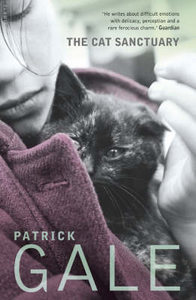
This is an early novel, his 6th, from 1990.
It’s about three women in a house.
The narrative is like a favourite aunt’s doily with a little trio of characters in the centre intricately embroided; there are a few men involved but only around the edges, woven in like a lace border, to frame it.
Or it’s a piece of chamber music, intimate, intricate, but allowing each character to the fore, their solo bit, not only to enlighten us about her but also about the others.
Gale’s voice is at an appropriate and un-judgemental distance, sensitive to the humour that can emerge from conflict. He knows the full picture but hones in on specifics, to add colour, backstory, and therefore understanding while stitching the story for us. He’s at his best with family politics.
It inspired an understanding of the complexity and the importance to storytelling of gossip. Gossip: noun, intimate detail about the people we don’t know. It’s television equivalent is soap opera. Intimate detail about the people we do know is higher art because we know the reasons, motivations, inevitabilities. It’s television equivalent is serial drama. We get to know these three women very well.
In novels, but not in television or film, this is achieved – not only but mostly – by the narrator; knowing what people are thinking, and sometimes the joy of reading about what people are thinking is knowing that what they are thinking is wrong, misplaced, or delusional. This, getting narrative information from what is not written – reading between the lines, is a hallmark of good writing.
Dialogue – in novels, television, and film – like “What’s wrong?”; “Are you OK?”, and “Do you have something to tell me?” are examples of bad writing. They should be completely unnecessary.
Good writers trust their readers to work it out; bad writers don’t trust their readers at all and spell it out.
Gale gives us juicy revelations; makes us doubt what we thought of something/someone; and forces us to do a lot of work (thinking) to assimilate the full complex picture. We are not always conscious of this but it is the major cause for answering the question “What was it like?” with “It was great. I loved it.”
Judith, a successful novelist lives in an isolated Cornish house with her lover, Joanna, a photographer. Judith’s estranged younger sister and a recent, and very sudden, widow, Deborah, comes to stay, to recuperate, reassess, get back on track. Three women in a house, all in a variety of positions on the road to contentment. Not far away lives a widow, Esther, who runs a dishevelled sanctuary for cats. And here is my only minor gripe: the metaphor: cats, women in a house all on the road to safety is very obvious. There was no need, Patrick, to explain it.
Conversations, backstory slotted in with ease, and three men, one in the present, two in the past, all pivotal are woven in with skill.
Here is a small sample of his writing: he’s describing the, now deceased, mother of the sisters, Judith and Deborah.
She had always drunk in company, but after her husband’s sudden death, she ceased what little entertaining she had ever managed and began to hide her bottles like so many lovers in a farce … A small rounded woman, her mother had appeared on a first encounter like some roly-poly matriarch in a child’s picture book, or a motherly glove puppet – nothing on her mind but baking and sweetness, nothing beneath her skirts but clothespegs and starch. One surreptitious glass too many, however, and her nursery rhyme equilibrium was upset, revealing all manner of spite and grievances to the unready … ‘I hope you realise that we only stayed together because of you graceless bitches,’ was the sort of declaration she would make when nearing the point of nightly collapse.
In my previous post I described my frustration at finding something to read that sparked my interest. I found this one. I read it in a weekend so I’m now in the same predicament. To avoid another collection of wasteful days I’m going straight to another Gale, his latest Take Nothing With You, which I should’ve blogged about already.
So what did I think of The Cat Sanctuary? It was great. I loved it.
You can buy the ebook, and/or read a free sample, here.
After I finished reading, and blogging about, Trent Dalton’s Boy Swallows Universe (see previous blog) I searched for my next book to read; not having a book on the go is unthinkable.
At my local bookshop, which I visit regularly, there is a free table outside at the door where damaged or unsaleable second-hand books are put for anyone to take. The free pile usually doesn’t interest me but yesterday the book on top of the unusually high pile did: The Ionian Mission by Patrick O’Brian, and under it, Vineland by Thomas Pynchon. I took them both.
Patrick O’Brian (1914 -2000) was an English novelist almost solely known for his 20 books about Jack Aubrey, sea captain, and Stephen Maturin, doctor, and their seafaring adventures during the Napoleonic wars of the early nineteenth century. The series has become known as the Master and Commander series after the successful film (2003) of the same name, based on the first book of the series, directed by Peter Weir and starring Russell Crowe. I’ve always wanted to read at least one of them.
Although written in the 1980’s the style is of the plot period, and sounds like Jane Austen, which has its own attractions, but his highly detailed and technical knowledge of the manning, sailing, and caring for a Royal Navy man-o-war left me cold. I put it down.
Thomas Pynchon (pronounced PIN shon), born 1937, is an American novelist who is as publicity-shy as J.D. Salinger; some even thought he was J.D. Salinger. He has rarely been seen or heard but has appeared, animated, in an episode of The Simpsons (2004) when Marge Simpson becomes a novelist. Pynchon was drawn with a brown paper bag over his head but his voice was his own. He has been called “a mathematician of prose” and a blender of high and low culture, but is usually considered a postmodernist. His 6th novel Inherent Vice was filmed by writer-director Paul Thomas Anderson, starring Joaquin Phoenix and premiered in December 2014. Vineland is his 4th novel.
The prose is indeed dense, sarcastic, and sometimes humorous; but with character names like Zoyd, Prairie, Thapsia, and Van Meter – all sounding like aliases from a C grade shlock-flick – it was hard to take the writing seriously, which, come to think of it, is what I’m probably supposed to do, not take it seriously. Anyway, I’ll try another day.
I was forced to peruse my library shelves and decided to re-read a Patrick Gale, one of my favourite writers; his 11th novel, Rough Music (2000) – I read it a long time ago and only recall a very unusual family relationship: the protagonist has a long-standing affair with his brother-in-law. Gale is best at family relationships. But! I found another Gale that I hadn’t read, his 6th novel, The Cat Sanctuary (1990) and didn’t remember how it got onto my bookshelf. It was well before the end of the very important first page that I knew this was it; the Gale had hit the spot. I was interested. I don’t know where it’s going yet, but I’m interested to find out.
After writing my 4th novel, I tried to get re-interested in two abandoned works – not having a book on the go is unthinkable – both of 20,000 – 40,000 words (see this post for details) but while reading them and getting to the point of abandonment … nothing. But it was a brief idea in a notebook, some 80 words or so, that when I read it a scene appeared; literally, popped into my head, and with it a burst of excitement. This scene became the first chapter. I was interested to see what happened next. And more scenes kept popping up, ramping up the excitement, and while they keep popping up I’ll keep writing them down.
Up to 36,977 words and counting. I’m aiming at 100,000. I vaguely know where it’s going but haven’t a clue how to get there. Yet. But I’m interested to find out.
Finding a book to read is very like finding a book to write.
Australian journalist turned novelist, Trent Dalton
This is a rollicking good read. Entertaining, insightful, rich in characters, with a heavy dose of autobiography, and only marred a little by the ending; more about that later.
Eli Bell is 12 years old and the younger son of dysfunctional but estranged parents, Frances and Robert, and they all bump along day to day on the outer hazardous rings of petty criminality in Brisbane in the 1980s. Rugby, television, drugs, poverty, junk food, cigarettes, XXXX beer, and a surprising amount of love for each other get them through every day. Well, almost. Eli’s ‘family’ is extended to include his mum’s boyfriend, Lyle, the first man he ever loved – it takes him time to feel that for his dad; Slim Halliday, his babysitter, mentor, and possible murderer, but certainly notorious escapee from Boggo Road Goal; and his older brother, August, who has decided not to talk since he and Eli were possible victims of attempted filicide. He communicates only with Eli who has learnt to decipher his brother’s air writing. They are inseparable.
The story is told in the first person and Eli’s colourful language, obvious intelligence, unwavering loyalty, and passion for words make him an unforgettable character. There’s a love story, or love fantasy, woven into the second half that is centred on a Courier-Mail crime reporter, Caitlyn Spies, eight years his senior. Eli hankers after, not only her lips and other parts of her body, but also a job like hers: he aches to be a crime-busting journalist. But does he make it? No spoilers here.
There is a lot of back-story to get through before the narrative really starts, so the opening is a bit slow but once Dalton gets in his stride you are grateful for the time taken; he also weaves in a flavour of surrealism that doesn’t quite work, for this reader, but it’s easy to go along with it and to allow yourself to be ‘taken for the ride.’
And what a ride!
It has all the flavour and action of a television crime story right down to the satisfying climax and the just-desserts handed out to the bad-guys. But there is a climactic tag, a chase sequence that is contrived, too long, and unnecessary. It’s like this sequence has been lifted from another genre and medium; it sits uncomfortably, and ‘tacked-on’, at the end of such a well-written story. But this is a minor criticism.
Yes, it would be perfect for a television, and an adaptation is in the pipeline, produced by Joel Edgerton, but, surprisingly, it is the theatre that has snaffled the goods first. The stage version is scheduled for the 2020 season of the Queensland Theatre Company for the Brisbane Festival in September of that year. Sam Strong, QTC’s artistic director will direct the adaptation written by Tim McGarry.
You can watch a promotional video here, where Dalton gives away a few secrets of inspiration for this, his debut novel with the books that helped him write it.
When you open a book to page one you usually do so with a blank mind, but an expectant one; waiting for the writer to paint you a picture which becomes – the quicker the better you hope – understanding: place, time, people, action. But right from the start of Max Porter’s Lanny this assumption is useless.
Don’t be put off, if by the end of page 9 you haven’t got a clue what’s going on. Let the snatches of village gossip and easy chatty phrases wash over you like breezes, like waves: exactly like they do on the page – yes exactly like waves, not in straight lines.
Watch and listen to Max Porter talk about the making and the essence of his book, Lanny.
In the first sentence you are introduced to Dead Papa Toothwort; at this moment, and for a few pages to come, a mystery. The more you read the more theories of his identity test themselves until you think that Dead Papa Toothwort is a presence, something like an invisible, all-knowing spirit that flits, swoops, and hovers in and over a village, through its stories, myths, and pliable imaginations, past and present. The strange beginning and pages of wavy lines are necessary: once you accept the existence of Dead Papa Toothwort, and you must, Porter prepares you to accept a whole lot more (no spoilers here).
But the village is real, as real as a novelistic village can be; a dormitory nameless village on the outskirts of London – and we finally meet characters in that village, and we are on safer ground. Understanding, place, time, characters, action emerge like a happy vista through a rising fog. Lanny’s Mum, Lanny’s Dad and Pete. They tell you their stories in the first person, and all of their stories revolve around Lanny. A boy. An exceptional boy. Everyone loves Lanny. He scares people sometimes, especially his parents. He sings when he walks. He collects stuff like a bower bird. He soothes anger with a well-chosen question or a song. And then Lanny disappears.
This book is not a conventional book. Porter has created something different, and what that something is I’m not sure, yet. What it has in common with a conventional book is that it is satisfying, a strange, but satisfying read. There are some conversations and dialogue but not in the familiar form – punctuation is minimal, but no quotation marks – yet it’s always clear what you’re reading, who is speaking, what is being said. You get to know these people very quickly. It’s a small book, I read it in two consecutive afternoons.
In the middle of the book when the town, the police, the media, turn on these three people the tension, the fear, and the unease is told through multiple voices; it isn’t important who says them; you can guess who says them.
Lanny is the centre of the story, but Lanny isn’t given his own voice. You learn to love Lanny via those around him. Porter gives you recognisable emotions, flawed parents, uncaring neighbours, who themselves sometimes are given a voice; familiar novelistic traits that are compensation for, it seems, for the unconventional beginning and format.
I have only one criticism: I would’ve liked to have witnessed more of Lanny’s exceptionalism; his soothing of anger with a song, for example, than just been told about it.
As Porter says, it is not a book that has much to do with today. There are no mobile phones, computers, or text-speak. It is a book about sound and our imagination and how we need to let a writer tickle that imagination into forms and acceptances that are a little out of our comfort zone.
I urge you to give him that chance.
Max Porter’s first novel, Grief is The Thing with Feathers (2015), won many awards and nominations and has been sold in twenty nine territories. A theatrical version was staged in Dublin in March 2018.
You can watch an interview with Porter about Lanny, it’s themes and genesis, here.











 Michael K Freundt