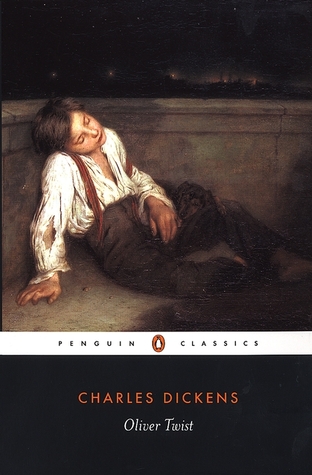
Oliver Twist by Charles Dickens

96h07/fion/3340/exp1576
Charles John Huffam Dickens      1812 – 1870


Original illustrations by George Cruikshank

“It’s all among Workhouses, and Coffin Makers and Pickpockets,” said Lord Melbourne, the young Queen Victoria’s prime minister. “I don’t like those things; I wish to avoid them; I don’t like them in reality, and therefore I don’t wish them represented.”

I think it’s “excessively interesting,” said the young Queen.

Oliver Twist (1837) was a bit of a shock for Dickens’ fans who were introduced to the writer through that plump, accident-prone, well-off, and comic character, Mr Pickwick. And then along comes the serialised Oliver Twist, even before the serialised The Pickwick Papers, which garnered a circulation  of 20,000,  had finished; and in a new magazine, Bentley’s Miscellany, edited by Dickens. The underworld of London low life had, in the past, been treated lightheartedly, even comically, but Oliver Twist was something very different. Thieves, house-breakers, pickpockets all living squashed together in dingy slums and mud, taking pride in their work, but seemingly surviving in little groups that resembled something close to ‘a family’; and dealing not only with petty crime, but also, kidnapping, murder, treachery, and domestic violence.

If you think you know the story, you probably do.

A young orphan, innocent and alone, is put to work in a workhouse, fed on watery gruel, and where he has the audacity to ask for ‘more’; is mistreated, runs away, meets Jack Dawkins, the Artful Dodger, and Fagin and his gang of thieving street boys; is saved from the same occupation by the kindly Mr Brownlow; is kidnapped by Nancy, harassed by the villainous Bill Sikes and forced into a stint of house-breaking, only to be shot and taken in by the also kindly Mrs Maylie and her ward Rose – really his aunt; threatened by the mysterious and dangerous, Mr Monks – who is actually Oliver’s half-brother; but saved by the pitiable but kind Nancy, who is murdered by her lover, Sikes for her efforts; and ultimately reunited with the kindly Mr Brownlow, who adopts him for a predictable happy ending: the oft used, and abused, first rule of novel writing. Oscar Wild said it best and said it better by giving it to Miss Prism to say in his most famous play, The Importance of being Earnest (1895):

The good end happily; the bad end unhappily. That’s what fiction means.

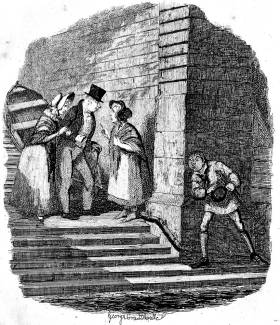
George_Cruikshank_Oliver_Twist 1
“I want some more.”

However, what is equally as interesting is what Dickens can teach writers.

Expression.

Oliver took the hint at once, for the fist had been so often impressed upon his body not to be deeply impressed upon his recollection.

Dickens sentences, usually long, are full of information and in a way that makes them seem packed with it; and sarcasm.

Oliver was frightened at the sight of so many gentlemen, which made him tremble; and the beadle gave him another tap behind, which made him cry; and these two causes made him answer in a very low and hesitating voice; whereupon a man in a white waistcoat said he was a fool, which was a capital way of raising his spirits, and putting him quite at his ease.

These two lines are early in the book, carrying some of the lightheartedness his readership would’ve expected having read The Pickwick Papers, but then surprising them later by his darker themes.

He also uses expression to mirror action. After Sike’s failed house-breaking attempt, during which Oliver is shot, the friends and neighbours of the assailed inhabitants, Mrs Maylie and her ward, Rose, decide to investigate the crime-scene.

Lights were then procured, and Messrs Blathers and Duff, attended by the native constable, Brittles, Giles, and everybody else in short, went into the little room at the end of the passage, and looked out at the window, and afterwards went round by way of the lawn, and looked in at the window, and after that had a candle handed out to inspect the shutter with, and after that a lantern to trace the footsteps with, and after that a pitchfork to poke the bushes with.

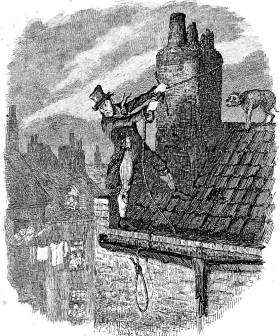
George Cruikshank OT 3
Oliver discovers what his street-mates are up to

A lot of repetitive energy, and phrases, to produce not a scrap of evidence.

Character.

Dickens is a great character-builder with the use of dialogue.

Mr Bumble, the beadle, drops the first syllable of ‘apprentice’ (‘prentis), the ‘n’ off the article ‘an’ (‘a old lady’), any syllable that gets in his way (‘unfort’nate’), uses ‘porochial’ (instead of ‘parochial’), and ‘w’ instead of ‘v’. Mr Grimwig, a friend of Mr Brownlow’s, uses a unique expression not ‘… I’ll eat my hat” but ” … I’ll eat my head.”  Barnaby, a street urchin, has an adenoidal problem over the letters ‘n’ and ‘m’: “Dobody but Biss Dadsy” (Nobody but Miss Nancy.) Bill Sikes regularly uses the word ‘damn’ but too risqué for British readers of 1838 so it was replaced simply by ‘D-‘; they understood what it meant but were not forced to actually ‘read’ such a shocking word. In a hierarchical society such as Dickensian London where one’s status is ruled by birth, income, education, and gender, such distinctive character differentiation may not be appropriate in a modern context but giving characters vocal habits is a useful device for character differentiation. Dickens has Fagin call everyone, regardless of gender, age, or status, ‘my dear’. Ascribing a character with a particular grammatical habit of, say, never using contractions helps to paint a rather serious and stern person. If characters are not first speakers of the readers’ first language grammatical mistakes ( no plural ‘s’, wrong prepositions, gerund misuse, etc) are really essential. I once heard a writer, a young male American, read, at a literary event, a section of his new novel that was set in Rome but had a Mexican character who sounded, when he spoke, nothing like a Mexican English-speaker living in Rome; he and each of the characters sounded like a young male American. A missed opportunity.

George Cruikshank OT 2
Nancy is betrayed.

Narrator.

In contemporary fiction the narrator is, usually in the third person, a nameless, genderless, all-knowing, god-like voice with access not only to characters’ thoughts, desires, and plans, but also to their past and future lives. Not so with Dickens. He writes directly to the ‘reader’, calling them such, and refers to himself as the ‘biographer’, and ‘faithful historian … who knows his place’. He even chastises himself for keeping an esteemed character waiting while dealing with other plot necessities. The use of the narrator for plot-based effects is rare but was used effectively by Ian McEwan in his 2012 novel Sweet Tooth, where the first person narrator turns out not to be the writer; and, most intriguingly, the satisfying ending is only evident because you, the reader, have read the book: it’s because the book is available to read that you then know the ending. Curious? Check the link above. Dickens used his narrators in a far freer and more colourful way with direct input into not only the plot but the tone. Here, in a recent short story, Serendipity, is an example of the narrator not only intruding into the writing of the story, but also is a secondary narrator with his own story: a double narrative, if you like, one feeds on the other.

Dickens’ reference to himself, the narrator, as ‘historian’ leads now to another novelistic ‘trick’: creating

George Cruikshank OT 5
The end of Bill Sikes

Verisimilitude.

Yes, we know that we are reading fiction, that most of the whole thing – sometimes not all – is made-up but the writer wants us to believe that the story is true. Writer’s rely on our imagination to create for ourselves our own reality, and so allowing our emotions to do their work. However, writer’s don’t want to ‘lose’ their readers by letting the text slip too far from possibility. A text in the first person has a better chance of doing that, more so than a text in the third.

However, Dickens ‘tricks’ us several times implying that what he is saying is true: 1) he (the narrator) admits to omitting a word in the dialogue of a character because it is too impolite for your, the reader’s, ears. By refusing to tell us what the word is he is implying that he actually heard it, but decided it was not suitable; 2) a character observes a conversation between two people in the same room but can’t hear the exact words and so infers what is said. This is a plot point but it also implies that the conversation actually happened – no, the narrator is not making this up because if he was he would’ve placed the character closer to the talkers; and 3) forgetting a name. We, real people, do this all the time, so by the narrator confessing he has forgotten someone’s name, or the name of some place, reinforces the truth of the scene because actually the person or the place is made-up – this is fiction, remember – and being made-up the writer (narrator) could’ve provided a name. But he didn’t, so the implication is that the action must’ve happened.

It is true to say that contemporary fiction is the mainstay of a modern reader’s literary diet. However, a dip into the classics now and again, is a palatable way to hone critical thinking, get a grip on literary history, and understand where our literary tastes may be heading, and where our cultural references came from.

Most of the classic literary texts from Australia, Britain, Europe, and America are out of copyright and are, therefore, available online for free. The University of Adelaide has established a website where you can find a myriad of classic texts. It contains all of Dickens’ novels as well as a large collection of his short fiction and you can download ebook versions in various formats and for various devices. Happy exploring.


Dickensian sentence p 10
“He took the hint at once, for the fist had been so often impressed upon his body not to be deeply impressed upon his recollection”
Sarcasm –
P12 “… made him answer in a very low and hesitating voice… at his ease.”
p13
“… the poor people liked it …”
Sinecure
Narrator as biographer p46
D is a great teacher of dialogue for character building:
Mr Bumble, the beadle, drops the first syllable of ‘apprentice’ (‘prentis), the ‘n’ off the article ‘an’ (‘a old lady’), and any syllable that gets in his way (‘unfort’nate’ p 296).
Ie Dodger,
Mr Grimwig ‘… I’ll eat my head” p110
And Barnaby p119 with his adenoid problem
P155 Bill Sikes who regularly uses the word ‘damn’ but too risqué for British readers of 1838 so it is replaced by ‘D-‘. Mr Bumble, the beadle, uses ‘porochial’ (instead of ‘parochial’) and ‘w’ instead of ‘v’.
The relationship between narrator and reader: strong in OT but rare in modern lit. P135
The narrator calling himself “author” and “faithful historian …. who knows his place” p216 and insinuating what kind of an author would he be to keep a beadle waiting …
Unpleasant description of Fagin: “loathsome reptile” p153. P154, by telling the reader that he, the narrator, will not mention something adds veracity to the tale.
Also, like forgetting a name, not hearing a conversation because the whispers were too quiet. P213;
Describing 1 or 2 minutes when nothing is said p 218
Possible theme: what Dickens can teach us about writing. Use of narrator. A N can be a biographer, a person, not just a dissociated god-like voice. But take it further, if s biographer, then why not a person; and one with opinions, attitudes, even a history, even a present history! Narrators nowadays are usually ‘apart’ from the narrative; what if the narrator was a part if the narrative, or framed a parallel story, see Serendipity. Link to Tablo.
Character: Nancy’s ‘acting’ p165 OT nor the reader is ever quite sure what Nancy is playing at.
Dickens on description p234-5 “0f the two ladies …” He describes not so much what they wear but the impression the whole picture gives.
Action
“Lights were then procured, and …with” p246
The bad are bad but show a little bit of good, ie Fagin. The good are good but not bad (Rose).


Latecomers by Anita Brookner

Anita Brookner pic
British novelist, Anita Brookner (1928 – 2016) won the Booker Prize in 1984 for Hotel du Lac.

When Brookner’s editor Liz Calder rang her up to report the news of her Booker Prize nomination Anita replied, “I think I shall go out and get a pair of shoes resoled. That will help me keep my feet on the ground.”

Everyone thought J. G. Ballard would win for Empire of the Sun – the odds were 6 to 1 that he would. He didn’t. She did.

Before becoming a novelist – she was always a writer –  she was a celebrated art historian and the first female Slade Professor of Fine Art at the University of Cambridge. She wrote 24 novels, almost one a year, from 1981, she was 53,  to 2011. She was an only child of “unhappy” parents who lived with her grandmother. “They were transplanted and fragile people, an unhappy brood, and I felt that I had to protect them. Indeed that is what they expected. As a result I became an adult too soon and paradoxically never grew up.” She never married or had children.

Fellow British writer and friend, Julias Barnes remembers, “She was witty, glitteringly intelligent, reserved, and unknowable beyond the point she herself had already decided upon. I can’t think of a novelist less likely to write an autobiography. She was fiercely moral without being moralistic, and fiercely truthful.”

With the opening to Latecomers you know you are in the safe hands of an authoritative wordsmith:

Hartmann, a voluptuary, lowered a spoonful of brown sugar crystals into his coffee cup, then placed a square of bitter chocolate on his tongue, and, while it was dissolving, lit his first cigarette. The ensuing mélange of tastes and aromas pleased him profoundly, as did the blue tracery of smoke above the white linen tablecloth, the spray of yellow carnations in the silver vase, and his manicured hand on which the wedding ring fitted loosely, without those deep indentations that afflict the man who has gained weight or age, a man to whom in any case his wedding might be presumed to be an affair of the irrelevant past. 

She then describes Hartmann’s gaze falling on a group of middle-management men and Brookner drops into the second person as Hartmann chastises them for gorging themselves on lobster cocktail and steak and kidney pie:

My dears, you do not look well … your complexions are not clear, your haircuts unbecoming.

It’s the story of two German Jewish immigrants, Hartmann the voluptuary, Fibich the worrier, who, although from the same background and bind their lives together in the same work, are two very different men, marry two very different women, and have, one each, two very different children. The narrator tells us about them. There is very little dialogue, hardly any; only carefully considered sentences almost bursting with detailed information. As you can see from the quote above hardly a noun is allowed to exist without at least one apt adjective. Brookner places a lot of trust and love into her adjectives and adverbs. When my book-fairy brought me this one from Europe late last year I looked at it and said, “Oh, I didn’t know about this one.” He said, “What? Oh, I don’t recall their titles, I just read her, over and over,” and he made a face as if to say, “Well, why wouldn’t you? They’re delicious.” Another apt adjective. Hers is the type of writing that brings you pleasure no matter what the writing is about. Of course, she honed her writing skills as an art historian writing about art, until hers became an art in itself.

Her style won’t please everybody; her focus is on what these people are like, not what they do but on the way you find out what they did, and how they did it, why, and what they felt about it. I often write about the image of a novel’s narrator as an imp sitting on the shoulders of the protagonists having access to what the protagonist not only sees and hears but also what they think; but in Brookner the imp is sitting just behind their eyes surrounded by the cluttered furniture of their hopes and fantasies, feelings and thoughts, and so by telling us all this the characters emerge and she shows us what being human is like.

Although the action is minimal, time passes – actually over 50 years pass, from when the boys first meet at boarding school to their latter years when grandchildren are on the way, mixed with the feelings of love, pride, and even disappointment in what their children have, or have not, achieved. Many critics of Brookner chastise her for her moody, timid, and undemanding characters due, they say, to her never marrying and not having children. However, for a husbandless and childless woman she deftly handles the changing feelings, the stings and shadows, joys and love-bursts of two very different couples for their offspring: one becomes a self-centred and ebullient actor, one a passive and disappointed housewife.

Fibich, the desperately thin and always fearful one, takes a courageous journey back to Berlin in an effort to try to recapture something of himself as a child; some inkling of what home might feel like. His journey is revelatory because of a chance scene he witnesses; something that has nothing to do with Germany, but all to do with memory. It’s Brookner at her best.

It’s a handsome volume and part of the Vintage Contemporaries Series, but don’t take much notice of the blurb on the back: it makes it sound something it isn’t, but then if you take the ebook, which you can find here – and where you can read the first few pages for free – you won’t be tempted.

Anita Brookner died on March 10th, 2016 and an obituary appeared in the Guardian, on Tuesday, March 15 You can read it here.

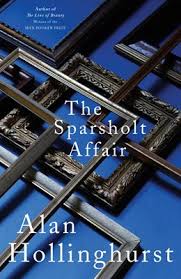
The Sparsholt Affair by Alan Hollinghurst

Alan Hollinghurst pic
British writer, Allan Hollinghurst.

A common theme throughout Hollinghurst’s work is how the past can be shaped by the present. The Stranger’s Child (2011) is about a poem written just before WWI but after the poem becomes famous it acts as a microscope on the lives and descendants of the people who were spending that weekend together when the poem was written in a teenage girl’s autograph book. Even his first The Swimming-Pool Library (1988) the past is a crucial element: a young lay-about is asked to write the biography of an ageing aristocrat and in reading the old man’s diaries comes to see the passions, oppressions, and obsessions of an earlier gay life refracted in his own; and, here too in The Sparsholt Affair, a sexual dalliance at Oxford during WW2 , is re-remembered when a lost memoir is discovered shortly after the author’s death. Whatever is happening, or improved, about the present it’s all because of what happened before.

Hollinghurst studied English Literature at Oxford in the 1970’s but concentrated his interests on writers whose homosexuality, though never expressed or admitted to publicly, permeated their work:  E.M. Forster, Philip Firbank, and L.P. Hartly. He is reported as saying that “I was fortunate to come along just as gay-lit was coming into its own” but it was actually his first, The Swimming-Pool Library, that let the way – particularly in literary fiction – in my memory. And that’s the point. Memory is such a slippery thing. Someone once said, “it’s like an oven; you put something in, wait a bit, open the door and there it is: something else.” Yes, there is an affair in The Sparsholt Affair (“Money, power … gay shenanigans! It had everything”) – in fact there are many Sparsholt affairs – but how much people remember about it is what interests Hollinghurst.

“If you think about the Poulson scandal in the early 1970s [a property and corruption case that resulted in the resignation of the home secretary, Reginald Maudling] … the Profumo affair people remember a bit better, but actually, if we tested each other on it now, we’d probably be a bit rocky, and that was a very, very prominent scandal.”

David Sparsholt arrives in Oxford in 1940 and all eyes, from a room across the quad, are on him as he, in a sweaty singlet, lifts weights in what he thinks is the privacy of his own room. The assemblage, mainly gay, some gay-ish, young men, plot and scheme to get Sparsholt’s attention; all to varying degrees, although one in particular succeeds spectacularly. So ends Part 1: The New Man.

In each successive Part – there are five in all – Hollinghurst jumps decades ahead to the Sparsholt family, friends, some from that Oxford group, now ageing, some new, some older, successful, some dying, to Part 5 which concentrates on David’s son, Johnny Sparsholt, a painter, now in his 60’s whose long-time partner Patrick has just died. Here at the end of the book a regular Hollinghurst theme emerges: how gay life of today is so much different from gay life then, when it was illegal, tragic, rife, but clandestine; and Hollinghurst gives us the most vivid and delicious description of gay clubbing, leisure drug-taking, sex for the moment – during which the past emerges, yet again. Permeating all five parts is the affair from Part 1, or it is the real Sparsholt Affair, the one that made the papers, and shocked the socks off everyone?

“What would two long-ago lovers be likely to feel, one of them twice married, the other losing his memory.”

Curiously, or not, for some, the central character, David Sparsholt is rarely in the spot light; he is relegated to the edges of the story, to the shadows of people’s memory and belief – even his son is a little vague about what his father is like;  but it’s the idea of him and what he did, or did not do, that is at the centre, and what was remembered about him, it.

What has always interested me about novels is not so much what happens but how each is told. Apart from Part 1, which is a first-person memoir, Hollinghurst employs a narrator that entirely operates through what his characters sense. They are all experts at defining and opinionising the thoughts, desires, and threats that flit and tumble over the faces of everyone else in the room. His language is Jamsean and sometimes you relish reading a sentence again just for the pleasure of it. He is interested in the tone, the flavour of things, be it the atmosphere in a bar, of a welcome, in the furnishings of a home, a decision, a sigh; and at times you are impressed by his descriptive accuracy:  “the gay voice that survives through generations, the illusionless adenoidal whine and drag …”

Hollinghurst is a stylist because he has a style, and one feature of this style is his phrases of opposites. It’s his logo, his leitmotif. They pepper all his work.

     ” … seemed to know and not to know …”

     “ … passed from shadow to shadow in doubt and then brief solidarity.”

     “ … he was smilingly both enemy and friend” which, of course is true of any auctioneer

     “ … more present and also more covetably remote…”

     ” … his relief that he wouldn’t be alone with Francesca was mixed with the relief that he wouldn’t be alone with Ivan… “

     “…he might be about to cry, or was just possibly stifling a laugh.”

     “It was as touching as it was annoying.”

     “ … magic as routine …”

It says something about the human condition – always to the fore in a Hollinghurst book – that these opposites are surprisingly apposite.

This is a book I will read again and unlike music which we listen to again because of what we remember, we re-read books because of what we forget, and not just the incidents but the pleasure of re-finding the joy in the details, the words, the phrases, the descriptions.

My only complaint with this book is the editing, or the lack of it, which, sadly, is what we have come to expect these days. I’m pleased that I’m not overtly annoyed by comma splices, of which there are many, but the sloppy use of pronouns especially in scenes with many characters of the same sex make re-reading for clarity an annoying necessity. There is even a sentence on page 181 that makes no sense at all but is due to, I suspect, a cut and paste not being checked for coherence.

Hollinghurst was born in a market town near Oxford in 1954; the only child of a bank manager, he had a happy childhood and especially remembers being flooded with relief, when his father said: “Awfully sorry, old chap, but you’re not going to have any brothers or sisters.” He didn’t mind at all and rather enjoyed playing Hide-&-Seek by himself: “It can’t be hide and seek if no one’s coming to look for you, darling,” his mother told him. “It’s just Hide.” He had a safe and uneventful childhood and eventually studied at Oxford and after gaining a BA and a MLitt lectured for a while at his alma mater, Magdalen College, and several other tertiary piles before landing a job in 1982 at The Times Literary Supplement and becoming its assistant editor from 1985 – 1990.  He spectacularly burst onto the literary scene with The Swimming-Pool Library which put well-adjusted and happy gay lives firmly into the literary landscape. I remember seeing the book, in hard-cover, large and impressive, being handled and protected carefully in the arms of an Anglophile friend of mine, a mauve sweater draped around his shoulders and a sleeve caught in its pages, like a bookmark. I knew very little about it except its gay theme, but what struck me that day was that it exuded importance. He won the Man-Booker Prize in 2004 for his 4th novel The Line of Beauty.

The Booker, once the sought-after pinnacle of literary fiction in English, has been tarnished somewhat by the inclusion, some say, in 2014, of work by American writers; two of them having won the 2016 and 2017 prizes, Paul Beatty for The Sellout and George Saunders for Lincoln in the Bardo, respectively. In February this year 30 publishing heavyweights wrote to the Man-Booker Foundation asking that the 2014 decision be reversed. The reason for the dispute seems to be to avoid “an homogenised literary future;” or, it could be because a Brit hasn’t won it since 2012. The Foundation responded with “The Man Booker prize expanded in 2014 to allow writers of any nationality, regardless of geography, to enter the prize providing that they are writing in English and published in the UK. The rule was not created specifically to include American writers.” The 2018 prize, its 50th, will announce the long list in July.

You can buy this book in Kindle, hardback, or paperback editions, here.

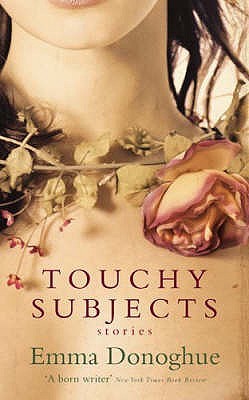
Touchy Subjects by Emma Donaghue

emma-donoghue-pic
Irish-Canadian writer, Emma Donoghue

In April 2008 in the Lower Austrian town of Amstetten a woman called Elizabeth Fritzl told police that she had for the past 24 years been held prisoner in an underground room under her father’s house. He had systematically raped her, she bore him seven children, and kept her from the world; even his wife didn’t know she was there.

This was the inspiration for Donoghue’s 2011 Man-Booker long-listed novel, Room, which went on to be filmed, with a script by Donoghue, in 2015, starring Brie Larson, who won an Oscar for Best Actress.

This book is a collection of short stories, her third, and came out in 2006. She tackles the foibles of modern people in stories told by various voices, genders, and sexualities: the desperate, but hilarious, lengths a forty-something woman will go to, to beat her biological clock; a cool romance set against the rough and back-slap masculinity of football where two rookies find more than the ball during their training sessions; and a touching and romantic story about the meeting of two minds and two bodies told in two narratives that weave and tangle with each other just like their hands do in the back of a van in the middle of a dark night, lost in the back lanes of Connemara. And that’s just three of them.

There’s a thread here running through these stories: of inner thoughts shared only with the reader that gives Donoghue’s writing the personal warmth and favouritism of dramatic irony; an intimacy with the reader that draws you in and makes you part of her intent.

Donoghue not always, but mostly, instills in the reader a confidence that you are in good literary hands. This is a book that could sit comfortably in your bedside book pile so you can dip into it again and again. Some stories will become favourites.

You can get the book, in various formats, here.


The World Broke in Two by Bill Goldstein

bill_goldstein_pic
American academic, Bill Goldstein is the founding editor of the books site of The New York Times on the Web, reviews books and interviews authors for NBC’s “Weekend Today in New York.” He is also curator of public programs at Roosevelt House, the public policy institute of New York’s Hunter College.

Virginia Woolf, T. S. Eliot, D. H. Lawrence, E. M. Forster, and the year that changed literature.

In January 1922 Adeline Woolf, everyone called her Virginia, turned 40 and was very sick with influenza that prevented her from writing; T. S. Eliot, everyone called him Tom, 34, had been over worked, unhappy, in therapy, but now quietly confident since he had started writing again but fearful of returning to the Bank that trapped him between the concrete and the sky; E. M. Forster, called Morgan, 43, was sexually and artistically frustrated; and D. H. Lawrence, called Bert, 36, had the threat of his books being banned  (Women in Love, 1921, ” … ugly, repellent, vile”), and a libel suit against him so wanted to know “For where was life to be found” and thought by going to a quiet place by himself he might find it: Ceylon, New Mexico, or New South Wales.

All four had achieved some degree of literary fame: Woolf had published two novels and the third, Jacob’s Room, was waiting for her final revisions, however her illness kept her away from her work. Eliot had published successfully The Lovesong of J. Alfred Prufrock in Poetry magazine in 1915 and had been a regular contributor of reviews and essays, primarily for The Times Literary Supplement right up to December 1921. Forster had achieved great success with a series of novels, usually about the English abroad, beginning with Where Angels Fear to Tread in 1905 but by 1922 nothing had appeared after the very successful Howard’s End in 1910. Lawrence was more infamous than famous and had had Women in Love published in June 1921. It garnered bad reviews, and low sales. This added to the outrage caused by its prequel, The Rainbow, 1915, when it was withdrawn by the publisher after it was banned under the Obscene Publications Act. Lawrence had also characterised in the latter work, an acquaintance, Philip Heseltine, and thought he had disguised him enough, but Heseltine was not fooled and threatened legal action.

virginia_woolf_pic
Adeline Virginia Woolf 1882 – 1941

For all four writers 1922 did not begin well.

Artistic endeavour is always trying to solve the problems of the art form itself. How does a writer write an autobiography and make it interesting without using the boring phrases, “Then I went …. she cried and so I said …., Then I said, and he went ….”? Novelists for centuries have been using description and dialogue to draw a character; but in an autobiography how do you create an image of the narrator? There must be another way. Yes, there is, and one of the first writers to find another way was James Joyce who began his autobiographical novel Portrait of the Artist as a Young Man (1916) like this

Once upon a time and a very good time it was there was a moocow coming down along the road and this moocow that was coming down along the road met a nicens little boy named baby tuckoo.

First of all he writes not in the first person, but in the third (very radical, this is an autobiography, remember) and the above opening is not dialogue, it is prose; it’s not said by the protagonist but by the narrator using the language that the little boy, James, might use to describe what he sees and what he sees is himself! It’s as if the third person narrator is not some all-pervasive, god-like know-it-all but an imp sitting on the shoulder of the little boy seeing the world through his eyes and hearing the thoughts in his head. This literary device has become known as free indirect discourse, or as the literary critic of The New Yorker, James Wood, calls it, ‘close writing’; and it’s as common today in contemporary fiction as Vegemite is for an Australian breakfast. But it can’t be used in the first person. Or can it? Now, there’s a challenge for an adventurous writer!

image
Edward Morgan Forster 1879 – 1970

Painters  sought to bypass the ‘real’ bit in order to paint, say, serenity, by trying to paint serenity with just the paint on the canvas, not trying to be something else, a face, a landscape, to ‘portray’ serenity. In other words, they painted not what they saw but what they felt. Writer’s similarly de-focused the ‘real’ bit and concentrated on, not what the characters did – the plot – but what the characters felt and thought. The plot became internalised.

Before January 1922 was over Eliot and Lawrence had succumbed to the influenza that brought Woolf so low and was rapidly becoming an epidemic to rival the devastating outbreak of 1918-19 that killed more people than the Great War. At least for Eliot the influenza kept him away from the bank and, despite the disease, hard at work on his long poem. His ill wife, also being absent, was yet another and usual worry out of the way.

On his way back to London from the unsuccessful trip to India Forster bought and read Proust’s first volume, Swann’s Way in French. He was “awestruck” and marveled at Proust’s use of memory to drive the narrative. Later in the year as the weather warmed he used Proustian ideas, and a poem by J. R. Ackerley, Ghosts, to impinge on him the truth that there is life after tragedy. His tragedy was the slow death of his unrequited lover in Egypt, whose death he almost wished would be sooner than later, as he was slowly re-reading the abandoned pages of his Indian novel, making notes and yearning for his tragedy to be behind him.

T.S.Eliot - pic
Thomas Stearns Eliot 1888 – 1965

Woolf, with her illness almost past, read Proust too, in the spring while working on an essay about reading and dabbling with a minor character from her first novel, The Voyage Out, Clarissa Dallaway, weaving her into a short story called Mrs Dallaway in Bond Street.  Woolf too was enthralled with Proust’s use of memory to evoke the current state of mind of a character. In the opening scene of the short story, which eventually evolved into the novel Mrs Dallaway, Woolf has Clarissa arrested by the chiming of Big Ben which announces the convergence of the past and present, not only in the character’s mind but also on the page. Very Proustian! Clarissa Dallaway in Woolf’s first novel is described by the narrator but Woolf was determined in this one, this modern one, to have Clarissa think everything the reader needs to know about her. As Woolf wrote later to a friend, she didn’t mind being sick as “Proust’s fat volume comes in very handy.” Woolf, who wrote that she wanted to write like Proust, didn’t of course, but it was because of him that she began to write like herself again.

Joyce, for her, was different. Woolf and Joyce were both British, they were both the same age, and Joyce in 1922 had “a novel out in the world, a massive – expensive – box of a book”, Ulysses, and Woolf had not published a novel in two and a half years. She was jealous. Besides, Ulysses didn’t impress her. She thought it was “underbred” by a “self-taught working man.” What she failed to realise was that Joyce had a degree, she didn’t; it was she, not him, who was self taught.

Lawrence left England in early 1922 for Ceylon, but found it unsatisfactory, then Perth, Western Australia, very unsatisfactory, then Thirroul, south of Sydney, where he transferred his thinking back to what he called his ‘interim’ books, short stories and journalism. Could he write a novel like those, in a month, or less, using nothing but what he had around him, namely Frieda and himself, and what he thought and felt? He decided to give it a go and the novel Kangaroo was born, but this too stalled. It was the third novel in a row that got ‘stuck’. However, without the help of Proust, Lawrence turned to memory, and chapter 12, the longest in the book and the only one not set in Australia, describes the fear he and Frieda experienced at the outbreak of World War I (she was German and had abandoned her first husband and children; he was excluded from service because of his frail body). Lawrence had instilled in his protagonist, Richard Somers, a ‘fear’, exemplified by the vastness of the Australian continent, and it was Lawrence’s explanation of this fear, via his personal experience, his memory, that ‘unstuck’ his progress, and he got the thing finished.

d-h-lawrence-pic
David Herbert Lawrence 1885 – 1930

T. S. Eliot finally saw his long poem, The Waste Land, the poem that had battled with his job, his contemporaries, his wife, his past, and his health, finally published. Goldstein spends a lot of time, too much you may think, on the procrastination, arguments, letters, late replies, betrayals, that stall the publication; and all concerning people, publishers, agents, friends, supporters, who want it published.

For a year that started badly for all of them, 1922 ended like a new dawn: Virginia Woolf had a new novel, Mrs Dallaway; E. M. Forster was well on his way with his Indian novel, the one that had caused him so much anguish, A Passage To India, (1924), and would become his most celebrated; D. H. Lawrence had written a new novel, very different from his previous works, no sex, but had also been vindicated by the courts: The Rainbow and Women in Love were judged not obscene, although some passages were, but the press-obsessed trials led to a resurgence of sales and interest in his work; and T. S. Eliot finally saw his long poem in print, and received the accolades he thought it deserved.

For readers who are interested in literature and its history this book is a must-read. Goldstein has sculptured a surprising and complex narrative, esoteric and detailed, yes, but intriguing, stimulating, and fascinating.

In the year 1922 these four writers, for various reasons, had already been chipping away, with varying intensities, at a ‘crack’ in the English literary world, hoping their artistic challenges and vaguely-inspired experiments would lead them in a new and exciting direction. Then came the thundering blows of Proust’s Remembrance of Things Past and Joyce’s Ulysses which, along with The Waste Land, caused the ‘break’ and English literature did indeed cleave in two and took off in a new direction. However, the ‘piece’ that remained behind kept the majority of readers with it and it was those readers who demanded, and got, a whole array of plot-based genres, the names of which you can see topping a multitude of racks of books in any sizable book shop today; and over there in the corner of the shop topping a not insubstantial, but nevertheless alone, book-stack is another sign: literary fiction.

You can find the book in various formats here.

The Story of a New Name by Elena Ferrante


Female-silhouette
Elena Ferrante is/might-be the pseudonymous name of an Italian writer. Publicity shy, she only accepts interviews by email. There are no photos of her online. James Wood, The New Yorker critic has deduced … a number of her letters have been collected and published. From them, we learn that she grew up in Naples, and has lived for periods outside Italy. She has a classics degree; she has referred to being a mother. One could also infer from her fiction and from her interviews that she is not now married…In addition to writing, “I study, I translate, I teach.”

the story of the facts has to reckon with filters, deferments, partial truths, half lies: from it comes as arduous measurement of time passed that is based completely on the unreliable measuring device of words.

That … what are writers stuck with? … the unreliable measuring device of words.

Every tone of voice, every possible meaning of words spoken, every possible meaning of words unspoken, the way they dress, walk, cry, smile, serve the pasta, look, and stand; all are analysed by Elena, the first-person narrator, in her attempt to understand what’s going on. It’s a Brugel-esque landscape of feelings colouring the lives of the Neapolitan working class in the 1960s and all seen through the eyes of Elena Greco  -“always fearful, always subordinate, always pleasingly willing”, the unmarried, bookish one with glasses.

Elena Greco:  I said to myself every day: I am what I am and I have to accept myself; I was born like this, in this city, with this dialect, without money, I will give what I can give, I will take what I can take, I will endure what has to be endured. This could easily be Lina’s creed too.

The title refers to Elena’s brilliant friend, Lina Cerullo and her new name now that she’s married, her married name, Lina Carracci, and, of course, Elena can’t be everywhere, especially in Lina and Stephano’s hotel room on their disastrous wedding night, but we get the scene, in the third person. Ferrante doesn’t need to justify how the narrator, Elena, knows what happened, she does (Lina told me) and clumsily so. However, there are other instances when the narration slips from the first to the third person unannounced. It’s OK. It’s a legitimate literary device, unnoticeable if attention is not drawn to it. It allows a flow of action or insight. This inconsistency is something the editor should’ve picked up. Ferrante is usually masterful at using these literary tools. Quotation marks, and ‘he said’, ‘she said’ are abandoned at times in the frenzy of verbal, sexual, or social violence giving the scene a filmic quality, making the action jump out of the flat page. This is good stuff, but doesn’t need justification.

The story is about Lina’s marriage that fell apart at the wedding at the end of Book One and how it continues on its downhill slide while Elena continues to bump against her upbringing and pursue an academic life, free – she thinks – from her stifling Neapolitan history; but Elena by this book’s end still believes Lina, despite her choices, is the more beautiful, the more intelligent.

Thank god there’s a glossary of families and family members at the front of the book. Ten families and their intra and extra familial relationships make up the fodder of the story and the glossary is well needed; and don’t be afraid to use it (no-one will know). Things get complicated especially with diminutives, family nicknames, and similarities; Alfonso, Antonio, Lina, Linu, which is a diminutive of Elena, not Lina whose real name is Raffaella. See? And don’t skip over the Italian family names, Cerullo, Cappuccio, Scanno, Solara. Say them out loud! You need to be familiar with them all and if you say them, you’ll be saying them a lot, right from the beginning so it won’t take long before you’re at one with the family, families. You’ll be in among them all. That’s the best bit.

The worst bit is the fate of the women. Not only are they treated like shit by all of the men – except when they want something, usually sex – their worst enemies are the other women: mothers, sisters, aunts, cousins, and  friends. Shame, gossip, inference, innuendo, treachery, lies, superstition, and pride are all weapons these Neapolitan women use against their own. And Elena sails bumpily, battered and bruised, but defiant, through it all, but ultimately aware that she is a woman and people see her more clearly, listen to her more intently, talk to her more respectfully, when she is on the arm, even metaphorically, of a man. Have things changed?

And then the story splits: Elena goes to study in Pisa, and Lina’s messy life of deception, abandoned commercial success, and personal war-mongering continues to engulf everyone in her circle of destructive intent and selfishness. Here I wanted to hear more about Elena, but I had to wait.

And then this:

One morning I bought a graph-paper notebook and began to write, in the third person, about what happened to me that night on the beach near Barano. Then, still in the third person, I wrote what happened to me on Ischia. Then I wrote a little about Naples and the neighborhood. Then I changed names and places and situations. Then I imagined a dark force crouching in the life of the protagonist, an entity that had the capacity to weld the world around her, with the colors of the flame of a blowtorch: a blue violet dome where everything went well for her, shooting sparks, but that soon came apart, breaking up into meaningless gray fragments. I spent twenty days writing this story, a period in which I saw no one, I went out only to eat. Finally, I reread some pages, I didn’t like them, and I forgot about it.

This is Elena Greco explaining herself, describing what changed her life, but it is more; it is a confession from Ferrante: how to write a novel. It’s finding the ‘dark force’ that’s the tricky bit. However, it’s this notebook, hand-written, unedited, that she gives as a gift – despite “I reread some pages, I didn’t like them” – and it’s this notebook that finds it’s way into literary circles, someone types it and shows it to a publisher and …

When Elena and Lina finally re-unite it’s in the most unlikely of places; two women, one about to be hoisted aloft, the other about as low as she can go but united by a shared intellect, history, and belief in the other, no mater how sorely that belief is tested. One ignored the upbringing they both had no control over; the other gave in to it. And like the end of Book One, My Brilliant Friend, this, Book Two, has a sting on the last page that compels you, no matter what you might think, to move on as quickly as possible to Book Three, Those Who Leave and Those Who Stay. Ferrante is a reading experience like no other.

You can purchase the book, in various formats including the ebook, here.

The Secret Scripture by Sebastian Barry

Sebastian Barry pic
Irish writer, Sebastian Barry.

Some years ago at the Ubud Readers and Writers Festival I was intrigued and entertained by a British writer called Jill Dawson who had the audience at her session in the palm of her hand, so I checked out one of her volumes in the festival bookshop. I place a lot of importance and insight into a book by its first page. It wasn’t long, still on page one, that I heard a faint gasp from my own mouth and a thunk as I put the book back immediately. Both actions were involuntary. I was alarmed; not by the content but by my reaction to the content: she was writing in the first person as a man. I was not aware that I held this prejudice. Since then I have tried several times to write as a woman; I mean, in a first person (and third person) female voice with mixed success. So, when it was clear that Barry’s first person narrator was a woman I did not act as before but thought it was time I faced my prejudice, although weakened since by my own efforts, and continued reading.

The narrative is, in fact, in two voices: one the old woman, Roseanne Clear, the dominant voice, and the other, Dr Grene, the psychiatrist who tends to her at the Roscommon mental hospital, St Malarky’s, where Roseanne has been living for as long as anyone can remember. Roseanne Clear is very old, maybe even a hundred.

I am only a thing left over, a remnant woman, and I do not even look like a human being no more, but a scraggy stretch of skin and bone in a bleak skirt and blouse, and a canvas jacket, and I sit here in my niche like a songless robin – no, like a mouse that died under the hearthstone where it was warm, and lies now like a mummy in the pyramids.

She writes out her life on “unwanted paper” and stashes it under a loose floorboard; not unusual as the building is falling apart. Barry gives her language that is poetic, articulate, melancholy, and wise but seemingly uneducated at times: “no more”, although this could be her Irish-ness peeking through. Yet she is in a mental hospital. This is usually a theatrical device, a character being one thing to the other characters, and someone else to the audience; a form of dramatic irony.  This is reinforced by conversations she has with Dr Grene where she gives simple answers or sometimes no answer at all, while telling the reader her reasons.

Her aim is to try and remember why she is where she is and whether memory, about a husband, then a non-husband, abandonment, expulsion, and a child, has any relation to reality. Is memory trustworthy?

Her story is one of Ireland: beginning with political unrest and genteel poverty as the daughter of a Presbyterian gravedigger in Sligo, western Ireland in the 1940s. Almost half of the book is devoted to her memory of her childhood with a father she adored, and you will too – even when be is reduced to work as a rat-catcher –  but with a mother who is as distant and silent as a housemaid, which she resembles. Dr Grene has a similar wife, blank, distracted, lonely and you wonder at times whose memory is the more reliable.

The themes here are literary-Irish through and through: the slap-dash care, easy-bitterness, and bloody-mindedness of family; the down-right intractability of a mean-spirited Church hiding behind the skirts of a dour and silent god; secrets of paternity; the hyper-critical branding based on any sexuality that isn’t church-condoned, but done in the dark, and never mentioned; and the dis-empowerment, subordination, and denigration of women.  It’s a very long way from the Ireland of today with its diminished religiosity, liberalism, and political leadership by an openly gay young man whose paternity is from India. However, as long as there are Irish writers who were damaged, but survived, their Irish past, as holocaust survivors survived theirs, there will be books like this.

The writing is luscious, and sometimes you need to re-read aloud a line, a paragraph, just to wallow in the words, to delight in the feel of them in your mouth; and since we read for pleasure – like we listen to music – there’s no need to engage the memory, this is a book for reading again.

The Secret Scripture was short-listed for the Man-Booker, won the Jame Tait Black Memorial Prize, and the Costa Award in 2008; which Barry won again in 2016 for Days Without End.

You can find the book in various formats, including audio book and audio CD, here.

The film version, directed and co-written by Jim Sheridan with Johnny Ferguson, was made in 2016 starring Rooney Mara (the love interest to Cate Blanchett’s title-character in Carol, from 2015) as young Rose, Vanessa Redgrave as old Rose, and Eric Bana as Dr Grene; it was released in the USA in October.  It will be in cinemas in Australia from December 7, 2017.


The Heart’s Invisible Furies by John Boyne

John Boyne pic
Irish writer, John Boyne.

Many years ago, on a small plane trip – the plane was small, not the trip –  as we were about to land in a provincial Queensland town, I continued to assiduously read my book. I was laughing so much, trying not to, but not succeeding, that my eyes were streaming, my nose running, and my face felt hot and red; the flight attendant broke the rules, unbuckled, and hurried to my seat to ask if I needed medical assistance. I just held up the book; I was unable to speak. She understood. Maybe she’d read it too. It was the hit of the season. The hysterical section was the Nativity Scene from A Prayer for Owen Meany by John Irving. The next time I laughed out loud, many decades later (yes, decades), was with this book, and the (highly illegal) Dinner Party Scene, from early on in The Heart’s Invisible Furies by John Boyne. Ironically Boyne has dedicated this book to Irving.

Making people laugh via the written word, and only the written word, is an extremely difficult and hazardous task. You can’t under play it or over sell it, and you certainly can’t ‘back-explain’ it; it’s all to do with tone, and tone is like a law of physics: it only happens when the universal conditions are absolutely right. It’s as if you need to foster a certain psychological state of mind, and write the episode with as much truthfulness and sincerity as you possibly can – don’t elaborate – just tell it, and if the tone is right, it will be hysterical. If it isn’t you can’t go back and make it right, edit it funny, you have to delete it all and start again. A plane will only fly if all the necessary preparations and current circumstances, weather, wind, mechanical health, operational skill, and power source, are perfect.

The dinner party – and it’s impossible to explain why it’s illegal, you’ll just have to read it to find out – is on page 92, but the preparation for it, and the other laugh-out-loud bits, preparation for the tone, I mean, in true Irving-esque fashion, begins right from the first killer sentence; and by the way, the opening sentence of Owen Meany has to be the killer-opening-sentence in all literature. There was a time when I knew it by heart and it became my dinner-party piece for some time after. I can’t sing, tell a joke, or play the piano, you see.

Boyne considers Irving a mentor, and Irving should be chest-thumpingly proud.

It’s impossible for Boyne to escape the moniker of “author of The Boy in the Striped Pyjamas” which he understands only too well, and he’s certain it will appear on his grave stone, so internationally popular was the book and film; but it changed his life making writing full time not only a possibility but a happy necessity.

Boyne was born in 1972. Ireland brought him up but the Church brought him down. He still suffers from its cruelty and hypocrisy. He’s not alone. His anger is present in this book but, much to his credit, he’s fashioned it into a cutting humour without lessening the truth of his understandable hatred.

The Heart’s Invisible Furies explains the life of Cyril Avery, although not a real Avery, from his pre-birth to two months before his death; from 1945 to 2015; and it is also the story of Ireland over that time; from a society dominated, straightjacketed, and suffocated by the Catholic Church, under the guise of strengthening morality, to one that legalises same-sex marriage. It’s a hell of a journey.

It’s full of surprising events, fashion, villains, extremely bad behaviour, political unrest, beauty, deception, selfishness, redemption, tears – yours as well as the character’s, death, forgiveness, love, birth in the midst of murder, politicians behaving badly, coincidences, literature, weddings, doctors behaving courageously, dreams – both fulfilled and dashed, sentiment, laughter, bigotry, violence, and even the ludicrous; in fact the entire palette that paints our lives that all conspires to prove that age-old adage, nobody’s perfect. And all these elements are wound around a cast of characters you won’t easily forget, and nor would you want to.

Boyne skillfuly uses many literary devices to tantalise and seduce his readers: he drops in an outcome before explaining how it happened; he triggers the reader’s memory before the character’s; and, best of the lot, dramatic irony: when the reader knows more that the characters do.

I love this book and I’ve recommended it to others, who too have loved it. I’m preparing a space on my bookshelf, between Jane Bowles and Peter Carey. You can get the book, in various formats, here.
House of Names by Colm Tóibín

Colm Toibin image
Irish writer Colm Tóibín

When trying to describe the writing of Colm Tóibín it is easier to point out, not what he does, but what he does not do. He does not use contractions which gives his writing formality, gravitas, and weight; he does not use many adjectives and rarely long and compound sentences making the writing plain, stark, and bold; he does not describe places, people, or the weather unless it is absolutely necessary; and he does not use many adverbs or sentimental phrases to steer the reader into an emotional reaction. It is like watching a movie without a soundtrack (and if you would like an example of such a movie try Maren Ade’s superb comedy/drama Toni Erdmann, 2016 – no soundtrack).

Tóibín asks a lot of his readers; he allows readers to supply the detail: he simply says
‘she walked slowly along the corridor of the palace to her room,’ and leaves it up to us to provide the detail: the decorations, the floor tiles, the guards and their uniforms, drapes, and statues. We all have an idea of the a corridor in a pre-christian palace. Our thoughts may not be accurate, but interior design has nothing to with Tóibín’s story. Our imaginative efforts are all he needs.

All of these elements are in his latest work, House of Names, Tóibín’s retelling of the pagan Greek tragedy of the turbulent family of the House of Atreus, headed by Agamemnon who prepares to besiege the city-state of Troy and return his kidnapped sister-in-law, the beautiful Helen, and return her to her husband, his brother, Menelaus. There is also no sense of good and evil, there is just what must be done to get what you want. Revenge, rape, human sacrifice, incest, matricide, kidnapping, imprisonment, and murder by any means are par for their daily lives as they are for the gods they worship and from whom they seek guidance.

She [Cassandra] had come to us in glory and now, in ignominy, she was running through the palace seeking Agamemnon, having divined that something had happened to him. Aegisthus followed her at a slow pace. When I saw her, I calmly ushered her into the bathroom, where she could see my husband bent over naked, his head in the bloody water. As she howled, I handed Aegisthus the knife I had used on Agamemnon and indicated to him that I would leave him to his task.

Tóibín has used the bones of the story garnered from the Greek playwrights, Sophocles, Euripides, and Aeschylus but has also relied heavily on his own imagination, especially in the Orestes section. The book is divided into parts each focusing on one of the three main characters, Clytemnestra, wife of Agamemnon, Orestes, their son, and Electra, their daughter. The sections labeled Clytemnestra are told in the first person, the others in the third. However, Tóibín uses free indirect discourse (also known as ‘close writing’) where the words used are similar to those the protagonist might use giving the third person narrative a taste of the first; so, whether told in the first or third person this tale is very personal to the murderous trio.

The story opens the day after Clytemnestra has slit the throat of her husband Agamemnon just after he slipped into a warm bath,

I gave orders that the bodies should remain in the open under the sun a day or two, until the sweetness gave way to stench

but quickly takes us back to the reason for this: the death of Iphigenia, Clytemnestra and Agamemnon’s eldest daughter; rather than marrying Achilles, her father’s famed warrior, which she thought was happening that day, she was sacrificed to the gods, with Agamemnon’s approval, to enable fair winds to take him and his fleet to Troy. Clytemnestra plots her revenge which never fades while Agamemnon is away fighting the decade long Trojan War.

This novel, his eleventh work of fiction, is a departure for Tóibín, which may have been his attraction to the idea. Usually his family stories are more about the emotional geography of everyday life of everyday people: the inability of a father to confess love to a lonely son; a recently widowed mother’s attempt to regain her life on her own terms; or how a writer, used to success, copes with failure; rather than the murderous shenanigans of the rich and powerful. However, in the first-person narrative of Clytemnestra, there are similarities with Tóibín 2012 novel, The Testament of Mary. Here too the tone is confessional: a woman, a character from our ancient past, confessing to the reader her inner thoughts, motivations, and decisions.

To facilitate her murderous plans, Clytemnestra has her son, Orestes, still a teenager, kidnapped and sent away along with other young men – to garner silence from their fathers – and guards who might get in her way. Orestes, with two others, the strong and decisive Leander, and the weak and sickly Mitros, escape and in this third-person narrated section there exists, eventually, a taste of domestic happiness, rural contentment, and even romance. But Tóibín only hints at such human pleasures with the same distanced control he uses to describe filial treachery, pride, and murder.

Electra, a sad and rather pathetic character does not have the beauty of her dead sister, Iphigenia, nor the cunning and charisma of her mother, or the courage of her brother, but she hovers over the story biding her time, making plans, until she is able to set up the matricide for her brother to commit.

I enjoyed this tale – it’s a quick read –  but I hanker for Tóibín to get back to what he does best and to the promise he made post Brooklyn (2009), that after three novels about women he would tackle a story about men; his previous, The Heather Blazing (1992), The Story of the Night (1996), and The Master (2004), where a long time ago.

You can obtain this work in various editions here.

Dubliners by James Joyce

james-joyce pic Intelligent

 Irish writer, James Joyce (1882-1941)

The first-person narrator, a boy, walks past the house of his dying priest night after night, wondering whether he is dead yet, but this night knows it to be true.

“Every night as I gazed up at the window I said softly to myself the word paralysis. It had always sounded strangely in my ears, like the word gnomon in the Euclid and the word simony in the Catechism.”

So begins the first story, The Sisters, in James Joyce’s collection Dubliners (1914) but in it is a clue to the theme of the book itself. Joyce wanted to write about the people of Dublin because to him it was the “city of paralysis” and the shadow of this word permeates the whole collection. For Joyce “paralysis” meant the inability to life meaningfully. Joyce spent most of his life on the continent, far away from Dublin, so strong was his belief that the city was tainted.

Here the “paralysis” is both literal, in the case of a dying priest after his third stroke, and moral: “simony” takes aim at the Catholic church’s corrupting stranglehold on Irish society; “gnomon” is somewhat different, being more about form than content (a gnomon is a parallelogram with a section removed, as well as the shadow-casting part of a sundial). The word is a cryptic warning to the reader that these stories contain many absences, not least traditional plot, character and scene-setting. These absences are part of what Joyce referred to as the style of “scrupulous meanness” with which he wrote Dubliners, meaning the frugality he applies to language, image and emotion.

Freytag’s pyramid, or dramatic arc or structure, suggests that a clear beginning consisting of a proper introduction of the setting and the characters, a middle discussing the conflict that would lead to a climax, and an end that ties the story together with a denouement are indispensable to any written work of fiction.

So was the literary thinking in 1914 – and in some circles it still is today. Joyce ignored it all, which may be why it took him 6 years to get this collection published.

In the story A Little Cloud, a shy and fragile clerk, known as Little Chandler, since “he gave one the idea of being a small man” meets in a bar, after 8 years, his friend Ignatius Gallaher, who once “known under a shabby and necessitous guise had become a brilliant figure on the London Press.” Little Chandler yearns of becoming a famous writer and dreams about the rave notices he would get for his work. He is delighted to see his old friend and Gallaher shouts him several whiskeys and regales the little man with innuendo and suggestions of his racy experiences in London and Paris: no married life for him. Of course, Little Chandler is late getting home to his young wife and child and had not brought the tea and sugar she had urged him not to forget. “She was in a bad humour and gave him short answers” and decides to go out and get the tea and sugar herself. “She put the sleeping child deftly in his arms and said: ‘Here. Don’t waken him’.” Little Gallaher cradles the child and stares at a photograph of his wife wearing an expensive blouse he had bought her. The image of his wife weaves no comparison to the “rich Jewesses” with “dark Oriental eyes” of Gallaher’s salacious plans and stories. Little Chandler feels nothing but entrapment, paralysis, in his mean little cottage with debt-laden furniture and no way of writing the book that “might open the way for him.” He reads some melancholy verse by Byron while nursing the child and wonders where he can find the time to write like that; he has so much to say. The baby wakes and cries and will not stop no matter how hard he tries to sooth him. Everything is useless. He is “a prisoner of life!” He loses his temper with the child and shouts at him which scares the infant and causes him to scream and “sob piteously”. His wife arrives and rescues the babe and glares at her useless husband and he listens to the child’s sobbing grow less and less in the arms of his loving mother. The story ends with Little Chandler just standing there as “tears of remorse started to his eyes.”

The reader is left with a feeling of pity and yearning for this little man who did the right thing, that every man should do, marry, start a family, and work to keep and protect them; while his friend did the other thing: travelled, wrote and became famous and whored around in London and Paris. This is the ending that Freytag’s pyramid espouses but it is a thought, not on the page but in the mind of the reader.

This was radical for 1914, when this collection first appeared. However, is it true today that more and more writers of fiction are leaving aspects of descriptive, consequential, and circumstantial narrative out of the text and up to the reader.  This is so true that it is not the writer’s place any more to answer the question, “And what did you mean by writing that?” After a story is in print – or, for that matter any creative work that is finally in the public domain – the meaning of what the reader reads is all to do with the reader – it means what the reader thinks it means – and has nothing to do any more with the writer and what was meant by the writer in the first place.

Although Dubliners is considered one of the greatest short story collections ever written, it is Anton Chekhov, the Russian playwright, who is generally considered the father of the modern short story. “The revolution that Chekhov set in train – and which reverberates still today – was not to abandon plot” – or Freyberg’s Pyramid – “but to make the plot of his stories like the plot of our lives: random, mysterious, run-of-the-mill, abrupt, chaotic, fiercely cruel, meaningless”. Chekhov’s short stories had been available in English since 1903, but Joyce didn’t get Dubliners published until 1914. He claims not to have read them. Many critics think this a little implausible since Dubliners seems to owe a lot to the work of the Russian. However, Joyce finished the collection by 1907, and with Chekhov’s work having been available in English only for a few years when Joyce was working as a teacher in Europe, it is entirely possible that he did not read it. Although William Boyd, American novelist and short story writer asserts that Chekhov liberated Joyce’s imagination as much as Joyce liberated writers that followed and “that the Chekhovian point of view is to look at life in all its banality and all its tragic comedy and refuse to make a judgment”. The Joycean view seems to look at life from the inside of his characters: to chart his country’s “moral history” in Dublin; and he does this by turning the plot inwards. It’s the landscape of dreams, desires, hopes and disappointments that bind the 15 stories together into a whole, which in itself is unique, creating a form of a novel in fifteen disparate but morally interconnected chapters: the early stories are from childhood, the centre charts the middle years, and the final devastating story, The Dead, his masterpiece, culminates in a mature realisation of man’s insignificance in the universe. In fact, the first image of the first story: a boy looking up at a window behind which lies a dead man, is reflected in the last image of the last story where a man looks out of a window contemplating all the dead that have gone before him and which one day he will join. Images like bookends.

Joyce’s narrator varies from story to story: first person in the first, but usually in the third-person but not of the omniscient kind:

“…as he set himself to fan the fire again, his crouching shadow ascended the opposite wall and his face slowly reemerged into the light. It was an old man’s face, very bony and hairy.” (Ivy Day in the Committee Room). The narrator doesn’t know the face until it is seen as everyone else sees it, including the reader. It’s like the narrator and the reader see and know everything at the same time; as if you and he are watching the scene together.

It is the final story, The Dead, that marks Joyce a masterful writer and it is easy to argue that it is the best short story ever written. It is the quintessential modern story although it’s structure is almost classic. It opens with a scene featuring minor players in the story; a device used by Shakespeare in the opening scenes of many of his plays: it’s a way to introduce the scene and action before the principle players emerge, creating setting, background, and expectation. The bulk of the story is the colouring of the situation: the interconnecting relationships, the characters, the party as life’s metaphor, building tension and expectation, preparing the reader for what will happen.

Lily the house maid is “run off her feet” tending to guests as they arrive for the annual dance party given by the aging Misses Morkan, Kate and Julia, and their niece Mary-Jane, a music teacher to some of the “better-class families on the Kingstown and Dalkey line.” All eyes and ears are attuned to the arrival of Gabriel Conroy, the old ladies’ nephew, and his wife, Gretta, but they are also worried that the local drunk, the course-featured Freddie Mullins, might make a too-soon appearance and spoil the party. All arrive as expected and the party is in full swing; shoes shuffle and skirts swish and sway to the dance music on the polished floor of the upstairs parlor under the chandelier and a piano recital is given by Mary-Jane and songs are sung by the talented tenor, Mr Bartell D’Arcy. The strata of Dublin society are represented: the proud and successful Gabriel and his unhappy wife, Gretta; the Morkans drenched in their good-natured, middle-class hospitality cocooned in their well-established morality; and the likes of Freddie Mullins who prizes a drink over employment, filial duty, and nationalistic pride.

And then there are the galoshes. Gabriel wears them and urges his wife to, but she refuses. They are a symbol of modernity, recently arrived from London and “Gabriel says everyone wears them on the continent”. They are a sign of progress but, of course, the locals don’t wear them, much to Gabriel’s disappointment, thinking that he may have been able to bring the modern world into the lives of his community and family; Aunt Julia isn’t even sure what they are; Gretta thinks they’re funny and “says the word reminds her of the Christy Minstrels”. The social boundaries are clearly drawn.

On the dance floor, Gabriel, preoccupied with his forthcoming speech and worrying that his planed quotes from Browning “would be above the heads of his listeners”, is half-jokingly harassed by his dance partner, Miss Ivors, who “has a crow to pluck” with him. She chastises him for writing book-reviews for an English newspaper; refusing to holiday in his “own land” among his “own people” and to speak his “own language” and therefore labels him a ‘West Briton”.

Gabriel is a dignified man. He is angered by Miss Ivor’s assertions regardless of her light-hearted tone; considers Dublin, like Joyce, a back-water of pseudo-happy and ignorant people; looks to England and Europe for artistic, fruitful, and intellectual sustenance; but, despite all this,  tonight he is excited by the idea of Gretta and he spending the night, without the children, in a local hotel. Their marriage has soured over the past few years into something that he sees as all too common in this society. He is hoping for, maybe even lustful, but at least an intimate night alone with his wife.

After all the singing, dancing, and a minor ruffle between the Catholics and “the other persuasion”, the goose is carved at the head of a fine, happy, and plentiful supper table. Gabriel’s speech is a great success.  The champagne flows freely. The annual party is drawing to a close and Gabriel while putting on his coat asks after his wife. He finds her standing high on the landing in the semi-darkness gazing at nothing in particular but seemingly listening to something. There is a plaintive singing voice “in the old Irish tonality” and distant chords on a piano that seemed to render his wife transfixed. This is the peak of the drama. What is happening to Gretta, what is going on in her mind, will bring down the story’s protagonist. But Joyce stretches the tension. There is the walk with others into the city, then to the hotel, then to their room, and their preparation for the night. Here, he, all expectant and eager, is willed finally to ask why she is so melancholy. Her reply, his reaction, and the devastating realisation because of it, ends the story.

What begins as a classically structured tale of Dublin life, full of Chekhovian realism bolstered by detail, humour, character, emotional connections, and social hierarchy, the epitome of life itself, ends as a modern fable, not based on action, but internal thought. And like all good writers, Joyce ends with an image: a disappointed and humbled man gazing through a window on to a darkened city as snow gently begins to fall all over Ireland.

“His soul swooned slowly as he heard the snow falling faintly through the universe and faintly falling, like the descent of their last end, upon all the living and the dead.”

-oOo-

The works of James Joyce, Dubliners, Portrait of the Artist as a Young Man, Ulysses, and Finnegan’s Wake, are out of copyright and can be downloaded, via various formats, for free here.